
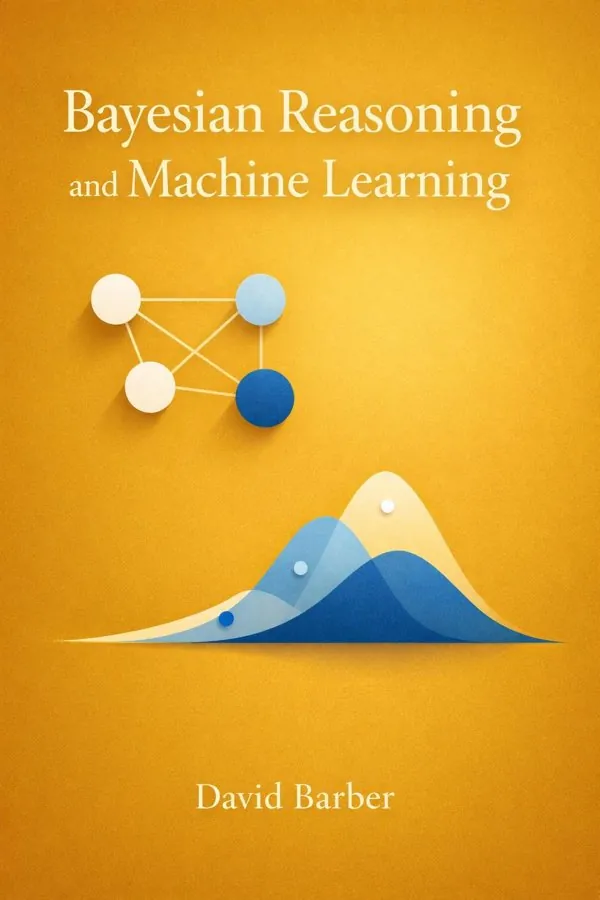
Bayesian Reasoning and Machine Learning: Summary & Key Insights
by David Barber
 10 min9 chaptersAudio available
Key Takeaways from Bayesian Reasoning and Machine Learning
Most machine learning failures begin where certainty is assumed too early.
Learning is not collecting facts; it is revising belief in light of evidence.
Complex systems become understandable when we can see how their parts depend on one another.
A machine learning system does not merely fit numbers; it commits to a view of how data is generated.
The most elegant probabilistic model is useless if we cannot compute with it.
What Is Bayesian Reasoning and Machine Learning About?
Bayesian Reasoning and Machine Learning by David Barber is a ai_ml book spanning 5 pages. What if uncertainty were not a problem to eliminate, but the very language through which intelligent systems should think? In Bayesian Reasoning and Machine Learning, David Barber presents machine learning not as a loose collection of tricks, but as a coherent framework for reasoning from incomplete, noisy, and ambiguous data. The book introduces the foundations of probability, Bayesian inference, graphical models, optimization, and approximation methods, then shows how these tools power real learning systems. What makes this book especially important is its unifying perspective. Instead of treating classification, regression, latent variable models, and decision-making as isolated topics, Barber shows how they emerge from the same probabilistic principles. That perspective matters deeply in modern AI, where uncertainty quantification, model interpretability, and principled learning are increasingly essential. Barber writes with the authority of a leading researcher and educator in probabilistic machine learning. As a professor at University College London and a specialist in inference and probabilistic modeling, he brings both mathematical rigor and practical insight. For students, researchers, and technically minded practitioners, this book offers a deep map of how intelligent systems can learn to reason under uncertainty.
This FizzRead summary covers all 9 key chapters of Bayesian Reasoning and Machine Learning in approximately 10 minutes, distilling the most important ideas, arguments, and takeaways from David Barber's work. Also available as an audio summary and Key Quotes Podcast.
Bayesian Reasoning and Machine Learning
What if uncertainty were not a problem to eliminate, but the very language through which intelligent systems should think? In Bayesian Reasoning and Machine Learning, David Barber presents machine learning not as a loose collection of tricks, but as a coherent framework for reasoning from incomplete, noisy, and ambiguous data. The book introduces the foundations of probability, Bayesian inference, graphical models, optimization, and approximation methods, then shows how these tools power real learning systems.
What makes this book especially important is its unifying perspective. Instead of treating classification, regression, latent variable models, and decision-making as isolated topics, Barber shows how they emerge from the same probabilistic principles. That perspective matters deeply in modern AI, where uncertainty quantification, model interpretability, and principled learning are increasingly essential.
Barber writes with the authority of a leading researcher and educator in probabilistic machine learning. As a professor at University College London and a specialist in inference and probabilistic modeling, he brings both mathematical rigor and practical insight. For students, researchers, and technically minded practitioners, this book offers a deep map of how intelligent systems can learn to reason under uncertainty.
Who Should Read Bayesian Reasoning and Machine Learning?
This book is perfect for anyone interested in ai_ml and looking to gain actionable insights in a short read. Whether you're a student, professional, or lifelong learner, the key ideas from Bayesian Reasoning and Machine Learning by David Barber will help you think differently.
- ✓Readers who enjoy ai_ml and want practical takeaways
- ✓Professionals looking to apply new ideas to their work and life
- ✓Anyone who wants the core insights of Bayesian Reasoning and Machine Learning in just 10 minutes
Want the full summary?
Get instant access to this book summary and 100K+ more with Fizz Moment.
Get Free SummaryAvailable on App Store • Free to download
Key Chapters
Most machine learning failures begin where certainty is assumed too early. Bayesian reasoning starts from a more realistic premise: the world is uncertain, observations are noisy, and intelligent systems must represent degrees of belief rather than pretend to know everything exactly. In this sense, probability is not just a branch of mathematics; it is the grammar of rational inference.
Barber begins by grounding the reader in the rules of probability: joint, marginal, and conditional distributions; independence assumptions; and Bayes’ rule itself. These are not abstract formalities. They define how information should be combined when evidence is incomplete. If a medical test is imperfect, if a sensor is noisy, or if a user behavior signal is ambiguous, probability gives us the tools to reason carefully rather than guess.
A practical example is spam filtering. An email may contain words strongly associated with spam, but not every suspicious word guarantees that classification. A probabilistic model weighs many weak signals, combining them into a calibrated estimate. Another example is self-driving perception, where a system must estimate whether an object is a pedestrian, cyclist, or shadow under uncertain conditions.
Barber’s deeper point is that probability is both descriptive and prescriptive. It describes uncertain systems, but it also prescribes coherent reasoning. If your beliefs violate probabilistic rules, your decisions become inconsistent.
Actionable takeaway: when approaching any learning problem, first ask what is uncertain, what variables are hidden, and how those uncertainties can be represented probabilistically before choosing an algorithm.
Learning is not collecting facts; it is revising belief in light of evidence. That is the heart of Bayesian inference. Barber shows that the triad of prior, likelihood, and posterior provides a disciplined way to move from assumptions to conclusions. The prior captures what is believed before seeing data, the likelihood expresses how probable the observed data would be under different hypotheses, and the posterior combines both into an updated belief.
This framework matters because data rarely speaks in isolation. A small sample can mislead, sensors can fail, and observations can be biased. Priors help stabilize learning, especially when information is sparse. For example, in estimating the click-through rate of a new online ad, a Bayesian approach avoids overreacting to a handful of early clicks by combining the limited data with prior expectations. In medical diagnosis, a rare disease remains unlikely even if a test is positive, unless the test is highly reliable and base rates are considered.
Barber emphasizes that Bayesian inference is not merely about inserting beliefs into science. It is about making assumptions explicit. Every model already contains assumptions, whether acknowledged or hidden. The Bayesian method forces those assumptions into the open, where they can be questioned and improved.
The resulting posterior is not a single answer but a distribution over plausible answers. That distribution allows richer decisions: confidence intervals, risk-sensitive actions, and principled model comparison.
Actionable takeaway: whenever you interpret data, separate clearly what comes from prior assumptions, what comes from the observed evidence, and how the two combine into a posterior belief.
Complex systems become understandable when we can see how their parts depend on one another. Graphical models are Barber’s answer to this challenge. They turn high-dimensional probabilistic reasoning into a structured representation of variables and dependencies, making it possible to build models that are both expressive and interpretable.
In a graphical model, nodes represent random variables and edges encode conditional relationships. Directed graphical models, such as Bayesian networks, capture causal or generative assumptions. Undirected models, such as Markov random fields, are often useful when local compatibility matters more than causal direction. This visual and mathematical structure makes it easier to factor joint distributions into smaller, tractable pieces.
Consider a recommendation system. A user’s preferences may depend on latent taste profiles, item attributes, and social influence. Modeling all variables jointly without structure would be overwhelming. A graphical model organizes the problem by specifying which factors interact directly and which do not. In natural language processing, hidden Markov models use graphical structure to relate observed words to hidden states like parts of speech. In computer vision, pixel labels can be linked locally to enforce spatial consistency.
Barber highlights a crucial benefit: structure is not cosmetic. It determines what can be inferred efficiently. By exploiting conditional independence, graphical models reduce computational burden and clarify model design.
Actionable takeaway: before fitting a model, sketch the variables involved and their dependencies. A simple graphical representation often reveals hidden assumptions, missing variables, and opportunities for more efficient inference.
A machine learning system does not merely fit numbers; it commits to a view of how data is generated. Barber makes an important distinction between choosing a model structure and estimating its parameters. Parameters determine the specific behavior of a model, while the model class determines what kinds of patterns can be expressed at all.
This matters because better optimization cannot rescue a poor modeling assumption. A linear regression model may estimate coefficients perfectly, yet still fail if the true relationship is highly nonlinear. Conversely, an expressive model can overfit if its parameters are not constrained or regularized appropriately. Bayesian reasoning addresses this by placing distributions over parameters instead of treating them as fixed unknown constants. That move reflects uncertainty and often improves generalization.
A practical example is polynomial curve fitting. A high-degree polynomial may fit training data exactly but behave wildly on new points. A Bayesian treatment can penalize implausibly large coefficients through priors, producing smoother and more reliable predictions. In topic modeling, the same principle helps infer latent themes in documents while controlling how diffuse or concentrated those themes should be.
Barber’s broader lesson is that learning has multiple layers: selecting the representation, estimating hidden variables, fitting parameters, and comparing model families. Good machine learning requires thinking across all of them rather than focusing only on training loss.
Actionable takeaway: when a model performs poorly, diagnose whether the problem lies in parameter estimation, model flexibility, prior assumptions, or data representation instead of only tuning optimization settings.
The most elegant probabilistic model is useless if we cannot compute with it. Barber is candid about a central reality of machine learning: exact inference is often intractable. As models grow richer, the number of latent configurations can explode, and exact posterior calculations become computationally impossible.
Rather than treat this as a defeat, the book turns it into a design principle. Approximate inference becomes one of the core engines of modern probabilistic learning. Barber explains that inference is the task of extracting useful beliefs from a model, such as marginals, expectations, or most probable assignments. In simple cases this can be done analytically, but in realistic systems we need approximations.
Examples appear everywhere. In a latent topic model for millions of documents, the exact posterior over topic assignments is unreachable. In image segmentation, the number of possible labelings is astronomically large. In Bayesian neural models, integrating over all parameter uncertainty is typically impossible in closed form. Yet approximate methods allow us to obtain useful answers that are often accurate enough for prediction and decision-making.
The key intellectual shift is this: machine learning is not only about choosing the right model, but also about choosing the right computational strategy for that model. Approximation is not a hack added after theory; it is part of the theory of practical reasoning under uncertainty.
Actionable takeaway: when building probabilistic systems, evaluate inferential feasibility early. A slightly simpler model with reliable approximate inference often outperforms a theoretically richer model that is computationally unusable.
Sometimes the best way to solve a hard problem is to solve a nearby one we can control. Variational inference embodies this idea. Barber presents it as a principled strategy for approximating complex posteriors by selecting a simpler family of distributions and then optimizing to find the member that most closely matches the true posterior.
The power of the method lies in turning inference into optimization. Instead of summing over huge spaces directly, we define an objective, often related to a lower bound on model evidence, and optimize it. This makes variational methods attractive in large-scale machine learning, where exact Bayesian computation is infeasible but deterministic, scalable approximations are needed.
A practical case is topic modeling for text corpora. With millions of words and latent variables, exact inference is impossible. Variational methods provide tractable approximations that scale to industrial datasets. In probabilistic matrix factorization for recommendations, they can estimate latent user and item features while maintaining uncertainty-aware structure.
Barber also makes clear that variational inference introduces bias. Because the approximation is restricted to a chosen family, the answer may be systematically simplified, often underestimating uncertainty. The benefit is speed and stability; the cost is fidelity. Understanding this trade-off is essential.
Variational thinking also teaches a broader lesson: many difficult learning tasks can be reframed through bounds, surrogates, and optimization-friendly objectives.
Actionable takeaway: use variational methods when you need scalable, repeatable inference on large datasets, but always check whether the chosen approximation family is distorting uncertainty in ways that matter for your application.
When exact calculation fails and optimization-based approximations are too restrictive, randomness itself can become a computational tool. Barber explains Monte Carlo methods as a family of techniques that use sampling to approximate expectations, probabilities, and posterior distributions. Instead of calculating every possibility, we draw representative samples and estimate quantities from them.
This idea is especially important in Bayesian machine learning because many predictions and decisions depend on integrals that cannot be solved analytically. Markov chain Monte Carlo methods, for instance, construct dependent samples whose long-run distribution matches the posterior of interest. With enough samples, posterior means, uncertainties, and predictive distributions can be estimated with high accuracy.
Think of a robotics problem in which a robot must estimate its position from noisy sensors. A particle filter, a sequential Monte Carlo method, tracks many possible states and updates them over time as new evidence arrives. In Bayesian parameter estimation, MCMC can explore multiple plausible explanations for the data rather than collapsing to a single best estimate.
Barber underscores that sampling methods are flexible but computationally demanding. They can be more faithful to the true posterior than variational approximations, yet they require convergence diagnostics, tuning, and patience. The choice between sampling and optimization is therefore both statistical and practical.
Actionable takeaway: consider Monte Carlo methods when uncertainty quality matters more than raw speed, and build in diagnostics to assess whether your samples are genuinely representing the posterior you care about.
A powerful intellectual framework is one that reduces many problems to a common form. Barber’s book argues that Bayesian reasoning is such a framework for machine learning. Classification, regression, clustering, sequence modeling, density estimation, and decision-making may look different on the surface, but they can all be seen as instances of probabilistic modeling plus inference.
This unifying view has practical consequences. It encourages modular thinking: define variables, specify priors, write down likelihoods, infer posteriors, and use them for prediction or action. It also connects model evaluation to probability itself through concepts like marginal likelihood and predictive performance. Rather than judging a model only by how well it fits past data, the Bayesian perspective asks how well it balances fit, uncertainty, and complexity.
Applications span nearly every field touched by data. In healthcare, Bayesian models can combine prior medical knowledge with patient-specific evidence. In engineering, they support fault detection under noisy measurements. In online platforms, they enable A/B testing that updates continuously as results arrive. In science, they provide a disciplined way to compare hypotheses and quantify uncertainty rather than report only point estimates.
Barber’s deeper contribution is philosophical as much as technical: intelligence is not the elimination of uncertainty but the ability to reason well within it. That is why Bayesian methods continue to matter, even as machine learning grows larger and more complex.
Actionable takeaway: treat machine learning problems as exercises in structured uncertainty management, not just function fitting, and you will often design models that are more robust, interpretable, and useful.
All Chapters in Bayesian Reasoning and Machine Learning
About the Author
David Barber is a leading scholar in machine learning and probabilistic modeling, best known for his work on Bayesian methods, approximate inference, and graphical models. He has served as a Professor of Machine Learning at University College London and has played a major role in advancing the theoretical and practical foundations of probabilistic AI. His research spans inference algorithms, uncertainty representation, and the mathematical structure of learning systems. Barber is also recognized as a gifted educator who can connect abstract probability theory to real machine learning problems. In Bayesian Reasoning and Machine Learning, he distills years of research and teaching into a rigorous but unifying framework, helping students and researchers understand how intelligent systems can reason, learn, and make decisions in uncertain environments.
Get This Summary in Your Preferred Format
Read or listen to the Bayesian Reasoning and Machine Learning summary by David Barber anytime, anywhere. FizzRead offers multiple formats so you can learn on your terms — all free.
Available formats: App · Audio · PDF · EPUB — All included free with FizzRead
Download Bayesian Reasoning and Machine Learning PDF and EPUB Summary
Key Quotes from Bayesian Reasoning and Machine Learning
“Most machine learning failures begin where certainty is assumed too early.”
“Learning is not collecting facts; it is revising belief in light of evidence.”
“Complex systems become understandable when we can see how their parts depend on one another.”
“A machine learning system does not merely fit numbers; it commits to a view of how data is generated.”
“The most elegant probabilistic model is useless if we cannot compute with it.”
Frequently Asked Questions about Bayesian Reasoning and Machine Learning
Bayesian Reasoning and Machine Learning by David Barber is a ai_ml book that explores key ideas across 9 chapters. What if uncertainty were not a problem to eliminate, but the very language through which intelligent systems should think? In Bayesian Reasoning and Machine Learning, David Barber presents machine learning not as a loose collection of tricks, but as a coherent framework for reasoning from incomplete, noisy, and ambiguous data. The book introduces the foundations of probability, Bayesian inference, graphical models, optimization, and approximation methods, then shows how these tools power real learning systems. What makes this book especially important is its unifying perspective. Instead of treating classification, regression, latent variable models, and decision-making as isolated topics, Barber shows how they emerge from the same probabilistic principles. That perspective matters deeply in modern AI, where uncertainty quantification, model interpretability, and principled learning are increasingly essential. Barber writes with the authority of a leading researcher and educator in probabilistic machine learning. As a professor at University College London and a specialist in inference and probabilistic modeling, he brings both mathematical rigor and practical insight. For students, researchers, and technically minded practitioners, this book offers a deep map of how intelligent systems can learn to reason under uncertainty.
You Might Also Like

Life 3.0
Max Tegmark
10 min
Superintelligence
Nick Bostrom
10 min
TensorFlow in Action
Thushan Ganegedara
10 min
AI Made Simple: A Beginner’s Guide to Generative AI, ChatGPT, and the Future of Work
Rajeev Kapur
10 min
AI Snake Oil
Arvind Narayanan, Sayash Kapoor
10 min
AI Superpowers: China, Silicon Valley, and the New World Order
Kai-Fu Lee
10 minBrowse by Category
Ready to read Bayesian Reasoning and Machine Learning?
Get the full summary and 100K+ more books with Fizz Moment.