
David Barber Books
David Barber is a Professor of Machine Learning at University College London (UCL) and Director of the UCL Centre for Artificial Intelligence. His research focuses on probabilistic modeling, approximate inference, and machine learning theory.
Known for: Bayesian Reasoning and Machine Learning
Books by David Barber
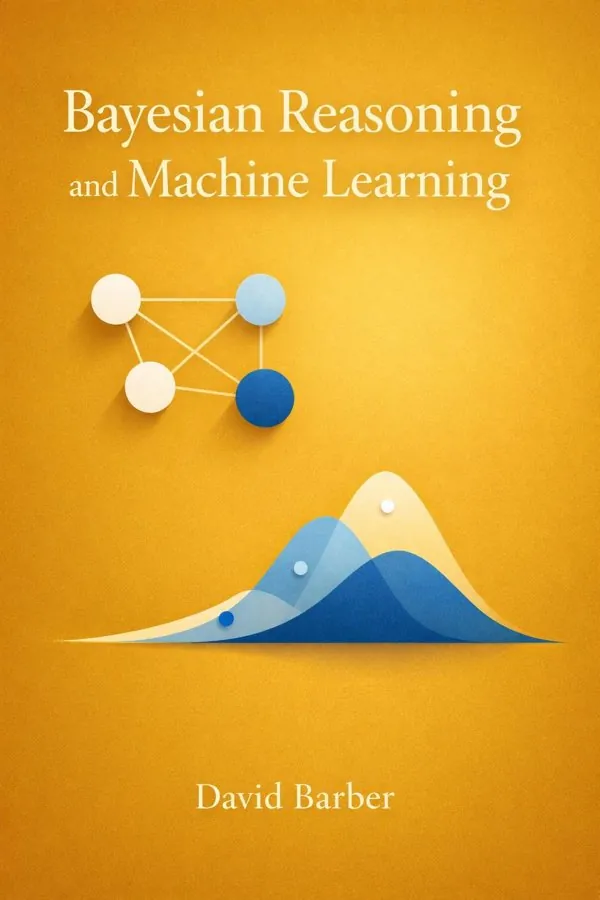
Bayesian Reasoning and Machine Learning
What if uncertainty were not a problem to eliminate, but the very language through which intelligent systems should think? In Bayesian Reasoning and Machine Learning, David Barber presents machine learning not as a loose collection of tricks, but as a coherent framework for reasoning from incomplete, noisy, and ambiguous data. The book introduces the foundations of probability, Bayesian inference, graphical models, optimization, and approximation methods, then shows how these tools power real learning systems. What makes this book especially important is its unifying perspective. Instead of treating classification, regression, latent variable models, and decision-making as isolated topics, Barber shows how they emerge from the same probabilistic principles. That perspective matters deeply in modern AI, where uncertainty quantification, model interpretability, and principled learning are increasingly essential. Barber writes with the authority of a leading researcher and educator in probabilistic machine learning. As a professor at University College London and a specialist in inference and probabilistic modeling, he brings both mathematical rigor and practical insight. For students, researchers, and technically minded practitioners, this book offers a deep map of how intelligent systems can learn to reason under uncertainty.
Read SummaryKey Insights from David Barber
Probability Is the Language of Uncertainty
Most machine learning failures begin where certainty is assumed too early. Bayesian reasoning starts from a more realistic premise: the world is uncertain, observations are noisy, and intelligent systems must represent degrees of belief rather than pretend to know everything exactly. In this sense, ...
From Bayesian Reasoning and Machine Learning
Bayesian Inference Means Updating Beliefs
Learning is not collecting facts; it is revising belief in light of evidence. That is the heart of Bayesian inference. Barber shows that the triad of prior, likelihood, and posterior provides a disciplined way to move from assumptions to conclusions. The prior captures what is believed before seeing...
From Bayesian Reasoning and Machine Learning
Graphical Models Make Complexity Manageable
Complex systems become understandable when we can see how their parts depend on one another. Graphical models are Barber’s answer to this challenge. They turn high-dimensional probabilistic reasoning into a structured representation of variables and dependencies, making it possible to build models t...
From Bayesian Reasoning and Machine Learning
Learning Requires Both Models and Parameters
A machine learning system does not merely fit numbers; it commits to a view of how data is generated. Barber makes an important distinction between choosing a model structure and estimating its parameters. Parameters determine the specific behavior of a model, while the model class determines what k...
From Bayesian Reasoning and Machine Learning
Exact Inference Is Often Impossible
The most elegant probabilistic model is useless if we cannot compute with it. Barber is candid about a central reality of machine learning: exact inference is often intractable. As models grow richer, the number of latent configurations can explode, and exact posterior calculations become computatio...
From Bayesian Reasoning and Machine Learning
Variational Methods Trade Accuracy for Speed
Sometimes the best way to solve a hard problem is to solve a nearby one we can control. Variational inference embodies this idea. Barber presents it as a principled strategy for approximating complex posteriors by selecting a simpler family of distributions and then optimizing to find the member tha...
From Bayesian Reasoning and Machine Learning
About David Barber
David Barber is a Professor of Machine Learning at University College London (UCL) and Director of the UCL Centre for Artificial Intelligence. His research focuses on probabilistic modeling, approximate inference, and machine learning theory. He has contributed extensively to the development of Baye...
Read more
David Barber is a Professor of Machine Learning at University College London (UCL) and Director of the UCL Centre for Artificial Intelligence. His research focuses on probabilistic modeling, approximate inference, and machine learning theory. He has contributed extensively to the development of Baye...
David Barber is a Professor of Machine Learning at University College London (UCL) and Director of the UCL Centre for Artificial Intelligence. His research focuses on probabilistic modeling, approximate inference, and machine learning theory. He has contributed extensively to the development of Bayesian methods and their applications in AI.

Frequently Asked Questions
David Barber is a Professor of Machine Learning at University College London (UCL) and Director of the UCL Centre for Artificial Intelligence. His research focuses on probabilistic modeling, approximate inference, and machine learning theory.
Read David Barber's books in 15 minutes
Get AI-powered summaries with key insights from 1 book by David Barber.