
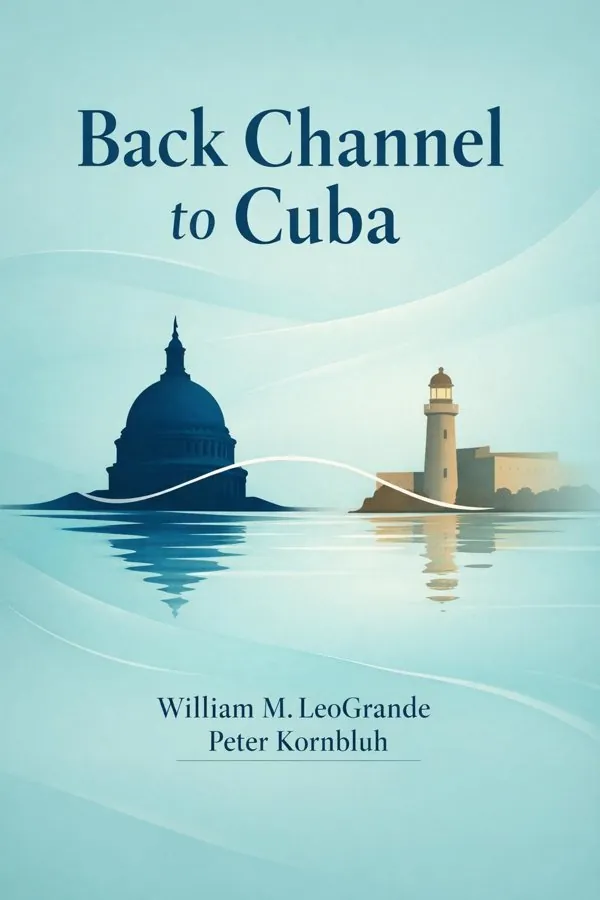
Back Channel to Cuba: The Hidden History of Negotiations Between Washington and Havana: Summary & Key Insights
by William M. LeoGrande, Peter Kornbluh
 10 min9 chaptersAudio available
Key Takeaways from Back Channel to Cuba: The Hidden History of Negotiations Between Washington and Havana
Diplomatic hostility often begins not with silence, but with confusion.
Hardline policy and diplomatic curiosity can coexist more easily than leaders admit.
Even ideologically opposed leaders may negotiate when strategic interests outweigh symbolism.
Goodwill can start a diplomatic opening, but only structure can sustain it.
The harsher the rhetoric, the more revealing the hidden conversations.
What Is Back Channel to Cuba: The Hidden History of Negotiations Between Washington and Havana About?
Back Channel to Cuba: The Hidden History of Negotiations Between Washington and Havana by William M. LeoGrande, Peter Kornbluh is a politics book spanning 9 pages. Back Channel to Cuba: The Hidden History of Negotiations Between Washington and Havana tells the hidden diplomatic story behind one of the longest political standoffs in modern history. While the public saw embargoes, invasions, propaganda, and Cold War hostility, William M. LeoGrande and Peter Kornbluh show that Washington and Havana were often talking quietly behind the scenes. Across multiple U.S. administrations and shifting Cuban priorities, secret envoys, informal intermediaries, and confidential messages repeatedly opened the possibility of reconciliation, only to be derailed by mistrust, domestic politics, or international crises. What makes this book especially important is its argument that U.S.-Cuba relations were never simply frozen. They were active, contested, and surprisingly fluid beneath the surface. Drawing on declassified documents, archival research, and interviews with participants, the authors reconstruct decades of hidden diplomacy with remarkable detail and credibility. LeoGrande, a leading scholar of Latin American politics, and Kornbluh, a senior analyst at the National Security Archive, combine academic rigor with investigative depth. The result is a revealing study of how diplomacy really works when official channels fail, and why political enemies often keep negotiating even while pretending they never will.
This FizzRead summary covers all 9 key chapters of Back Channel to Cuba: The Hidden History of Negotiations Between Washington and Havana in approximately 10 minutes, distilling the most important ideas, arguments, and takeaways from William M. LeoGrande, Peter Kornbluh's work. Also available as an audio summary and Key Quotes Podcast.
Back Channel to Cuba: The Hidden History of Negotiations Between Washington and Havana
Back Channel to Cuba: The Hidden History of Negotiations Between Washington and Havana tells the hidden diplomatic story behind one of the longest political standoffs in modern history. While the public saw embargoes, invasions, propaganda, and Cold War hostility, William M. LeoGrande and Peter Kornbluh show that Washington and Havana were often talking quietly behind the scenes. Across multiple U.S. administrations and shifting Cuban priorities, secret envoys, informal intermediaries, and confidential messages repeatedly opened the possibility of reconciliation, only to be derailed by mistrust, domestic politics, or international crises.
What makes this book especially important is its argument that U.S.-Cuba relations were never simply frozen. They were active, contested, and surprisingly fluid beneath the surface. Drawing on declassified documents, archival research, and interviews with participants, the authors reconstruct decades of hidden diplomacy with remarkable detail and credibility. LeoGrande, a leading scholar of Latin American politics, and Kornbluh, a senior analyst at the National Security Archive, combine academic rigor with investigative depth. The result is a revealing study of how diplomacy really works when official channels fail, and why political enemies often keep negotiating even while pretending they never will.
Who Should Read Back Channel to Cuba: The Hidden History of Negotiations Between Washington and Havana?
This book is perfect for anyone interested in politics and looking to gain actionable insights in a short read. Whether you're a student, professional, or lifelong learner, the key ideas from Back Channel to Cuba: The Hidden History of Negotiations Between Washington and Havana by William M. LeoGrande, Peter Kornbluh will help you think differently.
- ✓Readers who enjoy politics and want practical takeaways
- ✓Professionals looking to apply new ideas to their work and life
- ✓Anyone who wants the core insights of Back Channel to Cuba: The Hidden History of Negotiations Between Washington and Havana in just 10 minutes
Want the full summary?
Get instant access to this book summary and 100K+ more with Fizz Moment.
Get Free SummaryAvailable on App Store • Free to download
Key Chapters
Diplomatic hostility often begins not with silence, but with confusion. In the aftermath of the Cuban Revolution, Washington did not immediately settle on a clear strategy toward Fidel Castro. U.S. officials were divided: some saw a nationalist reformer who might be contained or influenced, while others feared a radical anti-American leader aligned with global communism. That uncertainty created an opening for both miscalculation and quiet communication.
During the Eisenhower and Kennedy years, the relationship deteriorated rapidly in public. Cuba nationalized U.S. property, moved closer to the Soviet Union, and challenged American dominance in the hemisphere. Washington responded with sanctions, covert operations, and ultimately support for the Bay of Pigs invasion. Yet even as official policy hardened, informal contacts and exploratory messages continued. Both sides tested whether coexistence, negotiation, or limited accommodation might still be possible.
The Kennedy administration embodied this contradiction. It pursued aggressive anti-Castro measures while also considering whether a modus vivendi could be reached after the trauma of the Cuban Missile Crisis. The crisis itself reinforced a central lesson of the book: adversaries can come closest to catastrophe when communication is weakest and assumptions are strongest. Back channels became necessary not because relations were improving, but because the risks of misunderstanding had become intolerably high.
A practical lesson emerges for politics, business, and personal conflict alike: when a relationship becomes publicly polarized, private communication matters even more. Openly hostile systems still need trusted channels to test intentions and reduce danger. Actionable takeaway: never mistake public confrontation for total disengagement; in high-stakes conflict, build discreet avenues for honest exchange before events spiral beyond control.
Hardline policy and diplomatic curiosity can coexist more easily than leaders admit. Lyndon Johnson inherited a relationship defined by invasion, crisis, and mutual suspicion. Publicly, his administration maintained pressure on Cuba and remained deeply wary of Castro’s revolutionary influence in Latin America. Privately, however, Johnson’s team explored whether selective communication could serve U.S. interests.
The book shows that Johnson was not ideologically committed to permanent paralysis. He was pragmatic. Cuba was still seen as a security concern, but it was also a persistent diplomatic problem that could not be managed by rhetoric alone. Secret contacts surfaced around issues such as migration, regional stability, and the possibility of reducing tensions. These efforts never became a full opening, in part because the broader Cold War environment and Cuba’s support for revolutionary movements kept reinforcing distrust.
What makes this period important is that it reveals how diplomatic possibilities often survive inside administrations that appear publicly immovable. Even when leaders are constrained by electoral politics, military concerns, or ideological pressures, they may still authorize exploratory conversations to learn the other side’s bottom line. These contacts can be valuable even when they do not produce breakthrough agreements. They clarify intentions, identify red lines, and preserve future options.
In practical terms, Johnson’s approach illustrates the value of strategic ambiguity in negotiation. Leaders sometimes need room to probe without overcommitting. For organizations, this is similar to holding informal talks before a formal merger, settlement, or policy shift. Actionable takeaway: when a public breakthrough is impossible, use limited, low-visibility engagement to gather information, reduce uncertainty, and prepare for more serious negotiation later.
Even ideologically opposed leaders may negotiate when strategic interests outweigh symbolism. Richard Nixon and Gerald Ford are not usually associated with reconciliation toward Cuba, yet the book reveals that their administrations also explored contacts with Havana. This was not driven by sentiment or trust. It was driven by realpolitik.
Nixon’s foreign policy style, shaped by Henry Kissinger, was grounded in power calculations. If the United States could open relations with China and manage détente with the Soviet Union, then Cuba too could be considered through a strategic lens. Secret signals and indirect communications suggested that a new framework might be possible, especially if Cuba moderated behavior that Washington considered destabilizing. The problem was that Cuba’s expanding military role in Africa, especially Angola, transformed the issue from bilateral nuisance to global confrontation in U.S. eyes.
Ford’s administration briefly kept alive the possibility of a policy shift, but events again overtook diplomacy. The lesson here is not simply that negotiations failed. It is that negotiations are highly vulnerable to external theaters of conflict. Progress in one channel can collapse because of actions somewhere else entirely. In modern terms, a trade negotiation might fail due to cybersecurity disputes, or a labor agreement might be derailed by public scandal.
This period demonstrates that diplomatic openings require alignment not only of intentions, but of timing, context, and third-party behavior. Secret talks can generate momentum, but they cannot survive if the broader strategic environment turns toxic. Actionable takeaway: when negotiating, assess external variables early. A deal is never shaped only by the two parties at the table; it also depends on how outside events affect trust, leverage, and political will.
Goodwill can start a diplomatic opening, but only structure can sustain it. Jimmy Carter came to office more willing than his predecessors to rethink relations with Cuba. His administration pursued one of the most meaningful early efforts at normalization, motivated by a broader commitment to human rights, reduced Cold War tension, and practical problem-solving.
Under Carter, the two countries established interest sections in Havana and Washington, creating semi-official diplomatic presences even without restoring full relations. They engaged on fisheries, maritime boundaries, migration, and prisoner issues. These were not symbolic gestures alone. They were functional steps that treated dialogue as a tool for managing real-world problems. For a moment, normalization seemed possible.
Yet the opening was fragile. Domestic political opposition in the United States remained intense, especially among anti-Castro constituencies. Then the Mariel boatlift in 1980 reshaped public perception and political incentives. A migration crisis quickly overwhelmed the broader diplomatic agenda, illustrating how one emotionally charged issue can reverse months or years of patient engagement.
Carter’s experience offers a practical lesson in change management. Leaders often underestimate how vulnerable reform is before institutions are built around it. An opening cannot rely solely on presidential preference or personal diplomacy. It needs bureaucratic support, public framing, and contingency planning for crises. The same principle applies in corporate restructuring, peacebuilding, and community conflict resolution.
Actionable takeaway: if you want a breakthrough to last, convert goodwill into durable mechanisms early. Create formal channels, define shared interests, and prepare for setbacks before opponents or crises exploit the opening.
The harsher the rhetoric, the more revealing the hidden conversations. Ronald Reagan publicly restored a strongly adversarial approach to Cuba, framing the island as a Soviet proxy and a source of regional subversion. His administration tightened pressure and returned anti-communist confrontation to the center of U.S. policy. On the surface, this looked like a complete rejection of engagement.
But the book shows that even Reagan’s administration maintained selective contacts with Havana when practical needs demanded it. Migration, prisoners, regional conflicts, and security concerns created spaces where communication remained necessary. This is one of the book’s most important recurring themes: governments rarely stop talking entirely, even when they insist they are doing exactly that.
The Reagan years also highlight the difference between strategic communication and political messaging. Publicly, both sides performed defiance for domestic and international audiences. Privately, they sometimes behaved with far more pragmatism. That gap is not hypocrisy so much as a feature of statecraft. Leaders often need to satisfy political supporters while also preventing escalation or managing shared problems.
For readers outside foreign policy, this dynamic is familiar. Companies in lawsuits may still negotiate settlements. Political rivals may cooperate on budget matters while attacking each other in speeches. Families in conflict may use intermediaries even when direct communication seems impossible. The existence of a conflict does not eliminate interdependence.
Actionable takeaway: learn to distinguish between public posture and operational reality. If you are trying to understand any high-conflict relationship, pay attention to what the parties quietly coordinate, not just what they loudly denounce.
When a geopolitical era ends, old policies do not disappear automatically. The collapse of the Soviet Union transformed Cuba’s strategic environment and removed the central Cold War framework that had long justified extreme hostility. In theory, this should have made normalization easier. In practice, it exposed how much U.S.-Cuba policy was now driven by domestic politics, entrenched habits, and symbolic identity.
George H. W. Bush and Bill Clinton governed during this transitional period. Cuba was weaker economically and less threatening militarily, yet Washington tightened sanctions rather than moving decisively toward rapprochement. Measures such as the Torricelli Act and Helms-Burton Act hardened the embargo and made future policy change more difficult by codifying restrictions in law. Meanwhile, migration crises and the politics of the Cuban American community complicated every move.
The key insight is that policies often outlive the conditions that created them. Institutions, interest groups, legal frameworks, and political narratives can keep a conflict frozen long after the original rationale has faded. This is true far beyond foreign policy. Organizations maintain outdated rules, industries preserve obsolete incentives, and societies continue symbolic battles that no longer solve current problems.
The post-Cold War period also shows that reduced threat does not automatically produce reconciliation. Sometimes it produces drift, fragmentation, and reactive policymaking. Without a new strategic story to replace the old one, leaders fall back on familiar scripts.
Actionable takeaway: periodically ask whether your current strategy still fits present realities. If the environment has changed but your policy has not, you may be defending a legacy position rather than solving a real problem.
Some of the most important negotiators are the ones who never appear at the podium. One of the book’s richest contributions is its detailed account of intermediaries who carried messages, built trust, and kept possibilities alive when formal diplomacy was blocked. These included journalists, Latin American leaders, religious figures, businesspeople, diplomats from third countries, academics, and personal associates of top officials.
Intermediaries mattered because direct contact between Washington and Havana was often politically explosive. A back channel allowed each side to test proposals, deny premature commitments, and communicate sensitive information without triggering public backlash. In many cases, these unofficial or semi-official actors were able to move conversations forward precisely because they stood slightly outside the machinery of state.
The use of intermediaries also reveals that diplomacy is not just about official meetings; it is about relationship architecture. Trust is often built through repetition, discretion, and credibility rather than formal status. A successful intermediary understands each side’s fears, language, timing, and domestic constraints. More importantly, they know when not to overpromise.
This insight has broad application. In labor disputes, mediators help parties save face. In corporate partnerships, advisors can surface issues that executives are unwilling to raise directly. In communities, respected third parties can reopen dialogue after breakdown. The principle is simple: when direct communication is too costly, use trusted bridges.
Actionable takeaway: identify the credible intermediaries in your own difficult negotiations. Choose people who are discreet, respected by both sides, and skilled at clarifying interests rather than inflaming emotions.
International negotiations often fail for reasons that have little to do with the foreign adversary. One of the clearest themes in Back Channel to Cuba is that domestic political constraints in both countries repeatedly derailed progress. In the United States, presidents had to weigh the electoral influence of anti-Castro voters, congressional pressure, media narratives, and the risks of appearing weak. In Cuba, the leadership had its own legitimacy concerns, revolutionary commitments, and sensitivities about sovereignty and regime survival.
This meant that even when officials found areas of mutual interest, they still faced a second negotiation at home. Every step toward normalization had to survive internal audiences who interpreted compromise as betrayal. Secret diplomacy became attractive partly because it helped leaders explore options before confronting domestic opposition. Yet secrecy had limits too. Without public preparation, even promising initiatives could collapse once exposed.
The broader lesson is that negotiation is never just external. Any leader representing an institution, electorate, board, or team must manage internal stakeholders while dealing with the other side. A technically sound agreement can still fail if supporters are not prepared to accept it. That is why framing, coalition-building, and timing matter as much as substance.
For example, a company may negotiate a smart acquisition only to face internal resistance from employees. A political leader may craft a sensible compromise but lose public support if the narrative is mishandled. The same pattern appears repeatedly in this book.
Actionable takeaway: before pursuing a breakthrough, map your internal veto points. Successful negotiation requires not only reaching an agreement, but making it politically survivable.
All Chapters in Back Channel to Cuba: The Hidden History of Negotiations Between Washington and Havana
About the Authors
William M. LeoGrande is a professor of government at American University and a respected scholar of Latin American politics and U.S. foreign policy. His research has focused extensively on Cuba, U.S.-Latin American relations, and the political dynamics of the Western Hemisphere. Peter Kornbluh is a senior analyst at the National Security Archive, where he specializes in declassified U.S. documents, diplomatic history, and covert operations in Latin America. He is widely known for uncovering archival evidence that reshapes public understanding of major foreign policy episodes. Together, LeoGrande and Kornbluh bring an unusually powerful combination of academic analysis and documentary investigation. Their work on U.S.-Cuba relations is especially authoritative because it blends historical context, policy insight, and firsthand archival research into a deeply sourced narrative.
Get This Summary in Your Preferred Format
Read or listen to the Back Channel to Cuba: The Hidden History of Negotiations Between Washington and Havana summary by William M. LeoGrande, Peter Kornbluh anytime, anywhere. FizzRead offers multiple formats so you can learn on your terms — all free.
Available formats: App · Audio · PDF · EPUB — All included free with FizzRead
Download Back Channel to Cuba: The Hidden History of Negotiations Between Washington and Havana PDF and EPUB Summary
Key Quotes from Back Channel to Cuba: The Hidden History of Negotiations Between Washington and Havana
“Diplomatic hostility often begins not with silence, but with confusion.”
“Hardline policy and diplomatic curiosity can coexist more easily than leaders admit.”
“Even ideologically opposed leaders may negotiate when strategic interests outweigh symbolism.”
“Goodwill can start a diplomatic opening, but only structure can sustain it.”
“The harsher the rhetoric, the more revealing the hidden conversations.”
Frequently Asked Questions about Back Channel to Cuba: The Hidden History of Negotiations Between Washington and Havana
Back Channel to Cuba: The Hidden History of Negotiations Between Washington and Havana by William M. LeoGrande, Peter Kornbluh is a politics book that explores key ideas across 9 chapters. Back Channel to Cuba: The Hidden History of Negotiations Between Washington and Havana tells the hidden diplomatic story behind one of the longest political standoffs in modern history. While the public saw embargoes, invasions, propaganda, and Cold War hostility, William M. LeoGrande and Peter Kornbluh show that Washington and Havana were often talking quietly behind the scenes. Across multiple U.S. administrations and shifting Cuban priorities, secret envoys, informal intermediaries, and confidential messages repeatedly opened the possibility of reconciliation, only to be derailed by mistrust, domestic politics, or international crises. What makes this book especially important is its argument that U.S.-Cuba relations were never simply frozen. They were active, contested, and surprisingly fluid beneath the surface. Drawing on declassified documents, archival research, and interviews with participants, the authors reconstruct decades of hidden diplomacy with remarkable detail and credibility. LeoGrande, a leading scholar of Latin American politics, and Kornbluh, a senior analyst at the National Security Archive, combine academic rigor with investigative depth. The result is a revealing study of how diplomacy really works when official channels fail, and why political enemies often keep negotiating even while pretending they never will.
You Might Also Like
Antifa: The Anti-Fascist Handbook
Mark Bray
10 min
Attack from Within: How Disinformation Is Sabotaging America
Barbara McQuade
10 min
Coercion, Capital, and European States, AD 990–1992
Charles Tilly
10 min
Digital Democracy: Concepts, Methodologies, Tools, and Applications
Various Authors
10 min
Fascism
Stanley G. Payne
10 min
Fire And Fury: Inside The Trump White House
Michael Wolff
10 minBrowse by Category
Ready to read Back Channel to Cuba: The Hidden History of Negotiations Between Washington and Havana?
Get the full summary and 100K+ more books with Fizz Moment.