
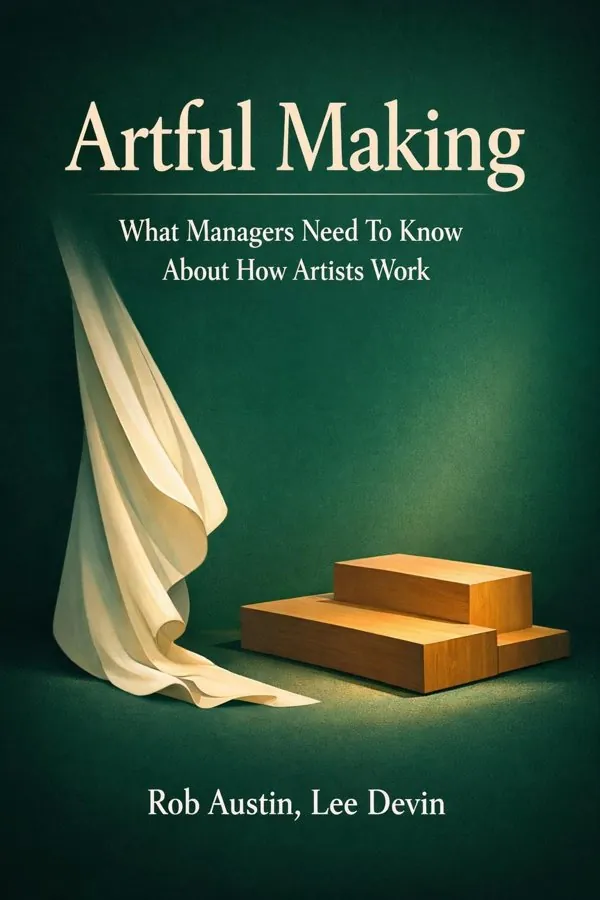
Artful Making: What Managers Need To Know About How Artists Work: Summary & Key Insights
by Rob Austin, Lee Devin
 10 min11 chaptersAudio available
What Is Artful Making: What Managers Need To Know About How Artists Work About?
Artful Making: What Managers Need To Know About How Artists Work by Rob Austin, Lee Devin is a leadership book spanning 11 pages. Artful Making explores how the creative processes used by artists can be applied to business management and innovation. Drawing from theater and performance arts, the authors demonstrate how managers can foster creativity, flexibility, and collaboration in organizations to drive innovation and adaptability.
This FizzRead summary covers all 11 key chapters of Artful Making: What Managers Need To Know About How Artists Work in approximately 10 minutes, distilling the most important ideas, arguments, and takeaways from Rob Austin, Lee Devin's work. Also available as an audio summary and Key Quotes Podcast.
Artful Making: What Managers Need To Know About How Artists Work
Artful Making explores how the creative processes used by artists can be applied to business management and innovation. Drawing from theater and performance arts, the authors demonstrate how managers can foster creativity, flexibility, and collaboration in organizations to drive innovation and adaptability.
Who Should Read Artful Making: What Managers Need To Know About How Artists Work?
This book is perfect for anyone interested in leadership and looking to gain actionable insights in a short read. Whether you're a student, professional, or lifelong learner, the key ideas from Artful Making: What Managers Need To Know About How Artists Work by Rob Austin, Lee Devin will help you think differently.
- ✓Readers who enjoy leadership and want practical takeaways
- ✓Professionals looking to apply new ideas to their work and life
- ✓Anyone who wants the core insights of Artful Making: What Managers Need To Know About How Artists Work in just 10 minutes
Want the full summary?
Get instant access to this book summary and 100K+ more with Fizz Moment.
Get Free SummaryAvailable on App Store • Free to download
Key Chapters
Artful making begins with the notion that creation is a process of emergence, not execution. In the world of theater—where one of us has lived for many years—no performance ever unfolds exactly as planned. Rehearsal is not a means to an end but part of the making itself. Directors, writers, and actors collaborate day after day, making discoveries they could not have anticipated when they began. This is a form of disciplined improvisation, and it demands that everyone involved be willing to adapt as the work evolves.
Contrast this with industrial making, where the ideal is stability. The industrial mindset thrives when inputs and outputs can be controlled and measured. In an assembly line, variation is the enemy; in artful making, it is the source of invention. Our goal here is not to disparage industrial discipline—it has its place—but to show that another kind of discipline, one born of artistry, is equally vital in today’s complex world.
Artful making rests on several key ideas: iteration, collaboration, and emergence. It acknowledges that in a creative process, we cannot know the final form at the outset. Knowledge grows in the doing; clarity appears in the making. For organizations, that means creating systems and cultures that encourage exploration rather than execution alone. It requires patience, trust, and a tolerance for ambiguity—but the rewards are deeper innovation and more resilient teams.
In the theater, collaboration takes the form of ensemble work. A strong ensemble operates on trust, openness, and shared commitment. Each actor contributes not only skill but also vulnerability, offering ideas that may fail in order to discover what truly works. The director’s role is not to control but to shape and facilitate this collective exploration.
When we apply this model to organizations, we see how profoundly different it is from the typical corporate team structure. Many teams are built around hierarchy and accountability rather than interdependence and trust. Ensemble practice suggests that creativity flourishes when members feel both supported and responsible to one another—not merely to their superiors. Collaboration becomes an art in itself, where every contribution nudges the collective work forward.
This insight challenges managers to rethink what teamwork means. It’s not about dividing tasks efficiently; it’s about co-creating an evolving whole. That shift requires psychological safety and a shared respect for process. Leaders must invest time in building environments where experimental contributions are welcomed and where feedback is a dialogue, not a judgment. In such spaces, trust acts as the invisible infrastructure that allows creativity to thrive.
+ 9 more chapters — available in the FizzRead app
All Chapters in Artful Making: What Managers Need To Know About How Artists Work
About the Authors
Rob Austin is a professor and researcher specializing in innovation and technology management. Lee Devin was a theater director and professor of theater arts, known for his work connecting artistic practice with organizational creativity.
Get This Summary in Your Preferred Format
Read or listen to the Artful Making: What Managers Need To Know About How Artists Work summary by Rob Austin, Lee Devin anytime, anywhere. FizzRead offers multiple formats so you can learn on your terms — all free.
Available formats: App · Audio · PDF · EPUB — All included free with FizzRead
Download Artful Making: What Managers Need To Know About How Artists Work PDF and EPUB Summary
Key Quotes from Artful Making: What Managers Need To Know About How Artists Work
“Artful making begins with the notion that creation is a process of emergence, not execution.”
“In the theater, collaboration takes the form of ensemble work.”
Frequently Asked Questions about Artful Making: What Managers Need To Know About How Artists Work
Artful Making: What Managers Need To Know About How Artists Work by Rob Austin, Lee Devin is a leadership book that explores key ideas across 11 chapters. Artful Making explores how the creative processes used by artists can be applied to business management and innovation. Drawing from theater and performance arts, the authors demonstrate how managers can foster creativity, flexibility, and collaboration in organizations to drive innovation and adaptability.
You Might Also Like

Extreme Ownership
Jocko Willink
10 min
Dare to Lead
Brene Brown
10 min
Leaders Eat Last
Simon Sinek
10 min
The 21 Irrefutable Laws of Leadership
John Maxwell
10 min
Start With Why
Simon Sinek
10 min
How to Lead When You're Not in Charge
Clay Scroggins
10 minBrowse by Category
Ready to read Artful Making: What Managers Need To Know About How Artists Work?
Get the full summary and 100K+ more books with Fizz Moment.