
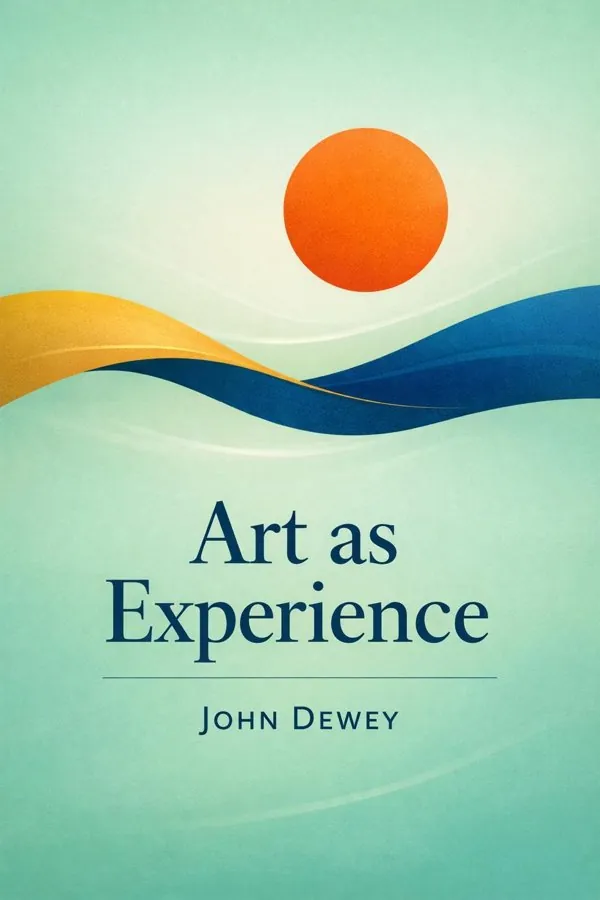
Art as Experience: Summary & Key Insights
by John Dewey
 10 min9 chaptersAudio available
What Is Art as Experience About?
Art as Experience by John Dewey is a western_phil book spanning 9 pages. In this seminal work, philosopher John Dewey explores the nature and significance of art in human experience. He argues that art is not an isolated aesthetic phenomenon but a vital part of everyday life, deeply connected to emotion, perception, and the rhythms of human activity. Dewey’s pragmatic approach redefines art as a mode of experience that integrates doing and undergoing, bridging the gap between the artist, the artwork, and the audience.
This FizzRead summary covers all 9 key chapters of Art as Experience in approximately 10 minutes, distilling the most important ideas, arguments, and takeaways from John Dewey's work. Also available as an audio summary and Key Quotes Podcast.
Art as Experience
In this seminal work, philosopher John Dewey explores the nature and significance of art in human experience. He argues that art is not an isolated aesthetic phenomenon but a vital part of everyday life, deeply connected to emotion, perception, and the rhythms of human activity. Dewey’s pragmatic approach redefines art as a mode of experience that integrates doing and undergoing, bridging the gap between the artist, the artwork, and the audience.
Who Should Read Art as Experience?
This book is perfect for anyone interested in western_phil and looking to gain actionable insights in a short read. Whether you're a student, professional, or lifelong learner, the key ideas from Art as Experience by John Dewey will help you think differently.
- ✓Readers who enjoy western_phil and want practical takeaways
- ✓Professionals looking to apply new ideas to their work and life
- ✓Anyone who wants the core insights of Art as Experience in just 10 minutes
Want the full summary?
Get instant access to this book summary and 100K+ more with Fizz Moment.
Get Free SummaryAvailable on App Store • Free to download
Key Chapters
Experience, as I use the term, is not mere succession of events or sensations. It is a continuous flow of interaction between organism and environment, a rhythm of acting and being acted upon. Every living creature is caught in this rhythm: we reach out, we are resisted; we assert, we undergo; and in that transaction meaning is born. An experience becomes truly aesthetic when this cycle attains a sense of fulfillment, when its parts are held together by cumulative movement toward an integrated whole.
Most of what we call experience in daily life is fractured and interrupted. But once in a while, there comes an experience that has a distinctive quality of closure, of consummation — perhaps a conversation that deepens into understanding, a walk that renews one’s sense of existence, a meal that leaves one both satisfied and reflective. In such experiences, doings and sufferings cohere; they become events worth remembering. This, essentially, is what happens in art. The artist is one who shapes raw experience into that consummate form, and the observer, when perceiving deeply, reconstructs this integration in their own consciousness.
To understand art as experience is to blur the artificial line between creator and spectator. The artist’s activity of shaping material, the observer’s perception that re-enacts the process — both are phases of the same experiential continuity that binds art to life. The philosophy I offer is, therefore, not an aesthetic theory of art objects, but of lived intensity — how we feel life to be organized when it becomes meaningful.
To see art as growing out of experience, we must return to the source: the live creature. Before we become divided into intellect, emotion, and will, we are beings whose existence consists in continual adjustment to our surroundings. Our senses are not windows for detached observation; they are active organs through which the organism searches, responds, and fulfills its needs. When life is at its most intense, perception and action fuse, and the energies of being are heightened. It is at such moments that aesthetic experience reveals itself most naturally.
Modern life, however, tends to dull this vitality. The artificialities of industrial existence blunt our sensory participation. We separate mind from body, thinking from doing, appreciation from production. Yet every child, every unspoiled moment in nature, reminds us of what it means to be a live creature — sensitive, responsive, in rhythm with our environment. In those experiences we feel the pulse that art later restores in a heightened, structured form.
Art, in this view, is not imposed upon life; it arises out of the same energies that sustain all living. The painter’s vision, the sculptor’s touch, the musician’s rhythm — these are amplifications of organic rhythm into cultural form. To appreciate art, then, is to recover our own vitality, to participate once more in the living continuum from which art springs.
+ 7 more chapters — available in the FizzRead app
All Chapters in Art as Experience
About the Author
John Dewey (1859–1952) was an American philosopher, psychologist, and educational reformer associated with pragmatism. His work profoundly influenced education, aesthetics, and democratic theory. Dewey’s philosophy emphasized experience, experimentation, and the interconnection between thought and action.
Get This Summary in Your Preferred Format
Read or listen to the Art as Experience summary by John Dewey anytime, anywhere. FizzRead offers multiple formats so you can learn on your terms — all free.
Available formats: App · Audio · PDF · EPUB — All included free with FizzRead
Download Art as Experience PDF and EPUB Summary
Key Quotes from Art as Experience
“Experience, as I use the term, is not mere succession of events or sensations.”
“To see art as growing out of experience, we must return to the source: the live creature.”
Frequently Asked Questions about Art as Experience
Art as Experience by John Dewey is a western_phil book that explores key ideas across 9 chapters. In this seminal work, philosopher John Dewey explores the nature and significance of art in human experience. He argues that art is not an isolated aesthetic phenomenon but a vital part of everyday life, deeply connected to emotion, perception, and the rhythms of human activity. Dewey’s pragmatic approach redefines art as a mode of experience that integrates doing and undergoing, bridging the gap between the artist, the artwork, and the audience.
You Might Also Like
A Little History of Philosophy
Nigel Warburton
10 min
Areopagitica
John Milton
10 min
How To Think Like A Philosopher: Essential Principles For Clear Thinking
Peter Cave
10 min
Language, Truth and Logic
A. J. Ayer
10 min
The Age of Reason
Thomas Paine
10 min
The Essays
Michel De Montaigne
10 minBrowse by Category
Ready to read Art as Experience?
Get the full summary and 100K+ more books with Fizz Moment.