
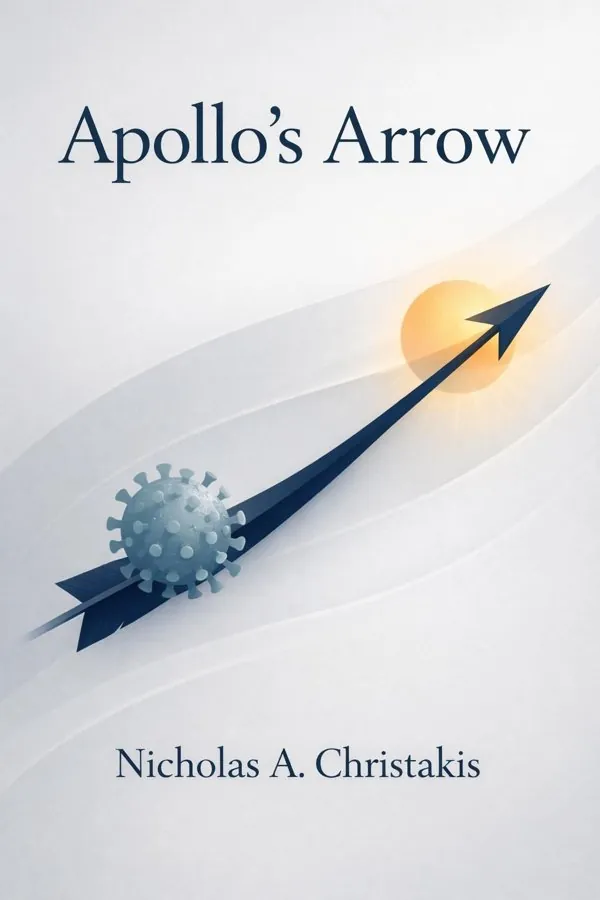
Apollo's Arrow: The Profound and Enduring Impact of Coronavirus on the Way We Live: Summary & Key Insights
 10 min12 chaptersAudio available
What Is Apollo's Arrow: The Profound and Enduring Impact of Coronavirus on the Way We Live About?
Apollo's Arrow: The Profound and Enduring Impact of Coronavirus on the Way We Live by Nicholas A. Christakis is a sociology book spanning 12 pages. In 'Apollo's Arrow', Nicholas A. Christakis explores the social, psychological, and biological consequences of the COVID-19 pandemic. Drawing on history, epidemiology, and sociology, he examines how pandemics shape societies, influence human behavior, and alter the course of civilization. The book provides a comprehensive analysis of how the coronavirus crisis has transformed our lives and what it reveals about human resilience and interconnectedness.
This FizzRead summary covers all 12 key chapters of Apollo's Arrow: The Profound and Enduring Impact of Coronavirus on the Way We Live in approximately 10 minutes, distilling the most important ideas, arguments, and takeaways from Nicholas A. Christakis's work. Also available as an audio summary and Key Quotes Podcast.
Apollo's Arrow: The Profound and Enduring Impact of Coronavirus on the Way We Live
In 'Apollo's Arrow', Nicholas A. Christakis explores the social, psychological, and biological consequences of the COVID-19 pandemic. Drawing on history, epidemiology, and sociology, he examines how pandemics shape societies, influence human behavior, and alter the course of civilization. The book provides a comprehensive analysis of how the coronavirus crisis has transformed our lives and what it reveals about human resilience and interconnectedness.
Who Should Read Apollo's Arrow: The Profound and Enduring Impact of Coronavirus on the Way We Live?
This book is perfect for anyone interested in sociology and looking to gain actionable insights in a short read. Whether you're a student, professional, or lifelong learner, the key ideas from Apollo's Arrow: The Profound and Enduring Impact of Coronavirus on the Way We Live by Nicholas A. Christakis will help you think differently.
- ✓Readers who enjoy sociology and want practical takeaways
- ✓Professionals looking to apply new ideas to their work and life
- ✓Anyone who wants the core insights of Apollo's Arrow: The Profound and Enduring Impact of Coronavirus on the Way We Live in just 10 minutes
Want the full summary?
Get instant access to this book summary and 100K+ more with Fizz Moment.
Get Free SummaryAvailable on App Store • Free to download
Key Chapters
To understand COVID-19, we must first recognize its lineage. Pandemics have always been part of human existence. The 1918 influenza swept across continents, killing tens of millions and seeding fear and mistrust within every community it touched. In the Middle Ages, the Black Death unravelled social hierarchies and challenged theological certainties. Each catastrophe left scars—and patterns. Our reactions to quarantine, scapegoating, and social isolation are as old as recorded history.
As I examined these historical parallels, the recurring cycles became clear. First, denial; then panic; then moral and social upheaval; finally, adaptation and recovery. Societies tend to follow this rhythm because human psychology and biology respond predictably to threat. The lessons of history show that collective trauma can generate both regression and innovation. After the 1918 influenza, the world saw vast improvements in public health infrastructure and epidemiology. Likewise, following COVID-19, we have begun to reevaluate work, medicine, and social trust.
Our ancestors’ stories reassure us that pandemics, though devastating, are survivable. They leave enduring marks not only on population numbers but also on values—our sense of solidarity and our understanding of mortality. By acknowledging continuity, we reclaim perspective: what we are enduring now is part of a much older human experience.
Every pandemic begins as a biological event—a microscopic organism crossing species barriers, replicating, and exploiting social pathways. In 'Apollo’s Arrow', I explain how SARS-CoV-2 operates: its mechanisms of transmission, its incubation period, and the role of asymptomatic carriers. Biology frames the story of human response, for the virus itself is indifferent to politics or morality.
Understanding this biology matters because it helps us grasp why behavioral interventions—masks, distancing, vaccination—are effective. The virus’s reproductive rate reflects not just its molecular structure but our social interactions. When we cluster in families or workplaces, we become conduits. When we isolate, we break its chains. Biological insight transforms public policy: contact tracing and immunity research are social tools as much as biochemical ones.
I emphasize that pandemics also generate an evolutionary dialogue. Human immune systems adapt, but social evolution races ahead—shifting norms of hygiene, collective care, and scientific collaboration. This interplay illustrates that biology and culture are inseparable in the story of disease.
+ 10 more chapters — available in the FizzRead app
All Chapters in Apollo's Arrow: The Profound and Enduring Impact of Coronavirus on the Way We Live
About the Author
Nicholas A. Christakis is an American sociologist and physician known for his research on social networks and their effects on health, behavior, and society. He is a professor at Yale University and the author of several influential books on human social behavior and public health.
Get This Summary in Your Preferred Format
Read or listen to the Apollo's Arrow: The Profound and Enduring Impact of Coronavirus on the Way We Live summary by Nicholas A. Christakis anytime, anywhere. FizzRead offers multiple formats so you can learn on your terms — all free.
Available formats: App · Audio · PDF · EPUB — All included free with FizzRead
Download Apollo's Arrow: The Profound and Enduring Impact of Coronavirus on the Way We Live PDF and EPUB Summary
Key Quotes from Apollo's Arrow: The Profound and Enduring Impact of Coronavirus on the Way We Live
“To understand COVID-19, we must first recognize its lineage.”
“Every pandemic begins as a biological event—a microscopic organism crossing species barriers, replicating, and exploiting social pathways.”
Frequently Asked Questions about Apollo's Arrow: The Profound and Enduring Impact of Coronavirus on the Way We Live
Apollo's Arrow: The Profound and Enduring Impact of Coronavirus on the Way We Live by Nicholas A. Christakis is a sociology book that explores key ideas across 12 chapters. In 'Apollo's Arrow', Nicholas A. Christakis explores the social, psychological, and biological consequences of the COVID-19 pandemic. Drawing on history, epidemiology, and sociology, he examines how pandemics shape societies, influence human behavior, and alter the course of civilization. The book provides a comprehensive analysis of how the coronavirus crisis has transformed our lives and what it reveals about human resilience and interconnectedness.
You Might Also Like
Between the World and Me
Ta-Nehisi Coates
10 min
Half the Sky
Nicholas D. Kristof, Sheryl WuDunn
10 min
Men Explain Things To Me
Rebecca Solnit
10 min
Rational Ritual
Michael Suk-Young Chwe
10 min
The New Jim Crow
Michelle Alexander
10 min
Beyond Culture
Edward T. Hall
10 minBrowse by Category
Ready to read Apollo's Arrow: The Profound and Enduring Impact of Coronavirus on the Way We Live?
Get the full summary and 100K+ more books with Fizz Moment.