
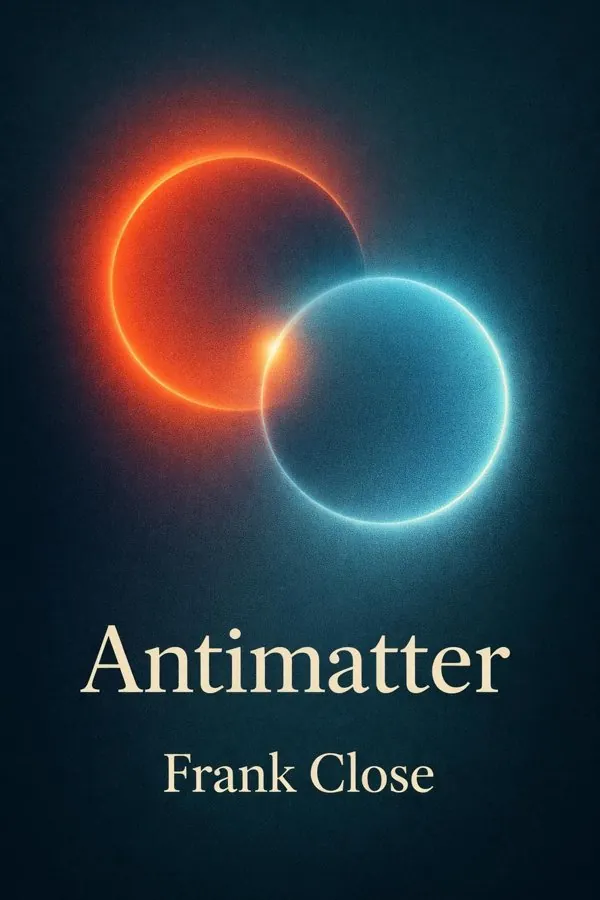
Antimatter: Summary & Key Insights
by Frank Close
 10 min5 chaptersAudio available
What Is Antimatter About?
Antimatter by Frank Close is a popular_sci book spanning 5 pages. Antimatter explores the scientific discovery, theoretical implications, and experimental pursuit of antimatter—from its prediction by Paul Dirac to its role in modern physics and cosmology. Frank Close explains how antimatter mirrors ordinary matter, why it is rare in the universe, and how it could revolutionize energy and medical technologies.
This FizzRead summary covers all 5 key chapters of Antimatter in approximately 10 minutes, distilling the most important ideas, arguments, and takeaways from Frank Close's work. Also available as an audio summary and Key Quotes Podcast.
Antimatter
Antimatter explores the scientific discovery, theoretical implications, and experimental pursuit of antimatter—from its prediction by Paul Dirac to its role in modern physics and cosmology. Frank Close explains how antimatter mirrors ordinary matter, why it is rare in the universe, and how it could revolutionize energy and medical technologies.
Who Should Read Antimatter?
This book is perfect for anyone interested in popular_sci and looking to gain actionable insights in a short read. Whether you're a student, professional, or lifelong learner, the key ideas from Antimatter by Frank Close will help you think differently.
- ✓Readers who enjoy popular_sci and want practical takeaways
- ✓Professionals looking to apply new ideas to their work and life
- ✓Anyone who wants the core insights of Antimatter in just 10 minutes
Want the full summary?
Get instant access to this book summary and 100K+ more with Fizz Moment.
Get Free SummaryAvailable on App Store • Free to download
Key Chapters
It all began with an equation. In 1928, Paul Dirac was trying to reconcile quantum mechanics with the special theory of relativity. His goal was simple in spirit yet profound in consequence: to describe the behavior of electrons moving near the speed of light. When he wrote the equation that did so, its mathematics revealed something curious – it permitted solutions with both positive and negative energy. This was not merely a quirk. Dirac realized that such solutions implied the existence of electrons identical in mass but opposite in charge. Antimatter, in a sense, was born on paper.
I often recall the audacity of that moment. Dirac could have ignored the negative states as meaningless, but his faith in mathematical beauty guided him otherwise. Physics progresses not only by data but also by intuition, and Dirac’s intuition told him that nature’s symmetries would not be so easily dismissed. His equation did not predict imaginary ghosts; it predicted real particles – the antiparticles – and it demanded that the universe contain them.
A few years later, Carl Anderson provided the proof. In 1932, while studying cosmic rays with a cloud chamber, Anderson observed the track of a particle bending opposite to what an electron should do, yet bearing the same mass. Here was the positron, the first piece of antimatter ever detected. The beauty of theory met the triumph of experiment, and together they opened a new world.
From that discovery grew a new understanding: every particle must have its counterpart. The proton has the antiproton, the neutron its antineutron. This pairing extended through physics like a mirror universe beside our own, and it still stands as one of the most beautiful features of nature’s design.
To understand antimatter, one must grasp symmetry. For every charge, for every property of matter, there exists an opposite that completes the equation. This isn’t mere metaphor – it is the reason why annihilation releases so much energy. When a particle meets its antiparticle, they do not simply cancel; they transform into something else entirely: pure energy, according to Einstein’s E = mc².
This annihilation is both poetic and powerful. In laboratory experiments, when electrons and positrons collide, the result is photons of high energy, light created from the obliteration of matter. The process is total and efficient, and it shows how deeply linked the two forms are. Matter and antimatter are like yin and yang, each defining the other’s existence.
But there is also a mystery. According to our best theories, the Big Bang should have birthed equal quantities of both. Yet the observable universe is overwhelmingly matter-dominated. The reason lies in subtle asymmetries known as CP violation — tiny differences in how certain particles behave under mirrored conditions. These minute deviations, detected in experiments with kaons and B mesons, may tell us why our cosmos survived as matter rather than disappearing into radiant nothingness.
In these paradoxes — of symmetry and imbalance, of creation through destruction — antimatter reveals the universe’s deep structure. For physicists, annihilation isn’t only a spectacular event; it’s a window onto nature’s bookkeeping, the conservation of charge, spin, and energy at the most fundamental level.
+ 3 more chapters — available in the FizzRead app
All Chapters in Antimatter
About the Author
Frank Close is a British particle physicist and professor emeritus at the University of Oxford. He is known for his research in theoretical physics and for writing accessible books on particle physics and cosmology.
Get This Summary in Your Preferred Format
Read or listen to the Antimatter summary by Frank Close anytime, anywhere. FizzRead offers multiple formats so you can learn on your terms — all free.
Available formats: App · Audio · PDF · EPUB — All included free with FizzRead
Download Antimatter PDF and EPUB Summary
Key Quotes from Antimatter
“In 1928, Paul Dirac was trying to reconcile quantum mechanics with the special theory of relativity.”
“To understand antimatter, one must grasp symmetry.”
Frequently Asked Questions about Antimatter
Antimatter by Frank Close is a popular_sci book that explores key ideas across 5 chapters. Antimatter explores the scientific discovery, theoretical implications, and experimental pursuit of antimatter—from its prediction by Paul Dirac to its role in modern physics and cosmology. Frank Close explains how antimatter mirrors ordinary matter, why it is rare in the universe, and how it could revolutionize energy and medical technologies.
You Might Also Like

Structures: Or Why Things Don"t Fall Down
J.E. Gordon
10 min
The Road to Wigan Pier
George Orwell
10 min
Bonk: The Curious Coupling of Science and Sex
Mary Roach
10 min
First Bite: How We Learn to Eat
Bee Wilson
10 min
In Pursuit Of The Unknown: 17 Equations That Changed The World
Ian Stewart
10 min
Napoleon's Buttons: 17 Molecules That Changed History
Penny Le Couteur and Jay Burreson
10 minBrowse by Category
Ready to read Antimatter?
Get the full summary and 100K+ more books with Fizz Moment.