
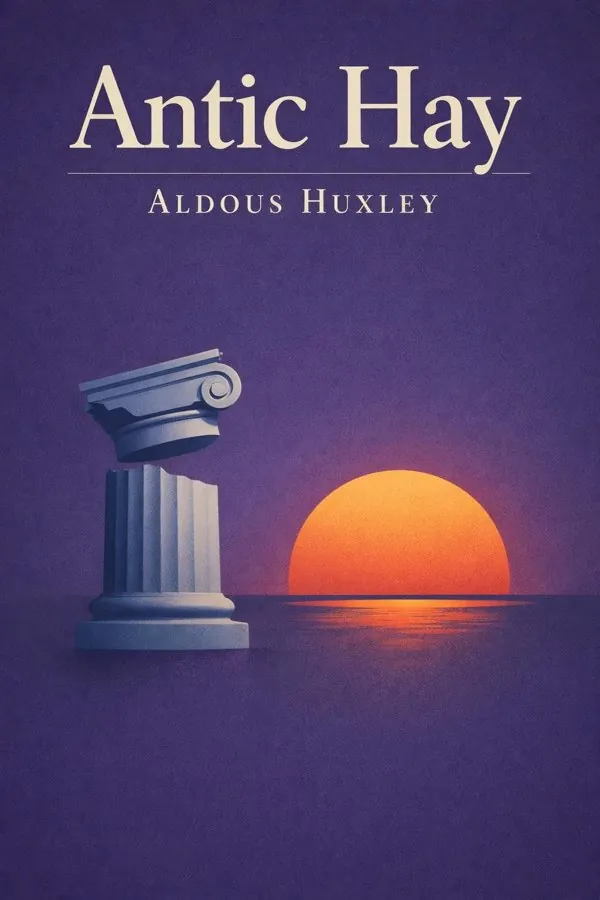
Antic Hay: Summary & Key Insights
 10 min9 chaptersAudio available
Key Takeaways from Antic Hay
A civilization does not collapse only when its buildings fall; it also collapses when its beliefs stop convincing the people who inherit them.
Absurdity often begins as a practical response to humiliation.
One of the sharpest insights in Antic Hay is that modern identity is often theatrical.
Intelligence without belief can become a form of self-defense.
Romantic confusion in Antic Hay is not just about mismatched attraction; it reveals a broader inability to love with seriousness.
What Is Antic Hay About?
Antic Hay by Aldous Huxley is a classics book spanning 5 pages. Aldous Huxley’s Antic Hay is a brilliant, restless satire of postwar London, a novel in which clever people talk endlessly, desire impulsively, and drift through modern life with very little faith in anything lasting. At its center is Theodore Gumbril Jr., a schoolmaster and aspiring inventor whose comic “pneumatic trousers” capture the spirit of the age: ingenious, absurd, and oddly revealing. Around him moves a circle of artists, skeptics, seducers, and would-be intellectuals, all searching for pleasure, significance, or escape in a world that no longer seems anchored by tradition, religion, or moral certainty. What makes Antic Hay matter is not simply its portrait of the 1920s, but its uncanny familiarity. Huxley shows how people use irony, performance, busyness, and erotic adventure to avoid confronting emptiness. The novel is funny, stylish, and sharply observant, yet beneath the comedy lies a serious diagnosis of spiritual exhaustion. Huxley, one of the twentieth century’s most penetrating social critics, writes with extraordinary intelligence about modernity, alienation, and self-deception. Antic Hay remains essential because it asks a question that still feels urgent today: what happens when a culture gains freedom, energy, and novelty, but loses purpose?
This FizzRead summary covers all 9 key chapters of Antic Hay in approximately 10 minutes, distilling the most important ideas, arguments, and takeaways from Aldous Huxley's work. Also available as an audio summary and Key Quotes Podcast.
Antic Hay
Aldous Huxley’s Antic Hay is a brilliant, restless satire of postwar London, a novel in which clever people talk endlessly, desire impulsively, and drift through modern life with very little faith in anything lasting. At its center is Theodore Gumbril Jr., a schoolmaster and aspiring inventor whose comic “pneumatic trousers” capture the spirit of the age: ingenious, absurd, and oddly revealing. Around him moves a circle of artists, skeptics, seducers, and would-be intellectuals, all searching for pleasure, significance, or escape in a world that no longer seems anchored by tradition, religion, or moral certainty.
What makes Antic Hay matter is not simply its portrait of the 1920s, but its uncanny familiarity. Huxley shows how people use irony, performance, busyness, and erotic adventure to avoid confronting emptiness. The novel is funny, stylish, and sharply observant, yet beneath the comedy lies a serious diagnosis of spiritual exhaustion. Huxley, one of the twentieth century’s most penetrating social critics, writes with extraordinary intelligence about modernity, alienation, and self-deception. Antic Hay remains essential because it asks a question that still feels urgent today: what happens when a culture gains freedom, energy, and novelty, but loses purpose?
Who Should Read Antic Hay?
This book is perfect for anyone interested in classics and looking to gain actionable insights in a short read. Whether you're a student, professional, or lifelong learner, the key ideas from Antic Hay by Aldous Huxley will help you think differently.
- ✓Readers who enjoy classics and want practical takeaways
- ✓Professionals looking to apply new ideas to their work and life
- ✓Anyone who wants the core insights of Antic Hay in just 10 minutes
Want the full summary?
Get instant access to this book summary and 100K+ more with Fizz Moment.
Get Free SummaryAvailable on App Store • Free to download
Key Chapters
A civilization does not collapse only when its buildings fall; it also collapses when its beliefs stop convincing the people who inherit them. That is the emotional starting point of Antic Hay. Huxley presents post-World War I London as a city still busy, fashionable, and intellectually alive, but inwardly hollow. The war has not merely caused grief. It has dissolved confidence in institutions, ideals, and inherited moral structures. People continue to work, flirt, socialize, and create, yet much of it feels automatic, as though society were continuing from habit rather than conviction.
This atmosphere matters because it shapes every character’s behavior. In an earlier age, ambition might have been directed toward service, art, faith, or public life. In Huxley’s London, those avenues feel compromised or performative. The result is a society of intelligent drifters. They are not always poor or oppressed; often, they are simply unconvinced. They have freedom without faith, stimulation without direction. That combination produces nervous wit, emotional instability, and endless experimentation.
Huxley’s satire works because he never treats disillusionment as abstract. He shows it in conversation, in failed romance, in career frustration, and in the strange emptiness behind fashionable modern life. The city becomes a psychological landscape: energetic on the surface, exhausted underneath.
This idea still applies today. Many people live amid comfort, technology, and choice, yet feel detached from meaning. Work can feel bureaucratic, culture performative, and relationships provisional. Huxley reminds us that social vitality is not the same as moral purpose.
Actionable takeaway: Pay attention to the beliefs organizing your own life. If your routines feel mechanical, do not just seek more stimulation; ask what deeper purpose, value, or commitment is missing.
Absurdity often begins as a practical response to humiliation. Theodore Gumbril Jr. is one of Huxley’s most revealing creations because he is both ridiculous and recognizable. A minor schoolmaster trapped in a deadening institution, Gumbril feels wasted by routine and diminished by social expectations. His answer is not heroism but invention: he creates his notorious “pneumatic trousers,” a comic device that promises modern comfort through technological ingenuity. The invention is funny, but it is also symbolic. Gumbril seeks identity through novelty because the traditional routes to significance seem closed or unconvincing.
Huxley uses Gumbril to expose how modern individuals compensate for inner uncertainty with cleverness. Gumbril is intelligent enough to understand his own mediocrity, which makes him both self-conscious and susceptible to fantasy. He imagines transformation through a gimmick, through romance, through style, through becoming someone other than his ordinary self. In that sense, he is not just one eccentric man in 1920s London. He is a prototype of the modern self-branding individual.
The comic force of the character comes from the mismatch between aspiration and substance. Gumbril does not lack imagination; he lacks anchoring. His schemes reveal the temptation to substitute performance for character. Today, this can look like obsessive productivity hacks, personal reinvention through aesthetics, or the belief that a clever side project will resolve a deeper existential dissatisfaction.
Yet Huxley is not simply cruel to him. Gumbril’s folly has a human core: the desire not to be trapped in insignificance. That is why the satire bites. We laugh because we understand the impulse.
Actionable takeaway: When you are tempted to solve a life crisis with a novelty, ask whether the real need is external improvement or inner clarity. Innovation can help, but it cannot replace purpose.
One of the sharpest insights in Antic Hay is that modern identity is often theatrical. Characters do not simply live; they pose, improvise, and curate versions of themselves for different audiences. The ideal of being a “complete man” sounds admirable, but Huxley treats it skeptically. In the novel’s world, completeness often means a restless accumulation of poses: intellectual sophistication, erotic freedom, artistic flair, worldly cynicism, and emotional detachment. The result is not wholeness but fragmentation.
This performance of identity emerges because stable roles have weakened. If religion, class, and inherited duty no longer provide a clear script, the modern person becomes an actor assembling a self from available styles. That can look liberating. It can also become exhausting. Huxley shows how people move from salon wit to private melancholy, from self-display to self-doubt. Their personalities are flexible, but not necessarily integrated.
The phrase “complete man” becomes ironic because the more one tries to contain every possible mode of being, the less one may know what is genuine. We see this in characters who confuse experience with growth and sophistication with maturity. A cultivated surface cannot compensate for inner incoherence.
The novel feels strikingly current here. Today, identity is often shaped through career branding, social media presence, relationship roles, and ideological affiliation. People may become highly skilled at presentation while remaining uncertain about conviction. Huxley’s point is not that self-fashioning is always false, but that it becomes dangerous when appearance outruns substance.
Actionable takeaway: Instead of asking whether you seem interesting, complete, or versatile, ask whether your values remain consistent across contexts. Integration matters more than image.
Intelligence without belief can become a form of self-defense. Huxley fills Antic Hay with witty, articulate, hyper-aware figures who can analyze almost everything and commit to almost nothing. These intellectuals and artists are not fools; indeed, their very sharpness is part of the problem. They see through hypocrisy, sentimentalism, convention, and public posturing. But because they are so practiced at debunking, they struggle to affirm anything durable in return.
This is one of the novel’s deepest social criticisms. Huxley suggests that an entire educated class has become brilliant at irony and weak at devotion. Conversation sparkles, but conviction evaporates. Cynicism becomes fashionable because sincerity feels naive. The danger is not merely moral laziness. It is existential paralysis. When every ideal is exposed as compromised, action begins to seem foolish and seriousness embarrassing.
Huxley’s treatment is subtle because he recognizes the appeal of such intelligence. There is pleasure in detachment. It protects against disappointment and grants a sense of superiority. But it also impoverishes emotional life. People who cannot trust ideals often drift into triviality, sensual distraction, or cultivated despair.
The pattern remains familiar. In many professional and cultural settings today, clever skepticism is rewarded more quickly than moral seriousness. People may mock institutions, relationships, or principles without offering alternatives. This can create a culture of commentary without commitment.
The practical lesson is not to reject critique. Critique is essential. Huxley’s warning is that critique alone cannot sustain a life. A mind that only negates eventually undermines itself.
Actionable takeaway: Notice where irony has become a shield in your life. Keep your critical intelligence, but pair it with at least one positive commitment you are willing to serve, defend, and deepen.
Romantic confusion in Antic Hay is not just about mismatched attraction; it reveals a broader inability to love with seriousness. Huxley portrays relationships as charged by desire, vanity, curiosity, and temporary emotional need, yet rarely stabilized by genuine commitment. People pursue one another not only because they care, but because seduction offers excitement, validation, or escape from boredom. Love becomes entangled with performance.
This is why the novel’s romantic entanglements are simultaneously comic and sad. Characters speak in sophisticated ways about intimacy, but often use intimacy to avoid themselves. They seek connection while preserving distance. They want admiration without vulnerability, pleasure without consequence, and emotional intensity without moral responsibility. The result is repeated disappointment.
Huxley is not condemning desire itself. He is exposing what happens when desire is severed from honesty. In such a setting, romance becomes another modern pastime, another arena for experimentation. But people are not abstractions, and emotional life resists pure cleverness. Even in a satirical novel, failed intimacy hurts because human beings continue to hunger for recognition and meaning.
This theme remains deeply relevant. In any culture that prizes choice, novelty, and self-protection, relationships can become unstable or strategic. People may maintain ambiguity to preserve options, confuse chemistry with substance, or use irony to avoid saying what they actually want. Huxley’s insight is that evasive love eventually becomes another expression of alienation.
Actionable takeaway: In your closest relationships, replace stylish ambiguity with directness. Say what you want, what you fear, and what you can genuinely offer. Emotional clarity is more valuable than seductive performance.
When people no longer believe that life has a stable purpose, they often do not become ascetics; they become consumers of distraction. Antic Hay repeatedly shows characters seeking relief in amusement, conversation, artifice, sex, parties, and novelty. None of these pleasures is inherently corrupt. Huxley’s point is that they are being used as substitutes for meaning rather than expressions of it.
That distinction matters. Pleasure can enrich a meaningful life, but it cannot by itself answer the question of why one lives. In the novel, diversion functions as anesthesia. Characters move from one stimulation to another because stillness would force self-confrontation. The comic rhythm of the book mirrors this restless searching: movement without arrival, appetite without fulfillment.
Huxley understood that hedonism is often less triumphant than it appears. The pursuit of pleasure can be driven by fear of emptiness. This helps explain the mixture of gaiety and fatigue that hangs over the novel. The characters are not simply libertines enjoying freedom. They are often fugitives from seriousness.
The contemporary parallel is obvious. Endless entertainment, social feeds, impulsive spending, casual hookups, constant travel, and digital busyness can all become ways of avoiding difficult interior questions. The issue is not moral panic; it is proportion. If pleasure becomes your primary strategy for managing life, it will gradually lose its power and deepen dissatisfaction.
Huxley’s satire encourages discipline not through preaching but through exposure. He shows what a culture looks like when stimulation outruns significance.
Actionable takeaway: Audit your distractions for one week. Ask which pleasures genuinely renew you and which merely help you avoid discomfort. Reduce the second category and invest more in what creates lasting satisfaction.
A cultured society can still be spiritually superficial. One of the most striking features of Antic Hay is the abundance of talk: witty exchange, intellectual display, artistic posturing, and endless social performance. Huxley is fascinated by a milieu in which language is abundant but depth is scarce. Conversation becomes an art form, yet also a defense mechanism. People talk brilliantly in order not to feel too deeply.
The novel therefore raises a difficult question about culture itself. Does exposure to art, literature, and ideas make people wiser, or can it simply furnish them with more refined forms of evasion? Huxley refuses easy answers. His characters are often educated and aesthetically alert, but they are not necessarily morally grounded. In fact, culture may intensify their self-consciousness and complicate their ability to act simply or sincerely.
This does not make Huxley anti-intellectual. Rather, he distinguishes between genuine depth and decorative intelligence. Art matters, but not when it becomes one more ornament in a life organized around vanity or drift. The same applies to conversation. Verbal brilliance can clarify truth, but it can also create the illusion of insight without the cost of transformation.
Modern readers can recognize this pattern in environments where people read, discuss, post, and comment constantly, yet rarely change their habits. Knowledge circulates; wisdom does not. There is a difference between being articulate about life and being accountable to it.
Actionable takeaway: After encountering a powerful book, idea, or conversation, ask one practical question: what behavior, relationship, or habit should change because of this? If nothing changes, culture may be functioning as decoration rather than depth.
The funniest books are often the ones most alert to despair. Antic Hay sparkles with comic invention, absurd situations, and satirical portraits, yet its laughter has a dark undertone. Huxley uses comedy not to trivialize modern life, but to reveal how far it has drifted from coherence. The novel is full of antic movement, but beneath the liveliness lies spiritual depletion.
This tonal complexity is central to the book’s power. A purely tragic account of postwar emptiness might feel heavy or doctrinaire. Huxley instead lets people expose themselves through their own absurdity. Their vanity, flirtation, posturing, and restless schemes become funny because they are disproportionate to the seriousness of what they are avoiding. Comedy becomes diagnosis.
This matters because people often mask their own crises with humor. A joke can be a release, but also a disguise. Whole social circles may normalize deflection through wit. When everyone is clever, no one has to admit vulnerability. Huxley understood that comedy can become a cultural style of repression.
At the same time, his satire is not nihilistic. By making emptiness visible, he creates the possibility of recognition. Readers laugh, then realize what exactly they are laughing at: disconnection, performative intelligence, evasive desire, and the fear of seriousness.
This remains one of the most useful ways to read the novel today. It teaches us to examine our own humor. Are we using comedy to illuminate truth, or to evade it? Are our jokes enlarging reality or shrinking it?
Actionable takeaway: Notice the patterns in what you consistently joke about. Repeated humor often points toward unresolved fear, frustration, or longing. Use laughter as a clue to deeper self-understanding, not only as an escape.
Modern freedom is exhilarating, but without an orienting purpose it easily turns into aimlessness. Antic Hay is populated by people who possess a remarkable degree of social, intellectual, and personal latitude. They can experiment with identity, relationships, ideas, and occupations. Yet that freedom rarely leads to flourishing. More often, it produces drift.
Huxley’s insight is that liberation from old constraints is only half a human achievement. The other half is learning what to do with freedom once inherited systems lose authority. His characters have escaped many conventional expectations, but they have not built stronger internal frameworks to replace them. As a result, their lives become episodic. They move from impulse to impulse, mood to mood, and encounter to encounter.
This is one reason the novel still feels so modern. Contemporary people are frequently told to design their own lives, create their own values, and remain endlessly open to reinvention. That sounds empowering, and often is. But it also imposes a burden: if nothing is given, everything must be chosen. Without discipline, reflection, and commitment, freedom becomes exhausting rather than liberating.
Huxley does not call for a simple return to the past. His point is subtler. Human beings need forms, aims, and loyalties strong enough to organize desire. Otherwise, possibility itself becomes destabilizing.
In practical terms, this means that autonomy is not enough. A successful life requires selected constraints: chosen responsibilities, moral boundaries, meaningful work, and honest relationships. These do not diminish freedom; they make it usable.
Actionable takeaway: Define three non-negotiable commitments that structure your life, such as a moral principle, a creative practice, or a relationship duty. Freedom becomes fruitful when it is deliberately directed.
All Chapters in Antic Hay
About the Author
Aldous Huxley (1894–1963) was an English writer, essayist, and public intellectual whose work explored the crises and possibilities of modern civilization. Born into a prominent intellectual family, he was educated at Eton and Balliol College, Oxford. Early in his career, Huxley became known for satirical novels such as Crome Yellow, Antic Hay, and Point Counter Point, which dissected the manners and anxieties of the interwar educated class. He later gained worldwide fame with Brave New World, his enduring dystopian vision of technological control and engineered conformity. Across fiction, essays, and philosophical works, Huxley examined science, politics, religion, art, and consciousness with unusual range and precision. His writing remains influential for its blend of wit, skepticism, and deep concern for the moral and spiritual fate of modern humanity.
Get This Summary in Your Preferred Format
Read or listen to the Antic Hay summary by Aldous Huxley anytime, anywhere. FizzRead offers multiple formats so you can learn on your terms — all free.
Available formats: App · Audio · PDF · EPUB — All included free with FizzRead
Download Antic Hay PDF and EPUB Summary
Key Quotes from Antic Hay
“A civilization does not collapse only when its buildings fall; it also collapses when its beliefs stop convincing the people who inherit them.”
“Absurdity often begins as a practical response to humiliation.”
“One of the sharpest insights in Antic Hay is that modern identity is often theatrical.”
“Intelligence without belief can become a form of self-defense.”
“Romantic confusion in Antic Hay is not just about mismatched attraction; it reveals a broader inability to love with seriousness.”
Frequently Asked Questions about Antic Hay
Antic Hay by Aldous Huxley is a classics book that explores key ideas across 9 chapters. Aldous Huxley’s Antic Hay is a brilliant, restless satire of postwar London, a novel in which clever people talk endlessly, desire impulsively, and drift through modern life with very little faith in anything lasting. At its center is Theodore Gumbril Jr., a schoolmaster and aspiring inventor whose comic “pneumatic trousers” capture the spirit of the age: ingenious, absurd, and oddly revealing. Around him moves a circle of artists, skeptics, seducers, and would-be intellectuals, all searching for pleasure, significance, or escape in a world that no longer seems anchored by tradition, religion, or moral certainty. What makes Antic Hay matter is not simply its portrait of the 1920s, but its uncanny familiarity. Huxley shows how people use irony, performance, busyness, and erotic adventure to avoid confronting emptiness. The novel is funny, stylish, and sharply observant, yet beneath the comedy lies a serious diagnosis of spiritual exhaustion. Huxley, one of the twentieth century’s most penetrating social critics, writes with extraordinary intelligence about modernity, alienation, and self-deception. Antic Hay remains essential because it asks a question that still feels urgent today: what happens when a culture gains freedom, energy, and novelty, but loses purpose?
More by Aldous Huxley
You Might Also Like

Browse by Category
Ready to read Antic Hay?
Get the full summary and 100K+ more books with Fizz Moment.