
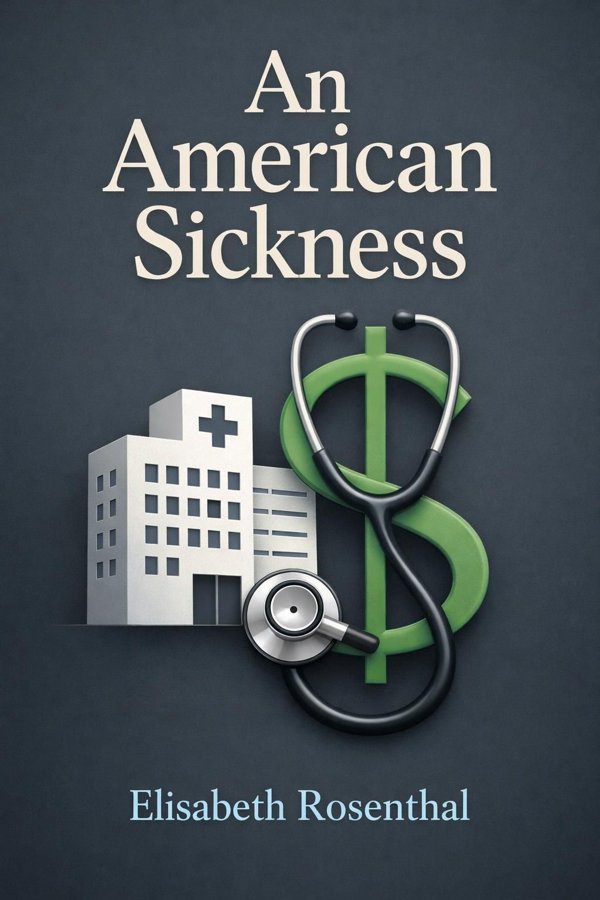
An American Sickness: How Healthcare Became Big Business and How You Can Take It Back: Summary & Key Insights
 10 min11 chaptersAudio available
What Is An American Sickness: How Healthcare Became Big Business and How You Can Take It Back About?
An American Sickness: How Healthcare Became Big Business and How You Can Take It Back by Elisabeth Rosenthal is a health_med book spanning 11 pages. In this investigative work, journalist and physician Elisabeth Rosenthal exposes how the U.S. healthcare system has transformed from a service-oriented model into a profit-driven industry. Drawing on extensive research and real patient stories, she explains how hospitals, insurers, and pharmaceutical companies prioritize financial gain over patient care, and offers practical advice for individuals to navigate and challenge the system.
This FizzRead summary covers all 11 key chapters of An American Sickness: How Healthcare Became Big Business and How You Can Take It Back in approximately 10 minutes, distilling the most important ideas, arguments, and takeaways from Elisabeth Rosenthal's work. Also available as an audio summary and Key Quotes Podcast.
An American Sickness: How Healthcare Became Big Business and How You Can Take It Back
In this investigative work, journalist and physician Elisabeth Rosenthal exposes how the U.S. healthcare system has transformed from a service-oriented model into a profit-driven industry. Drawing on extensive research and real patient stories, she explains how hospitals, insurers, and pharmaceutical companies prioritize financial gain over patient care, and offers practical advice for individuals to navigate and challenge the system.
Who Should Read An American Sickness: How Healthcare Became Big Business and How You Can Take It Back?
This book is perfect for anyone interested in health_med and looking to gain actionable insights in a short read. Whether you're a student, professional, or lifelong learner, the key ideas from An American Sickness: How Healthcare Became Big Business and How You Can Take It Back by Elisabeth Rosenthal will help you think differently.
- ✓Readers who enjoy health_med and want practical takeaways
- ✓Professionals looking to apply new ideas to their work and life
- ✓Anyone who wants the core insights of An American Sickness: How Healthcare Became Big Business and How You Can Take It Back in just 10 minutes
Want the full summary?
Get instant access to this book summary and 100K+ more with Fizz Moment.
Get Free SummaryAvailable on App Store • Free to download
Key Chapters
The first principle of the new economy of healthcare is that traditional market logic collapses the moment a human body is involved. In normal markets, competition drives prices down and improves quality. In healthcare, the opposite has occurred: costs spiral upward even as outcomes remain stagnant. This happens because patients are not consumers in the usual sense. When you arrive at an emergency room or learn of a diagnosis, you are not in a position to shop around or negotiate; you are vulnerable, anxious, and dependent on professional advice. Hospitals, insurers, and drug companies have learned to exploit that imbalance.
I introduce what I call the 'economic rules' of this market — rules that would terrify any economist. For example, in healthcare, price does not correlate with value. Providers can charge whatever the market “will bear,” but the market itself is opaque: no one knows the real price until the bill arrives. Moreover, demand in healthcare is often infinite, because fear and illness override restraint.
These economic distortions allow profit motives to thrive unrestrained. Administrators and policymakers cloak this dynamic in the language of innovation and efficiency, but at the ground level it means that care is monetized at every step. From facility fees to mysterious line-item surcharges, the system behaves less like a social service and more like a luxury industry that never posts prices. Once we see those rules clearly, the rest of the book becomes a journey through their consequences.
In the early days of American medicine, hospitals were often charitable institutions, run by churches or local communities to care for those in need. But that spirit has largely vanished. Today, hospitals operate as corporate enterprises, their financial structures resembling those of investment banks more than of places of healing. Gigantic networks expand not necessarily to improve care, but to increase market share. Luxurious facilities — complete with waterfalls, valet parking, and grand atriums — are built to attract well-insured patients. All these amenities, of course, feed the billing machine.
Inside, the modern hospital employs armies of coders and billing consultants who specialize in maximizing reimbursement. Every square foot, every bed, and even every time slot becomes a revenue-generating asset. I recount cases of patients charged thousands for simple procedures or billed separately for every item used during surgery. Clinical decisions become entangled with financial incentives; administrators evaluate departments not solely on outcomes but on profitability.
These institutions operate under the logic that more interventions equal more revenue. That is why your stay often includes redundant tests or extended admissions. Hospitals justify these tactics under the banner of 'necessary care,' yet the underlying driver is often economic. As one administrator admitted to me during my reporting, volume — not value — fuels the model. It is this transformation of hospitals into financial conglomerates that mirrors the dysfunction of the broader system.
+ 9 more chapters — available in the FizzRead app
All Chapters in An American Sickness: How Healthcare Became Big Business and How You Can Take It Back
About the Author
Elisabeth Rosenthal is an American journalist and physician. A former New York Times reporter and editor-in-chief of Kaiser Health News, she has written extensively on healthcare policy and reform, combining her medical background with investigative reporting to illuminate systemic issues in the U.S. healthcare system.
Get This Summary in Your Preferred Format
Read or listen to the An American Sickness: How Healthcare Became Big Business and How You Can Take It Back summary by Elisabeth Rosenthal anytime, anywhere. FizzRead offers multiple formats so you can learn on your terms — all free.
Available formats: App · Audio · PDF · EPUB — All included free with FizzRead
Download An American Sickness: How Healthcare Became Big Business and How You Can Take It Back PDF and EPUB Summary
Key Quotes from An American Sickness: How Healthcare Became Big Business and How You Can Take It Back
“The first principle of the new economy of healthcare is that traditional market logic collapses the moment a human body is involved.”
“In the early days of American medicine, hospitals were often charitable institutions, run by churches or local communities to care for those in need.”
Frequently Asked Questions about An American Sickness: How Healthcare Became Big Business and How You Can Take It Back
An American Sickness: How Healthcare Became Big Business and How You Can Take It Back by Elisabeth Rosenthal is a health_med book that explores key ideas across 11 chapters. In this investigative work, journalist and physician Elisabeth Rosenthal exposes how the U.S. healthcare system has transformed from a service-oriented model into a profit-driven industry. Drawing on extensive research and real patient stories, she explains how hospitals, insurers, and pharmaceutical companies prioritize financial gain over patient care, and offers practical advice for individuals to navigate and challenge the system.
You Might Also Like

On Immunity
Eula Biss
10 min
The Three-Body Problem
Liu Cixin
10 min
Community Health Volunteer Toolkit: Training and Practical Activities
World Health Organization
10 min
Healing Back Pain: The Mind-Body Connection
John E. Sarno
10 min
Health Literacy for All: Practical Guides to Communicate Health Information (Compilations)
World Health Organization
10 min
The Complete Guide to Sports Supplements: An Evidence-Based Review
Anita Bean
10 minBrowse by Category
Ready to read An American Sickness: How Healthcare Became Big Business and How You Can Take It Back?
Get the full summary and 100K+ more books with Fizz Moment.