
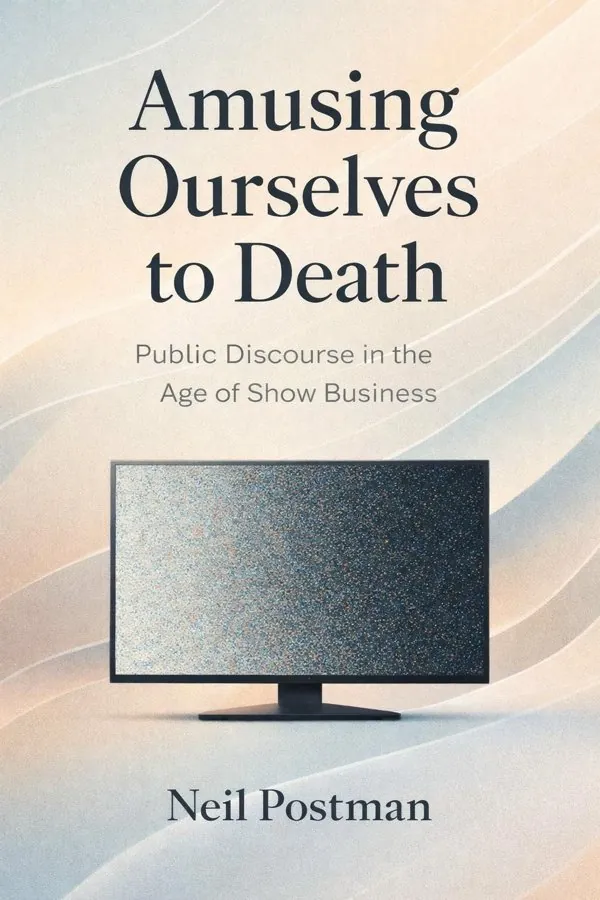
Amusing Ourselves to Death: Public Discourse in the Age of Show Business: Summary & Key Insights
by Neil Postman
 10 min10 chaptersAudio available
What Is Amusing Ourselves to Death: Public Discourse in the Age of Show Business About?
Amusing Ourselves to Death: Public Discourse in the Age of Show Business by Neil Postman is a sociology book spanning 10 pages. Amusing Ourselves to Death es un ensayo de Neil Postman publicado originalmente en 1985. El libro analiza cómo la televisión ha transformado el discurso público en entretenimiento, afectando la política, la educación, la religión y la ciencia. Postman argumenta que la forma en que los medios presentan la información influye profundamente en la cultura y la capacidad de pensamiento crítico de la sociedad.
This FizzRead summary covers all 10 key chapters of Amusing Ourselves to Death: Public Discourse in the Age of Show Business in approximately 10 minutes, distilling the most important ideas, arguments, and takeaways from Neil Postman's work. Also available as an audio summary and Key Quotes Podcast.
Amusing Ourselves to Death: Public Discourse in the Age of Show Business
Amusing Ourselves to Death es un ensayo de Neil Postman publicado originalmente en 1985. El libro analiza cómo la televisión ha transformado el discurso público en entretenimiento, afectando la política, la educación, la religión y la ciencia. Postman argumenta que la forma en que los medios presentan la información influye profundamente en la cultura y la capacidad de pensamiento crítico de la sociedad.
Who Should Read Amusing Ourselves to Death: Public Discourse in the Age of Show Business?
This book is perfect for anyone interested in sociology and looking to gain actionable insights in a short read. Whether you're a student, professional, or lifelong learner, the key ideas from Amusing Ourselves to Death: Public Discourse in the Age of Show Business by Neil Postman will help you think differently.
- ✓Readers who enjoy sociology and want practical takeaways
- ✓Professionals looking to apply new ideas to their work and life
- ✓Anyone who wants the core insights of Amusing Ourselves to Death: Public Discourse in the Age of Show Business in just 10 minutes
Want the full summary?
Get instant access to this book summary and 100K+ more with Fizz Moment.
Get Free SummaryAvailable on App Store • Free to download
Key Chapters
You might think that a medium is merely a vessel carrying content—a neutral pipeline through which messages flow. But that is the first illusion we must shatter. Every medium has a bias, a hidden grammar that shapes the content it conveys. The form determines the kind of ideas that can survive within it. A clock tells us we can measure time precisely, printing teaches us that ideas can be sequential and rational, and television—well, television tells us that truth is entertainment.
When I say the medium is the metaphor, I mean that every medium creates a new way of understanding reality. It becomes a metaphor for how we think the world itself works. For example, the printed word gives birth to a culture of logic and evidence. It assumes that ideas can be arranged in sequence, that we can follow arguments through paragraphs and pages. But television, by contrast, speaks in images and fragments. It rewards emotional immediacy and spectacle, not reasoning. Once a society adopts a new dominant medium, all public life begins to orbit its logic. News, religion, politics—all must adapt to fit what the medium permits them to be.
Once upon a time, America was a typographic culture. In the eighteenth and early nineteenth centuries, we were a nation defined by the printed word. Public discourse relied on literacy, on the careful reading and writing that print requires. In that time, citizens debated policy and philosophy as if they were extensions of the printing press. Speeches were written to be read, and reading was both an intellectual and moral act.
This was an era when even farmers and tradesmen attended political debates lasting hours, when candidates wrote essays rather than staged photo opportunities. The typographic man did not need entertainment to be engaged; he demanded coherence, logic, and proof. To participate in public life was to read and to think. Our founding documents—the Constitution, The Federalist Papers—were the offspring of this print-based rationality. Typography gave America not just literacy, but a way of seeing truth as something that could be debated through reason, not displayed through image.
+ 8 more chapters — available in the FizzRead app
All Chapters in Amusing Ourselves to Death: Public Discourse in the Age of Show Business
About the Author
Neil Postman (1931–2003) fue un sociólogo y teórico de los medios estadounidense. Profesor en la Universidad de Nueva York, es conocido por sus estudios sobre la influencia de la tecnología y los medios en la educación y la cultura. Entre sus obras más destacadas se encuentran 'Technopoly' y 'The Disappearance of Childhood'.
Get This Summary in Your Preferred Format
Read or listen to the Amusing Ourselves to Death: Public Discourse in the Age of Show Business summary by Neil Postman anytime, anywhere. FizzRead offers multiple formats so you can learn on your terms — all free.
Available formats: App · Audio · PDF · EPUB — All included free with FizzRead
Download Amusing Ourselves to Death: Public Discourse in the Age of Show Business PDF and EPUB Summary
Key Quotes from Amusing Ourselves to Death: Public Discourse in the Age of Show Business
“You might think that a medium is merely a vessel carrying content—a neutral pipeline through which messages flow.”
“Once upon a time, America was a typographic culture.”
Frequently Asked Questions about Amusing Ourselves to Death: Public Discourse in the Age of Show Business
Amusing Ourselves to Death: Public Discourse in the Age of Show Business by Neil Postman is a sociology book that explores key ideas across 10 chapters. Amusing Ourselves to Death es un ensayo de Neil Postman publicado originalmente en 1985. El libro analiza cómo la televisión ha transformado el discurso público en entretenimiento, afectando la política, la educación, la religión y la ciencia. Postman argumenta que la forma en que los medios presentan la información influye profundamente en la cultura y la capacidad de pensamiento crítico de la sociedad.
You Might Also Like
Between the World and Me
Ta-Nehisi Coates
10 min
Half the Sky
Nicholas D. Kristof, Sheryl WuDunn
10 min
Men Explain Things To Me
Rebecca Solnit
10 min
Rational Ritual
Michael Suk-Young Chwe
10 min
The New Jim Crow
Michelle Alexander
10 min
Beyond Culture
Edward T. Hall
10 minBrowse by Category
Ready to read Amusing Ourselves to Death: Public Discourse in the Age of Show Business?
Get the full summary and 100K+ more books with Fizz Moment.