
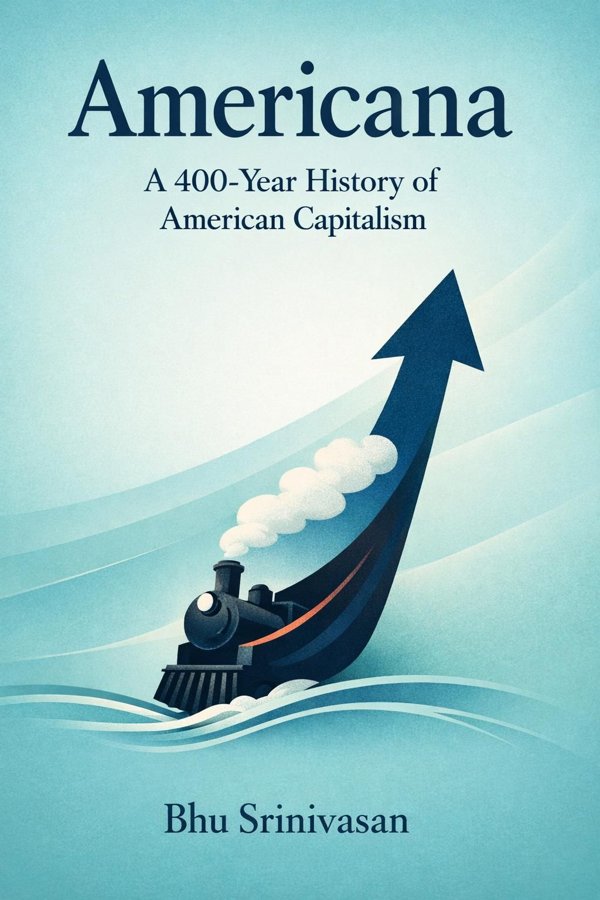
Americana: A 400-Year History of American Capitalism: Summary & Key Insights
 10 min11 chaptersAudio available
What Is Americana: A 400-Year History of American Capitalism About?
Americana: A 400-Year History of American Capitalism by Bhu Srinivasan is a economics book spanning 11 pages. Americana: A 400-Year History of American Capitalism is a sweeping narrative that traces the evolution of American capitalism from the early colonial period to the modern digital age. Bhu Srinivasan explores how innovation, entrepreneurship, and risk-taking have shaped the United States, weaving together stories of industries from cotton and railroads to Silicon Valley. The book highlights the interplay between technological progress, cultural change, and economic ambition that defines the American experience.
This FizzRead summary covers all 11 key chapters of Americana: A 400-Year History of American Capitalism in approximately 10 minutes, distilling the most important ideas, arguments, and takeaways from Bhu Srinivasan's work. Also available as an audio summary and Key Quotes Podcast.
Americana: A 400-Year History of American Capitalism
Americana: A 400-Year History of American Capitalism is a sweeping narrative that traces the evolution of American capitalism from the early colonial period to the modern digital age. Bhu Srinivasan explores how innovation, entrepreneurship, and risk-taking have shaped the United States, weaving together stories of industries from cotton and railroads to Silicon Valley. The book highlights the interplay between technological progress, cultural change, and economic ambition that defines the American experience.
Who Should Read Americana: A 400-Year History of American Capitalism?
This book is perfect for anyone interested in economics and looking to gain actionable insights in a short read. Whether you're a student, professional, or lifelong learner, the key ideas from Americana: A 400-Year History of American Capitalism by Bhu Srinivasan will help you think differently.
- ✓Readers who enjoy economics and want practical takeaways
- ✓Professionals looking to apply new ideas to their work and life
- ✓Anyone who wants the core insights of Americana: A 400-Year History of American Capitalism in just 10 minutes
Want the full summary?
Get instant access to this book summary and 100K+ more with Fizz Moment.
Get Free SummaryAvailable on App Store • Free to download
Key Chapters
When we look back to the earliest settlements, what we find at the heart of colonial America is not ideology, but trade. The colonies were business ventures first—Virginia was born of capital investment and risk-taking, Massachusetts Bay from mercantile ambition. Colonists didn’t come just seeking religious freedom; they came seeking opportunity. Tobacco became a currency, fur a luxury good, timber an export. The early economy was intensely practical: it was about survival, connection to markets, and eventually, profit.
In these formative decades, capitalism was primitive but real. The mercantile system tied the colonies to Britain in a web of supply and demand. American merchants learned early how to navigate regulations and monopolies, how to exploit scarcity and craft efficient production. It was in these years that the American instinct for self-direction took root—the conviction that enterprise could provide independence.
The Atlantic trade, including the dark system of slavery, also defined this foundation. It was a brutal truth: capitalism’s early American form was dependent on exploitation. Yet alongside the inequities was innovation—the beginnings of organized manufacturing, the emergence of domestic commerce. This duality, moral conflict and creative progress, became a recurring pattern of American capitalism.
From my perspective, these colonies built the economic language of ambition. They developed new methods for managing risk, diversifying production, and measuring profit. When the Revolution later arrived, its slogans of liberty were inseparable from these commercial experiences. The colonists had learned to compete, to build, and ultimately to demand autonomy not just politically, but economically. Their economy hadn’t simply sustained them; it had shaped their worldview.
The American Revolution is often remembered as a revolt against tyranny, but just beneath the politics was economics. Taxes, trade restrictions, monopolies—the grievances were rooted in commerce. I saw the entrepreneurial spirit that had thrived in the colonies turning against imperial constraint. Independence was not just a philosophical ideal; it was also the right to take economic risks free from the Crown’s interference.
Once independence was secured, a new question emerged: how to build a nation without inherited wealth or industrial infrastructure? What followed was a period of extraordinary improvisation. Entrepreneurs like Robert Morris financed war efforts as private investors, demonstrating that the American model would always intertwine public cause and private gain.
The Constitution itself reflected capitalist thinking. It established property rights, contract enforcement, and a unified market. Those foundations were revolutionary in their practicality—they promised a system where innovation could flourish. Even the early debates between Hamilton and Jefferson boiled down to competing visions of markets: Hamilton’s industrial nation of credit and banking versus Jefferson’s agrarian republic of land and self-sufficiency. In their struggle lay an enduring theme—the tension between centralized capital and individual independence.
In this era, I saw capitalism becoming the language of national identity. Independence was no longer enough; the new United States needed enterprise to survive. That drive to create wealth from principle—to turn ideals into industries—was the legacy of the Revolution that still echoes in every start-up and every act of innovation today.
+ 9 more chapters — available in the FizzRead app
All Chapters in Americana: A 400-Year History of American Capitalism
About the Author
Bhu Srinivasan is an Indian-American entrepreneur and author known for his work exploring the intersection of history, innovation, and capitalism. Before writing Americana, he founded several media and technology ventures. His writing reflects a deep interest in how economic and technological forces shape societies.
Get This Summary in Your Preferred Format
Read or listen to the Americana: A 400-Year History of American Capitalism summary by Bhu Srinivasan anytime, anywhere. FizzRead offers multiple formats so you can learn on your terms — all free.
Available formats: App · Audio · PDF · EPUB — All included free with FizzRead
Download Americana: A 400-Year History of American Capitalism PDF and EPUB Summary
Key Quotes from Americana: A 400-Year History of American Capitalism
“When we look back to the earliest settlements, what we find at the heart of colonial America is not ideology, but trade.”
“The American Revolution is often remembered as a revolt against tyranny, but just beneath the politics was economics.”
Frequently Asked Questions about Americana: A 400-Year History of American Capitalism
Americana: A 400-Year History of American Capitalism by Bhu Srinivasan is a economics book that explores key ideas across 11 chapters. Americana: A 400-Year History of American Capitalism is a sweeping narrative that traces the evolution of American capitalism from the early colonial period to the modern digital age. Bhu Srinivasan explores how innovation, entrepreneurship, and risk-taking have shaped the United States, weaving together stories of industries from cotton and railroads to Silicon Valley. The book highlights the interplay between technological progress, cultural change, and economic ambition that defines the American experience.
You Might Also Like

Business Adventures
John Brooks
10 min
Nudge
Richard H. Thaler, Cass R. Sunstein
10 min
The Hitchhiker"s Guide to the Galaxy
Douglas Adams
10 minThe Muqaddimah
Ibn Khaldun
10 minThe Outsiders
William N. Thorndike
10 min
A Little History of Economics
Niall Kishtainy
10 minFeatured In
Browse by Category
Ready to read Americana: A 400-Year History of American Capitalism?
Get the full summary and 100K+ more books with Fizz Moment.