
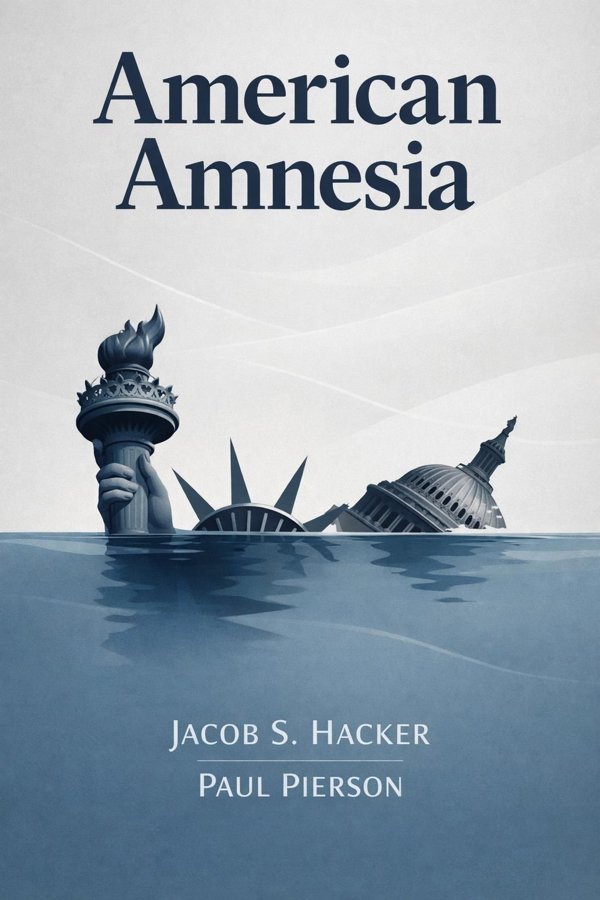
American Amnesia: How the War on Government Led Us to Forget What Made America Prosper: Summary & Key Insights
by Jacob S. Hacker, Paul Pierson
 10 min10 chaptersAudio available
What Is American Amnesia: How the War on Government Led Us to Forget What Made America Prosper About?
American Amnesia: How the War on Government Led Us to Forget What Made America Prosper by Jacob S. Hacker, Paul Pierson is a politics book spanning 10 pages. In this influential work, political scientists Jacob S. Hacker and Paul Pierson argue that the United States has suffered from a collective 'amnesia' about the crucial role government has played in fostering economic growth and shared prosperity. They trace how anti-government ideology and policy shifts since the late 20th century have undermined public institutions, widened inequality, and weakened the social contract that once supported a thriving middle class.
This FizzRead summary covers all 10 key chapters of American Amnesia: How the War on Government Led Us to Forget What Made America Prosper in approximately 10 minutes, distilling the most important ideas, arguments, and takeaways from Jacob S. Hacker, Paul Pierson's work. Also available as an audio summary and Key Quotes Podcast.
American Amnesia: How the War on Government Led Us to Forget What Made America Prosper
In this influential work, political scientists Jacob S. Hacker and Paul Pierson argue that the United States has suffered from a collective 'amnesia' about the crucial role government has played in fostering economic growth and shared prosperity. They trace how anti-government ideology and policy shifts since the late 20th century have undermined public institutions, widened inequality, and weakened the social contract that once supported a thriving middle class.
Who Should Read American Amnesia: How the War on Government Led Us to Forget What Made America Prosper?
This book is perfect for anyone interested in politics and looking to gain actionable insights in a short read. Whether you're a student, professional, or lifelong learner, the key ideas from American Amnesia: How the War on Government Led Us to Forget What Made America Prosper by Jacob S. Hacker, Paul Pierson will help you think differently.
- ✓Readers who enjoy politics and want practical takeaways
- ✓Professionals looking to apply new ideas to their work and life
- ✓Anyone who wants the core insights of American Amnesia: How the War on Government Led Us to Forget What Made America Prosper in just 10 minutes
Want the full summary?
Get instant access to this book summary and 100K+ more with Fizz Moment.
Get Free SummaryAvailable on App Store • Free to download
Key Chapters
Every advanced economy is a blend of public and private, but America’s distinctive genius was how it managed that blend. For much of the 20th century, we embraced what we call the mixed economy—a dynamic balance between market competition and government cooperation. Markets generated innovation, discipline, and efficiency; government provided the essential foundations those markets required to function: infrastructure, education, public health, regulation, and social insurance. Neither side could succeed alone.
Historically, the story of American growth cannot be told without public investment. Railroads and interstate highways did not emerge spontaneously from private vision; they were built on massive government funding. Science and technology—from the internet to GPS—were seeded by public research. The mixed economy recognized a simple truth: individual enterprise needs collective scaffolding. When government acts as a catalyst rather than a constraint, prosperity becomes more broadly shared.
We sometimes think of markets as natural systems, but they are social creations. They depend on rules, trust, and fairness, all enforced by publicly accountable institutions. The balance of these forces fostered decades of stable growth. The tragedy of our current amnesia is to mistake the visible hand of public purpose for interference, forgetting it was the invisible architecture that kept our markets honest and effective.
+ 8 more chapters — available in the FizzRead app
All Chapters in American Amnesia: How the War on Government Led Us to Forget What Made America Prosper
About the Authors
Jacob S. Hacker is a professor of political science at Yale University, known for his research on American political economy and social policy. Paul Pierson is a professor of political science at the University of California, Berkeley, specializing in comparative politics and public policy. Together, they have coauthored several influential books on American governance and inequality.
Get This Summary in Your Preferred Format
Read or listen to the American Amnesia: How the War on Government Led Us to Forget What Made America Prosper summary by Jacob S. Hacker, Paul Pierson anytime, anywhere. FizzRead offers multiple formats so you can learn on your terms — all free.
Available formats: App · Audio · PDF · EPUB — All included free with FizzRead
Download American Amnesia: How the War on Government Led Us to Forget What Made America Prosper PDF and EPUB Summary
Key Quotes from American Amnesia: How the War on Government Led Us to Forget What Made America Prosper
“Every advanced economy is a blend of public and private, but America’s distinctive genius was how it managed that blend.”
“From the end of World War II to the early 1970s, America experienced an unprecedented era of widely distributed prosperity.”
Frequently Asked Questions about American Amnesia: How the War on Government Led Us to Forget What Made America Prosper
American Amnesia: How the War on Government Led Us to Forget What Made America Prosper by Jacob S. Hacker, Paul Pierson is a politics book that explores key ideas across 10 chapters. In this influential work, political scientists Jacob S. Hacker and Paul Pierson argue that the United States has suffered from a collective 'amnesia' about the crucial role government has played in fostering economic growth and shared prosperity. They trace how anti-government ideology and policy shifts since the late 20th century have undermined public institutions, widened inequality, and weakened the social contract that once supported a thriving middle class.
More by Jacob S. Hacker, Paul Pierson
You Might Also Like
Antifa: The Anti-Fascist Handbook
Mark Bray
10 min
Attack from Within: How Disinformation Is Sabotaging America
Barbara McQuade
10 min
Coercion, Capital, and European States, AD 990–1992
Charles Tilly
10 min
Digital Democracy: Concepts, Methodologies, Tools, and Applications
Various Authors
10 min
Fascism
Stanley G. Payne
10 min
Fire And Fury: Inside The Trump White House
Michael Wolff
10 minBrowse by Category
Ready to read American Amnesia: How the War on Government Led Us to Forget What Made America Prosper?
Get the full summary and 100K+ more books with Fizz Moment.