
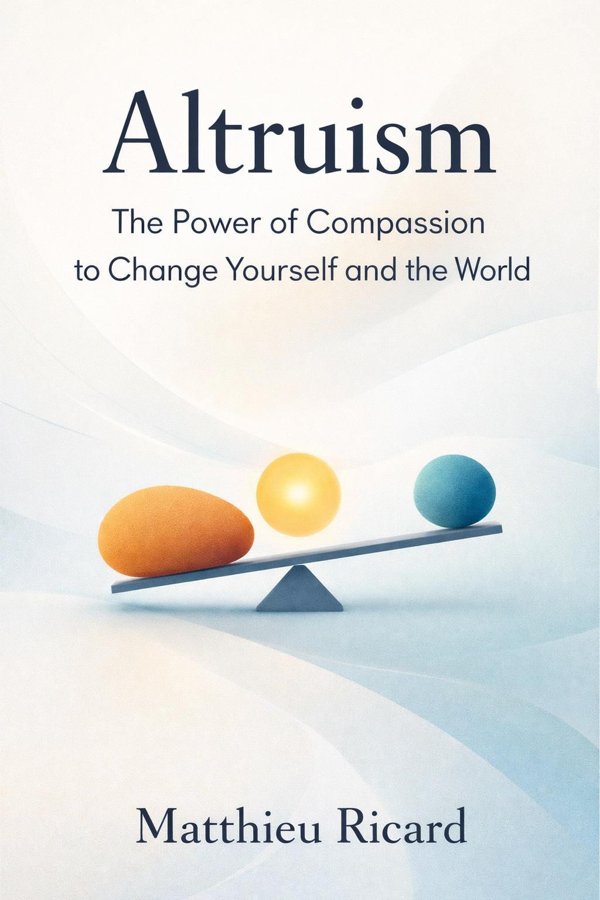
Altruism: The Power of Compassion to Change Yourself and the World: Summary & Key Insights
 10 min9 chaptersAudio available
What Is Altruism: The Power of Compassion to Change Yourself and the World About?
Altruism: The Power of Compassion to Change Yourself and the World by Matthieu Ricard is a positive_psych book spanning 9 pages. In this book, Matthieu Ricard explores altruism as a vital force for transforming both society and oneself. Drawing on research in psychology, neuroscience, and philosophy, he demonstrates that compassion and empathy can be cultivated and serve as pragmatic responses to contemporary challenges such as inequality, climate change, and collective well-being.
This FizzRead summary covers all 9 key chapters of Altruism: The Power of Compassion to Change Yourself and the World in approximately 10 minutes, distilling the most important ideas, arguments, and takeaways from Matthieu Ricard's work. Also available as an audio summary and Key Quotes Podcast.
Altruism: The Power of Compassion to Change Yourself and the World
In this book, Matthieu Ricard explores altruism as a vital force for transforming both society and oneself. Drawing on research in psychology, neuroscience, and philosophy, he demonstrates that compassion and empathy can be cultivated and serve as pragmatic responses to contemporary challenges such as inequality, climate change, and collective well-being.
Who Should Read Altruism: The Power of Compassion to Change Yourself and the World?
This book is perfect for anyone interested in positive_psych and looking to gain actionable insights in a short read. Whether you're a student, professional, or lifelong learner, the key ideas from Altruism: The Power of Compassion to Change Yourself and the World by Matthieu Ricard will help you think differently.
- ✓Readers who enjoy positive_psych and want practical takeaways
- ✓Professionals looking to apply new ideas to their work and life
- ✓Anyone who wants the core insights of Altruism: The Power of Compassion to Change Yourself and the World in just 10 minutes
Want the full summary?
Get instant access to this book summary and 100K+ more with Fizz Moment.
Get Free SummaryAvailable on App Store • Free to download
Key Chapters
In the beginning, we must clarify what altruism truly means. The term is simple, yet easily misunderstood. Many believe altruism opposes self-interest, as if caring for others necessarily means neglecting oneself. But I ask: can your well-being truly be independent from that of others? The distinction collapses once we see the interconnectedness of our existence.
Philosophically, altruism is the deliberate intention to promote another’s welfare without hidden calculation. Psychology tells us it arises naturally alongside empathy, our ability to feel with and for others. Yet pure altruism demands an extra step: the wish to relieve suffering, not simply resonate with it. Neuroscience has begun to identify the brain patterns of people actively cultivating compassion. When compared to mere emotional contagion or sympathy, altruism shows itself as a calm, luminous state—imbued with strength rather than overwhelm.
From a moral viewpoint, altruism challenges narrow egoism. It’s neither self-denial nor indulgence but balance born from insight. I draw inspiration from Buddhist ethics, in which compassion and wisdom are two wings of the same bird. Without compassion, wisdom withers into cold detachment; without wisdom, compassion burns out into sentimentality. This complementarity allows altruism to emerge as the most complete expression of human maturity.
Our confusion often arises from the modern idolization of competition. Economics, education, and even personal development often valorize the self-assertive individual. Yet when we examine the outcomes—rising inequality, isolation, ecological damage—we realize that unbridled self-interest is not adaptive but destructive. Altruism does not deny human individuality; it expands its horizon. It restores proportion between care of self and care of others, fostering an equilibrium in which empathy becomes an intelligent guide rather than an emotional burden.
One of the most encouraging discoveries of contemporary science is that altruism is not fixed—it can be developed. When I collaborated with neuroscientists like Tania Singer and Richard Davidson, we found empirical evidence that compassion meditation actually changes the brain. Regions associated with positive emotions and perspective-taking grow stronger with consistent practice. This means that altruism is not an innate gift bestowed on a few; it is a skill anyone can train.
In neuroscience, we distinguish between empathy and compassion. Empathy allows us to feel another’s pain, but prolonged exposure can lead to personal distress. Compassion, on the other hand, is an active, caring concern, infused with warmth and a desire to help. In functional MRI studies, those who trained in compassion show increased activation of areas linked to well-being and affiliation, while the centers of distress calm down. The brain learns new ways of relating—to care without collapsing.
Psychological experiments confirm this finding. Even brief sessions of loving-kindness meditation lead to measurable increases in generosity and resilience. These results dismantle the myth that humans are innately selfish. They reveal that cultivating altruism enhances not only social harmony but personal mental health. In schools where compassion-based curricula are introduced, students show reduced bullying and improved attention. In companies, leadership rooted in empathy correlates with employee satisfaction and productivity. Altruism, far from being a luxury, proves to be a pragmatic asset for flourishing in every context.
Through science, we validate what contemplatives have asserted for centuries: the human mind is malleable, and its natural expressions—kindness, clarity, and presence—can be strengthened through deliberate practice.
+ 7 more chapters — available in the FizzRead app
All Chapters in Altruism: The Power of Compassion to Change Yourself and the World
About the Author
Matthieu Ricard is a Buddhist monk, translator for the Dalai Lama, and author of several works on meditation, compassion, and the science of happiness. Born in France, he studied molecular biology before dedicating his life to spirituality and research on altruism.
Get This Summary in Your Preferred Format
Read or listen to the Altruism: The Power of Compassion to Change Yourself and the World summary by Matthieu Ricard anytime, anywhere. FizzRead offers multiple formats so you can learn on your terms — all free.
Available formats: App · Audio · PDF · EPUB — All included free with FizzRead
Download Altruism: The Power of Compassion to Change Yourself and the World PDF and EPUB Summary
Key Quotes from Altruism: The Power of Compassion to Change Yourself and the World
“In the beginning, we must clarify what altruism truly means.”
“One of the most encouraging discoveries of contemporary science is that altruism is not fixed—it can be developed.”
Frequently Asked Questions about Altruism: The Power of Compassion to Change Yourself and the World
Altruism: The Power of Compassion to Change Yourself and the World by Matthieu Ricard is a positive_psych book that explores key ideas across 9 chapters. In this book, Matthieu Ricard explores altruism as a vital force for transforming both society and oneself. Drawing on research in psychology, neuroscience, and philosophy, he demonstrates that compassion and empathy can be cultivated and serve as pragmatic responses to contemporary challenges such as inequality, climate change, and collective well-being.
You Might Also Like

Don't Sweat the Small Stuff... and It's All Small Stuff
Richard Carlson
10 min
Option B
Sheryl Sandberg & Adam Grant
10 min
Hallelujah Anyway: Rediscovering Mercy
Anne Lamott
10 min
I Can Do It: How to Use Affirmations to Change Your Life
Louise Hay
10 min
The Coffee Bean: A Simple Lesson to Create Positive Change
Jon Gordon, Damon West
10 min
The Happiness Hypothesis: Finding Modern Truth in Ancient Wisdom
Jonathan Haidt
10 minFeatured In
Browse by Category
Ready to read Altruism: The Power of Compassion to Change Yourself and the World?
Get the full summary and 100K+ more books with Fizz Moment.