
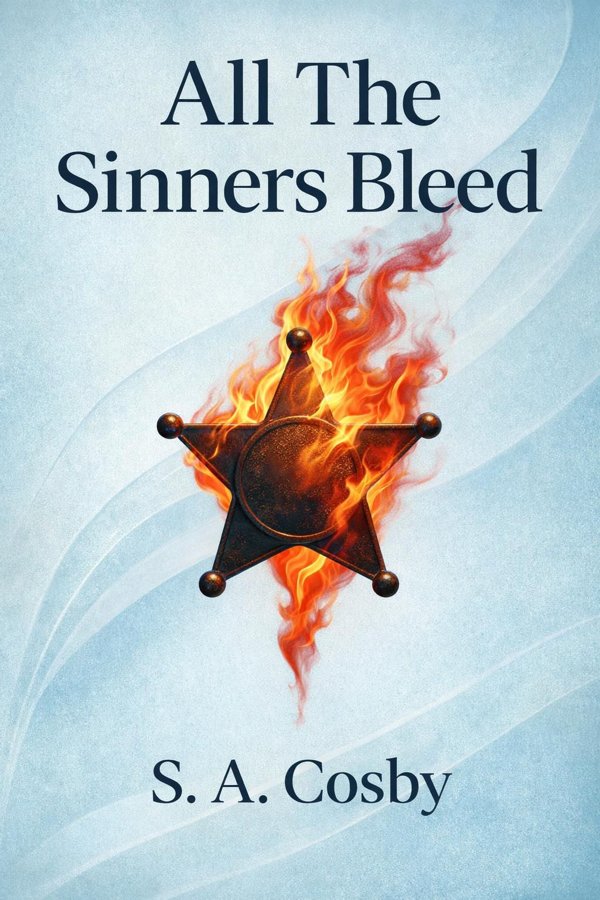
All The Sinners Bleed: Summary & Key Insights
by S. A. Cosby
 10 min9 chaptersAudio available
Key Takeaways from All The Sinners Bleed
Coming home is often harder than leaving, especially when the place you return to still wants to define you by its past.
Communities often call themselves peaceful when what they really mean is unexamined.
The most frightening evil is rarely the loudest; it is the evil protected by manners, status, and routine.
Race in this novel is not background texture; it is one of the central forces structuring every conflict.
Religion in All The Sinners Bleed is a source of language, identity, and moral aspiration, but also a possible hiding place for hypocrisy.
What Is All The Sinners Bleed About?
All The Sinners Bleed by S. A. Cosby is a mystery book spanning 5 pages. All The Sinners Bleed is a gripping Southern Gothic mystery that uses the machinery of crime fiction to examine race, faith, grief, and moral decay in a small Virginia county. At the center is Titus Crown, the first Black sheriff of Charon County, a former FBI agent who returned home hoping to do some good in a place shaped by old loyalties and older wounds. When a school shooting leaves a teacher dead and uncovers evidence of far darker crimes, Titus is forced into an investigation that pulls apart the town’s carefully maintained image of decency. What begins as a search for answers becomes a confrontation with hidden violence, institutional silence, and the unsettling truth that evil often thrives behind respected doors. The novel matters because it is not satisfied with solving a murder; it asks what kind of community allows horror to grow unnoticed, and what justice costs the people who pursue it. S. A. Cosby brings exceptional authority to this story as one of the defining voices in contemporary Southern crime fiction, known for blending propulsive plotting with sharp social insight.
This FizzRead summary covers all 9 key chapters of All The Sinners Bleed in approximately 10 minutes, distilling the most important ideas, arguments, and takeaways from S. A. Cosby's work. Also available as an audio summary and Key Quotes Podcast.
All The Sinners Bleed
All The Sinners Bleed is a gripping Southern Gothic mystery that uses the machinery of crime fiction to examine race, faith, grief, and moral decay in a small Virginia county. At the center is Titus Crown, the first Black sheriff of Charon County, a former FBI agent who returned home hoping to do some good in a place shaped by old loyalties and older wounds. When a school shooting leaves a teacher dead and uncovers evidence of far darker crimes, Titus is forced into an investigation that pulls apart the town’s carefully maintained image of decency. What begins as a search for answers becomes a confrontation with hidden violence, institutional silence, and the unsettling truth that evil often thrives behind respected doors. The novel matters because it is not satisfied with solving a murder; it asks what kind of community allows horror to grow unnoticed, and what justice costs the people who pursue it. S. A. Cosby brings exceptional authority to this story as one of the defining voices in contemporary Southern crime fiction, known for blending propulsive plotting with sharp social insight.
Who Should Read All The Sinners Bleed?
This book is perfect for anyone interested in mystery and looking to gain actionable insights in a short read. Whether you're a student, professional, or lifelong learner, the key ideas from All The Sinners Bleed by S. A. Cosby will help you think differently.
- ✓Readers who enjoy mystery and want practical takeaways
- ✓Professionals looking to apply new ideas to their work and life
- ✓Anyone who wants the core insights of All The Sinners Bleed in just 10 minutes
Want the full summary?
Get instant access to this book summary and 100K+ more with Fizz Moment.
Get Free SummaryAvailable on App Store • Free to download
Key Chapters
Coming home is often harder than leaving, especially when the place you return to still wants to define you by its past. Titus Crown returns to Charon County carrying the emotional scars of his FBI career and the symbolic weight of being the county’s first Black sheriff. He is both insider and outsider: he knows the rhythms of the town, its churches, families, and grudges, yet he is never allowed to forget that many people see his authority as conditional. Cosby uses Titus’s position to show how leadership becomes lonelier when every decision is filtered through race, memory, and local history.
Titus is not simply solving crimes. He is navigating a community that wants peace without change. Some residents support him because they believe he represents progress. Others tolerate him only as long as he does not challenge inherited power. This creates constant pressure. Every public action becomes a test of competence, identity, and loyalty. His return to Charon County is therefore not a homecoming in the sentimental sense. It is a trial by fire in a place that remembers him but does not fully embrace what he has become.
This dynamic has practical relevance beyond fiction. Anyone who has returned to a hometown, old workplace, or family system after personal growth knows the friction of being treated as a former version of yourself. People often prefer the roles they assigned us years ago because those roles make them comfortable.
The takeaway is clear: if you step into leadership where history is against you, expect resistance and do not mistake it for failure. Real change begins when you accept that belonging and truth-telling do not always arrive together.
Communities often call themselves peaceful when what they really mean is unexamined. The novel’s inciting shock arrives when a former student storms into a school and kills a beloved teacher, shattering Charon County’s illusion of safety. The event is immediate, chaotic, and deeply traumatic, but Cosby refuses to let it remain a self-contained tragedy. Instead, the shooting becomes the crack through which a much larger horror is revealed.
For Titus, the crisis is professional and deeply personal. He must respond as sheriff in a moment of public panic, but he must also confront the human cost of violence in a town where everyone is interconnected. The school should represent trust, innocence, and order. When blood is spilled there, the damage extends beyond the crime scene. Parents, students, deputies, clergy, and local leaders all begin reacting from fear, denial, or anger. Cosby captures how one violent event can destabilize an entire social ecosystem.
This idea applies broadly. In real life, organizations and communities are often most vulnerable where they assume they are safest. A scandal in a school, church, family business, or neighborhood usually feels shocking not because warning signs never existed, but because people trained themselves not to see them. The shooting in the novel forces characters to ask not only what happened, but what they missed before it happened.
The actionable lesson is to question any peace built only on appearances. When a crisis erupts, do not rush to restore normality before understanding the deeper system that allowed the damage. Surface calm is not the same thing as safety.
The most frightening evil is rarely the loudest; it is the evil protected by manners, status, and routine. As Titus investigates the murdered teacher and the shooter’s motives, he uncovers evidence of crimes far more disturbing than the town first imagines. The case expands into hidden predation and long-buried abuse, exposing how respectable institutions can become camouflage for cruelty. Cosby’s great achievement here is showing that monsters are not always obvious. Sometimes they are admired, trusted, and woven into the daily life of a community.
This is where All The Sinners Bleed rises above a conventional thriller. The mystery is not merely about identifying a criminal. It is about understanding the social architecture that protects one. People ignore inconsistencies because they do not want the truth to disrupt their assumptions. Some stay silent out of fear. Others benefit from silence. Still others genuinely cannot process that someone familiar could commit unforgivable acts. In that way, respectability becomes a shield stronger than secrecy.
This pattern appears outside the novel in schools, corporations, religious institutions, and families. Harm often persists when authority, charisma, or reputation discourages scrutiny. Warning signs get rationalized. Victims are doubted. Communities protect their image first and their vulnerable second.
The practical takeaway is unsettling but vital: trust should never replace accountability. When someone is insulated by admiration or status, that is precisely when scrutiny matters most. Healthy communities ask difficult questions even when the answers threaten comfort, tradition, or prestige.
Race in this novel is not background texture; it is one of the central forces structuring every conflict. Titus’s role as the first Black sheriff in Charon County means he must enforce the law within a system historically shaped by white power, Black pain, and selective memory. Cosby portrays race not as a single issue but as a lens affecting legitimacy, suspicion, grief, and public expectation. Titus is judged differently by nearly everyone around him. To some, he is a symbol of progress. To others, he is a threat to inherited hierarchy. To many Black residents, he represents hope but also impossible pressure.
What makes the book especially powerful is its refusal to flatten these tensions into slogans. Race intersects with class, religion, local history, and personal loyalty. A sheriff’s badge does not erase prejudice. Professional excellence does not guarantee trust. And justice itself is shown to be unevenly distributed, especially in places where old stories about who deserves protection still linger beneath the surface.
Readers can apply this insight by recognizing how institutions carry historical memory even when individuals claim neutrality. A workplace, town, or school may present itself as fair while still reproducing old exclusions in subtle ways: who gets believed, who gets promoted, who is considered suspicious, who is expected to prove themselves repeatedly.
The actionable takeaway is to examine power relationally, not abstractly. If you want to understand a conflict, ask who is presumed innocent, who must earn credibility, and whose pain is treated as inconvenient. Justice becomes more honest when we pay attention to those patterns instead of pretending they do not exist.
Religion in All The Sinners Bleed is a source of language, identity, and moral aspiration, but also a possible hiding place for hypocrisy. In Charon County, church life is not separate from civic life; it shapes reputation, authority, and communal belonging. That makes faith deeply meaningful, but it also makes it vulnerable to corruption. Cosby explores how religious language can uplift people in pain while simultaneously being used to excuse silence, shame victims, or protect the powerful.
This tension is one of the novel’s most unsettling themes. A town steeped in Christian rhetoric should, in theory, be alert to suffering and committed to truth. Yet piety can become performance. Public devotion can mask private depravity. Worse, collective reverence can make people reluctant to question leaders or institutions associated with moral authority. The result is not just individual hypocrisy but social paralysis.
This theme has practical resonance in any value-driven environment. Whether the governing language is religious, political, therapeutic, or corporate, communities often confuse speaking about virtue with practicing it. A mission statement, sermon, or public testimony means little if it discourages accountability. Values become dangerous when they are invoked mainly to defend appearances.
The takeaway is to measure moral credibility by behavior under pressure, not by eloquence. Ask whether a person or institution protects the vulnerable when doing so is costly. Faith, at its best, should sharpen conscience and compassion. If it instead silences truth or shields abuse, it has been turned into a weapon rather than a guide.
Terrible secrets rarely survive because one villain is clever; they survive because many people choose not to know too much. As Titus digs deeper, the novel reveals that silence in Charon County is not passive. It is active, distributed, and socially reinforced. Some characters keep quiet because they fear retaliation. Some do it out of shame. Others cling to denial because admitting the truth would force them to reevaluate people they love, institutions they trust, or stories they tell about their home.
Cosby presents silence as one of the novel’s most destructive moral forces. It allows abuse to continue, isolates victims, and turns bystanders into enablers even when they never commit the original crime. That idea is deeply uncomfortable because it expands responsibility beyond the obvious perpetrator. A rotten system is usually maintained by ordinary acts of avoidance: not reporting, not asking, not pressing, not listening.
In everyday life, this appears when families protect abusers to preserve harmony, when workplaces ignore misconduct to avoid legal risk, or when towns dismiss accusations because scandal would hurt the local image. Silence often presents itself as discretion, loyalty, or peacekeeping. In reality, it can be complicity with better manners.
The actionable lesson is to treat recurring discomfort as information. If a person, place, or pattern seems wrong, resist the pressure to look away simply because speaking up will be inconvenient. Ask one more question. Document one more concern. Believe that truth delayed usually becomes harm multiplied.
A detective story usually promises revelation, but Cosby insists that revelation alone is not justice. As the investigation narrows and the hidden architecture of violence becomes visible, Titus must decide what justice actually requires. Arresting the guilty matters, but the book shows that legal resolution does not automatically repair moral damage. Victims remain scarred. Communities remain divided. Trust, once broken, does not return because a case file is closed.
Titus’s challenge is therefore ethical as well as procedural. He must pursue the truth even when it implicates respected figures and inflames local tensions. He must weigh public order against honesty, personal grief against professional duty, and institutional limits against human need. The novel’s confrontation scenes carry such force because they are not only about catching a criminal. They are about whether a community is willing to face what justice will cost.
This has direct relevance beyond crime fiction. In schools, companies, or families, people often want problems handled quickly and quietly. They want consequences without disruption. But meaningful justice usually requires exposure, accountability, support for the harmed, and structural change so the same abuse cannot recur.
The takeaway is simple but demanding: do not confuse closure with justice. When something serious has gone wrong, ask not only who is responsible, but what repair looks like and what systems must change. Truth is the beginning of justice, not the end of it.
Investigations do not happen in emotional vacuum chambers; the people hunting the truth are changed by what they uncover. Titus is already marked by earlier violence from his time in federal law enforcement, and the events in Charon County force those wounds back to the surface. His intelligence and toughness make him capable, but they do not make him invulnerable. Cosby gives the novel unusual emotional depth by showing how professional competence can coexist with exhaustion, guilt, memory, and fear.
This matters because the book refuses the fantasy of the unbreakable hero. Titus pays a psychological price for carrying the burden of public leadership while confronting atrocity. He absorbs the pain of victims, the hostility of skeptics, and the pressure of expectation. The result is a portrait of masculinity that is not sentimental, but human. Strength is shown as endurance with damage, not absence of damage.
Outside fiction, this insight applies to first responders, managers, caregivers, journalists, teachers, and anyone who deals repeatedly with crisis. People praised for reliability are often the ones least permitted to admit strain. Yet unprocessed trauma distorts judgment, relationships, and health.
The actionable takeaway is to reject the idea that being strong means being untouched. If your role requires carrying other people’s crises, build deliberate habits of support: therapy, honest friendship, rest, reflection, and boundaries. Resilience is not silent suffering. It is sustained care that allows truth-seeking to continue without destroying the seeker.
People often talk about truth as liberation, but this novel reminds us that truth first arrives as disruption. By the time Charon County learns what has been hidden within it, no one can return to the comforting version of the town they had before. Relationships are altered, institutions are tainted, and personal histories must be reinterpreted. Cosby is clear-eyed about this cost. Exposure does not feel cleansing in the moment. It feels humiliating, destabilizing, and painful.
Yet the book also argues that false peace is its own form of violence. A community built on denial may appear functional, but it asks the vulnerable to bear the price of everyone else’s comfort. Truth wounds because it removes anesthesia. It forces people to confront what they ignored, enabled, or misunderstood. Only after that rupture can renewal begin.
This pattern is familiar in personal life as well. Honest conversations about family harm, workplace abuse, addiction, betrayal, or discrimination often make things feel worse before they make anything better. The old equilibrium collapses. Defensiveness rises. People grieve the loss of certainty. But that upheaval is often the necessary threshold of repair.
The takeaway is to judge truth by its long-term moral value, not its short-term emotional discomfort. If honesty breaks an unhealthy peace, that is not proof it was the wrong move. Sometimes healing starts the moment the lie stops working.
All Chapters in All The Sinners Bleed
About the Author
S. A. Cosby is an American crime fiction writer from Virginia whose work has helped redefine contemporary Southern noir. He is best known for acclaimed novels such as Blacktop Wasteland, Razorblade Tears, and All The Sinners Bleed, each blending fast-paced plotting with sharp explorations of race, class, violence, masculinity, and redemption. Cosby’s stories are rooted in the American South, but their themes reach far beyond region, examining how personal choices collide with history, community, and systemic injustice. Praised for muscular prose, emotional force, and moral complexity, he has become one of the most respected voices in modern crime literature. His fiction stands out for treating genre not as an escape from reality, but as a powerful way to confront it.
Get This Summary in Your Preferred Format
Read or listen to the All The Sinners Bleed summary by S. A. Cosby anytime, anywhere. FizzRead offers multiple formats so you can learn on your terms — all free.
Available formats: App · Audio · PDF · EPUB — All included free with FizzRead
Download All The Sinners Bleed PDF and EPUB Summary
Key Quotes from All The Sinners Bleed
“Coming home is often harder than leaving, especially when the place you return to still wants to define you by its past.”
“Communities often call themselves peaceful when what they really mean is unexamined.”
“The most frightening evil is rarely the loudest; it is the evil protected by manners, status, and routine.”
“Race in this novel is not background texture; it is one of the central forces structuring every conflict.”
“Religion in All The Sinners Bleed is a source of language, identity, and moral aspiration, but also a possible hiding place for hypocrisy.”
Frequently Asked Questions about All The Sinners Bleed
All The Sinners Bleed by S. A. Cosby is a mystery book that explores key ideas across 9 chapters. All The Sinners Bleed is a gripping Southern Gothic mystery that uses the machinery of crime fiction to examine race, faith, grief, and moral decay in a small Virginia county. At the center is Titus Crown, the first Black sheriff of Charon County, a former FBI agent who returned home hoping to do some good in a place shaped by old loyalties and older wounds. When a school shooting leaves a teacher dead and uncovers evidence of far darker crimes, Titus is forced into an investigation that pulls apart the town’s carefully maintained image of decency. What begins as a search for answers becomes a confrontation with hidden violence, institutional silence, and the unsettling truth that evil often thrives behind respected doors. The novel matters because it is not satisfied with solving a murder; it asks what kind of community allows horror to grow unnoticed, and what justice costs the people who pursue it. S. A. Cosby brings exceptional authority to this story as one of the defining voices in contemporary Southern crime fiction, known for blending propulsive plotting with sharp social insight.
You Might Also Like





Browse by Category
Ready to read All The Sinners Bleed?
Get the full summary and 100K+ more books with Fizz Moment.