
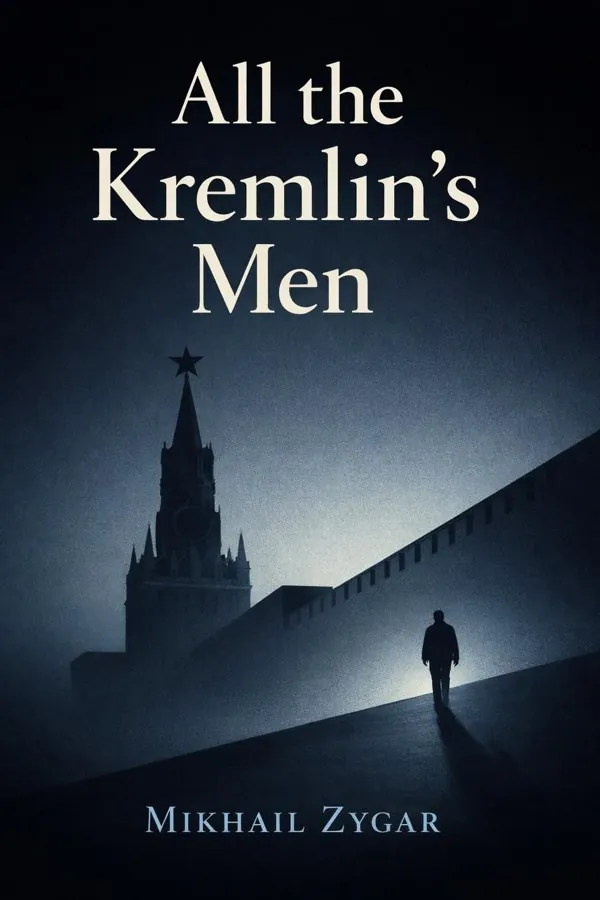
All the Kremlin's Men: Inside the Court of Vladimir Putin: Summary & Key Insights
 10 min11 chaptersAudio available
What Is All the Kremlin's Men: Inside the Court of Vladimir Putin About?
All the Kremlin's Men: Inside the Court of Vladimir Putin by Mikhail Zygar is a politics book spanning 11 pages. This book by Russian journalist Mikhail Zygar offers a revealing look into the inner workings of Vladimir Putin’s administration. Based on interviews with key figures in Russia’s political elite, it explores how personal relationships, rivalries, and ambitions have shaped the Kremlin’s decision-making. Zygar provides a detailed account of how Putin’s circle evolved over time, offering insight into the mechanisms of power in modern Russia.
This FizzRead summary covers all 11 key chapters of All the Kremlin's Men: Inside the Court of Vladimir Putin in approximately 10 minutes, distilling the most important ideas, arguments, and takeaways from Mikhail Zygar's work. Also available as an audio summary and Key Quotes Podcast.
All the Kremlin's Men: Inside the Court of Vladimir Putin
This book by Russian journalist Mikhail Zygar offers a revealing look into the inner workings of Vladimir Putin’s administration. Based on interviews with key figures in Russia’s political elite, it explores how personal relationships, rivalries, and ambitions have shaped the Kremlin’s decision-making. Zygar provides a detailed account of how Putin’s circle evolved over time, offering insight into the mechanisms of power in modern Russia.
Who Should Read All the Kremlin's Men: Inside the Court of Vladimir Putin?
This book is perfect for anyone interested in politics and looking to gain actionable insights in a short read. Whether you're a student, professional, or lifelong learner, the key ideas from All the Kremlin's Men: Inside the Court of Vladimir Putin by Mikhail Zygar will help you think differently.
- ✓Readers who enjoy politics and want practical takeaways
- ✓Professionals looking to apply new ideas to their work and life
- ✓Anyone who wants the core insights of All the Kremlin's Men: Inside the Court of Vladimir Putin in just 10 minutes
Want the full summary?
Get instant access to this book summary and 100K+ more with Fizz Moment.
Get Free SummaryAvailable on App Store • Free to download
Key Chapters
In recounting Putin’s ascent, I begin in St. Petersburg, where the foundations of his power were laid. As a quiet, disciplined KGB officer, Putin was far from the charismatic leader he later became. He was instead a loyal technocrat working in Anatoly Sobchak’s city administration, absorbing the ways of political maneuvering and learning how to form bonds that would serve as his lifeline in the future.
It was in these years that the group later known as the ‘St. Petersburg mafia’ of politics took shape—men like Dmitry Medvedev, Igor Sechin, and Alexei Kudrin. They were not ideologues, but pragmatists. Together, they represented the mixture of security-service discipline and managerial rationality that would define Putin’s style of governance. When the chaotic Yeltsin years created a vacuum of authority, Putin’s reliability became his greatest asset. He was invited to Moscow, and soon, step by step, ascended from deputy levels to head of the FSB, then prime minister, and finally, president.
What these early years reveal is not a story of ambition but of survival. Putin did not seize power; power found him. When Boris Yeltsin’s exhausted administration searched for someone untainted by corruption, someone uncharismatic yet predictable, they found in Putin a perfect vessel. He inherited a state marked by disarray, and in his quiet strength, people projected stability. Thus began the myth of the strong leader—a mythology that would slowly become the cornerstone of modern Russian identity.
After 2000, the concept of the ‘power vertical’ emerged—a system built to replace the fractured democracy of Yeltsin’s era with central control. I describe it not merely as administrative consolidation but as psychological reconstruction. Putin’s instinct was to eliminate ambiguity. Ministries, regional governors, media outlets—all had to align beneath a single chain of command. Loyalty became both political currency and moral virtue.
Those within the Kremlin understood that the new president valued predictability above all. Decisions became centralized, and the spirit of initiative began to fade. Governors lost direct elections; oligarchs were warned to stay out of politics; parliament became a rubber stamp. To outsiders, it seemed autocratic, but to the court, it felt like an inevitable correction to chaos. Many saw Putin’s project as patriotic—restoring dignity to a state humiliated by the 1990s.
However, as I documented through interviews, the vertical was more than structural—it became emotional. Those nearest to Putin grew to internalize his rhythms of suspicion and careful calculation. The state turned into a reflection of one man’s inner logic. In this vertical system, everyone looked upward, waiting for gestures, reading silence. In moments of uncertainty, fear filled the gaps, not discussion. It was the architecture of obedience disguised as unity.
+ 9 more chapters — available in the FizzRead app
All Chapters in All the Kremlin's Men: Inside the Court of Vladimir Putin
About the Author
Mikhail Zygar is a Russian journalist, author, and filmmaker. He was the founding editor-in-chief of the independent TV channel Dozhd (TV Rain) and is known for his investigative works on Russian politics and history, including 'All the Kremlin’s Men' and 'The Empire Must Die.'
Get This Summary in Your Preferred Format
Read or listen to the All the Kremlin's Men: Inside the Court of Vladimir Putin summary by Mikhail Zygar anytime, anywhere. FizzRead offers multiple formats so you can learn on your terms — all free.
Available formats: App · Audio · PDF · EPUB — All included free with FizzRead
Download All the Kremlin's Men: Inside the Court of Vladimir Putin PDF and EPUB Summary
Key Quotes from All the Kremlin's Men: Inside the Court of Vladimir Putin
“In recounting Putin’s ascent, I begin in St.”
“After 2000, the concept of the ‘power vertical’ emerged—a system built to replace the fractured democracy of Yeltsin’s era with central control.”
Frequently Asked Questions about All the Kremlin's Men: Inside the Court of Vladimir Putin
All the Kremlin's Men: Inside the Court of Vladimir Putin by Mikhail Zygar is a politics book that explores key ideas across 11 chapters. This book by Russian journalist Mikhail Zygar offers a revealing look into the inner workings of Vladimir Putin’s administration. Based on interviews with key figures in Russia’s political elite, it explores how personal relationships, rivalries, and ambitions have shaped the Kremlin’s decision-making. Zygar provides a detailed account of how Putin’s circle evolved over time, offering insight into the mechanisms of power in modern Russia.
You Might Also Like

Antifa: The Anti-Fascist Handbook
Mark Bray
10 min
Attack from Within: How Disinformation Is Sabotaging America
Barbara McQuade
10 min
Coercion, Capital, and European States, AD 990–1992
Charles Tilly
10 min
Digital Democracy: Concepts, Methodologies, Tools, and Applications
Various Authors
10 min
Fascism
Stanley G. Payne
10 min
Fire And Fury: Inside The Trump White House
Michael Wolff
10 minBrowse by Category
Ready to read All the Kremlin's Men: Inside the Court of Vladimir Putin?
Get the full summary and 100K+ more books with Fizz Moment.