
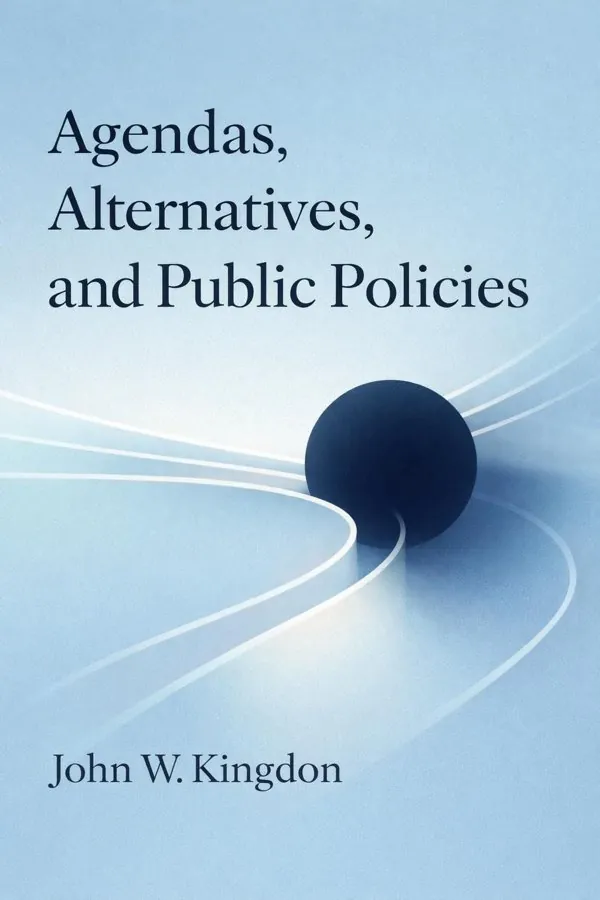
Agendas, Alternatives, and Public Policies: Summary & Key Insights
 10 min6 chaptersAudio available
What Is Agendas, Alternatives, and Public Policies About?
Agendas, Alternatives, and Public Policies by John W. Kingdon is a politics book spanning 6 pages. This influential work in public policy theory explores how issues come to the attention of government officials and how policy agendas are formed. Kingdon introduces the 'multiple streams' framework, explaining how problems, policies, and politics converge to open windows of opportunity for change. The book draws on extensive interviews and case studies of U.S. federal policymaking, offering a foundational model for understanding agenda-setting processes.
This FizzRead summary covers all 6 key chapters of Agendas, Alternatives, and Public Policies in approximately 10 minutes, distilling the most important ideas, arguments, and takeaways from John W. Kingdon's work. Also available as an audio summary and Key Quotes Podcast.
Agendas, Alternatives, and Public Policies
This influential work in public policy theory explores how issues come to the attention of government officials and how policy agendas are formed. Kingdon introduces the 'multiple streams' framework, explaining how problems, policies, and politics converge to open windows of opportunity for change. The book draws on extensive interviews and case studies of U.S. federal policymaking, offering a foundational model for understanding agenda-setting processes.
Who Should Read Agendas, Alternatives, and Public Policies?
This book is perfect for anyone interested in politics and looking to gain actionable insights in a short read. Whether you're a student, professional, or lifelong learner, the key ideas from Agendas, Alternatives, and Public Policies by John W. Kingdon will help you think differently.
- ✓Readers who enjoy politics and want practical takeaways
- ✓Professionals looking to apply new ideas to their work and life
- ✓Anyone who wants the core insights of Agendas, Alternatives, and Public Policies in just 10 minutes
Want the full summary?
Get instant access to this book summary and 100K+ more with Fizz Moment.
Get Free SummaryAvailable on App Store • Free to download
Key Chapters
In any society, countless social conditions may exist—poverty, pollution, unemployment, inflation—but only a few of them are ever recognized as problems requiring governmental attention. In my analysis, I call this the 'problem stream.' Problems do not announce themselves; they must be framed, measured, and sometimes dramatized. Indicators, focusing events, and feedback are central mechanisms.
Indicators—like statistics on crime rates or mortality—serve as continual signals, helping policymakers monitor trends. But raw numbers are not enough; interpretation counts. Policymakers and the media highlight certain data, transforming them into narratives of urgency. Similarly, focusing events—a plane crash, an oil spill, a public health scare—suddenly thrust long-standing conditions into prominence. These events shake complacency and make it politically unsafe to ignore certain issues.
Feedback also plays a vital role. Past governmental programs generate information about performance and unintended consequences. When the public or administrators judge existing policies as failures, they trigger reconsideration. Through these mechanisms, ordinary conditions evolve into recognized problems.
Yet recognition is not automatic. What matters most is perception—the way policymakers see an issue’s relevance to their values, constituencies, or careers. Problems rise when their framing aligns with broader political concerns or moral imperatives. Hence, the problem stream is not governed by logic alone; it flows through attention and emotion. Policymakers are human, and they respond to compelling stories and urgency more than to abstract data.
Parallel to the stream of problems flows the stream of policies—a realm dominated by what I call 'policy communities': networks of experts, researchers, analysts, and advocates who continuously generate and test ideas. In this stream, proposals compete like organisms in a Darwinian environment, where only those that survive technical scrutiny and political feasibility make it through.
The policy community is a world of white papers, committee hearings, journal articles, and internal memoranda. Here, ideas circulate and mature through debate and adaptation. Over time, strong proposals gain coherence—they become ready to attach to recognized problems once opportunity arises. Weak proposals fade, often because they are too costly, too complex, or lack champions.
Crucially, this process is independent of the political mood. The policy stream flows whether attention is high or low. It is continual, exploratory, and often insulated. When the political climate becomes favorable and a problem gains attention, these pre-formed ideas are available to act upon immediately. This readiness is essential, because in policymaking timing is everything. When a window opens, there is no time to invent from scratch; one must have the proposal at hand.
In this way, the policy stream teaches an important lesson: intellectual preparation and persistence matter. Policy entrepreneurs—those willing to nurture ideas even during dormant periods—make all the difference when the moment for action eventually arrives.
+ 4 more chapters — available in the FizzRead app
All Chapters in Agendas, Alternatives, and Public Policies
About the Author
John W. Kingdon was an American political scientist and professor at the University of Michigan. He was known for his research on public policy formation and political decision-making, particularly his development of the multiple streams framework. His work has had lasting influence in political science and public administration.
Get This Summary in Your Preferred Format
Read or listen to the Agendas, Alternatives, and Public Policies summary by John W. Kingdon anytime, anywhere. FizzRead offers multiple formats so you can learn on your terms — all free.
Available formats: App · Audio · PDF · EPUB — All included free with FizzRead
Download Agendas, Alternatives, and Public Policies PDF and EPUB Summary
Key Quotes from Agendas, Alternatives, and Public Policies
“In any society, countless social conditions may exist—poverty, pollution, unemployment, inflation—but only a few of them are ever recognized as problems requiring governmental attention.”
“In this stream, proposals compete like organisms in a Darwinian environment, where only those that survive technical scrutiny and political feasibility make it through.”
Frequently Asked Questions about Agendas, Alternatives, and Public Policies
Agendas, Alternatives, and Public Policies by John W. Kingdon is a politics book that explores key ideas across 6 chapters. This influential work in public policy theory explores how issues come to the attention of government officials and how policy agendas are formed. Kingdon introduces the 'multiple streams' framework, explaining how problems, policies, and politics converge to open windows of opportunity for change. The book draws on extensive interviews and case studies of U.S. federal policymaking, offering a foundational model for understanding agenda-setting processes.
You Might Also Like
Antifa: The Anti-Fascist Handbook
Mark Bray
10 min
Attack from Within: How Disinformation Is Sabotaging America
Barbara McQuade
10 min
Coercion, Capital, and European States, AD 990–1992
Charles Tilly
10 min
Digital Democracy: Concepts, Methodologies, Tools, and Applications
Various Authors
10 min
Fascism
Stanley G. Payne
10 min
Fire And Fury: Inside The Trump White House
Michael Wolff
10 minBrowse by Category
Ready to read Agendas, Alternatives, and Public Policies?
Get the full summary and 100K+ more books with Fizz Moment.