
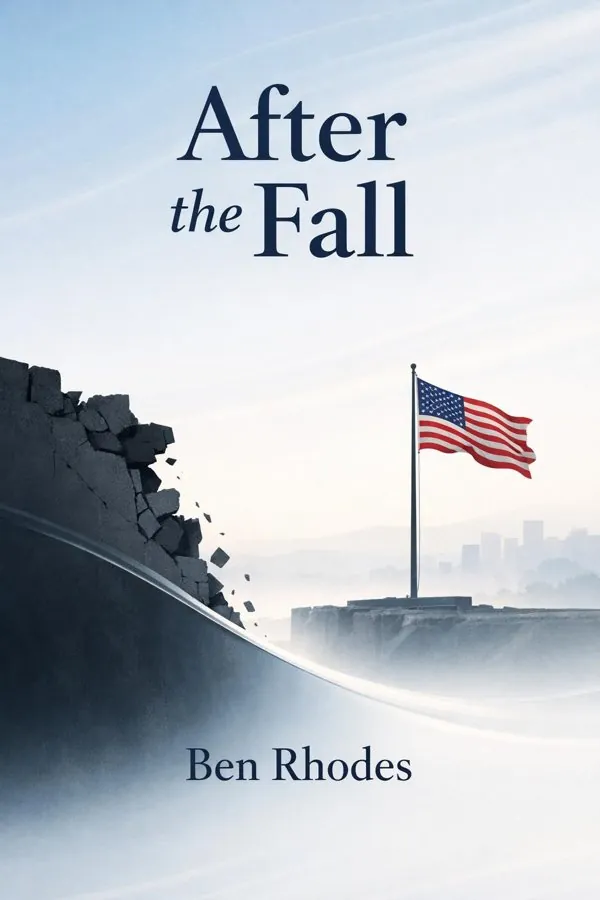
After the Fall: Summary & Key Insights
by Ben Rhodes
 10 min10 chaptersAudio available
Key Takeaways from After the Fall
A disturbing realization sits at the center of Rhodes’s journey: many of the pathologies Americans condemn abroad have taken root in the United States as well.
Authoritarianism often arrives wearing the clothes of legality.
In Rhodes’s encounters with Russia and its political culture, he examines how Vladimir Putin’s system thrives on cynicism, spectacle, and disinformation.
China’s rise complicates the old assumption that economic modernization naturally leads to political liberalization.
Few places illustrate democratic fragility more vividly than Hong Kong.
What Is After the Fall About?
After the Fall by Ben Rhodes is a politics book spanning 11 pages. In After the Fall: Being American in the World We’ve Made, Ben Rhodes examines a troubling reality: the democratic erosion many Americans associate with distant countries is also deeply rooted in the United States itself. After leaving the Obama White House, Rhodes traveled through Hungary, Russia, China, Hong Kong, Myanmar, and parts of Europe, speaking with dissidents, journalists, activists, and political leaders. What he found was not a series of isolated crises, but a connected global pattern in which authoritarianism, disinformation, nationalism, and institutional decay feed one another across borders. The book matters because it refuses easy explanations. Rhodes does not simply blame foreign strongmen or populist voters; he asks how American choices, myths, and failures helped shape the world now turning against liberal democracy. As a former Deputy National Security Advisor to President Barack Obama, Rhodes brings insider credibility, geopolitical range, and unusual candor about the limits of American power. The result is part political travelogue, part memoir, and part warning: if Americans want democracy to survive abroad, they must first reckon honestly with what has weakened it at home.
This FizzRead summary covers all 10 key chapters of After the Fall in approximately 10 minutes, distilling the most important ideas, arguments, and takeaways from Ben Rhodes's work. Also available as an audio summary and Key Quotes Podcast.
After the Fall
In After the Fall: Being American in the World We’ve Made, Ben Rhodes examines a troubling reality: the democratic erosion many Americans associate with distant countries is also deeply rooted in the United States itself. After leaving the Obama White House, Rhodes traveled through Hungary, Russia, China, Hong Kong, Myanmar, and parts of Europe, speaking with dissidents, journalists, activists, and political leaders. What he found was not a series of isolated crises, but a connected global pattern in which authoritarianism, disinformation, nationalism, and institutional decay feed one another across borders. The book matters because it refuses easy explanations. Rhodes does not simply blame foreign strongmen or populist voters; he asks how American choices, myths, and failures helped shape the world now turning against liberal democracy. As a former Deputy National Security Advisor to President Barack Obama, Rhodes brings insider credibility, geopolitical range, and unusual candor about the limits of American power. The result is part political travelogue, part memoir, and part warning: if Americans want democracy to survive abroad, they must first reckon honestly with what has weakened it at home.
Who Should Read After the Fall?
This book is perfect for anyone interested in politics and looking to gain actionable insights in a short read. Whether you're a student, professional, or lifelong learner, the key ideas from After the Fall by Ben Rhodes will help you think differently.
- ✓Readers who enjoy politics and want practical takeaways
- ✓Professionals looking to apply new ideas to their work and life
- ✓Anyone who wants the core insights of After the Fall in just 10 minutes
Want the full summary?
Get instant access to this book summary and 100K+ more with Fizz Moment.
Get Free SummaryAvailable on App Store • Free to download
Key Chapters
A disturbing realization sits at the center of Rhodes’s journey: many of the pathologies Americans condemn abroad have taken root in the United States as well. Polarization, political tribalism, contempt for institutions, conspiracy thinking, and media ecosystems built on outrage are not foreign abnormalities; they are also features of contemporary American life. Rhodes begins by turning inward because he sees that understanding global democratic decline requires confronting American dysfunction first. The United States long presented itself as a democratic model, yet its own racial inequities, forever wars, economic exclusion, and winner-take-all politics have weakened that claim.
This insight changes the lens through which the rest of the book is read. Instead of treating authoritarian resurgence as something happening “over there,” Rhodes shows how democracy can decay from within, often gradually and legally. Citizens become cynical, public trust erodes, and charismatic leaders exploit grievance while promising restoration. America’s example matters not because it is uniquely evil or uniquely noble, but because its influence is immense. When U.S. politics becomes more performative, more conspiratorial, and less accountable, those tendencies are amplified globally.
In practical terms, this means readers should resist the comfort of exceptionalism. If election denial, demonization of opponents, and attacks on an independent press can flourish in America, then no democracy is permanently safe. A useful application is to examine local politics with the same seriousness often reserved for international crises: how are schools, courts, election boards, and local media being pressured or delegitimized? Democratic decline is easier to notice once one stops imagining it always arrives in dramatic form.
Actionable takeaway: assess the health of democracy close to home by tracking trust, truth, and accountability in your own community, not just in headlines about other countries.
Authoritarianism often arrives wearing the clothes of legality. In Hungary, Rhodes finds a powerful case study in Viktor Orbán’s methodical dismantling of democratic norms without abolishing elections outright. Orbán did not need tanks in the streets to weaken democracy; he used constitutional changes, media capture, patronage networks, and nationalist rhetoric to tilt the system steadily in his favor. What emerges is a form of managed democracy, where formal institutions remain but meaningful competition and independent accountability are drained away.
Rhodes treats Hungary as a warning because it demonstrates how a modern, European state can backslide while preserving an appearance of normal politics. Orbán framed his project as defending the nation against liberal cosmopolitan elites, migrants, and foreign influence. This narrative gave moral cover to concentrating power. Citizens frustrated by economic instability or cultural anxiety were told that pluralism was weakness and that national unity required obedience. Once media outlets, courts, and civil society groups were branded enemies, democratic guardrails weakened quickly.
The lesson extends far beyond Hungary. In many countries, would-be strongmen do not announce that they oppose democracy. They claim to represent the “real people” against corrupt institutions. The practical application for readers is to pay close attention when leaders portray checks and balances as illegitimate obstacles rather than essential protections. Watch for attacks on universities, independent journalism, NGOs, and courts, especially when tied to nationalist slogans.
Rhodes’s broader point is that democratic systems can be captured incrementally. The danger lies not only in coups but in normalization: each procedural abuse seems technical, temporary, or justified until the cumulative damage becomes hard to reverse. Democracies often die by erosion before they die by force.
Actionable takeaway: when political leaders weaken independent institutions in the name of national renewal, treat that as an early emergency, not a routine partisan dispute.
One of the bleakest insights in After the Fall is that modern authoritarianism does not always depend on making people believe a single lie; it often succeeds by making people believe nothing at all. In Rhodes’s encounters with Russia and its political culture, he examines how Vladimir Putin’s system thrives on cynicism, spectacle, and disinformation. Rather than persuading citizens of one coherent ideology, the regime floods the public sphere with conflicting narratives, historical revisionism, propaganda, and intimidation until truth itself feels unstable.
This strategy has global consequences. Russian disinformation is not merely a foreign policy tool; it is part of a broader assault on democratic confidence. If people conclude that all media is corrupt, all leaders are hypocrites, and all facts are politically manufactured, then democratic accountability collapses. Authoritarian actors benefit when citizens become exhausted and detached. A public that distrusts everything is easier to manipulate than one that believes the wrong thing with conviction.
Rhodes also suggests that Russia understood before many democracies did how digital platforms reward emotional provocation, identity conflict, and conspiracy. The Kremlin exploited fractures already present in other societies, especially the United States. The practical lesson is that disinformation works best where there is preexisting grievance, inequality, or institutional distrust. Resilience therefore requires more than fact-checking. It requires rebuilding civic trust and media literacy.
Readers can apply this by slowing down before sharing content that triggers outrage, by diversifying information sources, and by supporting journalism grounded in verification rather than virality. It also means recognizing the emotional purpose of propaganda: often it is designed less to inform than to inflame or demoralize.
Actionable takeaway: protect yourself from manipulation by pairing skepticism with discipline—verify before amplifying, and do not let cynicism become surrender.
Few places illustrate democratic fragility more vividly than Hong Kong. Rhodes portrays the city as a front line where young activists, journalists, and ordinary citizens confronted the immense power of the Chinese state in defense of civil liberties and political autonomy. Their struggle exposes a painful truth: freedom can feel durable right until it is rapidly constrained. Institutions, legal protections, and open civic life may seem permanent, yet they depend on political conditions that can shift with shocking speed.
Rhodes is especially attentive to the emotional and moral courage of Hong Kong’s protest movement. These activists understood they were contesting forces far larger than themselves, but they acted anyway. Their resistance was not simply about electoral procedure; it was about memory, identity, and the right to speak without fear. In this way, Hong Kong becomes a lesson in democratic citizenship. Rights survive not only because laws recognize them, but because people are willing to defend them publicly.
For readers, the practical lesson is twofold. First, do not confuse stability with security. A free society remains free only when its institutions are protected and renewed. Second, solidarity matters. Authoritarian systems seek to isolate dissenters, making them seem fringe, dangerous, or doomed. Public support, international attention, and sustained civic engagement can help keep space open for resistance, even if outcomes remain uncertain.
Rhodes also suggests that watching Hong Kong should humble complacent democracies. If people risk prison to preserve freedoms others take for granted, then democratic rights should not be treated as background conditions. They are political achievements, not natural facts.
Actionable takeaway: treat civil liberties as living responsibilities—support organizations, media, and local movements that protect free expression, assembly, and the rule of law before those rights are under siege.
Myanmar reminds Rhodes that democratic transition is not the same as democratic consolidation. For a time, the country appeared to embody hopeful change: military rule seemed to be loosening, elections offered new possibility, and outside observers wanted to believe that a freer future was unfolding. Yet beneath that fragile opening lay deep structural weaknesses—military power remained entrenched, ethnic violence persisted, and democratic norms had not taken durable root. The later collapse into repression underscores how vulnerable reform can be when institutions, accountability, and civic inclusion remain incomplete.
Rhodes uses Myanmar to challenge simplistic narratives of democratic progress. Elections alone do not create a democratic culture. If the security state remains autonomous, minorities are excluded, and leaders fail to build habits of pluralism and restraint, formal openings can be reversed. The tragedy also reveals the danger of international wishful thinking. Outsiders often mistake symbolic progress for irreversible change, especially when they want to celebrate a success story.
This insight has practical relevance for anyone evaluating politics, organizations, or social change. Surface reforms can conceal unresolved power structures. A company may rebrand while maintaining abusive leadership. A government may hold elections while preserving coercive control. A community may celebrate inclusion while leaving old hierarchies intact. Sustainable change requires more than visible milestones; it requires institutional redesign, shared norms, and broad participation.
Rhodes’s account also carries a moral warning: when marginalized groups are ignored in the name of gradual progress, the entire democratic project is weakened. Exclusion corrodes legitimacy from the beginning.
Actionable takeaway: when assessing whether a system is truly becoming more democratic, look beyond elections and rhetoric to who holds coercive power, who is protected by law, and who remains excluded.
After the Fall is not only a geopolitical analysis; it is also a personal reckoning. Rhodes writes as someone who helped shape U.S. foreign policy and then had to confront its limits, contradictions, and unintended consequences. This introspective dimension gives the book unusual force. He is not simply diagnosing others from a distance; he is asking what it means to be an American after the failures of war, the election of Donald Trump, and the erosion of the liberal order many in his generation assumed would endure.
This self-questioning matters because political analysis often becomes sterile when it avoids moral implication. Rhodes understands that America cannot credibly defend democracy abroad while ignoring the damage caused by its own interventions, myths of innocence, and internal injustices. By weaving personal reflection into global observation, he demonstrates that political maturity requires humility. It means accepting that good intentions do not erase harmful outcomes, and that patriotism should include honest criticism.
The practical value of this idea extends beyond politics. In any domain, people make better judgments when they examine their own role in the systems they critique. Leaders improve when they ask how their assumptions shape outcomes. Citizens become more effective when they move from performative outrage to reflective responsibility. Rhodes models a way of engaging public life that is emotionally honest without collapsing into despair.
For readers, this can mean revisiting beliefs that feel central to identity. What national stories, family narratives, or ideological commitments have gone unquestioned? Which comforting assumptions prevent clearer understanding? Reflection is not withdrawal from action; it is preparation for more grounded action.
Actionable takeaway: strengthen your political judgment by pairing critique of external threats with a candid examination of your own assumptions, loyalties, and blind spots.
A core question running through Rhodes’s book is not only how authoritarianism rises, but what kind of American identity might resist it. Nationalism gains power when people feel their status is slipping and their community is under threat. In the United States, that fear has often been channeled through exclusionary stories about who truly belongs. Rhodes argues that a healthier alternative requires reimagining American identity in more civic, pluralist, and honest terms—less dependent on myth, domination, or nostalgia, and more grounded in democratic practice.
This is not a superficial call for unity. Rhodes recognizes that unity built on denial is fragile. An inclusive identity must make room for historical truth: slavery, racism, imperial overreach, and inequality are not deviations from the American story but part of it. Yet he does not treat that history as a reason to abandon national belonging altogether. Instead, he suggests that democratic renewal depends on building a form of patriotism capacious enough to include difference, self-criticism, and shared responsibility.
The practical implications are significant. In schools, workplaces, and civic life, communities become more resilient when belonging is defined by participation and principle rather than ethnicity, religion, or ideological conformity. This can look like local institutions teaching history honestly, public rituals that include varied narratives, and political language that invites rather than ranks people.
Rhodes’s broader point is that democracy cannot survive on procedure alone. It needs a story of “we” that does not require enemies within. If authoritarian politics offers identity through exclusion, democratic politics must offer identity through dignity and mutual obligation.
Actionable takeaway: support forms of civic culture—education, public dialogue, and community institutions—that define belonging by shared democratic commitment instead of tribal identity.
Rhodes ends not in triumph but in disciplined hope. After witnessing democratic retreat in multiple countries, he does not pretend that history naturally bends toward freedom. One of the book’s most important contributions is its rejection of passive optimism. The post-Cold War belief that markets, technology, and globalization would steadily spread liberal values has collapsed. Hope now has to be chosen and enacted under conditions of uncertainty, disappointment, and repeated setbacks.
This form of hope is different from reassurance. It is rooted in the people Rhodes meets—journalists who keep reporting, activists who keep organizing, citizens who keep showing up despite intimidation or loss. Their example suggests that democratic renewal rarely comes from a single election or charismatic leader. It emerges from persistence, coalition-building, truth-telling, and institutional work that often looks unglamorous. Hope survives when people continue acting as if democratic life is worth defending, even when outcomes are unclear.
For readers, this reframes political engagement. Instead of waiting for a grand solution, focus on durable practices: voting in local elections, supporting independent media, joining civic organizations, building relationships across difference, and defending the procedural norms that make disagreement possible. Rhodes implies that despair can be politically seductive because it excuses inaction. Authoritarians benefit when democratic citizens conclude that nothing matters.
The practical application is to trade abstract anxiety for specific commitments. Choose one institution, cause, or community where your participation can strengthen democratic life. Small-scale engagement is not a distraction from systemic change; it is often how systemic change begins.
Actionable takeaway: replace helplessness with one sustained civic commitment, and treat democracy as a practice you participate in, not a condition you inherit.
All Chapters in After the Fall
About the Author
Ben Rhodes is an American writer, political analyst, and former government official best known for serving as Deputy National Security Advisor for Strategic Communications during Barack Obama’s presidency. A longtime Obama speechwriter and foreign policy adviser, he played a prominent role in shaping the administration’s national security messaging and diplomatic narratives. After leaving the White House, Rhodes became a leading commentator on democracy, American identity, and U.S. foreign policy. He is the author of The World as It Is, a memoir about his years in the Obama administration, and After the Fall, which examines the global rise of authoritarianism. He also co-hosts Pod Save the World, a popular podcast focused on international affairs, diplomacy, and the shifting political order.
Get This Summary in Your Preferred Format
Read or listen to the After the Fall summary by Ben Rhodes anytime, anywhere. FizzRead offers multiple formats so you can learn on your terms — all free.
Available formats: App · Audio · PDF · EPUB — All included free with FizzRead
Download After the Fall PDF and EPUB Summary
Key Quotes from After the Fall
“A disturbing realization sits at the center of Rhodes’s journey: many of the pathologies Americans condemn abroad have taken root in the United States as well.”
“Authoritarianism often arrives wearing the clothes of legality.”
“One of the bleakest insights in After the Fall is that modern authoritarianism does not always depend on making people believe a single lie; it often succeeds by making people believe nothing at all.”
“Rhodes’s exploration of China highlights a challenge liberal democracies often underestimate: authoritarianism can present itself not as chaos or repression alone, but as competence.”
“Few places illustrate democratic fragility more vividly than Hong Kong.”
Frequently Asked Questions about After the Fall
After the Fall by Ben Rhodes is a politics book that explores key ideas across 10 chapters. In After the Fall: Being American in the World We’ve Made, Ben Rhodes examines a troubling reality: the democratic erosion many Americans associate with distant countries is also deeply rooted in the United States itself. After leaving the Obama White House, Rhodes traveled through Hungary, Russia, China, Hong Kong, Myanmar, and parts of Europe, speaking with dissidents, journalists, activists, and political leaders. What he found was not a series of isolated crises, but a connected global pattern in which authoritarianism, disinformation, nationalism, and institutional decay feed one another across borders. The book matters because it refuses easy explanations. Rhodes does not simply blame foreign strongmen or populist voters; he asks how American choices, myths, and failures helped shape the world now turning against liberal democracy. As a former Deputy National Security Advisor to President Barack Obama, Rhodes brings insider credibility, geopolitical range, and unusual candor about the limits of American power. The result is part political travelogue, part memoir, and part warning: if Americans want democracy to survive abroad, they must first reckon honestly with what has weakened it at home.
More by Ben Rhodes
You Might Also Like
Antifa: The Anti-Fascist Handbook
Mark Bray
10 min
Attack from Within: How Disinformation Is Sabotaging America
Barbara McQuade
10 min
Coercion, Capital, and European States, AD 990–1992
Charles Tilly
10 min
Digital Democracy: Concepts, Methodologies, Tools, and Applications
Various Authors
10 min
Fascism
Stanley G. Payne
10 min
Fire And Fury: Inside The Trump White House
Michael Wolff
10 minBrowse by Category
Ready to read After the Fall?
Get the full summary and 100K+ more books with Fizz Moment.