
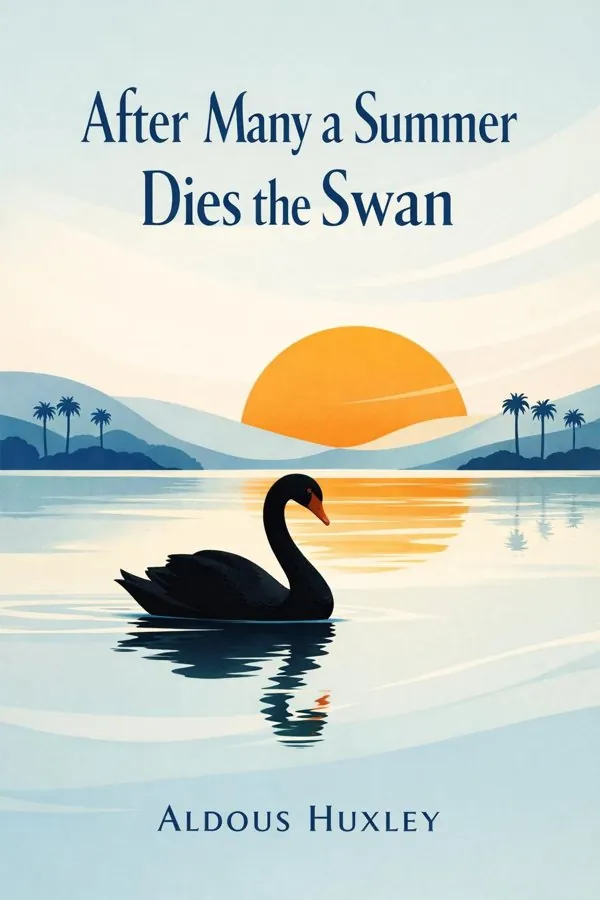
After Many a Summer Dies the Swan: Summary & Key Insights
 10 min9 chaptersAudio available
Key Takeaways from After Many a Summer Dies the Swan
The quickest way to understand a civilization is to look at what it builds to protect itself from reality.
Science becomes dangerous when it forgets that human beings are more than biological problems.
A culture obsessed with youth eventually teaches people to perform vitality rather than cultivate character.
To extend life without improving the soul is not progress but exaggeration.
Sometimes the most important character in a satire is the one who can still be shocked.
What Is After Many a Summer Dies the Swan About?
After Many a Summer Dies the Swan by Aldous Huxley is a classics book spanning 5 pages. Aldous Huxley’s After Many a Summer Dies the Swan is a brilliant satirical novel about what happens when a culture becomes terrified of aging, mortality, and spiritual depth. Set in the glittering artificial paradise of 1930s California, the story follows Jeremy Pordage, a restrained English scholar invited to the estate of millionaire Jo Stoyte, who is obsessed with prolonging his life. There he encounters a world of wealth, vanity, scientific ambition, and moral confusion, as Stoyte and his physician Dr. Obispo pursue a grotesque dream of human longevity. What begins as social comedy gradually darkens into philosophical fable, exposing the costs of trying to conquer death without confronting how to live well. Huxley, one of the twentieth century’s sharpest critics of modern civilization, brings to the novel his signature blend of wit, intellect, and unsettling vision. Best known for Brave New World, he was uniquely equipped to examine the collision of science, materialism, and spiritual emptiness. The result is a novel that remains strikingly relevant in an age still captivated by youth culture, biohacking, and the promise of technological immortality.
This FizzRead summary covers all 9 key chapters of After Many a Summer Dies the Swan in approximately 10 minutes, distilling the most important ideas, arguments, and takeaways from Aldous Huxley's work. Also available as an audio summary and Key Quotes Podcast.
After Many a Summer Dies the Swan
Aldous Huxley’s After Many a Summer Dies the Swan is a brilliant satirical novel about what happens when a culture becomes terrified of aging, mortality, and spiritual depth. Set in the glittering artificial paradise of 1930s California, the story follows Jeremy Pordage, a restrained English scholar invited to the estate of millionaire Jo Stoyte, who is obsessed with prolonging his life. There he encounters a world of wealth, vanity, scientific ambition, and moral confusion, as Stoyte and his physician Dr. Obispo pursue a grotesque dream of human longevity. What begins as social comedy gradually darkens into philosophical fable, exposing the costs of trying to conquer death without confronting how to live well. Huxley, one of the twentieth century’s sharpest critics of modern civilization, brings to the novel his signature blend of wit, intellect, and unsettling vision. Best known for Brave New World, he was uniquely equipped to examine the collision of science, materialism, and spiritual emptiness. The result is a novel that remains strikingly relevant in an age still captivated by youth culture, biohacking, and the promise of technological immortality.
Who Should Read After Many a Summer Dies the Swan?
This book is perfect for anyone interested in classics and looking to gain actionable insights in a short read. Whether you're a student, professional, or lifelong learner, the key ideas from After Many a Summer Dies the Swan by Aldous Huxley will help you think differently.
- ✓Readers who enjoy classics and want practical takeaways
- ✓Professionals looking to apply new ideas to their work and life
- ✓Anyone who wants the core insights of After Many a Summer Dies the Swan in just 10 minutes
Want the full summary?
Get instant access to this book summary and 100K+ more with Fizz Moment.
Get Free SummaryAvailable on App Store • Free to download
Key Chapters
The quickest way to understand a civilization is to look at what it builds to protect itself from reality. When Jeremy Pordage arrives in California and enters Jo Stoyte’s luxurious estate, he steps into a manufactured world designed to keep discomfort, history, and mortality at bay. The estate is more than a rich man’s home; it is a symbol of modernity’s dream of total control. Everything is curated, excessive, and insulated. Beauty exists, but it is purchased rather than earned. Comfort is abundant, but meaning is scarce.
Huxley uses Pordage’s outsider perspective to sharpen the satire. As an English archivist, Pordage is a man of memory, scholarship, and continuity. He comes from a culture burdened by history, tradition, and decay. California, by contrast, appears to him as a place devoted to surfaces, speed, and reinvention. The clash is not merely geographical. It is moral and philosophical. Pordage sees that Stoyte’s world treats the past as useless unless it can serve the present appetite. In this environment, even culture becomes decorative.
This idea remains powerfully relevant. Modern life often encourages us to create our own estates: carefully managed identities, optimized homes, controlled routines, and digital bubbles that keep anxiety away. But Huxley suggests that when life is arranged only for comfort, it becomes unable to face truth. A person who cannot tolerate impermanence will seek distraction instead of wisdom.
A practical application is to examine what in your life functions as insulation rather than nourishment. Are you using convenience, luxury, entertainment, or status to avoid harder questions about purpose, aging, or loss? Huxley does not condemn comfort itself; he warns against treating comfort as the highest good.
Actionable takeaway: Identify one area where you have chosen appearance or convenience over depth, and replace a layer of comfort with a habit that reconnects you to reality, such as reading history, having an honest conversation, or spending time without distraction.
Science becomes dangerous when it forgets that human beings are more than biological problems. Dr. Obispo is one of Huxley’s most unsettling creations because he represents intelligence detached from reverence. He is brilliant, ironic, and technically capable, yet his work on longevity is guided less by wisdom than by curiosity, vanity, and appetite. To him, aging is a mechanical failure and death a solvable inconvenience. The moral question of whether a life should be prolonged, and for what purpose, is secondary.
Huxley does not attack science itself. Instead, he satirizes scientism: the belief that technical power is sufficient guidance for human action. Obispo is willing to investigate bizarre methods of life extension because he assumes that what can be done ought at least to be tried. He exemplifies a modern mindset that confuses capability with legitimacy. Knowledge accumulates, but self-knowledge does not.
This theme resonates strongly today in debates about anti-aging technology, genetic engineering, AI, and biomedical enhancement. We often celebrate innovation before asking what kind of people it will make us. A breakthrough may be impressive and still spiritually catastrophic if it serves fear, greed, or domination. Huxley’s warning is not anti-progress. It is anti-naivete.
In practical terms, this idea applies beyond laboratories. In organizations and personal life, we often use tools, metrics, and systems to optimize outcomes without asking whether the outcome itself is worthy. A company can become more efficient while treating workers as replaceable parts. A person can track every health indicator while becoming more anxious and self-absorbed.
Actionable takeaway: Whenever you pursue an improvement through technology, medicine, or optimization, ask two questions first: What human good is this serving, and what moral cost might accompany the gain?
A culture obsessed with youth eventually teaches people to perform vitality rather than cultivate character. Virginia, the young woman at the center of the estate’s emotional tensions, embodies the pressure to remain desirable in a world that prizes appearance over maturity. Her presence reveals how the cult of youth turns human relationships into transactions of image, charm, and status. She is not merely an individual character; she is part of Huxley’s diagnosis of a society in which aging is treated as failure and beauty as currency.
Virginia’s situation also highlights the vulnerability created by such values. In a world shaped by wealthy men, scientific schemes, and social posing, her youth gives her influence but not security. She is admired, desired, and displayed, yet she exists within a framework she did not design. Huxley sees that the worship of youth is not flattering; it is dehumanizing. It reduces persons to temporary advantages and teaches them to fear the very process of becoming fully human.
This insight is strikingly contemporary. Social media, cosmetic industries, and entertainment culture continue to reward the appearance of endless youth. Many people feel compelled to manage their faces, bodies, and public personas as if aging were a moral lapse. Huxley reminds us that when societies deny aging, they also deny wisdom, patience, and inward growth.
A practical application is to notice where you evaluate yourself or others primarily through markers of attractiveness, novelty, or energy. Do you unconsciously associate aging with irrelevance? Do you value people less as they become more complex and less marketable? Reversing that habit requires conscious admiration for traits that deepen with time: judgment, compassion, steadiness, humor, and integrity.
Actionable takeaway: Choose one relationship this week in which you deliberately appreciate depth over appearance by affirming a quality rooted in character rather than youth, style, or attractiveness.
To extend life without improving the soul is not progress but exaggeration. One of the novel’s most disturbing insights emerges through the search for longevity and the grotesque revelation of where it may lead. Huxley imagines a future in which sheer biological continuation does not elevate humanity but degrades it. If desire, selfishness, and appetite remain unchecked, then adding years only gives vice more time to harden. The result is not immortality in any noble sense. It is a parody of survival.
This is where the novel moves beyond satire into moral horror. Stoyte wants more life, but he never seriously asks what life is for. His fear of death is not matched by any aspiration toward truth, goodness, or transcendence. Obispo’s experiments therefore expose a deeper absurdity: modern civilization may learn how to preserve the organism while neglecting the person. Huxley’s grotesque imagery drives home the point that quantity of life and quality of being are radically different matters.
The idea has clear practical relevance. Many of us pursue longevity through diets, exercise, supplements, and medical interventions. These can be sensible and beneficial. But Huxley invites a harder question: are we preparing to live longer, or only to postpone ending? A longer lifespan magnifies whatever habits we already possess. If those habits are shallow, fearful, or selfish, extra years may intensify emptiness rather than relieve it.
In everyday life, this suggests balancing health ambition with moral development. It is wise to care for the body, but it is equally necessary to cultivate purpose, discipline, and relationships. A long life without inner formation can become tedious, bitter, or absurd. The best preparation for longevity is not just maintenance, but transformation.
Actionable takeaway: Pair one physical health goal with one character goal, such as exercising regularly while also practicing generosity, patience, or spiritual reflection, so that added years support a fuller humanity.
Sometimes the most important character in a satire is the one who can still be shocked. Jeremy Pordage serves as the novel’s moral and intellectual witness, moving through Stoyte’s California with a mixture of curiosity, unease, and reflective distance. He is not a heroic reformer, nor is he free of weakness, but he retains the crucial ability to compare what he sees with a deeper standard of civilization. Through him, Huxley asks whether modern life has gained power at the cost of soul.
Pordage’s profession matters. As an archivist, he lives among records, relics, and the memory of what human beings have valued across time. He is attuned to continuity, mortality, and the long view. In Stoyte’s world, by contrast, immediacy reigns. The old matters only if it can be exploited for novelty or advantage. This contrast allows Huxley to stage a conflict between historical consciousness and the cult of the present.
Pordage’s reflections suggest that civilization is not measured only by wealth, innovation, or comfort. It is measured by what it reveres, what it restrains, and what kind of inner life it makes possible. A society may be materially advanced and spiritually primitive. That insight is one of Huxley’s central contributions, and it remains useful in evaluating our own era of abundance and distraction.
Practically, Pordage’s role encourages us to cultivate some form of distance from our own culture. Without distance, we mistake fashion for truth and convenience for progress. Reading older literature, studying history, or spending time in silence can restore perspective. These practices are not nostalgic retreats; they are methods of seeing clearly.
Actionable takeaway: Create one regular practice that gives you historical or spiritual perspective, such as weekly reading from a classic text or journaling about which cultural assumptions you are living by without examination.
The more desperately people try to buy security from existence, the more obvious it becomes that the deepest human needs are not for sale. Jo Stoyte is immensely rich, and his fortune allows him to collect objects, manipulate people, and command expertise. Yet all this power only dramatizes his inner poverty. He can purchase medicine, architecture, entertainment, and influence, but he cannot purchase peace before death. His wealth turns every fear into a larger enterprise, never into a solution.
Huxley’s satire of money is subtle because he does not portray wealth as evil in itself. Rather, he shows how wealth magnifies the character of its possessor. In Stoyte’s case, money amplifies insecurity, vanity, and control. Because he can act on every impulse, he is rarely forced into humility. He mistakes acquisition for agency and agency for wisdom. The richer he becomes, the less capable he is of accepting limits.
This dynamic is widespread far beyond elite estates. Many people assume that if they can secure enough income, possessions, or lifestyle upgrades, they will finally feel stable. But the threshold keeps moving. Huxley exposes the error: material abundance can reduce certain hardships, but it cannot answer spiritual questions. It cannot tell us what deserves loyalty, what kind of life is honorable, or how to face death without terror.
A practical application is to distinguish between useful resources and false salvation. Financial stability matters. Comfort matters. But once basic needs and reasonable security are addressed, the search for more often disguises a deeper hunger for significance, love, or transcendence. Without naming that hunger honestly, accumulation becomes endless.
Actionable takeaway: Review one major goal involving money or status and ask whether it solves a real need or masks an existential fear; then define a non-material source of meaning you will invest in alongside it.
Laughter can reveal corruption more effectively than outrage because it exposes the absurdity people work hardest to hide. Huxley uses satire throughout the novel not merely to entertain but to diagnose a condition he sees in modern civilization: outward refinement combined with inward disorder. The characters are cultured enough to speak intelligently, wealthy enough to live elegantly, and advanced enough to pursue scientific marvels. Yet beneath these signs of progress lie primitive motives—fear, lust, greed, vanity, and domination.
This is what makes the novel so unsettling. Huxley is not describing barbarism as something outside modern life; he is showing barbarism wearing expensive clothes and using modern tools. The novel’s brilliance lies in this inversion. Civilization often congratulates itself on its achievements while ignoring the continuity of human appetite underneath. Technology and luxury can make brutality more sophisticated without making people better.
Satire helps readers resist enchantment by appearances. By making Stoyte’s world ridiculous, Huxley forces us to ask what in our own world deserves similar scrutiny. Which fashionable beliefs are merely self-interest in elegant language? Which institutions celebrate progress while quietly rewarding pettiness and exploitation? The comic tone invites honesty where solemn moralizing might provoke defensiveness.
In practical terms, this idea suggests the value of irony and critical observation in everyday life. When we feel overly impressed by trends, experts, prestige, or polished branding, satire can restore proportion. It reminds us to look for motive behind performance. This applies to politics, business, wellness culture, and even personal identity.
Actionable takeaway: The next time you encounter something presented as impressive or progressive, ask what basic human motive might be operating beneath the polished surface, and let that question guide a more balanced judgment.
A person who cannot accept death will struggle to understand life. The deepest philosophical current in After Many a Summer Dies the Swan is not simply that immortality is impossible or grotesque, but that fear of death distorts every other value. Jo Stoyte’s obsession with survival narrows his world. Instead of asking how to live nobly, love honestly, or use wealth responsibly, he fixates on continued existence. Death becomes so intolerable that he stops living in any meaningful sense long before dying.
Huxley suggests that mortality is not merely a biological limit; it is a spiritual teacher. The fact that life ends gives urgency to choice, tenderness to relationships, and seriousness to moral development. When death is denied, people are tempted to postpone self-examination forever. They seek endless extension rather than transformation. In this way, the refusal to face death makes life thinner, not richer.
This idea has obvious modern applications. Contemporary culture often avoids aging and death through euphemism, entertainment, medicalization, or relentless busyness. Yet people who never think about mortality are often the least prepared to prioritize wisely. Awareness of finitude can clarify what matters most: relationships over possessions, purpose over distraction, and character over image.
Practically, this does not require morbid fixation. It means allowing mortality to inform judgment. Many traditions use forms of memento mori not to depress life, but to sharpen gratitude and courage. If time is limited, pettiness loses some of its appeal. Fear still exists, but it no longer governs everything.
Actionable takeaway: Spend ten minutes this week reflecting on what would matter if your time were more limited than you assume, then make one concrete change that aligns your schedule with that answer.
Progress without a vision of the good is merely movement with better machinery. Across the novel, Huxley assembles a world full of energy, innovation, and wealth, yet strangely incapable of answering basic human questions. California appears dynamic, inventive, and future-facing. But this very dynamism becomes a problem when no shared moral framework guides it. The result is a civilization that can do more and more while knowing less and less about what it ought to do.
This is the broader argument connecting the novel’s satire of youth culture, scientific ambition, and material excess. Huxley is not nostalgic for stagnation. He is warning that modern societies often confuse acceleration with advancement. A culture may pioneer new technologies, expand consumption, and celebrate individual freedom while simultaneously eroding the inner disciplines that make freedom humane. Without moral direction, progress serves appetite.
This insight is especially useful now. We live amid unprecedented tools for communication, medicine, productivity, and self-modification. Yet many people still experience confusion, loneliness, fragmentation, and ethical drift. Huxley helps explain why. Instruments cannot supply ends. Efficiency cannot determine purpose. We need some account of what a human being is for, or else our most dazzling capacities become servants of our least examined desires.
A practical application is to evaluate progress by human flourishing rather than novelty alone. In work, education, health, and technology, ask whether a change makes people wiser, freer in a meaningful sense, and more capable of love and responsibility. Not every upgrade is an improvement.
Actionable takeaway: Before adopting a new system, tool, or ambition, define the human value it is meant to protect or deepen, and reject it if it offers convenience at the expense of integrity, attention, or compassion.
All Chapters in After Many a Summer Dies the Swan
About the Author
Aldous Huxley (1894–1963) was an English novelist, essayist, and one of the twentieth century’s most incisive social critics. Born into a distinguished intellectual family, he was educated at Eton and Balliol College, Oxford. Huxley first gained attention for his satirical novels of manners before achieving lasting fame with Brave New World, his landmark vision of technological control and engineered happiness. Across his career, he wrote fiction, essays, travel writing, and philosophical works that examined science, politics, religion, art, and consciousness. His writing is marked by intellectual range, elegant prose, and a persistent concern with the spiritual consequences of modern life. After Many a Summer Dies the Swan reflects many of his central themes: the seductions of materialism, the misuse of science, and the search for a deeper human purpose beyond comfort and power.
Get This Summary in Your Preferred Format
Read or listen to the After Many a Summer Dies the Swan summary by Aldous Huxley anytime, anywhere. FizzRead offers multiple formats so you can learn on your terms — all free.
Available formats: App · Audio · PDF · EPUB — All included free with FizzRead
Download After Many a Summer Dies the Swan PDF and EPUB Summary
Key Quotes from After Many a Summer Dies the Swan
“The quickest way to understand a civilization is to look at what it builds to protect itself from reality.”
“Science becomes dangerous when it forgets that human beings are more than biological problems.”
“A culture obsessed with youth eventually teaches people to perform vitality rather than cultivate character.”
“To extend life without improving the soul is not progress but exaggeration.”
“Sometimes the most important character in a satire is the one who can still be shocked.”
Frequently Asked Questions about After Many a Summer Dies the Swan
After Many a Summer Dies the Swan by Aldous Huxley is a classics book that explores key ideas across 9 chapters. Aldous Huxley’s After Many a Summer Dies the Swan is a brilliant satirical novel about what happens when a culture becomes terrified of aging, mortality, and spiritual depth. Set in the glittering artificial paradise of 1930s California, the story follows Jeremy Pordage, a restrained English scholar invited to the estate of millionaire Jo Stoyte, who is obsessed with prolonging his life. There he encounters a world of wealth, vanity, scientific ambition, and moral confusion, as Stoyte and his physician Dr. Obispo pursue a grotesque dream of human longevity. What begins as social comedy gradually darkens into philosophical fable, exposing the costs of trying to conquer death without confronting how to live well. Huxley, one of the twentieth century’s sharpest critics of modern civilization, brings to the novel his signature blend of wit, intellect, and unsettling vision. Best known for Brave New World, he was uniquely equipped to examine the collision of science, materialism, and spiritual emptiness. The result is a novel that remains strikingly relevant in an age still captivated by youth culture, biohacking, and the promise of technological immortality.
More by Aldous Huxley
You Might Also Like



Browse by Category
Ready to read After Many a Summer Dies the Swan?
Get the full summary and 100K+ more books with Fizz Moment.