
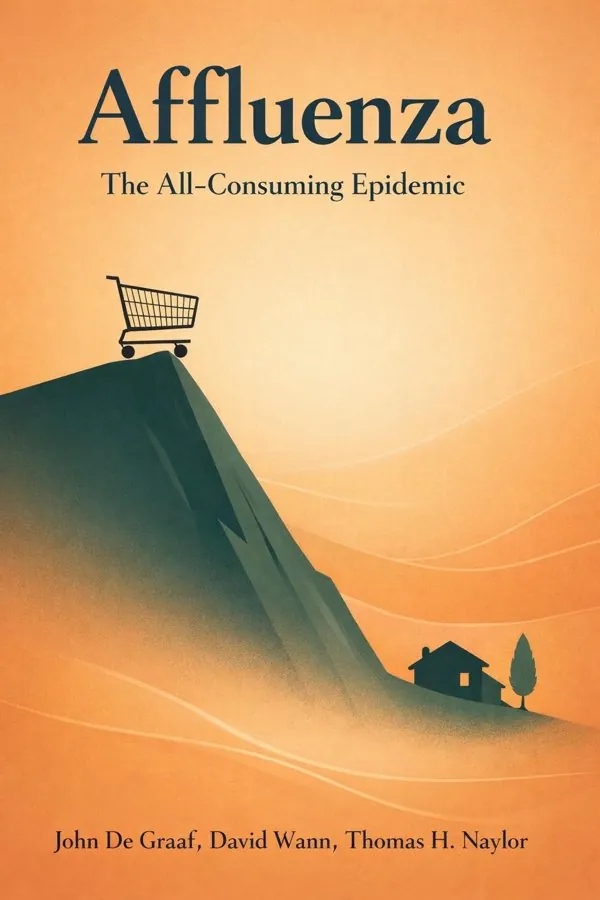
Affluenza: The All-Consuming Epidemic: Summary & Key Insights
by John De Graaf, David Wann, Thomas H. Naylor
 10 min9 chaptersAudio available
Key Takeaways from Affluenza: The All-Consuming Epidemic
Affluenza begins with a striking idea: consumerism did not simply happen naturally; it was built, marketed, normalized, and woven into the structure of postwar American life.
One of the book’s most memorable insights is that affluenza behaves like a social epidemic, with symptoms that are both personal and collective.
A powerful theme in Affluenza is that markets do not merely respond to needs; they actively create wants.
The authors criticize the assumption that higher consumption is always evidence of progress.
One of the book’s most important insights is that consumer culture does not affect everyone equally.
What Is Affluenza: The All-Consuming Epidemic About?
Affluenza: The All-Consuming Epidemic by John De Graaf, David Wann, Thomas H. Naylor is a sociology book spanning 5 pages. What if the unease many people feel is not a personal failure, but a social condition? In Affluenza: The All-Consuming Epidemic, John De Graaf, David Wann, and Thomas H. Naylor argue that modern consumer culture has created a destructive pattern of overwork, overconsumption, debt, waste, and dissatisfaction. First published at the turn of the twenty-first century, the book examines how the relentless pursuit of more money, bigger houses, newer products, and higher status has reshaped everyday life in the United States. The result, the authors contend, is not greater well-being but rising stress, inequality, ecological damage, and a persistent sense that nothing is ever enough. Their authority comes from a powerful mix of backgrounds: De Graaf is a documentary filmmaker and social critic, Wann is a writer focused on sustainability and culture, and Naylor was an economist known for challenging mainstream growth assumptions. Together, they offer a diagnosis of a culture that confuses consumption with fulfillment—and a compelling invitation to imagine healthier, more meaningful, and more sustainable ways of living.
This FizzRead summary covers all 9 key chapters of Affluenza: The All-Consuming Epidemic in approximately 10 minutes, distilling the most important ideas, arguments, and takeaways from John De Graaf, David Wann, Thomas H. Naylor's work. Also available as an audio summary and Key Quotes Podcast.
Affluenza: The All-Consuming Epidemic
What if the unease many people feel is not a personal failure, but a social condition? In Affluenza: The All-Consuming Epidemic, John De Graaf, David Wann, and Thomas H. Naylor argue that modern consumer culture has created a destructive pattern of overwork, overconsumption, debt, waste, and dissatisfaction. First published at the turn of the twenty-first century, the book examines how the relentless pursuit of more money, bigger houses, newer products, and higher status has reshaped everyday life in the United States. The result, the authors contend, is not greater well-being but rising stress, inequality, ecological damage, and a persistent sense that nothing is ever enough. Their authority comes from a powerful mix of backgrounds: De Graaf is a documentary filmmaker and social critic, Wann is a writer focused on sustainability and culture, and Naylor was an economist known for challenging mainstream growth assumptions. Together, they offer a diagnosis of a culture that confuses consumption with fulfillment—and a compelling invitation to imagine healthier, more meaningful, and more sustainable ways of living.
Who Should Read Affluenza: The All-Consuming Epidemic?
This book is perfect for anyone interested in sociology and looking to gain actionable insights in a short read. Whether you're a student, professional, or lifelong learner, the key ideas from Affluenza: The All-Consuming Epidemic by John De Graaf, David Wann, Thomas H. Naylor will help you think differently.
- ✓Readers who enjoy sociology and want practical takeaways
- ✓Professionals looking to apply new ideas to their work and life
- ✓Anyone who wants the core insights of Affluenza: The All-Consuming Epidemic in just 10 minutes
Want the full summary?
Get instant access to this book summary and 100K+ more with Fizz Moment.
Get Free SummaryAvailable on App Store • Free to download
Key Chapters
Affluenza begins with a striking idea: consumerism did not simply happen naturally; it was built, marketed, normalized, and woven into the structure of postwar American life. The authors trace the rise of affluenza to the decades after World War II, when the United States emerged with enormous industrial capacity and a strong appetite for growth. Factories that had produced military equipment shifted to making homes, cars, appliances, and household goods. At the same time, advertisers, policymakers, lenders, and mass media helped transform consumption from a practical necessity into a civic virtue and a marker of identity.
This shift mattered because it changed what success meant. Instead of emphasizing thrift, community, or sufficiency, culture increasingly rewarded visible consumption. Bigger houses became symbols of progress. Newer products signaled personal advancement. Shopping became not only an economic activity but also a social ritual and emotional outlet. Credit expanded, suburban development accelerated, and television helped standardize national aspirations. People were no longer just buying things; they were buying lifestyles.
The book shows that this historical context is essential for understanding present-day anxiety and excess. When a society constantly tells people that happiness lies one purchase away, dissatisfaction becomes predictable. You can see this today in the pressure to upgrade phones, renovate homes beyond practical need, or measure achievement through luxury. Once enough is replaced by more, the finish line keeps moving.
The practical lesson is to question inherited assumptions. Ask where your standards of success came from, who benefits from them, and whether they actually improve your life. Actionable takeaway: make a short list of the values you want guiding your decisions—such as health, time, relationships, or purpose—and use that list as a filter before major purchases.
One of the book’s most memorable insights is that affluenza behaves like a social epidemic, with symptoms that are both personal and collective. The authors describe a culture infected by chronic dissatisfaction, anxiety, debt, time pressure, and status competition. Even materially comfortable people often feel behind, deprived, or insecure. That is the paradox at the heart of affluenza: abundance does not necessarily produce contentment.
The syndrome shows up in everyday habits. People work longer hours to afford lifestyles that leave them too exhausted to enjoy what they have purchased. Families accumulate goods they barely use but struggle to find time for conversation, rest, or shared meals. Children absorb messages that identity comes from brands and possessions. Social comparison intensifies the condition, because people rarely judge their lives in absolute terms. They compare upward—to wealthier neighbors, more glamorous media figures, or curated lifestyles that seem effortlessly perfect.
The authors also highlight the emotional consequences. Affluenza can produce a low-grade but constant feeling of insufficiency: not successful enough, not stylish enough, not productive enough. This can lead to compulsive spending, hidden financial strain, and a sense of emptiness after the excitement of acquiring something new fades. It is a cycle of brief stimulation followed by renewed craving.
In practical terms, recognizing the symptoms is the first step toward recovery. You might notice them in impulse purchases made during stress, cluttered living spaces, persistent money anxiety despite decent income, or irritation that free time feels unproductive unless it produces visible results.
Actionable takeaway: perform a one-week audit of moments when you feel the urge to buy, compare, or upgrade, and note the emotion underneath—stress, boredom, loneliness, or status pressure. Awareness helps break the automatic cycle.
A powerful theme in Affluenza is that markets do not merely respond to needs; they actively create wants. The authors argue that modern advertising is not just informative but deeply psychological. Its real function is to shape desire, attach products to emotions, and persuade people that consumption can solve problems that are actually social, emotional, or existential.
This matters because when desire is engineered, dissatisfaction becomes profitable. Advertisements rarely sell the object alone; they sell beauty, belonging, youth, control, love, prestige, and escape. A car becomes freedom. A kitchen remodel becomes family harmony. A luxury brand becomes self-worth. The message is subtle but relentless: who you are is incomplete until you buy what is being offered. The authors show how this machinery of desire keeps the economy growing by ensuring that satisfaction remains temporary.
Children are especially vulnerable. When young people are exposed early to commercial messaging, they may learn to associate identity with ownership rather than character or contribution. Adults are not immune either. Career advancement, home upgrades, and lifestyle branding often become forms of self-advertising in a culture where social standing is highly visible. Even people who intellectually reject consumerism can still feel its pull emotionally.
A practical application is to examine how often purchases are tied to image rather than utility. Do you need the item, or do you need the feeling it promises? Could that feeling come from rest, friendship, exercise, creativity, or a meaningful challenge instead?
Actionable takeaway: create a 48-hour pause rule for nonessential purchases. During that pause, write down what you expect the item to change about your life. If the answer is mostly emotional or symbolic, look for a noncommercial way to meet that need first.
The book makes a sharp economic argument: a society organized around endless growth pushes people into a treadmill of work, borrowing, and consumption that can feel rational individually but damaging collectively. The authors criticize the assumption that higher consumption is always evidence of progress. In practice, many households chase rising standards of living by taking on debt, working longer hours, and sacrificing time that could be used for family, health, and civic life.
This treadmill operates through several mechanisms. Wages may stagnate while cultural expectations keep rising. Credit cards and easy loans allow people to buy now and worry later. Housing markets reward larger homes and longer commutes. Employers value constant availability. The result is that many people become asset-rich in appearance but time-poor in reality. Their lives look successful from the outside while feeling strained from within.
Affluenza invites readers to reconsider common economic measurements. Gross domestic product can rise when more goods are sold, more fuel is burned, and more medical treatment is needed, yet none of this necessarily means people are flourishing. If growth is accompanied by stress, family breakdown, pollution, or community decline, then the numbers tell only part of the story.
Examples are easy to recognize: upgrading to a larger house may require higher mortgage payments, forcing both partners to work more. More income then leads to convenience spending because there is less time to cook, repair, or rest. The cycle feeds itself.
Actionable takeaway: evaluate major financial decisions not only in dollars but also in hours of life. Before increasing your fixed expenses, calculate how much additional work time they will require and whether the trade truly supports your deepest priorities.
Perhaps the most challenging claim in the book is that beyond a certain threshold, increased consumption produces diminishing returns for happiness. The authors argue that while basic material security is essential, the constant pursuit of more rarely delivers the emotional fulfillment people expect. Once needs and reasonable comforts are met, well-being depends more on relationships, health, purpose, autonomy, belonging, and meaningful use of time than on accumulating additional possessions.
This idea runs against a central promise of consumer culture. People are taught to equate pleasure with progress and novelty with improvement. But the excitement of acquiring something new often fades quickly, a pattern now commonly described as hedonic adaptation. What felt thrilling becomes normal, and the desire for the next upgrade soon returns. If life satisfaction rests on repeated stimulation, it becomes fragile and expensive.
Affluenza encourages readers to distinguish between fleeting gratification and durable well-being. A purchase may be enjoyable and still not be transformative. By contrast, activities such as deep conversation, creative work, time in nature, volunteering, and shared rituals often generate meaning that compounds rather than evaporates. The book’s critique is not anti-comfort; it is anti-confusion. Material goods are useful tools, but they are poor substitutes for emotional nourishment and community.
A practical example is the difference between buying entertainment equipment and creating time to use it with loved ones. The device may matter less than the quality of attention around it. Likewise, a simpler vacation with real rest may provide more renewal than a costly trip designed mainly for status.
Actionable takeaway: before making a discretionary purchase, ask whether the same money or time could create a lasting memory, strengthen a relationship, or improve health. Choose the option with the deepest long-term benefit.
A subtle but profound contribution of Affluenza is its redefinition of wealth. The authors suggest that a good life cannot be measured only by income or possessions. Real wealth includes time to rest, relationships that provide support, neighborhoods that foster belonging, and communities where people trust one another. In consumer culture, however, these forms of wealth are often sacrificed in pursuit of financial gain and visible status.
Time scarcity is a recurring theme. People may have more conveniences than ever yet feel chronically rushed. Labor-saving devices have not necessarily produced more leisure because expectations have expanded to fill the space. The result is that many households trade time for money and then money for convenience, while missing the deeper value of unstructured time, friendship, and local engagement. Affluenza argues that this is a poor bargain.
The social implications are significant. When people are overworked and overscheduled, they have less energy for civic participation, caregiving, neighborhood life, or democratic engagement. Isolation grows, even in affluent areas. Rebuilding community therefore becomes both a personal remedy and a political act. Joining local groups, knowing neighbors, sharing resources, and investing in common spaces can reduce dependence on private consumption as the main source of comfort and identity.
Examples include community gardens, shared childcare, neighborhood tool libraries, potluck dinners, and choosing a shorter commute over a larger home. These decisions may look modest, but they can greatly improve daily life.
Actionable takeaway: protect one block of time each week for noncommercial connection—such as a shared meal, volunteer activity, neighborhood walk, or device-free visit with friends—and treat it as seriously as a work appointment.
The book’s alternative to affluenza is not deprivation but conscious simplicity. The authors argue that reducing unnecessary consumption can expand freedom by lowering financial pressure, reclaiming time, reducing clutter, and clarifying what matters. Simplicity is presented not as a rigid ideology but as a practical and ethical response to a culture of excess.
This idea is powerful because it shifts the narrative from sacrifice to agency. Many people assume that consuming less means settling for less. Affluenza suggests the opposite: when you stop chasing socially manufactured wants, you gain more space for purpose, creativity, health, and relationships. Simplicity can mean living in a smaller home to avoid crushing debt, cooking more and buying less processed convenience, repairing belongings, reducing screen-driven shopping triggers, or setting a cap on lifestyle inflation even when income rises.
The authors also connect simplicity with broader social change. Individual choices alone cannot fix systemic problems, but they can weaken the cultural hold of consumerism and support different economic priorities. If enough people value sufficiency over excess, policies and institutions can begin to reflect that shift through better public transit, stronger local economies, shorter workweeks, and environmental protections.
What makes this message enduring is its practicality. You do not have to withdraw from society to live differently. You can start with one domain: wardrobe, food, housing, work hours, debt, or media exposure. The goal is not purity but alignment.
Actionable takeaway: pick one simplifying change that will produce immediate relief—cancel an unnecessary subscription, declutter one room, automate savings instead of spending raises, or commit to one no-spend day per week—and use the saved time or money for something genuinely life-giving.
All Chapters in Affluenza: The All-Consuming Epidemic
About the Authors
John De Graaf is an American documentary filmmaker, writer, and public speaker known for his work on consumer culture, overwork, and environmental responsibility. David Wann is a writer and sustainability thinker whose books and essays often explore ecological living, cultural values, and practical alternatives to excess. Thomas H. Naylor was an economist, professor at Duke University, and outspoken critic of growth-centered capitalism and corporate power. Together, the three authors brought an unusually effective combination of media insight, ecological awareness, and economic analysis to Affluenza. Their collaboration helped make the book both accessible and intellectually grounded, blending social criticism with practical reflection on how people and societies might live more meaningfully, equitably, and sustainably.
Get This Summary in Your Preferred Format
Read or listen to the Affluenza: The All-Consuming Epidemic summary by John De Graaf, David Wann, Thomas H. Naylor anytime, anywhere. FizzRead offers multiple formats so you can learn on your terms — all free.
Available formats: App · Audio · PDF · EPUB — All included free with FizzRead
Download Affluenza: The All-Consuming Epidemic PDF and EPUB Summary
Key Quotes from Affluenza: The All-Consuming Epidemic
“Affluenza begins with a striking idea: consumerism did not simply happen naturally; it was built, marketed, normalized, and woven into the structure of postwar American life.”
“One of the book’s most memorable insights is that affluenza behaves like a social epidemic, with symptoms that are both personal and collective.”
“A powerful theme in Affluenza is that markets do not merely respond to needs; they actively create wants.”
“The authors criticize the assumption that higher consumption is always evidence of progress.”
“One of the book’s most important insights is that consumer culture does not affect everyone equally.”
Frequently Asked Questions about Affluenza: The All-Consuming Epidemic
Affluenza: The All-Consuming Epidemic by John De Graaf, David Wann, Thomas H. Naylor is a sociology book that explores key ideas across 9 chapters. What if the unease many people feel is not a personal failure, but a social condition? In Affluenza: The All-Consuming Epidemic, John De Graaf, David Wann, and Thomas H. Naylor argue that modern consumer culture has created a destructive pattern of overwork, overconsumption, debt, waste, and dissatisfaction. First published at the turn of the twenty-first century, the book examines how the relentless pursuit of more money, bigger houses, newer products, and higher status has reshaped everyday life in the United States. The result, the authors contend, is not greater well-being but rising stress, inequality, ecological damage, and a persistent sense that nothing is ever enough. Their authority comes from a powerful mix of backgrounds: De Graaf is a documentary filmmaker and social critic, Wann is a writer focused on sustainability and culture, and Naylor was an economist known for challenging mainstream growth assumptions. Together, they offer a diagnosis of a culture that confuses consumption with fulfillment—and a compelling invitation to imagine healthier, more meaningful, and more sustainable ways of living.
You Might Also Like

Between the World and Me
Ta-Nehisi Coates
10 min
Half the Sky
Nicholas D. Kristof, Sheryl WuDunn
10 min
Men Explain Things To Me
Rebecca Solnit
10 min
Rational Ritual
Michael Suk-Young Chwe
10 min
The New Jim Crow
Michelle Alexander
10 min
Beyond Culture
Edward T. Hall
10 minBrowse by Category
Ready to read Affluenza: The All-Consuming Epidemic?
Get the full summary and 100K+ more books with Fizz Moment.