
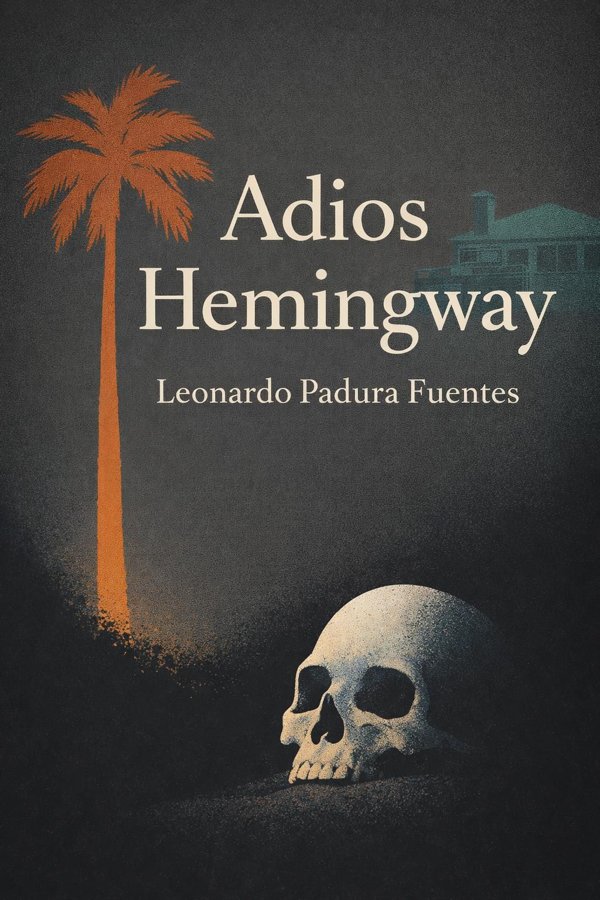
Adios Hemingway: Summary & Key Insights
 10 min8 chaptersAudio available
Key Takeaways from Adios Hemingway
A buried body can expose more than a crime; it can unearth an entire civilization of secrets.
Legends often appear strongest just before they collapse.
Cities remember what their citizens try to forget.
Sometimes an investigation becomes a mirror.
The best detective fiction is not only about who committed a crime, but about what kind of world made that crime possible.
What Is Adios Hemingway About?
Adios Hemingway by Leonardo Padura Fuentes is a mystery book spanning 4 pages. Adios Hemingway is a literary mystery that begins with a body and ends with a meditation on truth, memory, and the ruins left behind by fame. When a skeleton is discovered on the grounds of Ernest Hemingway’s former estate outside Havana, retired police investigator Mario Conde is drawn into an inquiry that is at once criminal, historical, and deeply personal. As Conde traces the identity of the dead man, Leonardo Padura Fuentes alternates between present-day Cuba and Hemingway’s final years on the island, creating a suspenseful story about what remains hidden beneath myth. What makes the novel matter is not simply its detective plot, but its unusual ambition. Padura uses the mystery form to examine aging, political disillusionment, artistic vanity, masculine performance, and the uneasy relationship between a real writer and the legend built around him. The result is both an investigation and an act of cultural excavation. Padura is especially well placed to tell this story: as one of Cuba’s most important contemporary novelists and the creator of the unforgettable Mario Conde, he brings historical depth, moral complexity, and a richly textured sense of Havana to every page.
This FizzRead summary covers all 8 key chapters of Adios Hemingway in approximately 10 minutes, distilling the most important ideas, arguments, and takeaways from Leonardo Padura Fuentes's work. Also available as an audio summary and Key Quotes Podcast.
Adios Hemingway
Adios Hemingway is a literary mystery that begins with a body and ends with a meditation on truth, memory, and the ruins left behind by fame. When a skeleton is discovered on the grounds of Ernest Hemingway’s former estate outside Havana, retired police investigator Mario Conde is drawn into an inquiry that is at once criminal, historical, and deeply personal. As Conde traces the identity of the dead man, Leonardo Padura Fuentes alternates between present-day Cuba and Hemingway’s final years on the island, creating a suspenseful story about what remains hidden beneath myth.
What makes the novel matter is not simply its detective plot, but its unusual ambition. Padura uses the mystery form to examine aging, political disillusionment, artistic vanity, masculine performance, and the uneasy relationship between a real writer and the legend built around him. The result is both an investigation and an act of cultural excavation. Padura is especially well placed to tell this story: as one of Cuba’s most important contemporary novelists and the creator of the unforgettable Mario Conde, he brings historical depth, moral complexity, and a richly textured sense of Havana to every page.
Who Should Read Adios Hemingway?
This book is perfect for anyone interested in mystery and looking to gain actionable insights in a short read. Whether you're a student, professional, or lifelong learner, the key ideas from Adios Hemingway by Leonardo Padura Fuentes will help you think differently.
- ✓Readers who enjoy mystery and want practical takeaways
- ✓Professionals looking to apply new ideas to their work and life
- ✓Anyone who wants the core insights of Adios Hemingway in just 10 minutes
Want the full summary?
Get instant access to this book summary and 100K+ more with Fizz Moment.
Get Free SummaryAvailable on App Store • Free to download
Key Chapters
A buried body can expose more than a crime; it can unearth an entire civilization of secrets. Adios Hemingway opens with the discovery of a skeleton in the neglected garden of Finca Vigia, Ernest Hemingway’s former Cuban home. What seems at first like a straightforward mystery immediately becomes something more layered. The dead man is not only an unknown victim but also a clue to the hidden underside of literary history, celebrity, and national memory. The garden itself matters: overgrown, half-forgotten, and haunted, it symbolizes the way the past is never truly gone, only covered over.
For Mario Conde, now removed from official police work, the case functions as a summons from history. He is not merely asked to identify a corpse; he is forced to interrogate a legend. Did Hemingway, one of the twentieth century’s most mythologized writers, have any connection to the death? Could violence have taken place under the roof of a home associated with artistic greatness and worldly glamour? The premise destabilizes the reader’s expectations from the start by asking whether genius can coexist comfortably with guilt.
Padura also uses the investigation to show how physical objects carry moral residue. Bones, soil, bullet wounds, old testimonies, and forgotten records all become fragments in a puzzle about who gets remembered and who disappears. In everyday life, this idea has practical force. Institutions, families, and even workplaces often build polished narratives while burying inconvenient facts. Revisiting old archives, asking neglected questions, or looking again at a familiar place can reveal truths that official stories conceal.
Actionable takeaway: when confronting any accepted version of the past, start with what has been ignored. The overlooked detail is often where the real story begins.
Legends often appear strongest just before they collapse. One of the novel’s most compelling achievements is its portrait of Hemingway during his final years in Cuba. Rather than presenting him only as the swaggering hunter, fisherman, war reporter, and Nobel-winning icon, Padura depicts a man increasingly trapped inside the image he helped create. This Hemingway is charismatic, physically imposing, and still capable of commanding a room, yet he is also vulnerable to exhaustion, paranoia, emotional instability, and the slow humiliations of aging.
The effect is not simple debunking. Padura does not reduce Hemingway to a fallen idol; instead, he shows the painful gap between public myth and private deterioration. The same traits that once made Hemingway admirable—his appetite for risk, his devotion to masculine codes of strength, his need to perform courage—become burdens when the body weakens and certainty fades. The reader witnesses a man trying to maintain mastery over his surroundings while losing control over himself.
This portrait has practical relevance beyond literature. Many people build identities around competence, toughness, beauty, productivity, or influence. Over time, however, the persona that once protected them can become a prison. Leaders may refuse help because they are known as decisive. Parents may hide fear because they are expected to be strong. Artists and professionals may cling to an earlier version of themselves long after it no longer fits. Padura invites us to see decline not as disgrace, but as an unavoidable human reality that demands honesty.
Actionable takeaway: examine the role you feel compelled to perform for others. If that role no longer allows truth, vulnerability, or change, it may be time to loosen your grip on the myth.
Cities remember what their citizens try to forget. In Adios Hemingway, Havana is not a mere backdrop for detective work; it is an active moral landscape. Through Mario Conde’s wandering eye, the reader sees a city marked by decay, nostalgia, endurance, and unresolved contradictions. Buildings crumble, objects survive beyond their era, and neighborhoods carry the emotional sediment of vanished hopes. This physical deterioration mirrors the psychic condition of Conde himself, a man shaped by disappointments yet still strangely loyal to the place that has wounded him.
Padura’s Havana matters because it grounds the mystery in lived reality. Conde’s investigation unfolds in a Cuba where history is not abstract but material: in old houses, fading records, remembered conversations, missing opportunities, and friendships maintained against hardship. The city’s decline is neither exoticized nor sentimentalized. Instead, it becomes the environment through which the novel explores what happens when ideals age badly. Conde’s melancholy, skepticism, humor, and persistence all arise from this social terrain.
The practical insight here is that environments influence moral perception. People often imagine investigation or reflection as purely mental acts, but place shapes what can be seen. A cluttered home preserves memories differently than a minimalist apartment. A neglected institution hides different truths than a highly managed one. Returning to meaningful locations can help us understand our own emotional history. Conde reads Havana the way others read dossiers: as a text filled with clues about collective and personal collapse.
For readers, this idea translates into a useful habit. Pay attention to the spaces you inhabit. What do they preserve? What do they conceal? What stories do they tell about the values you have inherited? Actionable takeaway: use place as a tool of reflection. Revisit one meaningful location from your past and ask what it reveals about what has changed in you.
Sometimes an investigation becomes a mirror. As Mario Conde digs deeper into the case surrounding Hemingway’s estate, the novel gradually links the detective and the writer in surprising ways. They are very different men—one a world-famous literary giant, the other a weary ex-policeman moving through Havana’s disappointments—yet both are haunted by memory, identity, and the gap between aspiration and reality. Padura uses this parallel not to equate them, but to let each illuminate the other.
Conde approaches Hemingway as both admirer and skeptic. He has lived in the shadow of cultural myths and knows that public reputations conceal private fractures. The more he learns, the less stable Hemingway’s image becomes. At the same time, his encounter with the writer’s life prompts self-recognition. Both men have had to negotiate what remains after youthful ambition cools. Both have stories they tell themselves about who they were and what they might have become. Through this crossing of lives, the mystery expands into a meditation on failed dreams and the stubborn need to go on living honestly anyway.
This dynamic applies to ordinary reading and everyday relationships. We often study public figures, mentors, or family members in search of facts, only to discover that our real interest lies in what they reveal about us. Biography becomes self-examination. A workplace conflict may expose our own fear of authority. Researching a parent’s past may clarify our habits. Conde’s inquiry shows that understanding another person is rarely separate from confronting one’s own unfinished story.
Actionable takeaway: the next time you feel drawn to someone else’s life, ask a second question alongside your curiosity: what part of my own life am I trying to understand through theirs?
The best detective fiction is not only about who committed a crime, but about what kind of world made that crime possible. Adios Hemingway follows the outward structure of a mystery—evidence is examined, witnesses are pursued, timelines are reconstructed—but Padura deliberately broadens the genre’s scope. The real suspense does not rest solely on identifying a killer. It also lies in discovering how power, desire, ego, class, and silence intersect around the dead man and the famous household in which he vanished.
This layered approach matters because it refuses simplistic closure. A solved case does not automatically resolve moral ambiguity. Even when facts emerge, motives remain shaded, and responsibility spreads across more than one act or one individual. The novel suggests that crimes are often the visible endpoint of long accumulations: of hierarchy, humiliation, neglect, possessiveness, and impunity. In this sense, detective work becomes social reading. Conde must interpret not just forensic signs but behavior, status, and the stories people invent to protect themselves.
Readers can apply this insight far beyond fiction. In organizations, families, and communities, visible breakdowns are often treated as isolated incidents when they are actually symptoms of deeper systems. A public scandal may follow years of tolerated abuse. A friendship may rupture after countless small evasions. An employee’s outburst may reflect structural disrespect, not just personal instability. Effective understanding requires asking not only what happened, but what conditions normalized the path toward that outcome.
Actionable takeaway: when facing any conflict, move one level below the event itself. Identify the patterns, incentives, and silences that allowed the problem to develop in the first place.
Fame has a peculiar power: it can make people overlook what they would condemn in ordinary life. One of Padura’s sharpest concerns in Adios Hemingway is the way celebrity distorts moral judgment. Hemingway’s stature as a literary titan, adventurer, and masculine icon affects how others interpret his behavior. The famous man acquires a protective halo. His temper becomes complexity, his cruelty becomes intensity, his excess becomes genius, and his violence risks being absorbed into legend.
Padura does not argue that fame automatically equals guilt. Rather, he shows how myth interferes with clear sight. People want their heroes intact, especially when those heroes symbolize artistic greatness or national prestige. That desire encourages selective memory. Admirers emphasize brilliance and excuse damage. Institutions preserve houses, artifacts, and anecdotes while softening the ethical costs of charisma. The novel insists that reverence should never replace scrutiny.
This idea has broad contemporary relevance. Public figures in politics, entertainment, sports, and business often benefit from narratives that turn misconduct into eccentricity or strength. Even on a smaller scale, charismatic bosses, beloved teachers, or admired relatives may receive moral exceptions because others are invested in their image. Padura’s novel encourages a more disciplined form of admiration—one that can acknowledge talent without surrendering ethical judgment.
Practically, this means learning to separate achievement from character. You can value someone’s work, leadership, or creativity while still asking hard questions about their behavior. This is not cynicism; it is moral maturity. Actionable takeaway: the next time you admire someone intensely, list two things separately—what they accomplished and how they treated people. Do not allow one list to erase the other.
Disillusionment is often treated as defeat, but Padura presents it as a form of hard-earned knowledge. Both Mario Conde and the Hemingway of the novel inhabit the afterlife of expectation. Youthful energy has receded. Grand narratives—personal, artistic, political, romantic—no longer hold with the same force. What remains is not triumph, but the daily challenge of continuing without illusion. In this, Adios Hemingway becomes more than a detective novel; it becomes a study of what adulthood looks like when certainty has thinned.
Conde is especially compelling because he is neither heroic in a conventional sense nor spiritually broken beyond repair. He is tired, ironic, occasionally bitter, but still capable of friendship, curiosity, and moral effort. That combination gives the novel much of its emotional credibility. Padura suggests that integrity in middle age or later life rarely looks glamorous. It often appears as persistence: showing up, asking questions, refusing easy lies, and preserving tenderness in damaged conditions.
This is a useful corrective to cultural narratives that prize reinvention, endless ambition, and youthful confidence. Many readers will recognize the quieter labor of adapting to limitation—whether in career, family, politics, health, or creativity. Aging does not only involve loss; it can also produce sharper judgment and freer honesty. Once illusions fall away, one may finally see what matters.
Actionable takeaway: make an inventory of one illusion you have outgrown and one value that has survived its collapse. Let the second guide your next practical decision, whether in work, relationships, or self-understanding.
Facts rarely arrive alone; they come wrapped in interpretation. A central pleasure of Adios Hemingway lies in watching Padura stage truth as a contest among stories. Witnesses remember selectively. Official records leave gaps. Personal loyalties shape testimony. Hemingway’s own self-invented persona further complicates matters, because he lived as a narrator of himself. Conde’s task is therefore not just to gather data, but to navigate competing versions of reality.
This narrative structure reflects an important philosophical point: truth is often accessible only through conflict between perspectives. One account may contain emotional honesty but factual distortion. Another may be technically accurate yet morally evasive. The novel does not slide into relativism; not every story is equally valid. But it acknowledges that understanding requires comparison, skepticism, and patience. Conde must learn how each speaker benefits from a particular version of events.
In practical terms, this is an essential skill in modern life. News, workplace disagreements, family disputes, and online controversies all involve partial narratives. People present themselves strategically. Institutions frame events to minimize liability. Memory itself edits. Good judgment depends on asking who is speaking, what they might gain, what remains unsaid, and which details can be independently confirmed. Padura dramatizes this process beautifully through the detective form.
The broader lesson is that truth-seeking is active, not passive. It requires us to tolerate uncertainty while continuing to investigate. We may never get perfect access to the past, but we can move closer to clarity by testing narratives against evidence and motive. Actionable takeaway: when confronted with conflicting accounts, write down three columns—claims, evidence, and possible interests. This simple method often reveals where credibility really lies.
All Chapters in Adios Hemingway
About the Author
Leonardo Padura Fuentes, born in Havana in 1955, is one of Cuba’s most celebrated contemporary writers. Trained as a journalist, he began his career in cultural reporting before turning to fiction, where he gained international recognition with his Mario Conde novels. Padura’s work stands out for blending detective fiction with literary depth, historical inquiry, and penetrating reflections on Cuban society. His novels often explore memory, disillusionment, friendship, and the moral tensions of everyday life, all rendered through a vividly textured Havana. Beyond crime fiction, he has written essays, screenplays, and ambitious historical novels, including The Man Who Loved Dogs. His books have been widely translated, and in 2015 he received the Princess of Asturias Award for Literature, confirming his place as a major voice in world literature.
Get This Summary in Your Preferred Format
Read or listen to the Adios Hemingway summary by Leonardo Padura Fuentes anytime, anywhere. FizzRead offers multiple formats so you can learn on your terms — all free.
Available formats: App · Audio · PDF · EPUB — All included free with FizzRead
Download Adios Hemingway PDF and EPUB Summary
Key Quotes from Adios Hemingway
“A buried body can expose more than a crime; it can unearth an entire civilization of secrets.”
“Legends often appear strongest just before they collapse.”
“Cities remember what their citizens try to forget.”
“Sometimes an investigation becomes a mirror.”
“The best detective fiction is not only about who committed a crime, but about what kind of world made that crime possible.”
Frequently Asked Questions about Adios Hemingway
Adios Hemingway by Leonardo Padura Fuentes is a mystery book that explores key ideas across 8 chapters. Adios Hemingway is a literary mystery that begins with a body and ends with a meditation on truth, memory, and the ruins left behind by fame. When a skeleton is discovered on the grounds of Ernest Hemingway’s former estate outside Havana, retired police investigator Mario Conde is drawn into an inquiry that is at once criminal, historical, and deeply personal. As Conde traces the identity of the dead man, Leonardo Padura Fuentes alternates between present-day Cuba and Hemingway’s final years on the island, creating a suspenseful story about what remains hidden beneath myth. What makes the novel matter is not simply its detective plot, but its unusual ambition. Padura uses the mystery form to examine aging, political disillusionment, artistic vanity, masculine performance, and the uneasy relationship between a real writer and the legend built around him. The result is both an investigation and an act of cultural excavation. Padura is especially well placed to tell this story: as one of Cuba’s most important contemporary novelists and the creator of the unforgettable Mario Conde, he brings historical depth, moral complexity, and a richly textured sense of Havana to every page.
You Might Also Like



Browse by Category
Ready to read Adios Hemingway?
Get the full summary and 100K+ more books with Fizz Moment.