
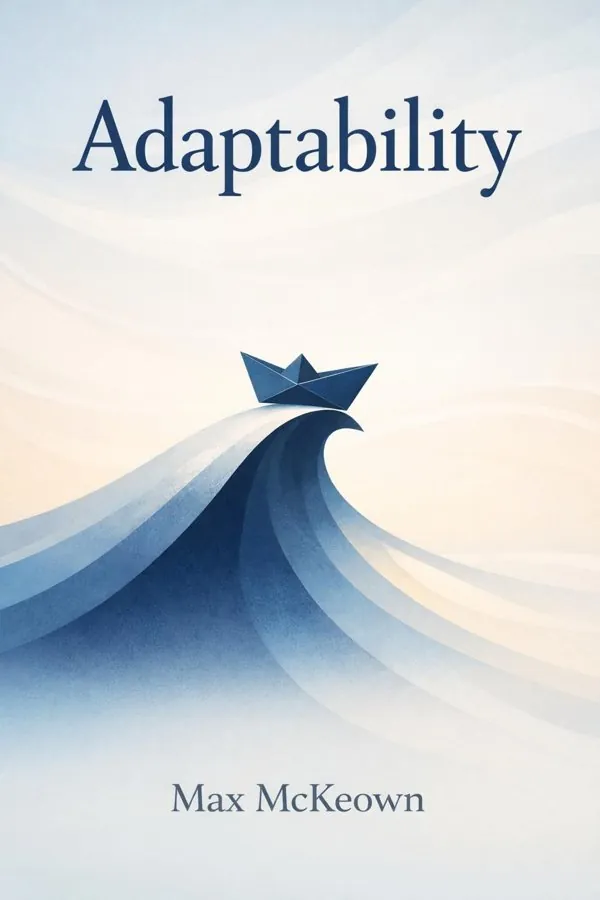
Adaptability: The Art of Winning in an Age of Uncertainty: Summary & Key Insights
by Max McKeown
 10 min8 chaptersAudio available
Key Takeaways from Adaptability: The Art of Winning in an Age of Uncertainty
Most people talk about adaptation as if it were an emergency response, but McKeown makes a more ambitious claim: real adaptability is about winning, not just enduring.
Before change becomes operational, financial, or strategic, it becomes emotional.
McKeown’s adaptability loop offers a simple but powerful model: perceive, respond, learn.
Resistance to change is often treated as a flaw in people, but McKeown presents it as a normal human reaction that can be understood and addressed.
McKeown treats adaptability as a leadership imperative because the adaptive capacity of any group reflects the behavior of its leaders.
What Is Adaptability: The Art of Winning in an Age of Uncertainty About?
Adaptability: The Art of Winning in an Age of Uncertainty by Max McKeown is a leadership book spanning 6 pages. Adaptability: The Art of Winning in an Age of Uncertainty is a practical leadership and business guide for anyone trying to succeed in a world where change arrives faster than plans can keep up. Max McKeown argues that adaptability is not merely about survival or defensive adjustment. It is about positioning yourself, your team, and your organization to learn quickly, respond intelligently, and turn uncertainty into advantage. Rather than treating change as an interruption, he presents it as the defining condition of modern life. What makes the book especially valuable is its blend of disciplines. McKeown draws from evolution, psychology, strategy, and real business examples to show how adaptive success actually works. He explains why some people freeze when conditions shift, why some organizations cling to outdated assumptions, and why others use disruption to reinvent themselves. The book offers memorable principles, practical rules, and a clear framework for thinking and acting under pressure. McKeown writes with the authority of a seasoned consultant, strategist, and leadership thinker who has spent years advising organizations on innovation and change. His central message is simple but powerful: in uncertain times, the winners are not the strongest or the smartest, but the most adaptable.
This FizzRead summary covers all 8 key chapters of Adaptability: The Art of Winning in an Age of Uncertainty in approximately 10 minutes, distilling the most important ideas, arguments, and takeaways from Max McKeown's work. Also available as an audio summary and Key Quotes Podcast.
Adaptability: The Art of Winning in an Age of Uncertainty
Adaptability: The Art of Winning in an Age of Uncertainty is a practical leadership and business guide for anyone trying to succeed in a world where change arrives faster than plans can keep up. Max McKeown argues that adaptability is not merely about survival or defensive adjustment. It is about positioning yourself, your team, and your organization to learn quickly, respond intelligently, and turn uncertainty into advantage. Rather than treating change as an interruption, he presents it as the defining condition of modern life.
What makes the book especially valuable is its blend of disciplines. McKeown draws from evolution, psychology, strategy, and real business examples to show how adaptive success actually works. He explains why some people freeze when conditions shift, why some organizations cling to outdated assumptions, and why others use disruption to reinvent themselves. The book offers memorable principles, practical rules, and a clear framework for thinking and acting under pressure.
McKeown writes with the authority of a seasoned consultant, strategist, and leadership thinker who has spent years advising organizations on innovation and change. His central message is simple but powerful: in uncertain times, the winners are not the strongest or the smartest, but the most adaptable.
Who Should Read Adaptability: The Art of Winning in an Age of Uncertainty?
This book is perfect for anyone interested in leadership and looking to gain actionable insights in a short read. Whether you're a student, professional, or lifelong learner, the key ideas from Adaptability: The Art of Winning in an Age of Uncertainty by Max McKeown will help you think differently.
- ✓Readers who enjoy leadership and want practical takeaways
- ✓Professionals looking to apply new ideas to their work and life
- ✓Anyone who wants the core insights of Adaptability: The Art of Winning in an Age of Uncertainty in just 10 minutes
Want the full summary?
Get instant access to this book summary and 100K+ more with Fizz Moment.
Get Free SummaryAvailable on App Store • Free to download
Key Chapters
Most people talk about adaptation as if it were an emergency response, but McKeown makes a more ambitious claim: real adaptability is about winning, not just enduring. Survival matters, of course. If a company cannot absorb shocks, stay solvent, or respond to immediate threats, it will not last. But survival alone is a low bar. It often produces cautious behavior, defensive thinking, and a culture that treats every change as a threat. McKeown argues that adaptive leaders go further. They use change to improve their position.
This distinction reshapes how we think about uncertainty. A business that merely survives new competition might cut costs, protect existing products, and try to hold on. A business that adapts to win asks different questions: What new customer needs are emerging? Which assumptions are becoming obsolete? Where can disruption create a strategic opening? The same logic applies to careers. A professional who adapts to survive learns only enough to stay relevant. One who adapts to win actively develops new capabilities before they become mandatory.
McKeown’s insight is especially useful in leadership. Teams take emotional cues from their leaders. If leaders frame change as something to fear, people become hesitant and rigid. If leaders frame change as a challenge that can reveal opportunity, people become more inventive and resilient. Consider how technology companies often use market shifts to launch new business models while slower competitors attempt only to preserve old ones.
The practical lesson is to stop asking, “How do we protect what we have?” and start asking, “How do we use this change to get better?” Actionable takeaway: when facing uncertainty, define one move that strengthens your future position rather than merely defending your current one.
Before change becomes operational, financial, or strategic, it becomes emotional. McKeown emphasizes that adaptability begins in the mind because people do not react to change objectively. They react through fear, hope, habits, identity, and assumptions. This is why the same event can energize one person and paralyze another. The external shift may be the same, but the internal interpretation differs.
One reason change feels threatening is that it disrupts predictability. Human beings like patterns because patterns reduce cognitive effort and create a sense of control. When familiar routines stop working, we often deny the need to change, delay action, or search for proof that the old way will soon return. Organizations do the same thing. Teams cling to established metrics, familiar structures, and past successes, even when the environment has already moved on.
McKeown shows that adaptable people develop a healthier relationship with uncertainty. They are not fearless; they simply learn to notice their reactions without being ruled by them. They become more curious than defensive. In practice, this means leaders should expect resistance, not interpret it as irrationality, and actively help people move through it. Communication matters here. If a manager announces change without context, people fill the gaps with anxiety. If the manager explains what is changing, why it matters, and how people can contribute, uncertainty becomes easier to bear.
A practical example is digital transformation. Employees often resist new systems not because they hate improvement, but because they fear incompetence, loss of status, or increased complexity. Good leaders address these fears directly through training, involvement, and reassurance.
Actionable takeaway: the next time change triggers resistance, identify the emotional story behind it and replace vague fear with specific, discussable concerns.
McKeown’s adaptability loop offers a simple but powerful model: perceive, respond, learn. It sounds straightforward, yet many individuals and organizations fail at one of these stages. They either do not notice change early enough, respond too slowly or rigidly, or fail to learn from the outcomes of their actions. The strength of the loop is that it turns adaptability into a repeatable discipline rather than a vague personality trait.
Perceiving means paying attention to signals from the environment. This includes market shifts, customer feedback, technological trends, social changes, and internal warning signs. Many failures begin with selective blindness. People see only what confirms what they already believe. Responding means taking action based on what has been observed. The response does not have to be perfect, but it must be timely. In uncertainty, speed of adjustment often matters more than elegance of planning. Learning means reviewing results honestly and using that feedback to improve future decisions.
The loop works in both personal and organizational life. A product team might perceive declining user engagement, respond by simplifying features or changing onboarding, and learn from customer data. A manager might notice rising burnout, respond by adjusting workloads and communication rhythms, then learn what actually improves team energy. The loop encourages experimentation because it assumes that learning comes through action, not endless analysis.
What makes this framework so useful is its humility. It accepts that no one can predict everything. Instead of demanding certainty upfront, it builds progress through observation and iteration. This is especially valuable in fast-moving environments where plans age quickly.
Actionable takeaway: choose one challenge this week and run the full loop deliberately by identifying what you need to notice, what response you will test, and how you will capture the lesson.
Resistance to change is often treated as a flaw in people, but McKeown presents it as a normal human reaction that can be understood and addressed. People resist for many reasons: they fear loss, distrust leadership, feel excluded from decisions, or simply lack the confidence to operate in a new situation. When leaders dismiss resistance as negativity, they usually intensify it. When they study it, they gain clues about what must be improved.
McKeown’s view encourages leaders to build adaptive capacity before crisis strikes. Adaptive capacity is the combination of mindset, skills, relationships, and processes that makes change easier to absorb. In a team with high adaptive capacity, people are used to learning, speaking up, experimenting, and revising assumptions. In a team with low adaptive capacity, even small changes feel destabilizing.
One practical implication is that adaptability is not built through slogans. It is built through repeated experiences that teach people change can be handled. For example, a company that runs small pilots, reviews mistakes without blame, and shares lessons openly creates confidence in motion. People become less attached to one fixed method because they have seen that adjustment can produce better results. Another important factor is participation. When people help shape change, they support it more readily. Ownership reduces fear.
Leaders can also reduce unnecessary resistance by removing ambiguity where possible. Explain what is changing, what is not changing, how success will be measured, and where support is available. The goal is not to eliminate discomfort entirely but to make progress easier than paralysis.
Actionable takeaway: when facing resistance, ask three questions: What are people afraid of losing, what support do they need, and how can they be involved in the change?
McKeown treats adaptability as a leadership imperative because the adaptive capacity of any group reflects the behavior of its leaders. Leaders define what gets noticed, what gets rewarded, and what is safe to question. If they cling to old assumptions, punish dissent, or confuse certainty with competence, the organization becomes brittle. If they remain curious, encourage learning, and act decisively without pretending to know everything, adaptability spreads.
This requires a shift in what leadership looks like. Traditional leadership models often celebrate control, consistency, and command. Those qualities may help in stable settings, but uncertainty demands something more flexible. Adaptive leaders do not abandon direction; they provide direction while staying open to revision. They set intent without over-specifying every step. They create alignment around purpose, then empower local judgment.
A strong example is found in organizations that operate in volatile markets. Leaders who insist that all decisions flow upward create bottlenecks and slow response times. Leaders who equip teams with principles, information, and authority allow faster adjustment. McKeown’s broader point is that adaptability is not chaos. It is disciplined flexibility.
Leaders also shape how failure is interpreted. If every mistake is punished, people hide problems and avoid experimentation. If intelligent risk is respected and lessons are extracted, teams become more capable. This does not mean lowering standards. It means distinguishing between careless errors and useful learning.
Ultimately, adaptive leadership is cultural leadership. It determines whether change is experienced as disruption to be survived or as a shared challenge that can be mastered. Actionable takeaway: model the behavior you want to see by openly revising one of your own assumptions and showing your team that learning is a strength, not a weakness.
One of McKeown’s most practical insights is that adaptability is strengthened through action, not theory alone. People often wait for perfect clarity before moving, but in uncertain environments clarity usually arrives after experimentation, not before it. This means adaptive individuals and organizations treat action as a way of learning. They run tests, gather feedback, and refine their approach instead of betting everything on one grand prediction.
This idea is especially relevant in innovation and strategy. A company entering a new market rarely knows the ideal pricing model, customer segment, or product configuration at the start. The most adaptive firms use pilots, prototypes, and staged investments to reduce uncertainty. They do not confuse caution with inaction. Similarly, an individual facing career disruption might try a course, side project, or networking effort rather than waiting until they feel completely ready.
Experimentation also changes the emotional texture of change. Large transformations feel abstract and overwhelming. Small experiments feel manageable. They convert fear into evidence. For instance, a department unsure about remote work can test flexible arrangements with one team, measure outcomes, and expand based on what works. A school trying a new teaching method can pilot it in one class before redesigning the whole system.
McKeown’s philosophy does not glorify reckless trial and error. Good experiments are purposeful. They are designed to answer real questions and produce actionable insights. The key is to stay in motion without becoming random. In uncertain conditions, movement with feedback beats waiting for certainty that never comes.
Actionable takeaway: break your next major change into one low-risk experiment that will teach you something concrete within a short time frame.
Adaptability is often described as a mindset, but McKeown shows that mindset alone is not enough. Organizations become adaptable when their daily rules, routines, and habits support flexible thinking and timely action. A team may say it values innovation, but if approvals take months, information is hoarded, and mistakes are punished, the real culture favors caution and delay. Adaptive culture is built through systems that make learning easier than stagnation.
This insight matters because culture is often too abstract to change directly. People cannot simply be told to “be more adaptive.” They need structures that encourage adaptive behavior. Short review cycles, open communication, cross-functional collaboration, and regular customer feedback are examples of such structures. These practices help teams detect change earlier and respond with less friction. Conversely, rigid hierarchies, outdated incentives, and silos create organizational blindness.
McKeown’s argument suggests leaders should audit not just beliefs but operating norms. What gets measured? How quickly can a decision be revised? Are frontline observations heard? Do people have time to reflect and learn, or are they trapped in reactive busyness? Even simple rituals can make a difference. A weekly meeting that asks, “What changed this week that matters?” can sharpen perception across a team.
The same principle applies personally. If you want to become more adaptable, your routines must support that goal. Reading widely, seeking feedback, reviewing failures, and regularly learning new skills all create adaptive habits. Adaptability is less about heroic flexibility in rare moments and more about practicing responsiveness every day.
Actionable takeaway: identify one routine, metric, or meeting in your environment that rewards rigidity, and redesign it to encourage learning, feedback, and faster adjustment.
McKeown repeatedly returns to a powerful truth: in uncertain times, the biggest advantage often belongs to those who learn fastest. Strength, size, and experience matter, but they can become liabilities if they produce complacency. Organizations that assume their past success guarantees future relevance stop paying attention. They interpret new developments through old categories and miss the need to evolve. Curious organizations behave differently. They treat every shift as information.
Curiosity is not softness. It is strategic alertness. A curious company listens closely to customers, studies emerging technologies, watches competitors, and asks uncomfortable questions about its own assumptions. It avoids the arrogance of believing it already knows enough. This learning orientation allows it to reframe threats as signals. For example, streaming services succeeded not just because technology changed, but because some leaders were willing to rethink how people wanted to consume entertainment. Others were too committed to physical distribution models to adapt in time.
At the team level, curiosity encourages better conversations. Instead of defending ideas too early, people explore possibilities. Instead of asking who is to blame, they ask what can be learned. This reduces ego-driven conflict and improves collective intelligence. McKeown’s broader point is that adaptability depends on an organization’s ability to revise its mental models. If the world changes but your interpretation of the world does not, your actions will drift further from reality.
For individuals, curiosity protects against obsolescence. Professionals who keep learning across disciplines, technologies, and industries are better able to spot opportunities and connect ideas in new ways.
Actionable takeaway: schedule regular time to explore trends, feedback, or perspectives outside your normal routine so learning becomes proactive rather than crisis-driven.
All Chapters in Adaptability: The Art of Winning in an Age of Uncertainty
About the Author
Max McKeown is a British author, strategist, consultant, and speaker whose work focuses on innovation, leadership, strategic thinking, and organizational change. He is known for helping leaders and companies navigate uncertainty by thinking more creatively and acting more effectively. Across his books, articles, and advisory work, McKeown has explored how ideas become action and how organizations can remain competitive in fast-changing environments. His writing stands out for combining practical business insight with ideas drawn from psychology, science, and management theory. In Adaptability, he brings these strengths together to show why flexibility is one of the most important capabilities in modern leadership. McKeown has built a strong reputation as a clear, engaging thinker who translates complex challenges into useful principles for professionals, executives, and teams.
Get This Summary in Your Preferred Format
Read or listen to the Adaptability: The Art of Winning in an Age of Uncertainty summary by Max McKeown anytime, anywhere. FizzRead offers multiple formats so you can learn on your terms — all free.
Available formats: App · Audio · PDF · EPUB — All included free with FizzRead
Download Adaptability: The Art of Winning in an Age of Uncertainty PDF and EPUB Summary
Key Quotes from Adaptability: The Art of Winning in an Age of Uncertainty
“Most people talk about adaptation as if it were an emergency response, but McKeown makes a more ambitious claim: real adaptability is about winning, not just enduring.”
“Before change becomes operational, financial, or strategic, it becomes emotional.”
“McKeown’s adaptability loop offers a simple but powerful model: perceive, respond, learn.”
“Resistance to change is often treated as a flaw in people, but McKeown presents it as a normal human reaction that can be understood and addressed.”
“McKeown treats adaptability as a leadership imperative because the adaptive capacity of any group reflects the behavior of its leaders.”
Frequently Asked Questions about Adaptability: The Art of Winning in an Age of Uncertainty
Adaptability: The Art of Winning in an Age of Uncertainty by Max McKeown is a leadership book that explores key ideas across 8 chapters. Adaptability: The Art of Winning in an Age of Uncertainty is a practical leadership and business guide for anyone trying to succeed in a world where change arrives faster than plans can keep up. Max McKeown argues that adaptability is not merely about survival or defensive adjustment. It is about positioning yourself, your team, and your organization to learn quickly, respond intelligently, and turn uncertainty into advantage. Rather than treating change as an interruption, he presents it as the defining condition of modern life. What makes the book especially valuable is its blend of disciplines. McKeown draws from evolution, psychology, strategy, and real business examples to show how adaptive success actually works. He explains why some people freeze when conditions shift, why some organizations cling to outdated assumptions, and why others use disruption to reinvent themselves. The book offers memorable principles, practical rules, and a clear framework for thinking and acting under pressure. McKeown writes with the authority of a seasoned consultant, strategist, and leadership thinker who has spent years advising organizations on innovation and change. His central message is simple but powerful: in uncertain times, the winners are not the strongest or the smartest, but the most adaptable.
You Might Also Like
Extreme Ownership
Jocko Willink
10 min
Dare to Lead
Brene Brown
10 min
Leaders Eat Last
Simon Sinek
10 min
The 21 Irrefutable Laws of Leadership
John Maxwell
10 min
Start With Why
Simon Sinek
10 min
How to Lead When You're Not in Charge
Clay Scroggins
10 minBrowse by Category
Ready to read Adaptability: The Art of Winning in an Age of Uncertainty?
Get the full summary and 100K+ more books with Fizz Moment.