
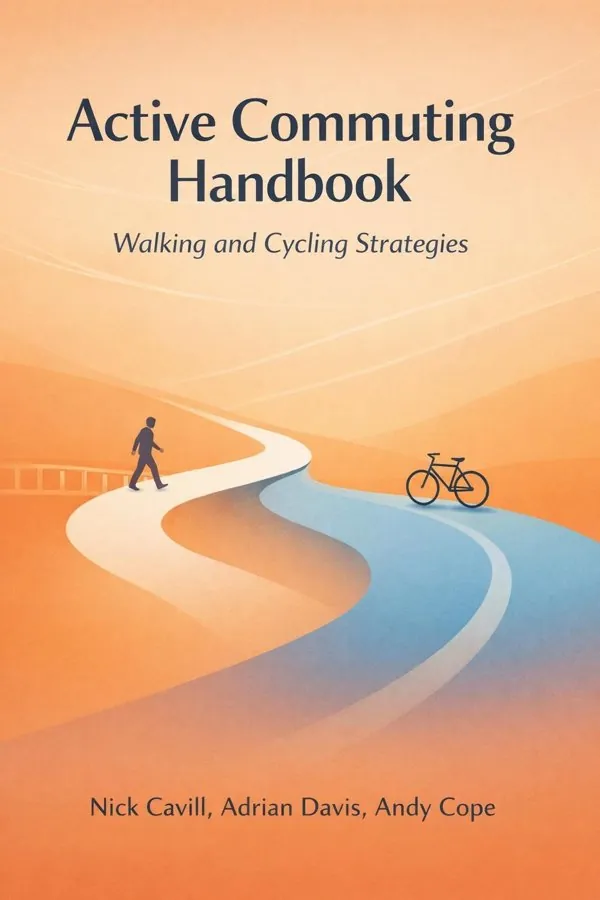
Active Commuting Handbook: Walking and Cycling Strategies: Summary & Key Insights
by Nick Cavill, Adrian Davis, Andy Cope
 10 min9 chaptersAudio available
Key Takeaways from Active Commuting Handbook: Walking and Cycling Strategies
The most powerful transport intervention may not be a new road at all, but a routine as ordinary as walking to work.
Travel behavior is often treated as a matter of personal choice, yet the book makes clear that choices are shaped by streets, distances, crossings, and design.
Commuting is not only a transport issue; it is also a workplace issue.
A short walk or bike ride may seem like a private choice, but the handbook shows that its benefits ripple through the economy and environment.
People do not choose routes based on engineering diagrams; they choose based on how safe they feel.
What Is Active Commuting Handbook: Walking and Cycling Strategies About?
Active Commuting Handbook: Walking and Cycling Strategies by Nick Cavill, Adrian Davis, Andy Cope is a health_med book spanning 4 pages. Active Commuting Handbook: Walking and Cycling Strategies is a practical guide to one of the most overlooked opportunities in public health and transport policy: turning everyday journeys into sources of exercise, cleaner air, and more livable communities. Rather than treating walking and cycling as niche hobbies or purely environmental choices, the book argues that active travel should be built into the way towns, cities, workplaces, and transport systems function. It brings together evidence on health, behavior change, urban planning, economics, and policy, showing how commuting habits can be reshaped through smart design and coordinated action. What makes this handbook especially valuable is its blend of research and application. It does not stop at saying active commuting is beneficial; it explains how local authorities, employers, planners, and public health leaders can make it normal, safe, and attractive. Nick Cavill, Adrian Davis, and Andy Cope write with strong authority, drawing on experience in physical activity promotion, transport research, and sustainable mobility practice. The result is a concise but influential handbook for anyone who wants to create healthier people, less congested roads, and places designed around human movement rather than car dependency.
This FizzRead summary covers all 9 key chapters of Active Commuting Handbook: Walking and Cycling Strategies in approximately 10 minutes, distilling the most important ideas, arguments, and takeaways from Nick Cavill, Adrian Davis, Andy Cope's work. Also available as an audio summary and Key Quotes Podcast.
Active Commuting Handbook: Walking and Cycling Strategies
Active Commuting Handbook: Walking and Cycling Strategies is a practical guide to one of the most overlooked opportunities in public health and transport policy: turning everyday journeys into sources of exercise, cleaner air, and more livable communities. Rather than treating walking and cycling as niche hobbies or purely environmental choices, the book argues that active travel should be built into the way towns, cities, workplaces, and transport systems function. It brings together evidence on health, behavior change, urban planning, economics, and policy, showing how commuting habits can be reshaped through smart design and coordinated action.
What makes this handbook especially valuable is its blend of research and application. It does not stop at saying active commuting is beneficial; it explains how local authorities, employers, planners, and public health leaders can make it normal, safe, and attractive. Nick Cavill, Adrian Davis, and Andy Cope write with strong authority, drawing on experience in physical activity promotion, transport research, and sustainable mobility practice. The result is a concise but influential handbook for anyone who wants to create healthier people, less congested roads, and places designed around human movement rather than car dependency.
Who Should Read Active Commuting Handbook: Walking and Cycling Strategies?
This book is perfect for anyone interested in health_med and looking to gain actionable insights in a short read. Whether you're a student, professional, or lifelong learner, the key ideas from Active Commuting Handbook: Walking and Cycling Strategies by Nick Cavill, Adrian Davis, Andy Cope will help you think differently.
- ✓Readers who enjoy health_med and want practical takeaways
- ✓Professionals looking to apply new ideas to their work and life
- ✓Anyone who wants the core insights of Active Commuting Handbook: Walking and Cycling Strategies in just 10 minutes
Want the full summary?
Get instant access to this book summary and 100K+ more with Fizz Moment.
Get Free SummaryAvailable on App Store • Free to download
Key Chapters
The most powerful transport intervention may not be a new road at all, but a routine as ordinary as walking to work. One of the book’s central arguments is that active travel offers a rare policy win because it improves health, mobility, and quality of life at the same time. Walking and cycling are not simply ways to get from one place to another; they are built-in opportunities for daily physical activity. For many adults, structured exercise is difficult to sustain, but commuting happens regularly. That makes it one of the most reliable places to embed movement into everyday life.
The handbook highlights strong evidence linking active commuting with lower risks of chronic disease, better cardiovascular health, healthier body weight, improved mental well-being, and increased overall fitness. Even moderate activity accumulated through daily trips can produce meaningful benefits. Importantly, the book frames these gains not as individual lifestyle bonuses alone, but as public health outcomes that can reduce healthcare burdens across populations.
The authors also challenge the idea that exercise must be time-consuming to be valuable. A brisk walk to the bus stop, a short bike ride to the office, or a mixed-mode journey that includes both public transport and walking can all contribute to recommended activity levels. In that sense, active travel democratizes health: it can fit people with limited time, limited money, and varied fitness levels.
A practical application is to present active commuting not as a sacrifice, but as a time-efficient habit that combines travel with health maintenance. Employers can support this framing through wellness campaigns, while local authorities can communicate health benefits in transport messaging rather than leaving them only to medical professionals.
Actionable takeaway: Reframe commuting as a daily health opportunity and identify one regular trip that can include ten to twenty minutes of walking or cycling.
Travel behavior is often treated as a matter of personal choice, yet the book makes clear that choices are shaped by streets, distances, crossings, and design. People are far more likely to walk or cycle when the environment makes those options feel direct, safe, comfortable, and socially normal. If roads are hostile, junctions are dangerous, sidewalks are narrow, and destinations are disconnected, even highly motivated people may default to the car.
This is why the authors place such emphasis on planning. Integrating walking and cycling into transport systems requires more than adding isolated bike lanes or painting symbols on roads. It calls for a people-centered approach in which active travel is considered from the beginning of infrastructure and land-use decisions. Streets must connect homes to schools, workplaces, shops, and transit hubs. Routes should be continuous, visible, and convenient. Crossings should prioritize pedestrians where appropriate, and cycling networks should reduce conflict with fast-moving traffic.
The handbook also emphasizes that transport planning should not measure success only by vehicle speed. A road that moves cars quickly but discourages walking may perform poorly from a public health and urban quality standpoint. By contrast, a street that supports slower traffic, safe crossings, and protected cycling may produce wider social value.
Examples include creating school routes that reduce parental fear, redesigning commuter corridors with protected cycle tracks, and ensuring new developments include direct walking links to public transport. These interventions can shift behavior because they reduce friction and perceived risk.
Actionable takeaway: Audit one commuting corridor from the perspective of a pedestrian or cyclist and identify the specific design barriers that make active travel feel inconvenient or unsafe.
Commuting is not only a transport issue; it is also a workplace issue. One of the handbook’s strongest insights is that employers can meaningfully shape how people travel, even when they do not control the wider road network. Workplaces influence norms, incentives, schedules, facilities, and expectations. If an employer offers only abundant free parking and no showers, bike storage, or flexible start times, it sends a clear signal about what kind of commuter is expected.
The book argues that creating a culture of active commuting requires policies that go beyond encouragement slogans. Employees are more likely to walk or cycle when workplaces provide practical support: secure bike parking, lockers, drying areas, shower access, mileage reimbursement for cycling, route information, and links to public transport. Travel plans can help organizations assess how staff currently commute and set realistic goals for change.
Behavior change works best when the environment and the message align. For example, an employer might run a cycle-to-work challenge, but unless staff also feel their bikes will be secure and their commute reasonably safe, enthusiasm will fade. Likewise, senior leaders who visibly walk, cycle, or use transit can reinforce credibility. The handbook suggests combining infrastructure, incentives, and communication rather than relying on any single tool.
Practical examples include subsidized bike purchase schemes, reduced parking availability paired with improved alternatives, and induction materials that show new employees safe active travel routes. Even small employers can support active commuting through partnerships with neighboring businesses or local councils.
Actionable takeaway: If you influence a workplace, start with a simple travel plan that matches one motivational campaign with one concrete facility improvement.
A short walk or bike ride may seem like a private choice, but the handbook shows that its benefits ripple through the economy and environment. Active commuting reduces traffic congestion, lowers emissions, decreases noise, improves local air quality, and can reduce pressure on health systems. In policy terms, this matters because transport investments are often judged by financial returns. The authors make the case that walking and cycling are not just ethically desirable; they are economically smart.
The book points to the broad value created when more people travel actively. Fewer car trips can reduce wear on infrastructure and cut delays caused by crowded roads. Healthier populations can mean fewer sick days, better productivity, and lower long-term public costs linked to inactivity-related illness. Local shops may benefit too, since pedestrians and cyclists often engage with high streets differently than drivers passing through quickly.
Environmental gains are equally important. Shifting even a portion of short urban trips from cars to walking or cycling can significantly reduce transport-related carbon emissions. Because many car journeys are very short, they are especially inefficient and polluting relative to their distance. Replacing those trips can deliver outsized environmental benefits.
The handbook also reminds readers that these gains strengthen the political case for action. When advocates can show that active travel supports climate goals, economic resilience, and public health simultaneously, they widen their coalition and improve the chances of sustained funding.
Actionable takeaway: When promoting active travel, present it as a multi-benefit investment by linking health, congestion, emissions, and economic productivity in the same conversation.
People do not choose routes based on engineering diagrams; they choose based on how safe they feel. A major theme running through the handbook is that perceived safety can be just as important as measured safety. Even where collision rates are statistically low, people may avoid walking or cycling if roads feel intimidating, crossings feel rushed, or cycling means mixing with high-speed traffic. This is especially true for children, older adults, and less confident riders.
The authors argue that normalizing active commuting requires reducing both actual danger and the fear of danger. Infrastructure plays a central role here. Protected cycle lanes, well-maintained sidewalks, traffic calming, lower urban speed limits, better street lighting, and clear crossings all help make active travel more inviting. But safety is also social and cultural. If walking and cycling are visible and common, they feel more legitimate and expected. If they seem marginal, people may assume they are risky or inconvenient.
Practical interventions include redesigning junctions where cyclists are most exposed, improving winter maintenance on paths, and removing street clutter that obstructs pedestrians. Communication matters too: route maps showing quieter streets or recommended cycle corridors can help beginners build confidence. Training programs for adults and children can further reduce uncertainty.
The book’s message is not that people must become braver. It is that systems should become more forgiving. The burden should not fall on individuals to tolerate poor conditions simply because active travel is good for them.
Actionable takeaway: Identify whether the main barrier in your context is actual danger, perceived danger, or both, and prioritize changes that make active travel feel safe to the least confident user.
Public health transformations rarely begin with dramatic gestures; they begin with ordinary habits repeated across large numbers of people. The handbook emphasizes that active commuting policy should not focus only on turning drivers into long-distance cyclists overnight. A more realistic and effective strategy is to enable many small shifts: one fewer car trip per week, walking part of a journey, cycling short local trips, or combining rail and bus travel with walking.
This population approach matters because it broadens the target audience. Not everyone can or wants to cycle ten miles to work. But many people can walk to a local destination, get off the bus one stop earlier, or ride a bike for the final leg of their commute if conditions allow. The cumulative health and environmental effects of these modest changes can be substantial when adopted across a city or workforce.
The authors also recognize that commuting decisions are shaped by routine. Once people establish a travel pattern, they tend to repeat it. That means transition moments are especially important: moving house, changing jobs, starting university, returning from parental leave, or beginning work in a new office. These are moments when people may be more open to new travel habits if they receive the right information and support.
Examples include welcome packs for new residents, personalized journey planning for staff joining an organization, or integrated ticketing that makes multimodal travel easier. Rather than demanding ideal behavior, the book encourages practical progression.
Actionable takeaway: Focus on the next feasible improvement in travel behavior, not the perfect one, and target support at life changes when routines are already in flux.
One of the reasons active commuting struggles to advance is that it falls between sectors. Transport departments may see it as a health issue, health teams may see it as a planning matter, and employers may assume it belongs to local government. The handbook argues that lasting progress depends on integration: active travel must be embedded across policy areas rather than treated as an optional add-on.
This means public health strategies should include transport objectives, while transport plans should explicitly account for health outcomes. Land-use policy should support compact, connected development instead of car-dependent sprawl. School travel planning, workplace mobility management, climate action plans, and regeneration projects should all align around making walking and cycling practical and desirable. Without this coordination, isolated interventions often underperform.
The authors suggest that leadership, targets, and accountability are essential. If agencies share goals but not responsibilities, little changes. By contrast, when authorities establish measurable objectives, dedicate budgets, and define who must deliver what, active travel moves from aspiration to implementation. The book also highlights the value of cross-sector partnerships, since no single institution controls all the necessary levers.
A practical example might be a city linking health improvement funds with street redesign projects near major employment centers, while employers simultaneously update parking policy and transit incentives. Another is requiring new developments to demonstrate walking and cycling access before approval.
Actionable takeaway: Treat active commuting as a cross-sector system issue and map which departments, organizations, and policies must align for your desired behavior change to become realistic.
What gets measured gets funded, and the handbook repeatedly underscores the importance of evidence, monitoring, and evaluation. Advocates for walking and cycling often know these modes are beneficial, but decision-makers need more than enthusiasm. They need data showing what problems exist, which interventions work, and what outcomes follow. Without this, active travel can be dismissed as symbolic or secondary compared with major road schemes.
The authors encourage the use of both quantitative and qualitative measures. Counts of pedestrians and cyclists, mode share data, commuting surveys, health indicators, collision data, and emissions estimates can all help demonstrate impact. But numbers alone may miss how people experience change. Interviews, focus groups, and user feedback can reveal whether routes feel safer, whether facilities are actually used, and why some groups remain excluded.
Importantly, the book implies that evaluation should be built into projects from the start. If a workplace installs cycle parking, it should also track commuting patterns before and after. If a city redesigns a corridor, it should measure not just traffic flow but walking levels, cycling uptake, and user satisfaction. Case studies become more persuasive when they include clear lessons rather than just promotional claims.
Better metrics also improve strategy. They help identify where uptake is strongest, where barriers remain, and whether interventions are reaching women, older adults, lower-income groups, or other populations that may face specific obstacles.
Actionable takeaway: Pair every active travel initiative with a simple evaluation plan that captures usage, user experience, and at least one broader outcome such as health, congestion, or emissions.
The deepest idea in the handbook is that active commuting is not only about transport behavior; it is about the kind of places we choose to build. Streets designed for walking and cycling tend to be more humane, social, and adaptable. They encourage street life, increase contact with local surroundings, and make neighborhoods feel less dominated by speed and traffic. In this sense, active travel is both a mobility strategy and a vision of urban life.
The authors suggest that when people move through places at human speed, they notice more. They are more likely to interact with others, support local businesses, and feel connected to their surroundings. Children gain independence when routes are safe. Older adults retain mobility when walking environments are accessible. Communities become less fragmented when crossing a street is not a stressful act.
This broader perspective matters because it elevates active commuting beyond a technical intervention. It becomes part of how cities pursue equity, public realm quality, and social well-being. A neighborhood that is pleasant to walk through is often also one that is easier to include, enjoy, and inhabit. Cycling and walking infrastructure can therefore be understood as investments in place quality as much as in transport efficiency.
Examples include town centers with reduced traffic dominance, mixed-use neighborhoods where daily needs are close at hand, and green corridors that make commuting restorative rather than stressful. The book invites readers to imagine mobility systems that support everyday dignity.
Actionable takeaway: Evaluate active commuting projects not only by trips shifted, but by how they improve the overall experience, accessibility, and livability of the places people move through.
All Chapters in Active Commuting Handbook: Walking and Cycling Strategies
About the Authors
Nick Cavill, Adrian Davis, and Andy Cope are leading voices in the field of active travel and healthy transport policy. Nick Cavill is a public health consultant known for his work on physical activity promotion and the links between everyday movement, prevention, and policy. Adrian Davis is a transport and health researcher whose work has helped connect mobility planning with evidence on public well-being, sustainability, and urban systems. Andy Cope has been closely associated with Sustrans and is widely recognized for his expertise in walking, cycling, and behavior change strategies that make active travel more practical and appealing. Together, they combine public health insight, research credibility, and implementation experience, making them especially well qualified to write a handbook on how walking and cycling can be embedded into daily commuting and wider transport planning.
Get This Summary in Your Preferred Format
Read or listen to the Active Commuting Handbook: Walking and Cycling Strategies summary by Nick Cavill, Adrian Davis, Andy Cope anytime, anywhere. FizzRead offers multiple formats so you can learn on your terms — all free.
Available formats: App · Audio · PDF · EPUB — All included free with FizzRead
Download Active Commuting Handbook: Walking and Cycling Strategies PDF and EPUB Summary
Key Quotes from Active Commuting Handbook: Walking and Cycling Strategies
“The most powerful transport intervention may not be a new road at all, but a routine as ordinary as walking to work.”
“Travel behavior is often treated as a matter of personal choice, yet the book makes clear that choices are shaped by streets, distances, crossings, and design.”
“Commuting is not only a transport issue; it is also a workplace issue.”
“A short walk or bike ride may seem like a private choice, but the handbook shows that its benefits ripple through the economy and environment.”
“People do not choose routes based on engineering diagrams; they choose based on how safe they feel.”
Frequently Asked Questions about Active Commuting Handbook: Walking and Cycling Strategies
Active Commuting Handbook: Walking and Cycling Strategies by Nick Cavill, Adrian Davis, Andy Cope is a health_med book that explores key ideas across 9 chapters. Active Commuting Handbook: Walking and Cycling Strategies is a practical guide to one of the most overlooked opportunities in public health and transport policy: turning everyday journeys into sources of exercise, cleaner air, and more livable communities. Rather than treating walking and cycling as niche hobbies or purely environmental choices, the book argues that active travel should be built into the way towns, cities, workplaces, and transport systems function. It brings together evidence on health, behavior change, urban planning, economics, and policy, showing how commuting habits can be reshaped through smart design and coordinated action. What makes this handbook especially valuable is its blend of research and application. It does not stop at saying active commuting is beneficial; it explains how local authorities, employers, planners, and public health leaders can make it normal, safe, and attractive. Nick Cavill, Adrian Davis, and Andy Cope write with strong authority, drawing on experience in physical activity promotion, transport research, and sustainable mobility practice. The result is a concise but influential handbook for anyone who wants to create healthier people, less congested roads, and places designed around human movement rather than car dependency.
You Might Also Like

On Immunity
Eula Biss
10 min
The Three-Body Problem
Liu Cixin
10 min
Community Health Volunteer Toolkit: Training and Practical Activities
World Health Organization
10 min
Healing Back Pain: The Mind-Body Connection
John E. Sarno
10 min
Health Literacy for All: Practical Guides to Communicate Health Information (Compilations)
World Health Organization
10 min
The Complete Guide to Sports Supplements: An Evidence-Based Review
Anita Bean
10 minBrowse by Category
Ready to read Active Commuting Handbook: Walking and Cycling Strategies?
Get the full summary and 100K+ more books with Fizz Moment.