
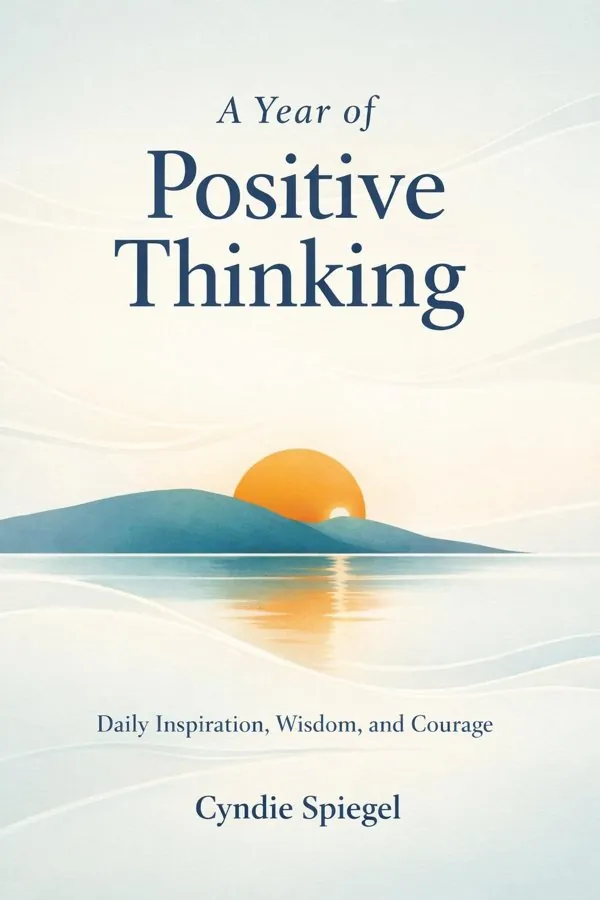
A Year of Positive Thinking: Daily Inspiration, Wisdom, and Courage: Summary & Key Insights
 10 min9 chaptersAudio available
Key Takeaways from A Year of Positive Thinking: Daily Inspiration, Wisdom, and Courage
The thoughts you repeat most often eventually sound like the truth, whether they help you or harm you.
You cannot shift a pattern you refuse to notice.
Joy often disappears not because life has none to offer, but because attention has been captured by worry, comparison, and speed.
In A Year of Positive Thinking, resilience is not the absence of struggle.
Many people speak to themselves with a level of harshness they would never direct at someone they love.
What Is A Year of Positive Thinking: Daily Inspiration, Wisdom, and Courage About?
A Year of Positive Thinking: Daily Inspiration, Wisdom, and Courage by Cyndie Spiegel is a positive_psych book spanning 8 pages. A Year of Positive Thinking by Cyndie Spiegel is a daily companion for anyone who wants to build a more hopeful, grounded, and compassionate way of living. Rather than offering positivity as a shallow command to "just be happy," Spiegel presents it as a steady practice: a way of meeting everyday life with intention, courage, and kindness. Through short reflections, affirmations, and prompts spread across the year, she helps readers strengthen emotional resilience, become more self-aware, and reconnect with what matters most. What makes this book valuable is its accessibility. You do not need to overhaul your life overnight. Instead, Spiegel shows how small shifts in thought, attention, and language can gradually reshape your inner world. Her approach blends encouragement with honesty, acknowledging struggle while still making room for hope. That balance is why the book resonates with readers facing stress, self-doubt, transition, or emotional fatigue. As a speaker, author, and advocate for authenticity and personal growth, Spiegel writes with warmth and lived conviction. Her message is clear: positivity is not denial. It is a daily decision to return to yourself with grace and begin again.
This FizzRead summary covers all 9 key chapters of A Year of Positive Thinking: Daily Inspiration, Wisdom, and Courage in approximately 10 minutes, distilling the most important ideas, arguments, and takeaways from Cyndie Spiegel's work. Also available as an audio summary and Key Quotes Podcast.
A Year of Positive Thinking: Daily Inspiration, Wisdom, and Courage
A Year of Positive Thinking by Cyndie Spiegel is a daily companion for anyone who wants to build a more hopeful, grounded, and compassionate way of living. Rather than offering positivity as a shallow command to "just be happy," Spiegel presents it as a steady practice: a way of meeting everyday life with intention, courage, and kindness. Through short reflections, affirmations, and prompts spread across the year, she helps readers strengthen emotional resilience, become more self-aware, and reconnect with what matters most.
What makes this book valuable is its accessibility. You do not need to overhaul your life overnight. Instead, Spiegel shows how small shifts in thought, attention, and language can gradually reshape your inner world. Her approach blends encouragement with honesty, acknowledging struggle while still making room for hope. That balance is why the book resonates with readers facing stress, self-doubt, transition, or emotional fatigue.
As a speaker, author, and advocate for authenticity and personal growth, Spiegel writes with warmth and lived conviction. Her message is clear: positivity is not denial. It is a daily decision to return to yourself with grace and begin again.
Who Should Read A Year of Positive Thinking: Daily Inspiration, Wisdom, and Courage?
This book is perfect for anyone interested in positive_psych and looking to gain actionable insights in a short read. Whether you're a student, professional, or lifelong learner, the key ideas from A Year of Positive Thinking: Daily Inspiration, Wisdom, and Courage by Cyndie Spiegel will help you think differently.
- ✓Readers who enjoy positive_psych and want practical takeaways
- ✓Professionals looking to apply new ideas to their work and life
- ✓Anyone who wants the core insights of A Year of Positive Thinking: Daily Inspiration, Wisdom, and Courage in just 10 minutes
Want the full summary?
Get instant access to this book summary and 100K+ more with Fizz Moment.
Get Free SummaryAvailable on App Store • Free to download
Key Chapters
The thoughts you repeat most often eventually sound like the truth, whether they help you or harm you. That is the central power behind affirmations in A Year of Positive Thinking. Cyndie Spiegel does not treat affirmations as magical phrases that erase pain or instantly transform reality. Instead, she frames them as intentional statements that interrupt habitual negativity and train the mind toward possibility, self-respect, and courage.
Many people live with a relentless internal narrator that says, "I am behind," "I am not enough," or "Nothing ever works out for me." Spiegel argues that these patterns are often so familiar we mistake them for facts. Daily affirmations create a pause. They offer an alternative voice: "I am learning," "I can begin again," or "I am worthy of kindness today." Repeating such language consistently can soften self-criticism and gradually build a more stable emotional foundation.
The practical value lies in repetition linked to ordinary life. You might begin your morning by reading one affirmation before checking your phone. You might write a single sentence on a sticky note and place it on your mirror. Before a difficult conversation, you could repeat, "I can be honest and calm." During a hard season, a phrase like "This moment is not my whole story" can become an anchor.
Spiegel's deeper point is that mindset is not changed only by big breakthroughs. It is shaped by the words we rehearse every day. If your inner dialogue has become harsh, hurried, or hopeless, affirmations offer a gentle way to reclaim it.
Actionable takeaway: Choose one affirmation that speaks to your current challenge and repeat it each morning for the next seven days.
You cannot shift a pattern you refuse to notice. Spiegel places self-awareness at the root of positive thinking because optimism without honest observation becomes performative rather than healing. Before you can become more compassionate, resilient, or intentional, you have to see how you currently respond to stress, disappointment, uncertainty, and success.
Self-awareness in this book is not harsh self-analysis. It is a gentle practice of paying attention. What thoughts appear when you wake up? How do you speak to yourself after making a mistake? What kind of people, environments, or habits drain your energy? By noticing these patterns without immediate judgment, you create space to respond differently.
This matters because many negative cycles run automatically. A delayed email may trigger anxiety. A small criticism may spiral into shame. A demanding day may lead to emotional numbness or irritation with loved ones. Spiegel encourages readers to become curious rather than condemning. Curiosity asks, "Why did that affect me so strongly?" or "What do I need right now?" That shift alone can change the quality of your inner life.
Practical applications can be simple. Pause for two minutes at midday and ask yourself what emotion is strongest. Keep a journal of recurring thoughts. Notice what happens in your body during stress: tight shoulders, shallow breathing, clenched jaw. These signals are invitations to greater awareness, not evidence of failure.
Spiegel's message is clear: positivity does not start with pretending everything is fine. It begins with recognizing what is true within you, then meeting that truth with care.
Actionable takeaway: For one week, write down one recurring thought each day and ask whether it supports your well-being or undermines it.
Joy often disappears not because life has none to offer, but because attention has been captured by worry, comparison, and speed. Spiegel treats gratitude as a practice that helps us recover what we might otherwise overlook. In her view, gratitude is not reserved for major milestones or perfect circumstances. It is built in the ordinary: a quiet morning, a kind message, a deep breath after a hard day, the simple fact that we made it through.
This perspective matters because the mind is naturally alert to problems. We scan for what is missing, uncertain, or unfinished. Gratitude gently rebalances that tendency. It does not deny grief, stress, or frustration. Instead, it widens the frame. It reminds us that difficulty and beauty often coexist.
Spiegel invites readers to look for small, specific moments rather than vague declarations. "I am grateful for everything" is less transformative than noticing, "I am grateful for the friend who checked on me today," or "I am grateful that I had the courage to rest." Such specificity deepens emotional connection and makes gratitude feel real rather than forced.
In practice, this can be woven into daily routines. At dinner, name one thing that brought relief or delight. During a commute, reflect on one person who made your day easier. If a season feels especially heavy, keep a running list titled "proof that life is still offering me something." Over time, this habit strengthens your ability to recognize joy without waiting for life to become flawless.
Spiegel suggests that gratitude is not about settling for less. It is about becoming fully present to the goodness that already exists alongside struggle.
Actionable takeaway: End each day by writing down three specific moments, however small, that you are grateful for.
Resilience is often misunderstood as toughness, but Spiegel presents it as something more human and more useful: the willingness to return to yourself after disappointment, exhaustion, or pain. In A Year of Positive Thinking, resilience is not the absence of struggle. It is the capacity to stay in relationship with hope even when life does not go according to plan.
This reframing is powerful because many people assume they are failing when they feel discouraged. They believe strength means never breaking down, never needing rest, and never losing confidence. Spiegel rejects that myth. She reminds readers that falling apart does not disqualify you from healing. Starting over is not weakness. It is evidence that you are still participating in your own life.
The courage to begin again may look ordinary. You apply for a new job after a rejection. You apologize after speaking harshly. You return to a healthy routine after weeks of stress eating or isolation. You keep creating, loving, or trying even after something important did not work out. These are not small acts. They are resilience in practice.
Spiegel also emphasizes emotional recovery. Resilience is built through rest, reflection, support, and self-kindness. A person who pauses to grieve, ask for help, or slow down may be showing more resilience than someone who keeps pushing without feeling. Recovery is not a detour from strength; it is part of it.
The book repeatedly returns to this hopeful idea: no single hard moment defines your future. You can pause, regroup, and reenter your life with renewed intention.
Actionable takeaway: Think of one area where you feel stuck, then identify the smallest possible “begin again” step you can take today.
Many people speak to themselves with a level of harshness they would never direct at someone they love. Spiegel sees self-compassion as essential to positive thinking because a peaceful life cannot be built on inner cruelty. If your motivation depends on shame, fear, or perfectionism, eventually your spirit becomes exhausted.
Self-compassion in this book does not mean avoiding responsibility or pretending pain is pleasant. It means responding to your humanity with gentleness instead of contempt. When you make a mistake, feel overwhelmed, or move more slowly than expected, mindfulness allows you to notice what is happening, and self-compassion helps you meet that moment with understanding.
Mindful presence supports this process. So much suffering comes from mentally living everywhere except the present: replaying the past, rehearsing future disasters, comparing ourselves to others. Spiegel encourages readers to come back to now. A single breath, a brief pause, a moment of noticing light through a window can reconnect you to your life as it is actually unfolding.
In practice, self-compassion might sound like, "I am having a hard day, and that does not make me weak." Mindfulness might mean putting down your phone for five minutes and noticing your body, emotions, and environment. Together, these practices create steadiness. They reduce reactivity and help you choose your next step with more care.
Spiegel's insight is simple but profound: positivity becomes sustainable when it is rooted in presence, not pressure. You do not need to force yourself into joy. You need to stop abandoning yourself.
Actionable takeaway: The next time you feel overwhelmed, pause and say, “This is a difficult moment, and I can meet it with kindness.”
A positive life is not built by becoming more acceptable to everyone else. It is built by becoming more honest with yourself. Spiegel links courage and authenticity because so much inner suffering comes from living according to inherited fears, outdated labels, and limiting beliefs about who we are allowed to be.
These beliefs often sound familiar: "I am too much," "I am not talented enough," "I always ruin things," or "It is too late for me." Over time, such stories become invisible rules that shape our choices. We stay silent, shrink our goals, tolerate misalignment, or hide important parts of ourselves. Spiegel encourages readers to question these beliefs rather than obey them.
Authenticity requires courage because truth can disrupt comfort. Saying what you mean, setting boundaries, pursuing a new path, or admitting you want something different may disappoint others or challenge your own old identity. Yet Spiegel argues that living inauthentically drains energy and erodes self-trust. Real positivity grows when your outer life begins to reflect your inner values.
A practical way to apply this idea is to notice where you regularly betray yourself. Do you agree when you mean no? Do you minimize your ambitions to seem more manageable? Do you hold onto roles that no longer fit? Releasing limiting beliefs is not a one-time revelation. It is an ongoing practice of replacing fear-based assumptions with more truthful, empowering ones.
Spiegel does not promise that authenticity will make life easier. She suggests something better: it will make life more aligned, more meaningful, and more your own.
Actionable takeaway: Write down one limiting belief you have carried for years, then replace it with a more honest statement that leaves room for growth.
A meaningful life is rarely built through grand gestures alone; it is shaped by the small ways we show up for one another. Spiegel emphasizes connection and kindness as daily practices that strengthen both personal well-being and collective healing. Positive thinking is not just an internal exercise. It changes how we relate to people around us.
Kindness matters because it interrupts isolation. A sincere compliment, a patient response, a listening ear, or a simple check-in can shift someone’s day more than we realize. Spiegel reminds readers that in a world where many people are carrying invisible burdens, tenderness is never trivial. Small acts of care create belonging, and belonging supports resilience.
This idea also works inwardly. When we practice kindness toward others, we often become more aware of the harshness we normalize in ourselves. Conversely, when we cultivate self-respect, our relationships become less reactive and more generous. Positivity becomes relational rather than performative.
Practical examples are everywhere. Send a message to someone you have been thinking about. Offer gratitude instead of criticism in a work setting. Put away distractions when a loved one is speaking. Volunteer time, donate what you can, or simply hold space for someone without trying to fix them. These actions may seem modest, but they reinforce a worldview in which care is powerful.
Spiegel’s message is hopeful: even when life feels fragmented, connection remains available through attention, empathy, and presence. You do not need to change the whole world in a day. You can make one interaction more humane.
Actionable takeaway: Perform one intentional act of kindness today without expecting recognition, and notice how it affects both you and the other person.
Life keeps moving, whether we feel ready or not. Spiegel encourages readers to see change not only as disruption, but also as an invitation to live more intentionally. Many people resist change because uncertainty feels unsafe. We cling to familiar roles, routines, and identities even when they no longer serve us. Yet growth often requires letting the old version of life end so something truer can emerge.
In this book, intentional living means choosing your direction instead of drifting through habit, fear, or external expectation. It asks questions like: What matters to me now? What kind of life am I creating with my daily choices? Where am I saying yes out of obligation rather than alignment? These questions help transform change from something that merely happens to you into something you can participate in with awareness.
Spiegel does not romanticize transition. Change can involve grief, instability, and discomfort. But she suggests that resistance adds another layer of suffering. When you accept that life is dynamic, you become more able to adapt thoughtfully rather than react blindly.
This can be practiced in simple ways. Review your calendar and see whether it reflects your values. If rest matters, is there room for it? If creativity matters, are you protecting time for it? If a relationship or commitment keeps draining you, what boundary would create greater integrity? Intentionality lives in these concrete decisions.
The broader lesson is that positivity is not passive. It includes the courage to redesign your habits, priorities, and environment so they support the life you want to inhabit.
Actionable takeaway: Choose one daily routine this week and adjust it so it better reflects the person you want to become.
Transformation rarely arrives in a dramatic flash; more often, it is built through repetition. One of Spiegel’s most practical contributions is her insistence that emotional well-being grows from daily practice rather than occasional inspiration. Reading one uplifting sentence can help, but lasting change happens when reflection becomes routine.
This matters because many readers search for a breakthrough strong enough to permanently erase fear, sadness, or self-doubt. Spiegel offers a gentler truth: healing is cyclical, and growth is maintained through return. You may need to relearn the same lesson in different seasons. That does not mean you are failing. It means you are human.
The daily structure of the book reinforces this idea. By returning each day to one reflection or affirmation, readers create a ritual of self-connection. Ritual is powerful because it gives shape to intention. A person who spends even three minutes each morning grounding themselves in a meaningful thought is more likely to move through the day with awareness than someone who starts in chaos.
Practical application can be simple and sustainable. Pair a daily reading with coffee, journaling, or a nightly wind-down. Revisit certain entries during stressful weeks. Mark the passages that consistently bring clarity. Think of the book not as something to finish quickly, but as something to practice with.
Spiegel ultimately argues that the life you want is influenced by what you do regularly, not only by what you believe occasionally. Small, repeated acts of reflection create emotional momentum.
Actionable takeaway: Build a five-minute daily ritual around one positive practice such as reading, journaling, breathing, or repeating an affirmation.
All Chapters in A Year of Positive Thinking: Daily Inspiration, Wisdom, and Courage
About the Author
Cyndie Spiegel is an American author, speaker, and community builder known for her work in personal development, empowerment, and authentic leadership. Her writing focuses on helping people cultivate self-awareness, confidence, resilience, and meaningful change in their lives. Spiegel’s approach blends encouragement with emotional honesty, making her work accessible to readers seeking both inspiration and practical guidance. She has built a reputation for speaking about the power of mindset, the importance of compassion, and the courage required to live truthfully. In A Year of Positive Thinking, she brings those themes into a daily format, offering reflections and affirmations that support steady, sustainable growth. Her voice resonates with readers who want motivation that feels grounded, humane, and genuinely transformative rather than superficial.
Get This Summary in Your Preferred Format
Read or listen to the A Year of Positive Thinking: Daily Inspiration, Wisdom, and Courage summary by Cyndie Spiegel anytime, anywhere. FizzRead offers multiple formats so you can learn on your terms — all free.
Available formats: App · Audio · PDF · EPUB — All included free with FizzRead
Download A Year of Positive Thinking: Daily Inspiration, Wisdom, and Courage PDF and EPUB Summary
Key Quotes from A Year of Positive Thinking: Daily Inspiration, Wisdom, and Courage
“The thoughts you repeat most often eventually sound like the truth, whether they help you or harm you.”
“You cannot shift a pattern you refuse to notice.”
“Joy often disappears not because life has none to offer, but because attention has been captured by worry, comparison, and speed.”
“Resilience is often misunderstood as toughness, but Spiegel presents it as something more human and more useful: the willingness to return to yourself after disappointment, exhaustion, or pain.”
“Many people speak to themselves with a level of harshness they would never direct at someone they love.”
Frequently Asked Questions about A Year of Positive Thinking: Daily Inspiration, Wisdom, and Courage
A Year of Positive Thinking: Daily Inspiration, Wisdom, and Courage by Cyndie Spiegel is a positive_psych book that explores key ideas across 9 chapters. A Year of Positive Thinking by Cyndie Spiegel is a daily companion for anyone who wants to build a more hopeful, grounded, and compassionate way of living. Rather than offering positivity as a shallow command to "just be happy," Spiegel presents it as a steady practice: a way of meeting everyday life with intention, courage, and kindness. Through short reflections, affirmations, and prompts spread across the year, she helps readers strengthen emotional resilience, become more self-aware, and reconnect with what matters most. What makes this book valuable is its accessibility. You do not need to overhaul your life overnight. Instead, Spiegel shows how small shifts in thought, attention, and language can gradually reshape your inner world. Her approach blends encouragement with honesty, acknowledging struggle while still making room for hope. That balance is why the book resonates with readers facing stress, self-doubt, transition, or emotional fatigue. As a speaker, author, and advocate for authenticity and personal growth, Spiegel writes with warmth and lived conviction. Her message is clear: positivity is not denial. It is a daily decision to return to yourself with grace and begin again.
You Might Also Like

Don't Sweat the Small Stuff... and It's All Small Stuff
Richard Carlson
10 min
Option B
Sheryl Sandberg & Adam Grant
10 min
Hallelujah Anyway: Rediscovering Mercy
Anne Lamott
10 min
I Can Do It: How to Use Affirmations to Change Your Life
Louise Hay
10 min
The Coffee Bean: A Simple Lesson to Create Positive Change
Jon Gordon, Damon West
10 min
The Happiness Hypothesis: Finding Modern Truth in Ancient Wisdom
Jonathan Haidt
10 minFeatured In
Browse by Category
Ready to read A Year of Positive Thinking: Daily Inspiration, Wisdom, and Courage?
Get the full summary and 100K+ more books with Fizz Moment.