
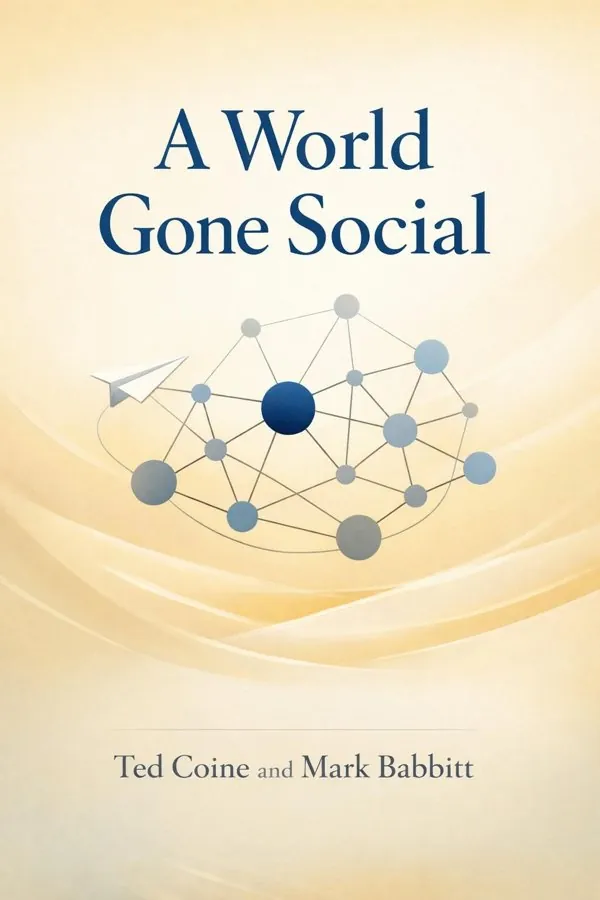
A World Gone Social: How Companies Must Adapt to Survive: Summary & Key Insights
 10 min9 chaptersAudio available
Key Takeaways from A World Gone Social: How Companies Must Adapt to Survive
The most disruptive change in modern business is not technological; it is structural.
In a world where nearly everyone can publish, record, review, and respond, authenticity is no longer a branding preference; it is a survival requirement.
Many leaders believe social business begins with tools, but Coine and Babbitt show that it begins with mindset.
One of the book’s strongest insights is that social transformation cannot be outsourced.
The social age has elevated employees from internal operators to public-facing reputation shapers.
What Is A World Gone Social: How Companies Must Adapt to Survive About?
A World Gone Social: How Companies Must Adapt to Survive by Ted Coine and Mark Babbitt is a leadership book spanning 5 pages. A World Gone Social argues that social media did not simply add a new marketing channel to business; it rewired the rules of leadership, communication, and organizational success. Ted Coine and Mark Babbitt show how power has shifted from executives, institutions, and polished corporate messaging toward connected customers, vocal employees, and online communities that can influence reputation in real time. In this new environment, command-and-control leadership is too slow, too opaque, and too detached from the human relationships that now drive trust. What makes this book matter is its insistence that “social” is not about tweeting more often or opening a LinkedIn page. It is about becoming a more transparent, responsive, collaborative, and human organization from the inside out. The authors combine leadership insight, workplace culture thinking, and practical examples to explain why old structures are breaking down and what must replace them. Coine, a leadership speaker and social business advocate, and Babbitt, a consultant and founder of the career mentoring platform YouTern, write with authority grounded in modern work, talent, and communication trends. Their message is clear: organizations that refuse to adapt to the social age may still operate, but they will struggle to earn trust, attract talent, and remain relevant.
This FizzRead summary covers all 9 key chapters of A World Gone Social: How Companies Must Adapt to Survive in approximately 10 minutes, distilling the most important ideas, arguments, and takeaways from Ted Coine and Mark Babbitt's work. Also available as an audio summary and Key Quotes Podcast.
A World Gone Social: How Companies Must Adapt to Survive
A World Gone Social argues that social media did not simply add a new marketing channel to business; it rewired the rules of leadership, communication, and organizational success. Ted Coine and Mark Babbitt show how power has shifted from executives, institutions, and polished corporate messaging toward connected customers, vocal employees, and online communities that can influence reputation in real time. In this new environment, command-and-control leadership is too slow, too opaque, and too detached from the human relationships that now drive trust.
What makes this book matter is its insistence that “social” is not about tweeting more often or opening a LinkedIn page. It is about becoming a more transparent, responsive, collaborative, and human organization from the inside out. The authors combine leadership insight, workplace culture thinking, and practical examples to explain why old structures are breaking down and what must replace them. Coine, a leadership speaker and social business advocate, and Babbitt, a consultant and founder of the career mentoring platform YouTern, write with authority grounded in modern work, talent, and communication trends. Their message is clear: organizations that refuse to adapt to the social age may still operate, but they will struggle to earn trust, attract talent, and remain relevant.
Who Should Read A World Gone Social: How Companies Must Adapt to Survive?
This book is perfect for anyone interested in leadership and looking to gain actionable insights in a short read. Whether you're a student, professional, or lifelong learner, the key ideas from A World Gone Social: How Companies Must Adapt to Survive by Ted Coine and Mark Babbitt will help you think differently.
- ✓Readers who enjoy leadership and want practical takeaways
- ✓Professionals looking to apply new ideas to their work and life
- ✓Anyone who wants the core insights of A World Gone Social: How Companies Must Adapt to Survive in just 10 minutes
Want the full summary?
Get instant access to this book summary and 100K+ more with Fizz Moment.
Get Free SummaryAvailable on App Store • Free to download
Key Chapters
The most disruptive change in modern business is not technological; it is structural. For generations, organizations were built like pyramids. Information rose slowly, authority flowed downward, and decisions were made by a few people at the top. That model made sense when communication was expensive, media channels were limited, and customers had little public voice. In a social world, those assumptions no longer hold.
Coine and Babbitt argue that connected networks now outperform rigid hierarchies because they move faster, learn faster, and respond faster. Employees no longer need to wait for permission to share insight. Customers no longer need a newspaper or television station to amplify complaints or praise. A single online interaction can shape perception more than a multimillion-dollar ad campaign. That means organizations must stop acting as if they control the conversation and start participating in it.
This does not mean leadership disappears. It means leadership changes form. Instead of commanding every step, leaders must create conditions for smart, decentralized action. Teams closer to customers should be trusted to solve problems. Internal communication should become more open so that useful knowledge is not trapped in silos. Brands should listen continuously, not periodically.
A practical example is customer service. In a hierarchical company, a complaint might pass through multiple approvals before a response is issued. In a social company, trained frontline employees can respond quickly, publicly, and helpfully, turning a potential reputational problem into a trust-building moment.
Actionable takeaway: audit where decisions are unnecessarily trapped at the top, then push authority closer to employees and customers so your organization can act at the speed of relationships.
In a world where nearly everyone can publish, record, review, and respond, authenticity is no longer a branding preference; it is a survival requirement. Coine and Babbitt emphasize that polished corporate messaging cannot compensate for a culture people experience as dishonest, evasive, or disconnected. If there is a gap between what a company says and what it does, the social web will expose it.
The authors explain that trust has become the central currency of the social age. Customers want to buy from companies that feel real. Employees want to work for leaders who tell the truth. Communities reward organizations that admit mistakes, explain decisions, and communicate in a human voice. Transparency does not mean revealing everything, but it does mean replacing defensiveness and spin with candor and accountability.
Consider how businesses handle failure. In the old model, the instinct was often to hide problems until a carefully managed statement could be released. In the social era, silence usually looks suspicious. A delayed response gives others time to define the story. By contrast, companies that quickly acknowledge an issue, explain what happened, and describe their corrective actions often preserve more trust than companies that pretend nothing is wrong.
Authenticity also matters internally. Employees notice when leaders use values language publicly but behave differently privately. That inconsistency weakens morale and damages employer reputation. Transparent communication about strategy, change, and uncertainty fosters resilience because people are more willing to support what they understand.
Actionable takeaway: identify one area where your organization relies on image management over honest dialogue, and replace that habit with direct, human, transparent communication.
The social age has elevated employees from internal operators to public-facing reputation shapers. Whether organizations acknowledge it or not, workers talk about their jobs, managers, values, and experiences online. Coine and Babbitt argue that this is not a threat to suppress but an opportunity to cultivate. Employees are often the most trusted voices connected to a brand because they are perceived as closer to reality than official advertising.
This changes how companies should think about engagement. Instead of trying to control every external mention, leaders should focus on creating a workplace employees genuinely want to talk about. A positive culture becomes visible through recruiting platforms, social media posts, referrals, and everyday conversations. A toxic one becomes visible the same way.
Employee advocacy works best when it is voluntary, informed, and supported. Teams need clear values, useful information, and confidence that the company will stand behind them. They should understand the brand story, but they should never sound scripted. Authentic enthusiasm persuades; corporate mimicry does not.
A practical application is in talent acquisition. Potential hires increasingly trust current employee perspectives over polished recruitment pages. If workers share stories about growth, mentorship, flexibility, and purpose, they become a recruiting force stronger than most employer branding campaigns. The same applies to customer trust: hearing an engineer explain how quality decisions are made can be more convincing than a slogan.
The lesson is simple: your culture is already speaking through your people. The only question is whether what it says helps or hurts you.
Actionable takeaway: invest less in managing employee messaging and more in improving the employee experience so positive advocacy emerges naturally.
In traditional business communication, speaking was often valued more than listening. Companies crafted messages, bought distribution, and measured reach. In the social age, listening has become a strategic advantage. Coine and Babbitt show that organizations gain far more by hearing what customers, employees, and communities are actually saying than by endlessly pushing polished content into crowded feeds.
Listening matters because it reveals reality early. It helps companies detect service failures, reputation risks, unmet needs, and emerging trends before they become expensive problems. It also uncovers language customers naturally use, which can improve product design, support documentation, and marketing clarity. Good listening is not passive monitoring. It is active interpretation followed by meaningful response.
For example, if multiple customers repeatedly complain online about a confusing onboarding process, that is not just a social media issue. It is operational intelligence. A social organization routes that information to the product and customer success teams, then closes the loop publicly when improvements are made. That demonstrates responsiveness and respect.
The same principle applies internally. Employees often surface process friction, leadership blind spots, and innovation ideas long before executives see them in dashboards. When leaders listen well, they reduce avoidable turnover and strengthen engagement.
Broadcasting still has a role, but content without listening becomes self-referential. Social influence grows when organizations prove that input leads to change. People continue sharing when they believe someone is paying attention.
Actionable takeaway: create a simple listening system that gathers recurring customer and employee feedback, assigns ownership, and tracks what actions result from what you hear.
Beneath the book’s discussion of social media and digital platforms lies a deeper claim: the future of work belongs to organizations that become more human, not less. Coine and Babbitt reject the idea that efficiency alone can sustain long-term success. In a transparent, connected economy, people evaluate companies not only by products and profits but by how they treat employees, customers, and communities.
That means traits once dismissed as soft, such as empathy, humility, accessibility, and trustworthiness, have become strategically important. Workers want meaning, flexibility, and respect. Customers want responsiveness and honesty. Communities want responsible corporate behavior. Social technology amplifies these expectations because people can compare experiences, mobilize opinion, and reward or punish brands publicly.
The authors suggest that companies that cling to purely transactional relationships will struggle. The best organizations understand that work is social because people are social. Collaboration, belonging, and shared purpose are not extras layered on top of performance; they increasingly shape performance itself.
Think of retention. Employees rarely stay loyal to organizations that treat them as replaceable units, especially when they can research cultures and build professional networks independently. By contrast, companies that invest in mentorship, communication, and purpose create stronger commitment. That commitment improves service, innovation, and reputation in a reinforcing cycle.
The future of work described here is not casual or vague. It is disciplined humanity: clear expectations paired with respect, transparency paired with accountability, and digital connection paired with real relationships.
Actionable takeaway: choose one leadership practice that makes work more human, such as more transparent communication, better recognition, or stronger mentoring, and implement it consistently.
All Chapters in A World Gone Social: How Companies Must Adapt to Survive
About the Authors
Ted Coine is a leadership expert, speaker, and consultant known for his work on social business, organizational culture, and the changing nature of leadership in a connected world. He has advised organizations on how transparency, trust, and digital communication are reshaping management and brand reputation. Mark Babbitt is a leadership consultant, speaker, and the founder and CEO of YouTern, a career mentoring organization that helps students and young professionals navigate work and build meaningful careers. His work often focuses on workplace culture, mentoring, and human-centered leadership. Together, Coine and Babbitt became recognized voices on the future of work, arguing that successful organizations must be more authentic, collaborative, and responsive to both employees and customers in the social age.
Get This Summary in Your Preferred Format
Read or listen to the A World Gone Social: How Companies Must Adapt to Survive summary by Ted Coine and Mark Babbitt anytime, anywhere. FizzRead offers multiple formats so you can learn on your terms — all free.
Available formats: App · Audio · PDF · EPUB — All included free with FizzRead
Download A World Gone Social: How Companies Must Adapt to Survive PDF and EPUB Summary
Key Quotes from A World Gone Social: How Companies Must Adapt to Survive
“The most disruptive change in modern business is not technological; it is structural.”
“In a world where nearly everyone can publish, record, review, and respond, authenticity is no longer a branding preference; it is a survival requirement.”
“Many leaders believe social business begins with tools, but Coine and Babbitt show that it begins with mindset.”
“One of the book’s strongest insights is that social transformation cannot be outsourced.”
“The social age has elevated employees from internal operators to public-facing reputation shapers.”
Frequently Asked Questions about A World Gone Social: How Companies Must Adapt to Survive
A World Gone Social: How Companies Must Adapt to Survive by Ted Coine and Mark Babbitt is a leadership book that explores key ideas across 9 chapters. A World Gone Social argues that social media did not simply add a new marketing channel to business; it rewired the rules of leadership, communication, and organizational success. Ted Coine and Mark Babbitt show how power has shifted from executives, institutions, and polished corporate messaging toward connected customers, vocal employees, and online communities that can influence reputation in real time. In this new environment, command-and-control leadership is too slow, too opaque, and too detached from the human relationships that now drive trust. What makes this book matter is its insistence that “social” is not about tweeting more often or opening a LinkedIn page. It is about becoming a more transparent, responsive, collaborative, and human organization from the inside out. The authors combine leadership insight, workplace culture thinking, and practical examples to explain why old structures are breaking down and what must replace them. Coine, a leadership speaker and social business advocate, and Babbitt, a consultant and founder of the career mentoring platform YouTern, write with authority grounded in modern work, talent, and communication trends. Their message is clear: organizations that refuse to adapt to the social age may still operate, but they will struggle to earn trust, attract talent, and remain relevant.
You Might Also Like

Extreme Ownership
Jocko Willink
10 min
Dare to Lead
Brene Brown
10 min
Leaders Eat Last
Simon Sinek
10 min
The 21 Irrefutable Laws of Leadership
John Maxwell
10 min
Start With Why
Simon Sinek
10 min
How to Lead When You're Not in Charge
Clay Scroggins
10 minFeatured In
Browse by Category
Ready to read A World Gone Social: How Companies Must Adapt to Survive?
Get the full summary and 100K+ more books with Fizz Moment.