
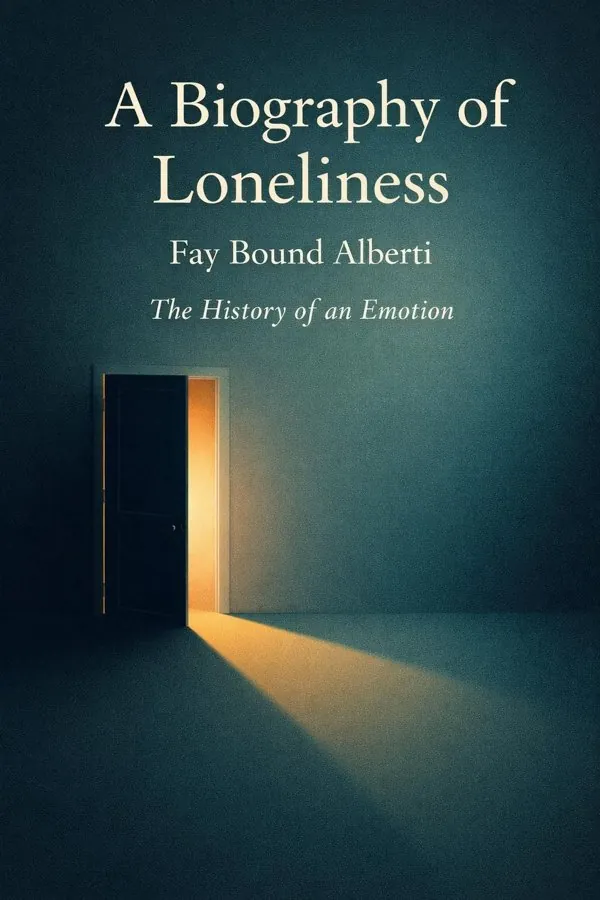
A Biography of Loneliness: The History of an Emotion: Summary & Key Insights
 10 min8 chaptersAudio available
What Is A Biography of Loneliness: The History of an Emotion About?
A Biography of Loneliness: The History of an Emotion by Fay Bound Alberti is a sociology book spanning 8 pages. This book explores the cultural and historical evolution of loneliness as an emotion, tracing its emergence in Western societies from the eighteenth century to the present. Fay Bound Alberti examines how loneliness has been shaped by social, medical, and technological changes, and how it reflects broader transformations in ideas of selfhood, community, and emotional life.
This FizzRead summary covers all 8 key chapters of A Biography of Loneliness: The History of an Emotion in approximately 10 minutes, distilling the most important ideas, arguments, and takeaways from Fay Bound Alberti's work. Also available as an audio summary and Key Quotes Podcast.
A Biography of Loneliness: The History of an Emotion
This book explores the cultural and historical evolution of loneliness as an emotion, tracing its emergence in Western societies from the eighteenth century to the present. Fay Bound Alberti examines how loneliness has been shaped by social, medical, and technological changes, and how it reflects broader transformations in ideas of selfhood, community, and emotional life.
Who Should Read A Biography of Loneliness: The History of an Emotion?
This book is perfect for anyone interested in sociology and looking to gain actionable insights in a short read. Whether you're a student, professional, or lifelong learner, the key ideas from A Biography of Loneliness: The History of an Emotion by Fay Bound Alberti will help you think differently.
- ✓Readers who enjoy sociology and want practical takeaways
- ✓Professionals looking to apply new ideas to their work and life
- ✓Anyone who wants the core insights of A Biography of Loneliness: The History of an Emotion in just 10 minutes
Want the full summary?
Get instant access to this book summary and 100K+ more with Fizz Moment.
Get Free SummaryAvailable on App Store • Free to download
Key Chapters
Before the eighteenth century, there was solitude and there was separation, but not loneliness as we know it. People spoke of withdrawal and isolation in spiritual or moral terms — as paths toward enlightenment, penance, or contemplation. Solitude was an act, not a feeling; it was chosen, often revered. In medieval Europe and the Renaissance, solitary experiences were framed through religion and philosophy: hermits and monks sought closeness to God through isolation; scholars and poets found intellectual clarity in quiet reflection. Emotional suffering from isolation, however, was rarely articulated as 'loneliness'.
What defined premodern emotional life was its collective nature. The self was interwoven with kin, locality, and faith. Communities were tight circles of identity and survival, and emotional well-being depended on those networks. To be alone meant to be physically apart, not existentially alienated. Love and belonging were communal forces, measured through participation. When people withdrew, it was either a spiritual calling or a social punishment.
This absence of loneliness reveals something powerful: the modern assumption that solitude equals emotional pain is historically recent. In the premodern world, solitude was not pathological — it could be sacred. Only when human emotional life shifted from communal to individual perspectives did loneliness begin to emerge as a distinct emotional category.
Understanding this foundation is crucial. Loneliness did not simply appear; it was made possible by the cultural invention of the modern self — a self capable of feeling emotionally separate from others, even when surrounded by them. And that invention began in the eighteenth century.
In the eighteenth century, Western societies underwent profound transformations. The Enlightenment reshaped intellectual, philosophical, and emotional landscapes. For the first time, individuals were encouraged to see themselves as autonomous beings, capable of reason and self-awareness. This recognition of individuality — what I call the birth of the modern self — opened a new emotional domain: the feeling of being separate not only physically but existentially.
With introspection came alienation. When thinkers like Rousseau and Locke examined interiority, they redefined the relationship between person and society. The notion of 'the individual' implied boundaries — between what was inside and what was outside, between private and public selves. In this new world, solitude began to carry an emotional weight. No longer merely a religious or intellectual condition, it became something felt, sometimes painfully so.
Language reflected these changes. The word 'lonely' began to appear more often in English texts, now describing emotional desolation, not mere physical isolation. The rise of letter-writing and personal diaries — forms of self-expression previously uncommon — allowed people to articulate states of mind once invisible. Loneliness was born as part of this fabric of self-awareness.
Yet this age of reason and progress also carried its paradoxes. The more the individual was celebrated, the more the collective fracture widened. As social mobility and urban life expanded, traditional communities weakened. Emotional life turned inward, creating fertile ground for a new kind of suffering — one that stemmed not from being alone, but from being disconnected in a world that increasingly prized self-sufficiency.
Thus, the eighteenth century gave loneliness its emotional vocabulary. It turned isolation into introspection, and introspection into emotion. The modern self was both empowered and exposed.
+ 6 more chapters — available in the FizzRead app
All Chapters in A Biography of Loneliness: The History of an Emotion
About the Author
Fay Bound Alberti is a British historian specializing in the history of emotions, medicine, and the body. She is a Reader in History and UK Research and Innovation Future Leaders Fellow at the University of York. Her research focuses on emotional well-being, gender, and the cultural meanings of health and illness.
Get This Summary in Your Preferred Format
Read or listen to the A Biography of Loneliness: The History of an Emotion summary by Fay Bound Alberti anytime, anywhere. FizzRead offers multiple formats so you can learn on your terms — all free.
Available formats: App · Audio · PDF · EPUB — All included free with FizzRead
Download A Biography of Loneliness: The History of an Emotion PDF and EPUB Summary
Key Quotes from A Biography of Loneliness: The History of an Emotion
“Before the eighteenth century, there was solitude and there was separation, but not loneliness as we know it.”
“In the eighteenth century, Western societies underwent profound transformations.”
Frequently Asked Questions about A Biography of Loneliness: The History of an Emotion
A Biography of Loneliness: The History of an Emotion by Fay Bound Alberti is a sociology book that explores key ideas across 8 chapters. This book explores the cultural and historical evolution of loneliness as an emotion, tracing its emergence in Western societies from the eighteenth century to the present. Fay Bound Alberti examines how loneliness has been shaped by social, medical, and technological changes, and how it reflects broader transformations in ideas of selfhood, community, and emotional life.
You Might Also Like
Between the World and Me
Ta-Nehisi Coates
10 min
Half the Sky
Nicholas D. Kristof, Sheryl WuDunn
10 min
Men Explain Things To Me
Rebecca Solnit
10 min
Rational Ritual
Michael Suk-Young Chwe
10 min
The New Jim Crow
Michelle Alexander
10 min
Beyond Culture
Edward T. Hall
10 minBrowse by Category
Ready to read A Biography of Loneliness: The History of an Emotion?
Get the full summary and 100K+ more books with Fizz Moment.