
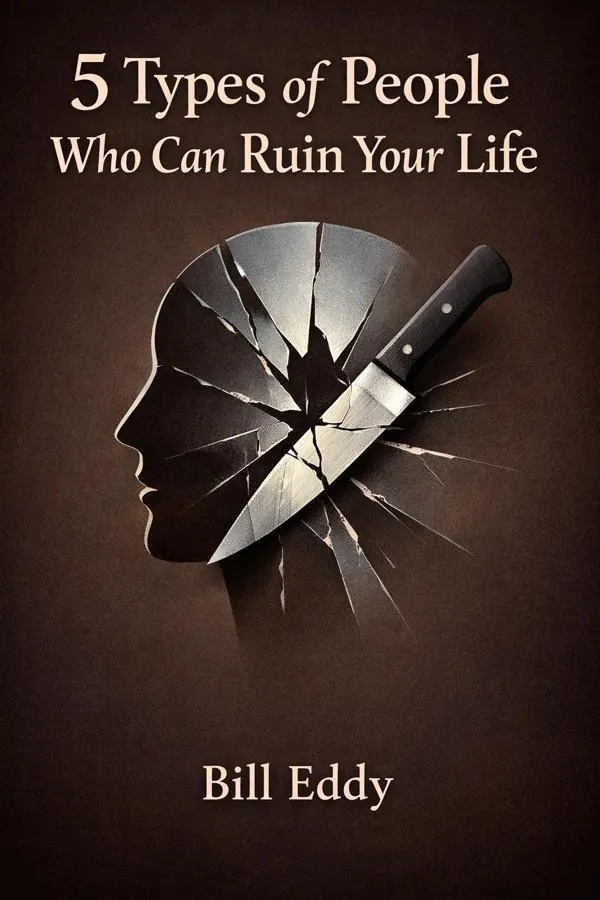
5 Types of People Who Can Ruin Your Life: Identifying and Dealing with Narcissists, Sociopaths, and Other High-Conflict Personalities: Summary & Key Insights
by Bill Eddy
 10 min9 chaptersAudio available
Key Takeaways from 5 Types of People Who Can Ruin Your Life: Identifying and Dealing with Narcissists, Sociopaths, and Other High-Conflict Personalities
Most people create conflict occasionally; high-conflict people create it repeatedly, intensely, and often predictably.
The most intense reactions often come from the deepest fears.
Some of the most destructive people do not appear unstable at all—they appear impressive.
Distrust becomes dangerous when it turns into a fixed way of interpreting the world.
The most obvious danger in Eddy’s framework comes from people who do not just create conflict—they use it strategically.
What Is 5 Types of People Who Can Ruin Your Life: Identifying and Dealing with Narcissists, Sociopaths, and Other High-Conflict Personalities About?
5 Types of People Who Can Ruin Your Life: Identifying and Dealing with Narcissists, Sociopaths, and Other High-Conflict Personalities by Bill Eddy is a psychology book spanning 9 pages. Some of the most damaging people in life do not look dangerous at first. They can appear charismatic, needy, confident, misunderstood, or even helpless—until their patterns of blame, manipulation, and emotional chaos begin to dominate every interaction. In 5 Types of People Who Can Ruin Your Life, Bill Eddy explains how certain high-conflict personalities create repeated crises in families, workplaces, friendships, and romantic relationships, and why ordinary conflict-management skills often fail with them. Eddy draws on a rare combination of expertise: he is both a licensed clinical social worker and an attorney, and he has spent decades working with people caught in destructive interpersonal battles. That dual background allows him to connect psychological insight with practical protection. Rather than encouraging readers to diagnose others casually, he teaches them to identify recurring behavioral patterns—especially in people with borderline, narcissistic, paranoid, antisocial, and histrionic traits. This book matters because the cost of missing these warning signs can be enormous: emotional burnout, damaged reputations, legal trouble, financial loss, and deep confusion. Eddy’s central promise is simple but powerful: if you can spot high-conflict patterns early, you can make safer, wiser choices about whom to trust, how to respond, and when to walk away.
This FizzRead summary covers all 9 key chapters of 5 Types of People Who Can Ruin Your Life: Identifying and Dealing with Narcissists, Sociopaths, and Other High-Conflict Personalities in approximately 10 minutes, distilling the most important ideas, arguments, and takeaways from Bill Eddy's work. Also available as an audio summary and Key Quotes Podcast.
5 Types of People Who Can Ruin Your Life: Identifying and Dealing with Narcissists, Sociopaths, and Other High-Conflict Personalities
Some of the most damaging people in life do not look dangerous at first. They can appear charismatic, needy, confident, misunderstood, or even helpless—until their patterns of blame, manipulation, and emotional chaos begin to dominate every interaction. In 5 Types of People Who Can Ruin Your Life, Bill Eddy explains how certain high-conflict personalities create repeated crises in families, workplaces, friendships, and romantic relationships, and why ordinary conflict-management skills often fail with them.
Eddy draws on a rare combination of expertise: he is both a licensed clinical social worker and an attorney, and he has spent decades working with people caught in destructive interpersonal battles. That dual background allows him to connect psychological insight with practical protection. Rather than encouraging readers to diagnose others casually, he teaches them to identify recurring behavioral patterns—especially in people with borderline, narcissistic, paranoid, antisocial, and histrionic traits.
This book matters because the cost of missing these warning signs can be enormous: emotional burnout, damaged reputations, legal trouble, financial loss, and deep confusion. Eddy’s central promise is simple but powerful: if you can spot high-conflict patterns early, you can make safer, wiser choices about whom to trust, how to respond, and when to walk away.
Who Should Read 5 Types of People Who Can Ruin Your Life: Identifying and Dealing with Narcissists, Sociopaths, and Other High-Conflict Personalities?
This book is perfect for anyone interested in psychology and looking to gain actionable insights in a short read. Whether you're a student, professional, or lifelong learner, the key ideas from 5 Types of People Who Can Ruin Your Life: Identifying and Dealing with Narcissists, Sociopaths, and Other High-Conflict Personalities by Bill Eddy will help you think differently.
- ✓Readers who enjoy psychology and want practical takeaways
- ✓Professionals looking to apply new ideas to their work and life
- ✓Anyone who wants the core insights of 5 Types of People Who Can Ruin Your Life: Identifying and Dealing with Narcissists, Sociopaths, and Other High-Conflict Personalities in just 10 minutes
Want the full summary?
Get instant access to this book summary and 100K+ more with Fizz Moment.
Get Free SummaryAvailable on App Store • Free to download
Key Chapters
Most people create conflict occasionally; high-conflict people create it repeatedly, intensely, and often predictably. Bill Eddy’s key distinction is that these individuals are not merely difficult, moody, or argumentative. They show enduring patterns of behavior centered on blaming others, escalating disputes, recruiting allies, and refusing genuine self-reflection. In ordinary disagreements, people may cool down, compromise, or accept some responsibility. High-conflict personalities tend to do the opposite: they fixate on a target of blame, magnify small issues into moral battles, and repeat the same cycles across relationships.
Eddy emphasizes that the danger lies not only in their emotions but in their patterns. A person may seem charming, wounded, or persuasive at first, but over time the same themes emerge: “Everything is someone else’s fault,” “I’m the victim,” or “You must prove your loyalty by taking my side.” These patterns can show up in divorce, workplace politics, friendships, dating, and even neighborhood disputes. The result is often exhaustion and confusion for everyone around them.
The book also warns against trying to reason with high-conflict behavior as if it were normal conflict. Traditional approaches—long explanations, emotional reassurance, or repeated second chances—may backfire because the person is not seeking resolution so much as emotional discharge or control. That is why recognition matters more than persuasion.
A practical way to apply this idea is to stop asking, “How do I fix this argument?” and start asking, “Is this a recurring pattern of blame, escalation, and instability?” Actionable takeaway: judge people by repeated patterns under stress, not by first impressions or isolated apologies.
The most intense reactions often come from the deepest fears. Eddy describes borderline personality patterns as driven largely by fear of abandonment, emotional instability, and rapidly shifting perceptions of others. Someone with these traits may idealize you one day and condemn you the next, especially if they feel ignored, criticized, or uncertain about the relationship. Their emotional pain can be real and severe, which is why they may initially evoke sympathy. But that pain can also fuel impulsive accusations, dramatic breakups, self-destructive behavior, or frantic efforts to prevent separation.
A crucial insight in the book is that the issue is not simply strong emotion; it is unstable attachment combined with high-conflict behavior. In practice, this can look like a romantic partner who constantly tests your loyalty, a friend who reacts to minor disappointments as betrayal, or a co-parent who swings between pleading and rage. You may feel forced into endless reassurance, walking on eggshells to avoid the next explosion.
Eddy does not present these individuals as monsters. Instead, he shows how their desperation can create serious harm when unmanaged. Compassion is appropriate, but unstructured compassion can trap you in a cycle of rescuing, defending, and apologizing for things you did not do.
Helpful responses include staying calm, avoiding emotional overreaction, setting predictable limits, and refusing to be pulled into all-or-nothing narratives. If safety is at risk, distance may be necessary. Actionable takeaway: show empathy for distress, but protect yourself with consistent boundaries and do not let fear-driven drama dictate your decisions.
Some of the most destructive people do not appear unstable at all—they appear impressive. Eddy explains that narcissistic patterns are often built around entitlement, superiority, and a striking lack of empathy. These individuals may be highly charismatic, polished, ambitious, or socially skilled. Early on, they can seem exceptional: confident leaders, ideal partners, or brilliant colleagues. The problem emerges when their need for admiration and control outweighs any concern for fairness or mutual respect.
A narcissistic high-conflict person typically reacts badly to criticism, competition, or being denied special treatment. They may rewrite events to preserve their image, belittle others to maintain status, or retaliate when challenged. In relationships, they often seek admiration more than intimacy. In workplaces, they may take credit, undermine peers, or turn disagreement into a personal attack. Their confidence can be so convincing that others doubt their own perceptions.
Eddy’s practical value lies in showing readers that charm is not character. If someone consistently demands special rules, ignores your feelings, and treats every boundary as an insult, you are likely dealing with more than ordinary selfishness. The damage can range from emotional erosion to public humiliation or career sabotage.
Effective strategies include keeping interactions factual, limiting personal disclosure, documenting important exchanges, and avoiding ego battles you cannot win. The goal is not to reform their personality but to reduce your vulnerability to manipulation. Actionable takeaway: when someone’s charisma is paired with chronic entitlement and zero empathy, trust the pattern—not the performance.
Distrust becomes dangerous when it turns into a fixed way of interpreting the world. According to Eddy, people with paranoid personality patterns are chronically suspicious, quick to perceive hidden threats, and often convinced that others are deceptive, disloyal, or out to harm them. Unlike healthy caution, this suspicion is rigid and self-reinforcing. Neutral events become evidence, misunderstandings become conspiracies, and disagreement becomes proof of betrayal.
In everyday life, this can look like a coworker who believes others are sabotaging them, a partner who sees ordinary independence as infidelity, or a neighbor who escalates minor issues into formal complaints and accusations. Because they often appear serious, logical, and determined, it can be hard to realize how distorted the situation has become. They may gather “proof,” question motives relentlessly, and pressure others to defend themselves against bizarre claims.
Eddy points out that arguing facts alone rarely solves the problem. The suspicious person often filters every explanation through a lens of mistrust, so your defense may be interpreted as further deception. That is what makes these interactions so draining: you are trapped in a courtroom where the verdict was decided in advance.
The safest response is usually to be clear, brief, respectful, and well-documented. Do not overexplain, joke about sensitive topics, or assume goodwill where there is chronic hostility. In higher-stakes settings—such as business, legal disputes, or co-parenting—written records can be essential. Actionable takeaway: when dealing with chronic suspicion, communicate simply, document carefully, and avoid getting pulled into endless efforts to prove your innocence.
Attention can feel like affection, but sometimes it is really fuel. Eddy describes histrionic personality patterns as driven by dramatic emotional expression, attention-seeking, suggestibility, and a tendency to intensify situations for impact. These individuals may be lively, engaging, seductive, or socially magnetic. Yet beneath the charm is often a need to remain the center of emotional gravity, even if that requires exaggeration, flirtation, tears, or crisis-making.
This type can be confusing because their warmth may feel genuine, and sometimes it is. The problem arises when every setting becomes a stage. In friendships, they may stir conflict to stay relevant. In workplaces, they may create theatrical disputes, inappropriate intimacy, or rumor-fueled alliances. In dating, they can accelerate closeness quickly and then destabilize it through jealousy, emotional displays, or competing bids for attention.
Eddy’s contribution here is to show that drama itself can be a red flag. People who constantly intensify events can pull entire groups into unstable dynamics. Others end up overfunctioning—soothing, clarifying, rescuing, or reacting—while the high-conflict person remains the focal point.
The most effective response is grounded calm. Avoid rewarding theatrics with excessive emotional engagement. Keep discussions concrete, redirect to facts, and resist being cast into melodramatic roles such as rescuer, villain, or adoring audience. In teams or families, consistent norms reduce the payoff of dramatic disruption. Actionable takeaway: when someone habitually turns ordinary life into emotional theater, respond with calm structure rather than attention-fueled reaction.
Life-changing trouble rarely begins with a life-changing event; it usually begins with subtle warning signs people talk themselves out of seeing. One of Eddy’s most practical messages is that early detection matters more than late recovery. High-conflict personalities often reveal themselves through small but meaningful clues long before a crisis: intense charm followed by blame, rushed intimacy, frequent stories about enemies, refusal to accept responsibility, boundary-testing, and a pattern of conflict in past relationships.
A powerful technique Eddy recommends is paying attention to the person’s “target of blame.” If someone always has a villain—an ex, a boss, a sibling, a system, a friend—and tells stories in which they are perpetually innocent, you should slow down. Another clue is emotional speed. Relationships that become deeply personal, financially entangled, or professionally dependent too quickly can leave you vulnerable before you have enough evidence to judge character.
Consider how this applies in real life. A new partner says all former relationships ended because others were “crazy.” A job candidate seems brilliant but trashes every past employer. A potential business partner pushes for immediate trust while dismissing normal due diligence as insulting. None of these signs prove a diagnosis, but together they suggest risk.
The goal is not paranoia but informed caution. You do not need certainty to pause, ask questions, or delay commitment. Often, time itself is the best screening tool because patterns reveal themselves under stress. Actionable takeaway: when you notice chronic blame, rushed closeness, and repeated boundary tests, slow the relationship down and gather more information before deepening trust.
When emotions run high, the wrong reply can become gasoline. One of Eddy’s best-known tools is BIFF: Brief, Informative, Friendly, and Firm communication. He developed this method because high-conflict people often bait others into long defenses, angry counterattacks, or emotionally loaded exchanges that only deepen the conflict. BIFF offers a disciplined alternative: say only what is necessary, provide useful information, keep the tone civil, and end with a clear boundary or decision.
This works because many high-conflict interactions are traps disguised as conversations. A hostile email may invite you to defend your character, rehash old grievances, or retaliate. A BIFF response refuses the invitation. For example, instead of writing a five-paragraph rebuttal to accusations from a co-parent, you might respond: “I will pick up the children at 5 p.m. on Friday as scheduled. If you need to change the time, let me know by noon.” The message is calm, practical, and closed-ended.
BIFF is especially useful in email, text, workplace communication, customer disputes, and family conflicts where a written record matters. It does not solve every problem, but it reduces escalation and protects your credibility. Importantly, “friendly” does not mean warm compliance, and “firm” does not mean harshness. The power lies in restraint.
This method also helps emotionally. By shortening your responses, you stop rehearsing the conflict in your mind and begin regaining control of your attention. Actionable takeaway: before replying to a provocative message, rewrite it using BIFF—shorter, calmer, more factual, and with a clear limit.
Not every harmful relationship can be healed, and one of Eddy’s most liberating messages is that leaving is sometimes the healthiest choice. Readers often hope that enough patience, love, logic, or sacrifice will finally stabilize a high-conflict person. But when a relationship repeatedly produces fear, confusion, legal risk, financial damage, or emotional collapse, the question shifts from “How do I help them?” to “How do I protect myself?” Boundaries are not punishments; they are acts of reality-based self-respect.
Eddy discusses practical forms of protection: limiting access to your time and emotions, using structured communication, involving neutral third parties, documenting incidents, securing finances, and planning exits carefully when necessary. In some situations—especially those involving abuse, intimidation, stalking, or exploitation—distance is not overreacting but risk management. Recovery also matters. After prolonged conflict, people often carry shame, self-doubt, hypervigilance, and grief. They may question their judgment because manipulation made them second-guess everything.
Healing involves more than separation. It requires rebuilding trust in your perceptions, reconnecting with supportive people, and learning the lessons without becoming cynical. Therapy, legal advice, financial planning, and trauma-informed support can all play a role depending on the damage done.
The book’s final wisdom is that spotting these patterns is not about labeling others from a place of superiority. It is about making wiser relationship choices and refusing to normalize chaos. Actionable takeaway: if a relationship repeatedly harms your safety, sanity, or stability, create a concrete boundary plan—and if needed, an exit plan—before the next crisis arrives.
All Chapters in 5 Types of People Who Can Ruin Your Life: Identifying and Dealing with Narcissists, Sociopaths, and Other High-Conflict Personalities
About the Author
Bill Eddy, LCSW, Esq., is a therapist, lawyer, mediator, and the co-founder of the High Conflict Institute. He is internationally recognized for his expertise in managing high-conflict personalities and disputes in family law, workplaces, organizations, and personal relationships. With a professional background that spans both mental health and legal practice, Eddy brings an unusually practical perspective to conflict: he understands the psychology behind destructive behavior and the real-world consequences it can create. He has written several influential books on high-conflict people, personality patterns, and communication strategies, including the widely used BIFF method. His work is valued by professionals such as lawyers, mediators, therapists, and HR leaders, as well as general readers seeking clear guidance for dealing with difficult and potentially harmful people.
Get This Summary in Your Preferred Format
Read or listen to the 5 Types of People Who Can Ruin Your Life: Identifying and Dealing with Narcissists, Sociopaths, and Other High-Conflict Personalities summary by Bill Eddy anytime, anywhere. FizzRead offers multiple formats so you can learn on your terms — all free.
Available formats: App · Audio · PDF · EPUB — All included free with FizzRead
Download 5 Types of People Who Can Ruin Your Life: Identifying and Dealing with Narcissists, Sociopaths, and Other High-Conflict Personalities PDF and EPUB Summary
Key Quotes from 5 Types of People Who Can Ruin Your Life: Identifying and Dealing with Narcissists, Sociopaths, and Other High-Conflict Personalities
“Most people create conflict occasionally; high-conflict people create it repeatedly, intensely, and often predictably.”
“The most intense reactions often come from the deepest fears.”
“Some of the most destructive people do not appear unstable at all—they appear impressive.”
“Distrust becomes dangerous when it turns into a fixed way of interpreting the world.”
“The most obvious danger in Eddy’s framework comes from people who do not just create conflict—they use it strategically.”
Frequently Asked Questions about 5 Types of People Who Can Ruin Your Life: Identifying and Dealing with Narcissists, Sociopaths, and Other High-Conflict Personalities
5 Types of People Who Can Ruin Your Life: Identifying and Dealing with Narcissists, Sociopaths, and Other High-Conflict Personalities by Bill Eddy is a psychology book that explores key ideas across 9 chapters. Some of the most damaging people in life do not look dangerous at first. They can appear charismatic, needy, confident, misunderstood, or even helpless—until their patterns of blame, manipulation, and emotional chaos begin to dominate every interaction. In 5 Types of People Who Can Ruin Your Life, Bill Eddy explains how certain high-conflict personalities create repeated crises in families, workplaces, friendships, and romantic relationships, and why ordinary conflict-management skills often fail with them. Eddy draws on a rare combination of expertise: he is both a licensed clinical social worker and an attorney, and he has spent decades working with people caught in destructive interpersonal battles. That dual background allows him to connect psychological insight with practical protection. Rather than encouraging readers to diagnose others casually, he teaches them to identify recurring behavioral patterns—especially in people with borderline, narcissistic, paranoid, antisocial, and histrionic traits. This book matters because the cost of missing these warning signs can be enormous: emotional burnout, damaged reputations, legal trouble, financial loss, and deep confusion. Eddy’s central promise is simple but powerful: if you can spot high-conflict patterns early, you can make safer, wiser choices about whom to trust, how to respond, and when to walk away.
You Might Also Like
The Body Keeps the Score
Bessel van der Kolk
10 min
Surrounded by Idiots
Thomas Erikson
10 min
Emotional Intelligence
Daniel Goleman
10 min
Attached
Amir Levine
10 min
Why Does He Do That
Lundy Bancroft
10 min
Women Who Run with the Wolves
Clarissa Pinkola Estés
10 minBrowse by Category
Ready to read 5 Types of People Who Can Ruin Your Life: Identifying and Dealing with Narcissists, Sociopaths, and Other High-Conflict Personalities?
Get the full summary and 100K+ more books with Fizz Moment.