
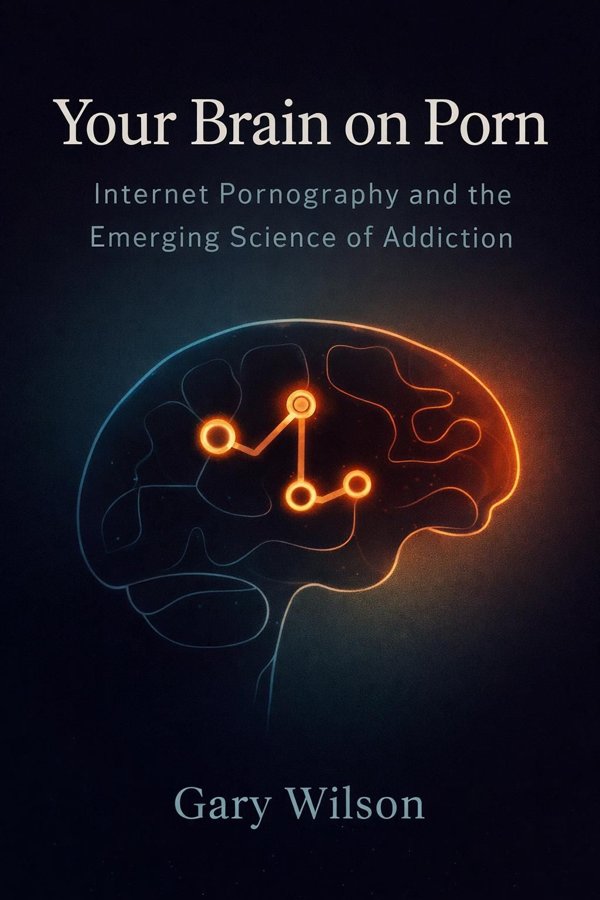
Your Brain on Porn: Internet Pornography and the Emerging Science of Addiction: Summary & Key Insights
by Gary Wilson
 10 min4 chaptersAudio available
What Is Your Brain on Porn: Internet Pornography and the Emerging Science of Addiction About?
Your Brain on Porn: Internet Pornography and the Emerging Science of Addiction by Gary Wilson is a neuroscience book spanning 4 pages. In this book, Gary Wilson explores how internet pornography affects the brain’s reward system, leading to addiction-like symptoms and sexual dysfunction. Drawing on neuroscience and behavioral research, Wilson explains the mechanisms of dopamine-driven conditioning and offers insights into recovery and self-control.
This FizzRead summary covers all 4 key chapters of Your Brain on Porn: Internet Pornography and the Emerging Science of Addiction in approximately 10 minutes, distilling the most important ideas, arguments, and takeaways from Gary Wilson's work. Also available as an audio summary and Key Quotes Podcast.
Your Brain on Porn: Internet Pornography and the Emerging Science of Addiction
In this book, Gary Wilson explores how internet pornography affects the brain’s reward system, leading to addiction-like symptoms and sexual dysfunction. Drawing on neuroscience and behavioral research, Wilson explains the mechanisms of dopamine-driven conditioning and offers insights into recovery and self-control.
Who Should Read Your Brain on Porn: Internet Pornography and the Emerging Science of Addiction?
This book is perfect for anyone interested in neuroscience and looking to gain actionable insights in a short read. Whether you're a student, professional, or lifelong learner, the key ideas from Your Brain on Porn: Internet Pornography and the Emerging Science of Addiction by Gary Wilson will help you think differently.
- ✓Readers who enjoy neuroscience and want practical takeaways
- ✓Professionals looking to apply new ideas to their work and life
- ✓Anyone who wants the core insights of Your Brain on Porn: Internet Pornography and the Emerging Science of Addiction in just 10 minutes
Want the full summary?
Get instant access to this book summary and 100K+ more with Fizz Moment.
Get Free SummaryAvailable on App Store • Free to download
Key Chapters
In the brain’s deepest regions lies a circuitry built for survival: the reward system. Every time we encounter something novel or pleasurable—whether it’s food, social connection, or sexual stimuli—dopamine is released. This chemical doesn’t just make us feel good; it motivates us to seek again. In evolutionary terms, it ensured our species survived through repetition of life-sustaining behaviors. But under the lens of modern neuroscience, we find that constant overstimulation rewires these systems.
Internet pornography delivers an endless stream of novelty. The dopamine spikes generated by each new video or image are unlike what ancestral brains ever encountered. In simple terms, you’re giving the reward system a buffet of artificial cues—pressing the 'seek' button repeatedly without ever arriving at true satisfaction. Neuroplasticity ensures the brain adapts to this pattern. Circuits governing sexual arousal, motivation, and bonding begin to align with virtual stimuli rather than real human connection. The result is a desensitized reward pathway: natural pleasures lose their appeal, while conditioned cues—pornographic imagery and novelty—gain dominance.
Neuroscientific studies reinforce this model. Imaging shows reduced gray-matter volume in the reward centers of heavy porn users, as well as altered dopamine receptor responsiveness. These physical changes manifest as psychological symptoms: loss of excitement with partners, compulsive scrolling behaviors, and reliance on specific genres to achieve arousal. The brain ceases to treat sex as an interpersonal experience—it becomes a pattern of clicks, pixels, and anticipation.
Yet this system is flexible. Just as it can adapt toward unhealthy patterns, it can rewire back toward balance. Understanding these mechanics is empowering: the craving is not an enemy but an echo of circuitry that has learned the wrong tune. The first steps toward recovery involve halting overstimulation long enough for neuroplasticity to reverse the conditioning. Over time, the dopamine system recalibrates, and normal reward sensitivity returns. In essence, the same biology that led you into compulsive patterns can also lead you out—if you give the brain time to heal.
From a scientific standpoint, internet pornography is not simply another form of entertainment—it’s an evolutionary hijack. In nature, sexual cues are rare and contextually bound, triggering moderate excitement that propels bonding and reproduction. Online, these cues are magnified, multiplied, and made endlessly available. Each new clip taps into the novelty-seeking circuits activated by dopamine, offering an infinite series of 'first exposures.' The result is overstimulation of a system never designed for such variety.
Traditional erotic material offered limited novelty; consummation followed a linear path of desire and satisfaction. Internet pornography, by contrast, allows a user to click through hundreds or thousands of scenes in a single session. With each new video, dopamine resets, urging yet another search. This creates a cycle called 'the Coolidge effect,' where the brain continually craves new partners or scenarios. Over time, novelty becomes the goal, not satisfaction.
This compulsion mirrors substance addiction in key ways. Users describe tolerance—needing more extreme material to feel the same arousal—withdrawal-like irritability when abstaining, and loss of control over viewing patterns. Even without external chemicals, the internal release of dopamine and endogenous opioids follows the same circuitry as drug addiction. Thus, behavioral addiction arises from the same neurochemical loops.
Understanding this isn’t moralizing—it’s evolutionary reality. Our ancestors never faced such stimuli, so our brains lack natural defenses against digital excess. What we perceive as 'choice' often becomes conditioned response: seek, stimulate, repeat. Recovery must therefore engage the biology beneath the behavior—remapping desire toward genuine connection and calming the reward system through rest and real intimacy. The shift from compulsion to freedom begins with insight: seeing pornography not as harmless fantasy, but as a neurological trap that trades fleeting novelty for sustained fulfillment.
+ 2 more chapters — available in the FizzRead app
All Chapters in Your Brain on Porn: Internet Pornography and the Emerging Science of Addiction
About the Author
Gary Wilson was an American educator and public speaker known for his work on the neuroscience of pornography addiction. He founded the website YourBrainOnPorn.com and delivered a widely viewed TEDx talk on the subject. Wilson’s work focused on the effects of internet pornography on motivation, relationships, and mental health.
Get This Summary in Your Preferred Format
Read or listen to the Your Brain on Porn: Internet Pornography and the Emerging Science of Addiction summary by Gary Wilson anytime, anywhere. FizzRead offers multiple formats so you can learn on your terms — all free.
Available formats: App · Audio · PDF · EPUB — All included free with FizzRead
Download Your Brain on Porn: Internet Pornography and the Emerging Science of Addiction PDF and EPUB Summary
Key Quotes from Your Brain on Porn: Internet Pornography and the Emerging Science of Addiction
“In the brain’s deepest regions lies a circuitry built for survival: the reward system.”
“From a scientific standpoint, internet pornography is not simply another form of entertainment—it’s an evolutionary hijack.”
Frequently Asked Questions about Your Brain on Porn: Internet Pornography and the Emerging Science of Addiction
Your Brain on Porn: Internet Pornography and the Emerging Science of Addiction by Gary Wilson is a neuroscience book that explores key ideas across 4 chapters. In this book, Gary Wilson explores how internet pornography affects the brain’s reward system, leading to addiction-like symptoms and sexual dysfunction. Drawing on neuroscience and behavioral research, Wilson explains the mechanisms of dopamine-driven conditioning and offers insights into recovery and self-control.
You Might Also Like
Anxious
Joseph LeDoux
10 min
Hallucinations
Oliver Sacks
10 min
The Biological Mind: How Brain, Body, and Environment Collaborate to Make Us Who We Are
Alan Jasanoff
10 min
The Feeling of Life Itself: Why Consciousness Is Widespread but Can't Be Computed
Christof Koch
10 min
The No-Nonsense Meditation Book
Steven Laureys
10 min
A General Theory of Love
Thomas Lewis, Fari Amini, Richard Lannon
10 minBrowse by Category
Ready to read Your Brain on Porn: Internet Pornography and the Emerging Science of Addiction?
Get the full summary and 100K+ more books with Fizz Moment.