
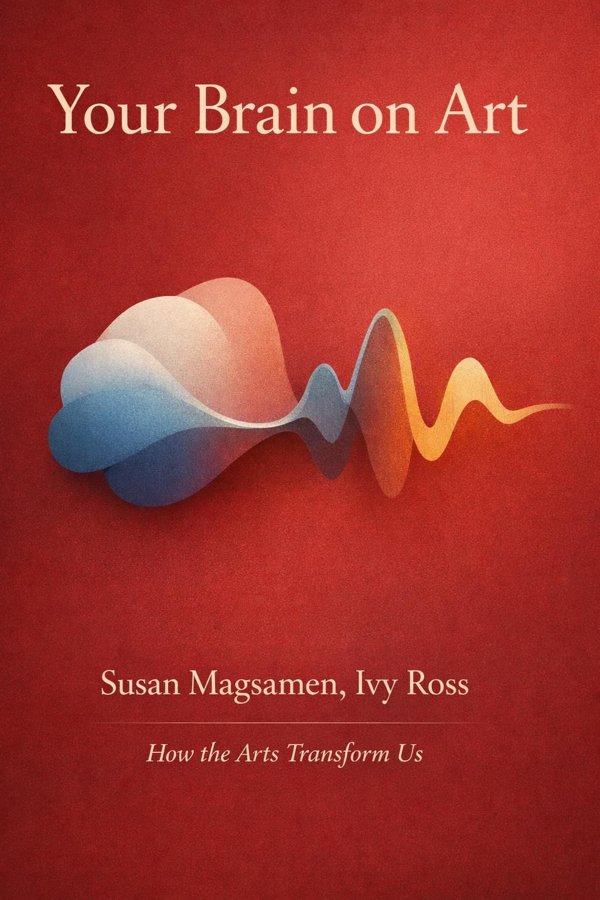
Your Brain on Art: How the Arts Transform Us: Summary & Key Insights
 10 min6 chaptersAudio available
What Is Your Brain on Art: How the Arts Transform Us About?
Your Brain on Art: How the Arts Transform Us by Susan Magsamen, Ivy Ross is a neuroscience book spanning 6 pages. This book explores the intersection of neuroscience and creativity, revealing how engagement with art, music, dance, and other creative practices can profoundly shape our brains, improve mental health, and enhance overall well-being. Drawing on scientific research and real-world examples, the authors demonstrate that art is not a luxury but a fundamental part of human biology and a powerful tool for healing and transformation.
This FizzRead summary covers all 6 key chapters of Your Brain on Art: How the Arts Transform Us in approximately 10 minutes, distilling the most important ideas, arguments, and takeaways from Susan Magsamen, Ivy Ross's work. Also available as an audio summary and Key Quotes Podcast.
Your Brain on Art: How the Arts Transform Us
This book explores the intersection of neuroscience and creativity, revealing how engagement with art, music, dance, and other creative practices can profoundly shape our brains, improve mental health, and enhance overall well-being. Drawing on scientific research and real-world examples, the authors demonstrate that art is not a luxury but a fundamental part of human biology and a powerful tool for healing and transformation.
Who Should Read Your Brain on Art: How the Arts Transform Us?
This book is perfect for anyone interested in neuroscience and looking to gain actionable insights in a short read. Whether you're a student, professional, or lifelong learner, the key ideas from Your Brain on Art: How the Arts Transform Us by Susan Magsamen, Ivy Ross will help you think differently.
- ✓Readers who enjoy neuroscience and want practical takeaways
- ✓Professionals looking to apply new ideas to their work and life
- ✓Anyone who wants the core insights of Your Brain on Art: How the Arts Transform Us in just 10 minutes
Want the full summary?
Get instant access to this book summary and 100K+ more with Fizz Moment.
Get Free SummaryAvailable on App Store • Free to download
Key Chapters
Neuroaesthetics—the science that studies how the brain responds to aesthetic and creative experiences—forms the foundation of our exploration. When we encounter art, music, or design, our neural networks light up in intricate choreography. The sensory cortices analyze patterns, the limbic system interprets emotional meaning, and the prefrontal cortex constructs narrative and value. Neurochemicals such as dopamine, serotonin, and oxytocin surge, reinforcing feelings of connection and pleasure. What was once a philosophical question—why beauty matters—has become a measurable biological phenomenon.
Through imaging studies at institutions like Johns Hopkins and the NIH, we learned that engaging with beauty activates multimodal regions of the brain that govern empathy, decision making, and emotional regulation. This means art does more than entertain; it reorganizes neural architecture. Healing through art, therefore, is not metaphorical—it’s neurological factuality. We see this in stroke patients who regain motor control through music therapy, and in soldiers finding cognitive relief from post-traumatic stress after expressive writing.
Neuroaesthetics reveals something vital: creative activities are not separate from survival behaviors like mating or shelter-building; they emerge from the same biological imperative to understand and connect. Our ancestors painted on cave walls not for decoration but for communication and cohesion. Today, every aesthetic experience still carries that ancestral echo. When you respond to beauty, your brain whispers, “You belong. You are part of something larger.”
Each art form accesses distinct yet overlapping neural circuits. Music, for instance, drives rhythmic synchronization across hemispheres, enhancing connectivity and memory. Visual art engages the occipital and parietal lobes, deepening spatial awareness and emotion. Movement-based arts such as dance stimulate the cerebellum and basal ganglia, improving coordination and mood. Storytelling and literature activate the default mode network—the brain’s system for reflection, empathy, and identity formation.
One of the most striking discoveries in recent neuroscience is the role of dopamine—the neurotransmitter associated with reward—in creative engagement. When we anticipate or experience art that resonates with us, the nucleus accumbens unleashes dopamine, producing feelings of joy and meaning. Yet this joy is not trivial; it helps regulate motivation, learning, and resilience. Artistic practice becomes a form of neurochemical training: it teaches the brain to seek and sustain pleasure in adaptive ways.
Our sensory systems weave together all these signals. To paint, listen, dance, or read is to orchestrate biology through perception. The arts temporarily suspend the readiness for threat and reorient the brain toward curiosity and trust. That is why a single melody can make us cry, or a color field can calm the mind after grief. Art gives us a safe space for emotional recalibration—a biological detox that allows the nervous system to rest, integrate, and grow.
+ 4 more chapters — available in the FizzRead app
All Chapters in Your Brain on Art: How the Arts Transform Us
About the Authors
Susan Magsamen is the founder and executive director of the International Arts + Mind Lab at Johns Hopkins University School of Medicine. Ivy Ross is Vice President of Design for Hardware Products at Google. Together, they combine expertise in neuroscience, design, and creativity to explore how art impacts human development and health.
Get This Summary in Your Preferred Format
Read or listen to the Your Brain on Art: How the Arts Transform Us summary by Susan Magsamen, Ivy Ross anytime, anywhere. FizzRead offers multiple formats so you can learn on your terms — all free.
Available formats: App · Audio · PDF · EPUB — All included free with FizzRead
Download Your Brain on Art: How the Arts Transform Us PDF and EPUB Summary
Key Quotes from Your Brain on Art: How the Arts Transform Us
“Neuroaesthetics—the science that studies how the brain responds to aesthetic and creative experiences—forms the foundation of our exploration.”
“Each art form accesses distinct yet overlapping neural circuits.”
Frequently Asked Questions about Your Brain on Art: How the Arts Transform Us
Your Brain on Art: How the Arts Transform Us by Susan Magsamen, Ivy Ross is a neuroscience book that explores key ideas across 6 chapters. This book explores the intersection of neuroscience and creativity, revealing how engagement with art, music, dance, and other creative practices can profoundly shape our brains, improve mental health, and enhance overall well-being. Drawing on scientific research and real-world examples, the authors demonstrate that art is not a luxury but a fundamental part of human biology and a powerful tool for healing and transformation.
You Might Also Like
Anxious
Joseph LeDoux
10 min
Hallucinations
Oliver Sacks
10 min
The Biological Mind: How Brain, Body, and Environment Collaborate to Make Us Who We Are
Alan Jasanoff
10 min
The Feeling of Life Itself: Why Consciousness Is Widespread but Can't Be Computed
Christof Koch
10 min
The No-Nonsense Meditation Book
Steven Laureys
10 min
A General Theory of Love
Thomas Lewis, Fari Amini, Richard Lannon
10 minBrowse by Category
Ready to read Your Brain on Art: How the Arts Transform Us?
Get the full summary and 100K+ more books with Fizz Moment.