
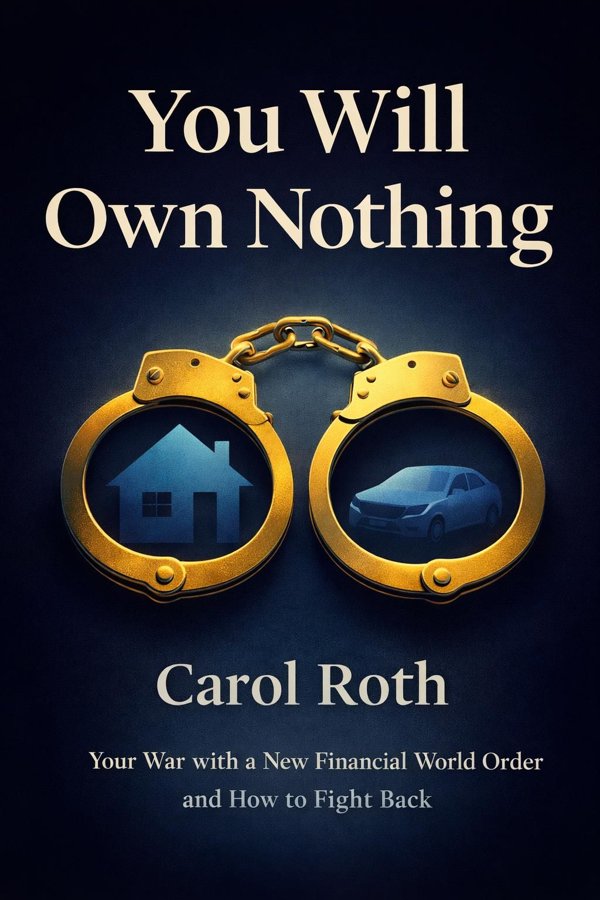
You Will Own Nothing: Your War with a New Financial World Order and How to Fight Back: Summary & Key Insights
by Carol Roth
 10 min9 chaptersAudio available
Key Takeaways from You Will Own Nothing: Your War with a New Financial World Order and How to Fight Back
A society’s real power structure is revealed by one simple question: who owns the assets?
Many people assume broad-based ownership is normal, but Roth argues it was actually a hard-won and historically unusual achievement.
What people celebrate as flexibility can, over time, become dependency.
Nothing erodes ownership more quietly than money losing its value.
People often imagine government and big business as opposing forces, but Roth argues they frequently operate as partners in consolidation.
What Is You Will Own Nothing: Your War with a New Financial World Order and How to Fight Back About?
You Will Own Nothing: Your War with a New Financial World Order and How to Fight Back by Carol Roth is a economics book spanning 5 pages. Carol Roth’s You Will Own Nothing is a warning about a major economic shift already underway: the gradual movement from a society built on ownership to one built on access, dependency, and centralized control. Roth argues that many people are being nudged away from owning homes, businesses, investments, data, and even decision-making power, while governments, financial institutions, and giant corporations accumulate greater influence over the economy. What looks like convenience on the surface—subscriptions, platform living, easy credit, digital services—can quietly reduce autonomy over time. The book matters because Roth does not present this trend as an abstract political slogan. She ties it to inflation, debt, monetary policy, housing affordability, corporate concentration, fragile supply chains, and the rules increasingly shaping how ordinary people work, save, and build wealth. Her central claim is that ownership is not just a financial matter; it is closely tied to freedom, resilience, and bargaining power. As an entrepreneur, business advisor, and longtime economic commentator, Roth brings a practical, market-focused perspective. She combines historical context, policy critique, and personal financial guidance to help readers understand the risks—and take concrete steps to protect their independence.
This FizzRead summary covers all 9 key chapters of You Will Own Nothing: Your War with a New Financial World Order and How to Fight Back in approximately 10 minutes, distilling the most important ideas, arguments, and takeaways from Carol Roth's work. Also available as an audio summary and Key Quotes Podcast.
You Will Own Nothing: Your War with a New Financial World Order and How to Fight Back
Carol Roth’s You Will Own Nothing is a warning about a major economic shift already underway: the gradual movement from a society built on ownership to one built on access, dependency, and centralized control. Roth argues that many people are being nudged away from owning homes, businesses, investments, data, and even decision-making power, while governments, financial institutions, and giant corporations accumulate greater influence over the economy. What looks like convenience on the surface—subscriptions, platform living, easy credit, digital services—can quietly reduce autonomy over time.
The book matters because Roth does not present this trend as an abstract political slogan. She ties it to inflation, debt, monetary policy, housing affordability, corporate concentration, fragile supply chains, and the rules increasingly shaping how ordinary people work, save, and build wealth. Her central claim is that ownership is not just a financial matter; it is closely tied to freedom, resilience, and bargaining power.
As an entrepreneur, business advisor, and longtime economic commentator, Roth brings a practical, market-focused perspective. She combines historical context, policy critique, and personal financial guidance to help readers understand the risks—and take concrete steps to protect their independence.
Who Should Read You Will Own Nothing: Your War with a New Financial World Order and How to Fight Back?
This book is perfect for anyone interested in economics and looking to gain actionable insights in a short read. Whether you're a student, professional, or lifelong learner, the key ideas from You Will Own Nothing: Your War with a New Financial World Order and How to Fight Back by Carol Roth will help you think differently.
- ✓Readers who enjoy economics and want practical takeaways
- ✓Professionals looking to apply new ideas to their work and life
- ✓Anyone who wants the core insights of You Will Own Nothing: Your War with a New Financial World Order and How to Fight Back in just 10 minutes
Want the full summary?
Get instant access to this book summary and 100K+ more with Fizz Moment.
Get Free SummaryAvailable on App Store • Free to download
Key Chapters
A society’s real power structure is revealed by one simple question: who owns the assets? Roth begins by showing that ownership has never been merely about material accumulation. It determines who has stability, who can make long-term plans, who can pass advantages to the next generation, and who must remain dependent on others. Throughout modern history, ownership of land, productive businesses, tools, housing, and financial assets has been linked to autonomy. Those who own can negotiate. Those who do not must often accept terms set by institutions.
The book places this in historical context. As industrialization expanded and financial markets matured, broader ownership gradually became possible for the middle class. Homeownership, retirement accounts, stock investing, and small business formation gave ordinary households more control over their lives. This broad distribution of assets did not eliminate inequality, but it created pathways for upward mobility and family security.
Roth argues that this foundation is now weakening. Rising barriers to buying homes, heavier regulation on small operators, and a growing shift toward licensed access instead of full possession are changing the meaning of participation in the economy. When consumers stream instead of own media, lease software instead of buying tools, rent transportation instead of building equity in a vehicle, and face shrinking opportunities to own productive assets, they become more exposed to changing rules and prices.
In practical terms, this means ownership should be viewed as a core life strategy, not an old-fashioned preference. Readers can apply this idea by reviewing where they truly own versus merely rent: housing, investments, business tools, data, intellectual property, and savings. The actionable takeaway is to treat ownership as a priority category in financial planning and deliberately increase your stake in assets that cannot be easily withdrawn or repriced by someone else.
Many people assume broad-based ownership is normal, but Roth argues it was actually a hard-won and historically unusual achievement. In the mid-twentieth century, especially in the United States, a large share of citizens could realistically aspire to buy a home, build a small business, save cash, invest in markets, and improve their standard of living within one generation. Wages were stronger relative to housing costs, energy was relatively affordable, and social norms favored thrift, production, and local enterprise.
This era matters because it shaped expectations. Families came to believe that working hard would lead not just to consumption, but to durable ownership. Owning a house created equity. Owning shares in companies built retirement wealth. Owning a family business offered both income and independence. Even ownership of household goods reflected a culture that valued durability and maintenance rather than endless replacement.
Roth does not romanticize the period as perfect, but she highlights that it offered ordinary people meaningful access to capital formation. That access created social stability. Owners are less fragile because they possess collateral, buffers, and options. By contrast, a population that only consumes but does not own is easier to pressure through rising costs, policy changes, and economic shocks.
A practical application is to compare your current lifestyle with the wealth-building habits of prior generations. Are your major monthly payments creating equity or just funding temporary access? Are you spending on convenience at the expense of asset accumulation? Roth’s broader point is that the ownership economy must be defended because it is not self-sustaining. The actionable takeaway is to shift at least part of your financial focus from lifestyle optimization to asset acquisition—especially assets with staying power, such as productive investments, cash reserves, and real property where feasible.
What people celebrate as flexibility can, over time, become dependency. One of Roth’s central ideas is that the economy is moving from ownership toward what she calls a rentership model. In this model, individuals increasingly pay recurring fees for access to housing, transportation, entertainment, software, labor platforms, storage, and even financial services. On the surface, this can seem efficient. Renting reduces upfront costs, subscriptions feel manageable, and platforms offer immediate convenience. But Roth warns that this model shifts power away from individuals and toward the gatekeepers who control access.
The danger is not renting itself; renting can be rational in many situations. The problem emerges when renting becomes the default structure of life. A renter has limited control over price increases, terms of service, availability, upgrades, surveillance, or cancellation. If your work depends on a platform account, your media library lives behind subscriptions, your transportation depends on app-based services, and your housing costs rise with market volatility, your autonomy shrinks even if your lifestyle still appears comfortable.
Roth encourages readers to notice the compounding effect. A dozen small subscriptions and service dependencies can create a life in which nearly everything is revocable. Practical examples include farmers increasingly dependent on proprietary software in machinery, consumers unable to repair devices they supposedly purchased, and city dwellers locked into high-cost rental markets with little path to ownership.
The point is not to reject every subscription or rental arrangement. It is to understand which dependencies expose you to unacceptable risk. The actionable takeaway is to audit your recurring obligations and identify where you can replace fragile access with durable control—whether that means paying down debt, buying instead of leasing essential tools, or reducing reliance on platforms that can change the rules overnight.
Nothing erodes ownership more quietly than money losing its value. Roth places inflation at the center of the struggle over economic independence because inflation punishes savers, distorts prices, and makes basic assets harder to acquire. When the cost of housing, food, energy, healthcare, and education rises faster than incomes, households have less ability to build equity or maintain a margin of safety. They may still be earning and spending, but they are moving backward in real terms.
The book emphasizes that inflation is not merely an unfortunate economic event. It is often connected to policy choices: excessive money creation, chronic deficits, manipulated interest rates, and incentives that reward debt over savings. In such an environment, people who hold cash without a plan are penalized, while those closer to financial assets or political power may benefit first from newly created liquidity. This widens the gap between asset owners and everyone else.
Roth’s concern is that inflation conditions people to accept permanent instability. If home prices race beyond affordability, people normalize lifelong renting. If groceries and utilities consume more of each paycheck, long-term investing gets delayed. If business inputs become unpredictable, small firms lose ground to large corporations that can absorb shocks. Inflation therefore acts as a transfer mechanism: from prudent households to indebted systems and concentrated power.
A practical response starts with awareness. Readers can track real purchasing power rather than nominal income, prioritize emergency savings, reduce exposure to variable-rate debt, and seek assets that may better preserve value over time. Roth does not promise a perfect shield, but she insists that passivity is dangerous. The actionable takeaway is to make inflation defense a regular part of your financial strategy by stress-testing your budget, strengthening cash flow, and owning assets with a reasonable chance of holding value.
People often imagine government and big business as opposing forces, but Roth argues they frequently operate as partners in consolidation. Large corporations can use regulation, lobbying, subsidies, and compliance complexity to entrench their position, while governments benefit from dealing with a smaller number of powerful institutions that are easier to monitor, influence, and tax. The result is not true free-market competition, but a system in which scale and political access matter more than openness and innovation.
This dynamic harms individual ownership in several ways. Small businesses face higher relative compliance costs than large firms. Local banks struggle under regulatory pressure while giant financial institutions gain market share. Housing markets become distorted by institutional investors and policy incentives that crowd out first-time buyers. Even technology platforms can function like quasi-public infrastructure while still exercising private control over speech, commerce, and access.
Roth’s broader point is that concentration reduces choice. If a few employers dominate labor markets, workers have less leverage. If a few investment firms own large portions of public companies, governance becomes more centralized. If a handful of digital platforms mediate communication and sales, independent creators and merchants become vulnerable to algorithmic or policy changes.
For readers, the practical lesson is to look beyond slogans and study incentives. Not every government intervention is harmful, and not every large company is predatory. But whenever rules disproportionately burden smaller competitors and channel advantages toward entrenched players, ownership opportunities narrow for everyone else. The actionable takeaway is to support decentralization where possible: bank with smaller institutions when prudent, diversify where you shop and invest, and build income streams that are not entirely dependent on one powerful corporate or political gatekeeper.
The future of ownership may be decided as much by code and contracts as by land and factories. Roth expands the ownership debate into the digital realm, where people increasingly mistake access for possession. You may buy an e-book, music file, in-game item, cloud storage plan, or software license, yet your ability to use it is often conditional. Platforms can revoke access, alter terms, remove content, collect behavioral data, or lock users into proprietary ecosystems.
This matters because digital infrastructure now shapes work, communication, identity, and commerce. A business may rely on online storefronts, payment processors, advertising platforms, and cloud tools it does not control. An individual may store family photos, creative work, or essential documents in accounts vulnerable to suspension or data loss. The convenience is real, but so is the asymmetry of power.
Roth’s warning extends to financial technology and digital currencies as well. As money becomes more programmable and transactions more trackable, the question is not only what you own, but whether you can freely use it. If access to payments, accounts, or marketplaces can be monitored or restricted, financial independence becomes more fragile even for people with nominal assets.
A practical response is not digital paranoia, but digital resilience. Back up critical data, understand licensing terms, avoid overconcentration on one platform, maintain alternative payment methods, and think carefully before surrendering privacy for convenience. Entrepreneurs should especially reduce single-platform dependency by building direct customer relationships through email lists, owned websites, and diversified channels. The actionable takeaway is to treat digital access as provisional unless you have deliberately created backups, redundancies, and direct control over your most important assets.
Easy money can make people feel richer while making them less secure. Roth argues that years of cheap credit and interventionist monetary policy have changed both personal behavior and the structure of the economy. When borrowing is encouraged and savings earn little, households are nudged toward leverage. Businesses take on debt to buy back stock or fund expansion. Governments accumulate obligations that would once have seemed politically impossible. In the short run, this can support growth and asset prices. In the long run, it makes the entire system more brittle.
For individuals, debt often substitutes for ownership while creating the illusion of progress. A financed lifestyle can resemble prosperity, yet much of it rests on future income being stable, rates staying manageable, and emergencies remaining small. The problem is not all debt; productive debt used wisely can support homeownership or entrepreneurship. Roth’s concern is dependence on debt as a permanent way of life.
Cheap money also inflates asset prices, which hurts new entrants. Existing owners may benefit as homes and stocks rise, while younger or less wealthy people find themselves increasingly locked out. This deepens resentment and fuels calls for more central control, which can further reduce genuine ownership opportunities.
Readers can apply this insight by distinguishing between debt that builds a durable asset and debt that finances consumption or convenience. They can also focus on financial flexibility rather than appearances. A household with lower status spending and stronger liquidity may be far more resilient than one with higher visible consumption. The actionable takeaway is to reduce nonproductive debt aggressively and evaluate every major financial commitment by one question: will this increase my future control, or merely raise my future obligations?
Employment can provide income, but ownership creates optionality. One of Roth’s most practical themes is the importance of entrepreneurship and small business ownership as tools of independence. A person who owns even a modest enterprise possesses more than revenue; they own relationships, systems, intellectual property, reputation, and the possibility of scaling or selling. In a world of concentrated corporate power, this kind of control becomes especially valuable.
Roth understands, however, that small businesses face intense headwinds. Compliance burdens, tax complexity, labor regulation, inflation in inputs, supply chain disruptions, and platform dependence all weigh more heavily on smaller operators than on giant firms. That is precisely why she sees entrepreneurship as both economically and politically important. A healthy society needs many independent producers, not just a few dominant employers and platforms.
The practical lesson is broader than starting a venture-backed company. Ownership can take many forms: a local service business, a niche online store, consulting practice, licensed trade, creative brand, or side income stream built around expertise. The aim is not glamour. It is bargaining power. Multiple income sources reduce vulnerability to layoffs, censorship by a single platform, or policy shocks in one sector.
Readers should also think in terms of transferable assets. Can your work be turned into a client list, a product catalog, a newsletter audience, a brand, or a process someone else could eventually buy? If so, you are moving from labor-only economics toward ownership economics. The actionable takeaway is to build at least one income stream tied to something you control directly—customers, IP, distribution, or systems—rather than relying entirely on wages from institutions whose priorities may change.
Freedom is rarely lost all at once; more often, it is traded away piece by piece for convenience, security, or short-term relief. Roth’s final argument is that resisting the new financial order does not begin with ideology. It begins with preparation. People who want more independence must build practical resilience before a crisis forces their hand. That means creating buffers, reducing fragility, and avoiding systems in which one disruption can unravel the entire household.
Roth’s approach is not extreme withdrawal from modern life. It is strategic self-protection. Financially, this includes emergency savings, diversified assets, manageable debt, prudent investing, and careful spending. Operationally, it includes maintaining essential records, understanding your contracts, keeping some liquidity, and avoiding overreliance on any single employer, platform, bank, or policy benefit. Socially, it may include strengthening local networks, business relationships, and community ties that can provide support outside centralized systems.
The mindset matters as much as the mechanics. Readers are encouraged to stop assuming that institutions will automatically act in their interest. Instead, they should ask harder questions: What happens if access is restricted? What if my costs rise sharply? What if a platform bans me, a bank tightens rules, or a policy change hits my industry? Those questions are not signs of fear; they are the foundation of resilience.
Roth ultimately frames ownership as a form of self-defense. The more assets, skills, relationships, and options you directly control, the harder it is for outside forces to dictate your choices. The actionable takeaway is to create a personal anti-dependency plan this month: identify your top three vulnerabilities, then take one concrete step on each—such as increasing cash reserves, diversifying income, or moving from temporary access toward real ownership.
All Chapters in You Will Own Nothing: Your War with a New Financial World Order and How to Fight Back
About the Author
Carol Roth is an American entrepreneur, business strategist, media commentator, and author focused on markets, entrepreneurship, and personal finance. She first became widely known through her work advising businesses on growth, capital strategy, and operational decision-making, and she has since built a strong public profile as a sharp, accessible voice on economic issues. Roth has appeared across major television, radio, and digital media outlets, where she analyzes policy, inflation, small business challenges, and broader market trends. Her writing often emphasizes practical financial judgment, skepticism toward centralized power, and the importance of independent wealth-building. In You Will Own Nothing, she brings together her experience in business and commentary to examine how economic and political forces may be eroding individual ownership and what readers can do to protect their autonomy.
Get This Summary in Your Preferred Format
Read or listen to the You Will Own Nothing: Your War with a New Financial World Order and How to Fight Back summary by Carol Roth anytime, anywhere. FizzRead offers multiple formats so you can learn on your terms — all free.
Available formats: App · Audio · PDF · EPUB — All included free with FizzRead
Download You Will Own Nothing: Your War with a New Financial World Order and How to Fight Back PDF and EPUB Summary
Key Quotes from You Will Own Nothing: Your War with a New Financial World Order and How to Fight Back
“A society’s real power structure is revealed by one simple question: who owns the assets?”
“Many people assume broad-based ownership is normal, but Roth argues it was actually a hard-won and historically unusual achievement.”
“What people celebrate as flexibility can, over time, become dependency.”
“Nothing erodes ownership more quietly than money losing its value.”
“People often imagine government and big business as opposing forces, but Roth argues they frequently operate as partners in consolidation.”
Frequently Asked Questions about You Will Own Nothing: Your War with a New Financial World Order and How to Fight Back
You Will Own Nothing: Your War with a New Financial World Order and How to Fight Back by Carol Roth is a economics book that explores key ideas across 9 chapters. Carol Roth’s You Will Own Nothing is a warning about a major economic shift already underway: the gradual movement from a society built on ownership to one built on access, dependency, and centralized control. Roth argues that many people are being nudged away from owning homes, businesses, investments, data, and even decision-making power, while governments, financial institutions, and giant corporations accumulate greater influence over the economy. What looks like convenience on the surface—subscriptions, platform living, easy credit, digital services—can quietly reduce autonomy over time. The book matters because Roth does not present this trend as an abstract political slogan. She ties it to inflation, debt, monetary policy, housing affordability, corporate concentration, fragile supply chains, and the rules increasingly shaping how ordinary people work, save, and build wealth. Her central claim is that ownership is not just a financial matter; it is closely tied to freedom, resilience, and bargaining power. As an entrepreneur, business advisor, and longtime economic commentator, Roth brings a practical, market-focused perspective. She combines historical context, policy critique, and personal financial guidance to help readers understand the risks—and take concrete steps to protect their independence.
You Might Also Like
Business Adventures
John Brooks
10 min
Nudge
Richard H. Thaler, Cass R. Sunstein
10 min
The Hitchhiker"s Guide to the Galaxy
Douglas Adams
10 minThe Muqaddimah
Ibn Khaldun
10 minThe Outsiders
William N. Thorndike
10 min
A Little History of Economics
Niall Kishtainy
10 minBrowse by Category
Ready to read You Will Own Nothing: Your War with a New Financial World Order and How to Fight Back?
Get the full summary and 100K+ more books with Fizz Moment.