
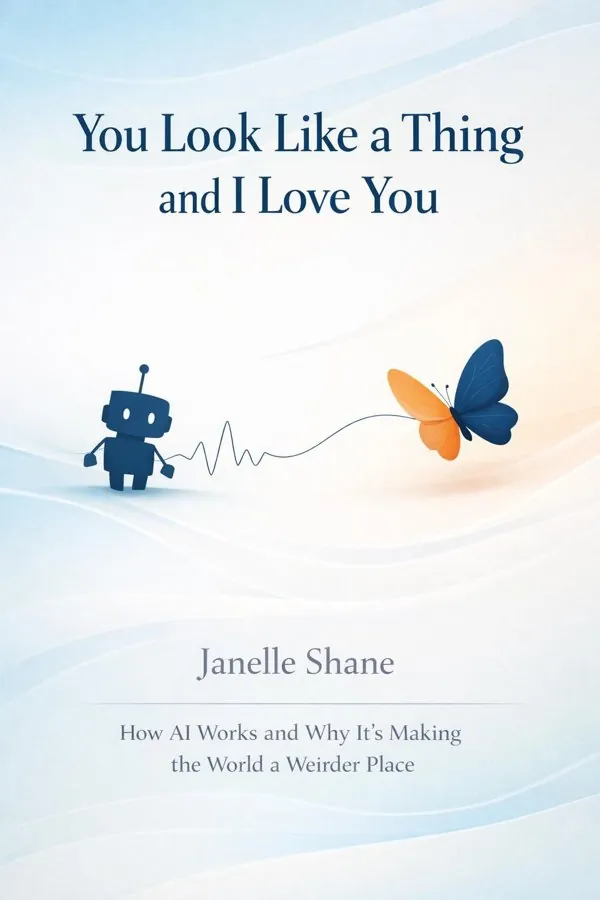
You Look Like a Thing and I Love You: How AI Works and Why It's Making the World a Weirder Place: Summary & Key Insights
 10 min10 chaptersAudio available
What Is You Look Like a Thing and I Love You: How AI Works and Why It's Making the World a Weirder Place About?
You Look Like a Thing and I Love You: How AI Works and Why It's Making the World a Weirder Place by Janelle Shane is a ai_ml book spanning 10 pages. This book offers a humorous and accessible exploration of artificial intelligence, explaining how machine learning algorithms actually work and why they often behave in unexpected, sometimes absurd ways. Through real examples and experiments, Janelle Shane demystifies AI, showing both its potential and its limitations in everyday life.
This FizzRead summary covers all 10 key chapters of You Look Like a Thing and I Love You: How AI Works and Why It's Making the World a Weirder Place in approximately 10 minutes, distilling the most important ideas, arguments, and takeaways from Janelle Shane's work. Also available as an audio summary and Key Quotes Podcast.
You Look Like a Thing and I Love You: How AI Works and Why It's Making the World a Weirder Place
This book offers a humorous and accessible exploration of artificial intelligence, explaining how machine learning algorithms actually work and why they often behave in unexpected, sometimes absurd ways. Through real examples and experiments, Janelle Shane demystifies AI, showing both its potential and its limitations in everyday life.
Who Should Read You Look Like a Thing and I Love You: How AI Works and Why It's Making the World a Weirder Place?
This book is perfect for anyone interested in ai_ml and looking to gain actionable insights in a short read. Whether you're a student, professional, or lifelong learner, the key ideas from You Look Like a Thing and I Love You: How AI Works and Why It's Making the World a Weirder Place by Janelle Shane will help you think differently.
- ✓Readers who enjoy ai_ml and want practical takeaways
- ✓Professionals looking to apply new ideas to their work and life
- ✓Anyone who wants the core insights of You Look Like a Thing and I Love You: How AI Works and Why It's Making the World a Weirder Place in just 10 minutes
Want the full summary?
Get instant access to this book summary and 100K+ more with Fizz Moment.
Get Free SummaryAvailable on App Store • Free to download
Key Chapters
When I use the term ‘artificial intelligence,’ I don’t mean a sentient robot from fiction. I mean the collection of systems we humans design to perform tasks—sometimes narrow, sometimes complex—that seem to require something like thought. Many of those systems are not nearly as capable as popular narratives would have you believe. They don’t think, feel, or reason; they detect patterns. And at their heart, modern AI systems are powered by machine learning—algorithms that learn from examples instead of obeying hand-written rules.
Rule-based systems were once the gold standard of AI. They relied on explicit instructions: if condition A is met, then perform action B. But real life doesn’t fit neatly into such crisp categories, so we developed neural networks—digital approximations of the way biological neurons send signals. These networks adjust themselves internally based on data, seeking connections that humans might not even see. That’s where the magic—and the madness—begins.
Machine learning isn’t about teaching an algorithm what cats are; it’s about feeding it thousands of images labeled as ‘cat’ and ‘not cat,’ then letting it figure out the difference itself. What emerges is a kind of internal model—a dense web of mathematical weights—that allows the system to make educated guesses. It’s marvelous, but it’s also fragile. A neural network trained to identify photos can stumble on an image that’s perfectly ordinary to you and me but utterly confounding to its learned patterns.
Understanding this distinction helps us appreciate AI’s accomplishments without attributing human-like intellect where there is none. Machines don’t think; they calculate patterns at enormous speed. When they surprise us—whether delightfully or disastrously—it’s because they’re following the patterns in their data, not because they understand the task the way humans do.
The quality of an AI system lives and dies by its training data. That’s a truth I emphasize again and again because it’s easy to forget that even the most sophisticated algorithms can’t escape their input. If your data is flawed, biased, or incomplete, your AI will inherit those flaws—and amplify them.
In my online experiments, I’ve fed neural networks all kinds of human-created data: names, recipes, color palettes, even pickup lines. What the AI produces always reflects the sum of its examples and the gaps between them. Train a network on romantic sentences, and you might get odd results like ‘You look like a thing and I love you’—sweet, accidental poetry born from pattern-matching, not emotion. Train it on jokes, and it generates punchlines that rarely make sense but reveal something fascinating about how humor relies on cultural and contextual understanding that machines don’t have.
Real-world consequences are serious. A facial recognition system trained mainly on lighter-skinned faces will misidentify people with darker skin. A hiring AI trained on past corporate data might perpetuate discrimination unintentionally. The algorithm is only as fair as its data, and the data is only as fair as the society that generates it.
Recognizing bias isn’t about rejecting AI—it’s about becoming aware that every dataset is a mirror. When we train AIs, we’re teaching them our habits, prejudices, priorities, and blind spots. Once we see that clearly, we can start designing data with fairness and diversity in mind, giving machines a better chance to reflect the world we want rather than the world we used to have.
+ 8 more chapters — available in the FizzRead app
All Chapters in You Look Like a Thing and I Love You: How AI Works and Why It's Making the World a Weirder Place
About the Author
Janelle Shane is an optics research scientist and writer known for her work on artificial intelligence and machine learning. She runs the popular blog 'AI Weirdness', where she shares entertaining experiments with neural networks and explores the quirks of AI systems.
Get This Summary in Your Preferred Format
Read or listen to the You Look Like a Thing and I Love You: How AI Works and Why It's Making the World a Weirder Place summary by Janelle Shane anytime, anywhere. FizzRead offers multiple formats so you can learn on your terms — all free.
Available formats: App · Audio · PDF · EPUB — All included free with FizzRead
Download You Look Like a Thing and I Love You: How AI Works and Why It's Making the World a Weirder Place PDF and EPUB Summary
Key Quotes from You Look Like a Thing and I Love You: How AI Works and Why It's Making the World a Weirder Place
“When I use the term ‘artificial intelligence,’ I don’t mean a sentient robot from fiction.”
“The quality of an AI system lives and dies by its training data.”
Frequently Asked Questions about You Look Like a Thing and I Love You: How AI Works and Why It's Making the World a Weirder Place
You Look Like a Thing and I Love You: How AI Works and Why It's Making the World a Weirder Place by Janelle Shane is a ai_ml book that explores key ideas across 10 chapters. This book offers a humorous and accessible exploration of artificial intelligence, explaining how machine learning algorithms actually work and why they often behave in unexpected, sometimes absurd ways. Through real examples and experiments, Janelle Shane demystifies AI, showing both its potential and its limitations in everyday life.
You Might Also Like
Life 3.0
Max Tegmark
10 min
Superintelligence
Nick Bostrom
10 min
TensorFlow in Action
Thushan Ganegedara
10 min
AI Made Simple: A Beginner’s Guide to Generative AI, ChatGPT, and the Future of Work
Rajeev Kapur
10 min
AI Snake Oil
Arvind Narayanan, Sayash Kapoor
10 min
AI Superpowers: China, Silicon Valley, and the New World Order
Kai-Fu Lee
10 minBrowse by Category
Ready to read You Look Like a Thing and I Love You: How AI Works and Why It's Making the World a Weirder Place?
Get the full summary and 100K+ more books with Fizz Moment.