
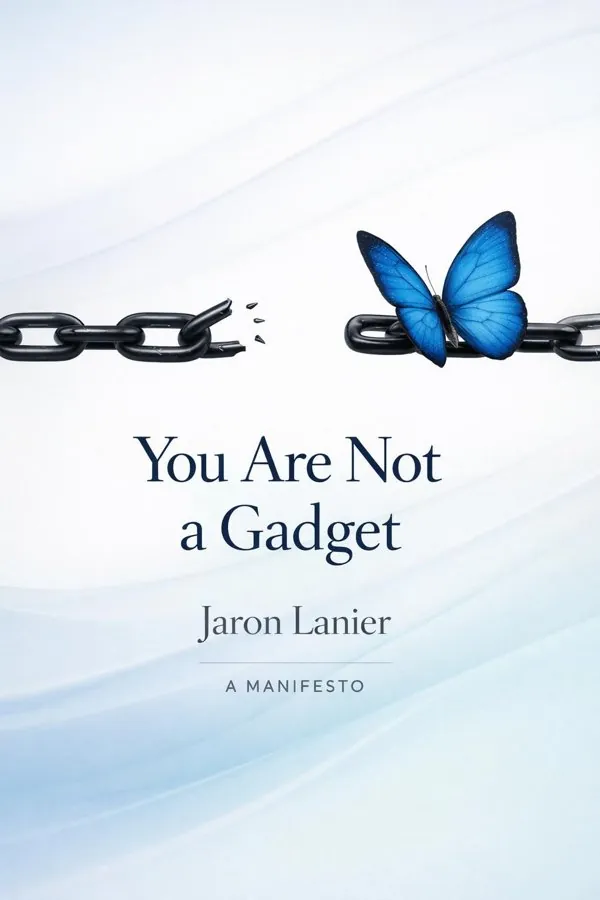
You Are Not a Gadget: A Manifesto: Summary & Key Insights
by Jaron Lanier
 10 min10 chaptersAudio available
What Is You Are Not a Gadget: A Manifesto About?
You Are Not a Gadget: A Manifesto by Jaron Lanier is a digital_culture book spanning 10 pages. You Are Not a Gadget is a critical examination of the digital culture that has emerged from the early ideals of the internet. Jaron Lanier, a pioneer in virtual reality, argues that the web’s design has led to a devaluation of individuality, creativity, and human expression. He critiques the rise of collectivist online behavior, the dominance of algorithms, and the loss of personal agency in the age of social media and open-source culture. The book calls for a rethinking of technology’s role in society, urging readers to reclaim their humanity in a world increasingly shaped by machines and networks.
This FizzRead summary covers all 10 key chapters of You Are Not a Gadget: A Manifesto in approximately 10 minutes, distilling the most important ideas, arguments, and takeaways from Jaron Lanier's work. Also available as an audio summary and Key Quotes Podcast.
You Are Not a Gadget: A Manifesto
You Are Not a Gadget is a critical examination of the digital culture that has emerged from the early ideals of the internet. Jaron Lanier, a pioneer in virtual reality, argues that the web’s design has led to a devaluation of individuality, creativity, and human expression. He critiques the rise of collectivist online behavior, the dominance of algorithms, and the loss of personal agency in the age of social media and open-source culture. The book calls for a rethinking of technology’s role in society, urging readers to reclaim their humanity in a world increasingly shaped by machines and networks.
Who Should Read You Are Not a Gadget: A Manifesto?
This book is perfect for anyone interested in digital_culture and looking to gain actionable insights in a short read. Whether you're a student, professional, or lifelong learner, the key ideas from You Are Not a Gadget: A Manifesto by Jaron Lanier will help you think differently.
- ✓Readers who enjoy digital_culture and want practical takeaways
- ✓Professionals looking to apply new ideas to their work and life
- ✓Anyone who wants the core insights of You Are Not a Gadget: A Manifesto in just 10 minutes
Want the full summary?
Get instant access to this book summary and 100K+ more with Fizz Moment.
Get Free SummaryAvailable on App Store • Free to download
Key Chapters
In the beginning, the internet celebrated individuality—a place for quirky homepages, idiosyncratic voices, and spontaneous creativity. Yet, as networks grew and standardized, those distinctive sparks were subsumed by uniform templates and behavior. Anonymity, though liberating in theory, blurred the boundary between individual accountability and collective noise. I watched as unique authorship dissolved into undifferentiated crowds—the 'user' replacing the person.
Online collectivism and the culture of remixing certainly allow for collaboration, but they also create a world where original thought is drowned in overwhelming aggregation. When everyone’s expression is anonymous, creative risk declines; people conform to the dominant tone of the crowd. The web became a sea of flattened personas—the meme replacing the voice, the trending topic replacing the idea.
This loss matters profoundly, because individuality is the origin of all progress and empathy. Creative authorship is more than self-expression; it is the moral stance that says, 'I am responsible for what I make.' When we surrender that authorship to automation or crowdsourcing, we lose the integrity that defines art, science, and fellowship. The antidote begins with designing systems that recognize the person behind the content, that respect presence rather than dissolve it in data. To honor individuality is not to reject connectedness—it is to restore the dignity of personal thought within it.
The notion that 'the crowd knows best' has seduced technologists and internet idealists alike. Wikipedia, open-source projects, and social networks embody the idea that collective intelligence outperforms individual judgment. But when you scrutinize these systems, you see that what emerges is not wisdom but regression toward average conformity. In the hive mind, originality is suspect, and dissent uncomfortable.
I coined the term 'Digital Maoism' to describe this tendency—the collective belief that the masses, mediated by algorithms, represent an enlightened truth superior to that of any one person. History teaches that such collectivist faith often ends in cultural uniformity and suppression of nuance. The hive mind rewards consensus over insight; popularity measures replace the messy but fruitful process of debate and discovery.
Consider how a single erroneous statement can propagate online simply because it fits into the crowd’s narrative. Information becomes a feedback loop, filtered by the group’s emotional mood. The individuality that drives scientific breakthroughs or artistic revolutions cannot survive in such an environment, because the hive mind’s currency is approval, not understanding.
The solution I advocate is a return to valuing named voices, accountable authors, identifiable creators. A culture that re-centers personal intellect and responsibility can use collaboration as a tool, not a substitute for human discernment. We must remember that every idea begins in one mind before it spreads to many. The goal of technology should be to amplify minds, not dissolve them into data.
+ 8 more chapters — available in the FizzRead app
All Chapters in You Are Not a Gadget: A Manifesto
About the Author
Jaron Lanier is an American computer scientist, composer, and visual artist, best known as a pioneer of virtual reality technology. He has worked at major technology companies and research institutions, and is recognized for his critical writings on the social and philosophical implications of digital technology. Lanier’s work bridges science, art, and humanism, advocating for a more ethical and human-centered approach to innovation.
Get This Summary in Your Preferred Format
Read or listen to the You Are Not a Gadget: A Manifesto summary by Jaron Lanier anytime, anywhere. FizzRead offers multiple formats so you can learn on your terms — all free.
Available formats: App · Audio · PDF · EPUB — All included free with FizzRead
Download You Are Not a Gadget: A Manifesto PDF and EPUB Summary
Key Quotes from You Are Not a Gadget: A Manifesto
“In the beginning, the internet celebrated individuality—a place for quirky homepages, idiosyncratic voices, and spontaneous creativity.”
“The notion that 'the crowd knows best' has seduced technologists and internet idealists alike.”
Frequently Asked Questions about You Are Not a Gadget: A Manifesto
You Are Not a Gadget: A Manifesto by Jaron Lanier is a digital_culture book that explores key ideas across 10 chapters. You Are Not a Gadget is a critical examination of the digital culture that has emerged from the early ideals of the internet. Jaron Lanier, a pioneer in virtual reality, argues that the web’s design has led to a devaluation of individuality, creativity, and human expression. He critiques the rise of collectivist online behavior, the dominance of algorithms, and the loss of personal agency in the age of social media and open-source culture. The book calls for a rethinking of technology’s role in society, urging readers to reclaim their humanity in a world increasingly shaped by machines and networks.
More by Jaron Lanier

You Might Also Like

An Ugly Truth: Inside Facebook’s Battle for Domination
Sheera Frenkel, Cecilia Kang
10 min
Cyber Citizens
Ian Goodfellow
10 min
Digital Minimalism: Choosing a Focused Life in a Noisy World
Cal Newport
10 min
E‑Books & Beyond
Various Authors
10 min
The Future of Media
Various Authors
10 min
This Is Why We Can't Have Nice Things
Whitney Phillips
10 minBrowse by Category
Ready to read You Are Not a Gadget: A Manifesto?
Get the full summary and 100K+ more books with Fizz Moment.