
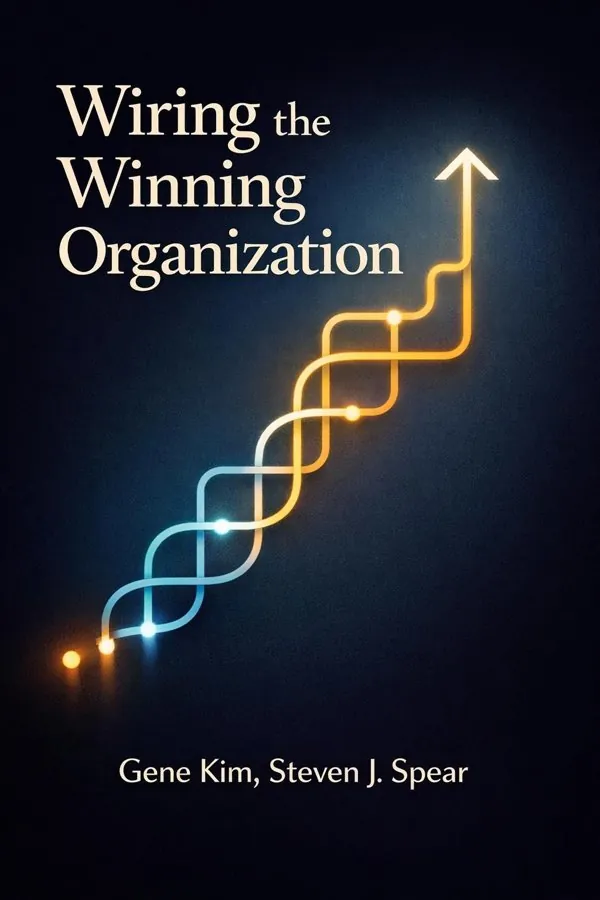
Wiring the Winning Organization: 20 Timeless Principles of Organizational Effectiveness: Summary & Key Insights
 10 min9 chaptersAudio available
What Is Wiring the Winning Organization: 20 Timeless Principles of Organizational Effectiveness About?
Wiring the Winning Organization: 20 Timeless Principles of Organizational Effectiveness by Gene Kim, Steven J. Spear is a leadership book spanning 9 pages. Wiring the Winning Organization presents a framework for building organizations that can continuously learn, adapt, and excel. Drawing on decades of research and practical experience, Gene Kim and Steven J. Spear outline 20 principles that help leaders design systems where people can perform at their best, problems are detected early, and improvement becomes a natural part of daily work. The book bridges management science, systems thinking, and organizational design to help companies achieve sustainable excellence.
This FizzRead summary covers all 9 key chapters of Wiring the Winning Organization: 20 Timeless Principles of Organizational Effectiveness in approximately 10 minutes, distilling the most important ideas, arguments, and takeaways from Gene Kim, Steven J. Spear's work. Also available as an audio summary and Key Quotes Podcast.
Wiring the Winning Organization: 20 Timeless Principles of Organizational Effectiveness
Wiring the Winning Organization presents a framework for building organizations that can continuously learn, adapt, and excel. Drawing on decades of research and practical experience, Gene Kim and Steven J. Spear outline 20 principles that help leaders design systems where people can perform at their best, problems are detected early, and improvement becomes a natural part of daily work. The book bridges management science, systems thinking, and organizational design to help companies achieve sustainable excellence.
Who Should Read Wiring the Winning Organization: 20 Timeless Principles of Organizational Effectiveness?
This book is perfect for anyone interested in leadership and looking to gain actionable insights in a short read. Whether you're a student, professional, or lifelong learner, the key ideas from Wiring the Winning Organization: 20 Timeless Principles of Organizational Effectiveness by Gene Kim, Steven J. Spear will help you think differently.
- ✓Readers who enjoy leadership and want practical takeaways
- ✓Professionals looking to apply new ideas to their work and life
- ✓Anyone who wants the core insights of Wiring the Winning Organization: 20 Timeless Principles of Organizational Effectiveness in just 10 minutes
Want the full summary?
Get instant access to this book summary and 100K+ more with Fizz Moment.
Get Free SummaryAvailable on App Store • Free to download
Key Chapters
Every struggling organization I’ve studied shares a common pathology: friction. It might not appear on financial statements, but you can feel it everywhere. It’s the confusion when roles overlap and no one knows who owns the outcome. It’s the rework caused by late-discovered errors. It’s the silence that settles in when people stop raising issues because it’s too risky or too painful. Friction wastes energy, obscures reality, and destroys learning.
Friction emerges when work is designed as a collection of local optimizations instead of a coherent flow. Software teams optimize code while ignoring how their work integrates with others. Hospitals optimize departments without seeing how patients traverse the system. Factories optimize throughput but hide defects. Each domain is a silo; the whole organization becomes a maze. This fragmentation makes coordination slow, problem-solving reactive, and discovery accidental.
We call this the 'gravity of complexity.' It drags organizations down over time unless leaders deliberately counteract it. Overcoming friction begins with clarity—clear purpose, clear roles, visible work, and fast feedback. Without clarity, even the most talented people operate at a fraction of their potential. It’s not about working harder or hiring smarter; it’s about designing the work system so that good performance is the natural outcome, not a heroic effort.
Imagine a hospital where each nurse can see patient flow in real time, where staff instantly notice when a handoff fails, where small experiments improve daily routines. Contrast that with one where errors surface only during audits, and problems are discussed only after crises. Both have equally dedicated professionals, but one is wired for friction, the other for flow. Our task in the chapters ahead is to understand how to design for the latter—to wire organizations that learn continuously.
The first set of principles deal with design—creating an organizational structure that allows information, intent, and work to flow without distortion. When people know why their work matters, what outcomes they’re responsible for, and how their efforts interact with others’, magic happens. Clarity converts confusion into purpose. Flow turns stop-and-go work into coordinated movement.
At Toyota, we observed this in action decades ago. Every production step was visible and connected. Defects could be spotted at their origin. Workers had the authority to pull the cord that stopped the entire line. This wasn’t an act of control—it was an act of empowerment. The structure ensured that information about quality flowed freely and immediately.
In most organizations, by contrast, feedback is delayed and filtered. Work passes through multiple layers before anyone identifies an issue. Meetings replace reflection. The key to designing for flow is to shorten the loops between action, feedback, and adjustment. Clarity in design requires that everyone can see how their local context fits within the global purpose. Principles one through five articulate that design clarity isn’t aesthetic—it’s a moral commitment to make work meaningful and sustainable. When leaders build systems where people can see the purpose and the process, the organization starts breathing again.
+ 7 more chapters — available in the FizzRead app
All Chapters in Wiring the Winning Organization: 20 Timeless Principles of Organizational Effectiveness
About the Authors
Gene Kim is a researcher and author known for his work on IT operations, DevOps, and organizational performance, including The Phoenix Project and The Unicorn Project. Steven J. Spear is a senior lecturer at MIT Sloan School of Management and an expert on high-velocity organizations, known for his research on Toyota and complex system design.
Get This Summary in Your Preferred Format
Read or listen to the Wiring the Winning Organization: 20 Timeless Principles of Organizational Effectiveness summary by Gene Kim, Steven J. Spear anytime, anywhere. FizzRead offers multiple formats so you can learn on your terms — all free.
Available formats: App · Audio · PDF · EPUB — All included free with FizzRead
Download Wiring the Winning Organization: 20 Timeless Principles of Organizational Effectiveness PDF and EPUB Summary
Key Quotes from Wiring the Winning Organization: 20 Timeless Principles of Organizational Effectiveness
“Every struggling organization I’ve studied shares a common pathology: friction.”
“The first set of principles deal with design—creating an organizational structure that allows information, intent, and work to flow without distortion.”
Frequently Asked Questions about Wiring the Winning Organization: 20 Timeless Principles of Organizational Effectiveness
Wiring the Winning Organization: 20 Timeless Principles of Organizational Effectiveness by Gene Kim, Steven J. Spear is a leadership book that explores key ideas across 9 chapters. Wiring the Winning Organization presents a framework for building organizations that can continuously learn, adapt, and excel. Drawing on decades of research and practical experience, Gene Kim and Steven J. Spear outline 20 principles that help leaders design systems where people can perform at their best, problems are detected early, and improvement becomes a natural part of daily work. The book bridges management science, systems thinking, and organizational design to help companies achieve sustainable excellence.
You Might Also Like
Extreme Ownership
Jocko Willink
10 min
Dare to Lead
Brene Brown
10 min
Leaders Eat Last
Simon Sinek
10 min
The 21 Irrefutable Laws of Leadership
John Maxwell
10 min
Start With Why
Simon Sinek
10 min
How to Lead When You're Not in Charge
Clay Scroggins
10 minBrowse by Category
Ready to read Wiring the Winning Organization: 20 Timeless Principles of Organizational Effectiveness?
Get the full summary and 100K+ more books with Fizz Moment.