
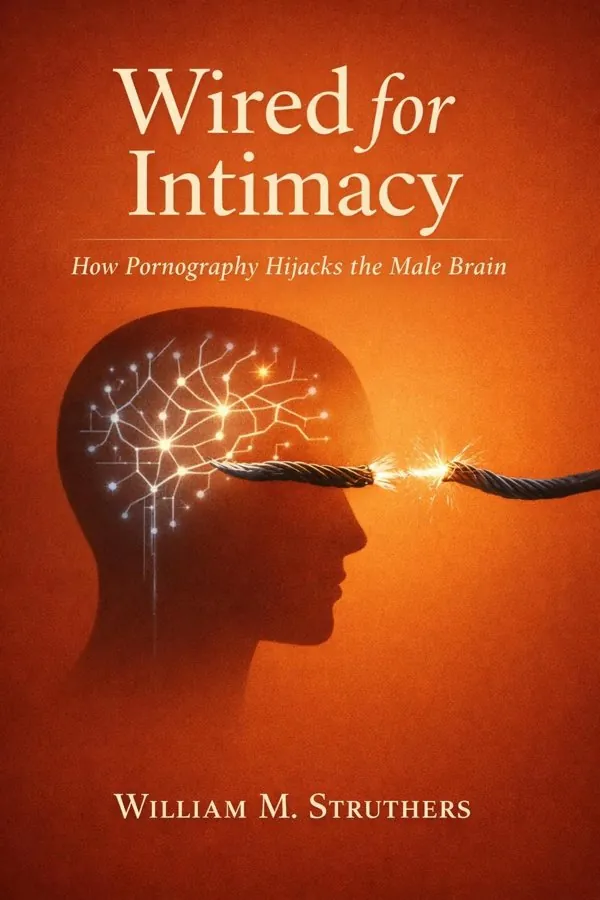
Wired for Intimacy: How Pornography Hijacks the Male Brain: Summary & Key Insights
 10 min9 chaptersAudio available
Key Takeaways from Wired for Intimacy: How Pornography Hijacks the Male Brain
What feels intensely personal and spontaneous is also deeply biological.
The brain remembers what it does often.
The human brain is vulnerable to exaggerated versions of natural rewards.
Addiction is rarely about pleasure alone.
What we repeatedly look at changes how we learn to see.
What Is Wired for Intimacy: How Pornography Hijacks the Male Brain About?
Wired for Intimacy: How Pornography Hijacks the Male Brain by William M. Struthers is a neuroscience book spanning 8 pages. Wired for Intimacy examines a question with enormous personal and cultural consequences: what happens to the male brain when sexual desire is repeatedly shaped by pornography rather than real human relationship? In this book, neuroscientist and psychology professor William M. Struthers argues that pornography is not simply a private habit or a moral issue in isolation. It is also a neurological training system that can reshape attention, desire, memory, and attachment. By combining brain science with Christian moral reflection, Struthers explains how sexual arousal becomes linked to images, novelty, secrecy, and control, and why those patterns can erode intimacy in real life. What makes the book powerful is its dual perspective. Struthers writes with scientific authority about neural pathways, reward circuitry, hormones, and habit formation, yet he is equally concerned with the emotional, relational, and spiritual costs of pornography use. Rather than relying on alarmism, he offers a framework for understanding why pornography can become compelling and why recovery requires more than willpower. The result is a thoughtful, challenging book for readers who want to understand both the brain-based and moral dimensions of sexual behavior.
This FizzRead summary covers all 9 key chapters of Wired for Intimacy: How Pornography Hijacks the Male Brain in approximately 10 minutes, distilling the most important ideas, arguments, and takeaways from William M. Struthers's work. Also available as an audio summary and Key Quotes Podcast.
Wired for Intimacy: How Pornography Hijacks the Male Brain
Wired for Intimacy examines a question with enormous personal and cultural consequences: what happens to the male brain when sexual desire is repeatedly shaped by pornography rather than real human relationship? In this book, neuroscientist and psychology professor William M. Struthers argues that pornography is not simply a private habit or a moral issue in isolation. It is also a neurological training system that can reshape attention, desire, memory, and attachment. By combining brain science with Christian moral reflection, Struthers explains how sexual arousal becomes linked to images, novelty, secrecy, and control, and why those patterns can erode intimacy in real life.
What makes the book powerful is its dual perspective. Struthers writes with scientific authority about neural pathways, reward circuitry, hormones, and habit formation, yet he is equally concerned with the emotional, relational, and spiritual costs of pornography use. Rather than relying on alarmism, he offers a framework for understanding why pornography can become compelling and why recovery requires more than willpower. The result is a thoughtful, challenging book for readers who want to understand both the brain-based and moral dimensions of sexual behavior.
Who Should Read Wired for Intimacy: How Pornography Hijacks the Male Brain?
This book is perfect for anyone interested in neuroscience and looking to gain actionable insights in a short read. Whether you're a student, professional, or lifelong learner, the key ideas from Wired for Intimacy: How Pornography Hijacks the Male Brain by William M. Struthers will help you think differently.
- ✓Readers who enjoy neuroscience and want practical takeaways
- ✓Professionals looking to apply new ideas to their work and life
- ✓Anyone who wants the core insights of Wired for Intimacy: How Pornography Hijacks the Male Brain in just 10 minutes
Want the full summary?
Get instant access to this book summary and 100K+ more with Fizz Moment.
Get Free SummaryAvailable on App Store • Free to download
Key Chapters
What feels intensely personal and spontaneous is also deeply biological. Struthers begins by showing that male sexual arousal is not limited to the body; it is orchestrated by a network of brain systems that process reward, emotion, memory, and motivation. Structures such as the amygdala, hypothalamus, and nucleus accumbens help interpret sexual cues, assign them emotional value, and generate anticipation. Neurochemicals like dopamine reinforce the experience, making the brain more likely to seek the same stimulation again.
This matters because pornography does not merely trigger arousal in the moment. It teaches the brain what to notice, what to want, and where to look for satisfaction. A man who repeatedly turns to sexual images is not only indulging a preference; he is repeatedly activating a powerful reward system designed to bind desire to meaningful cues. Over time, the brain starts to expect the kinds of stimulation it has been trained to consume.
A practical implication is that sexual habits are not neutral. If someone spends late nights scrolling through explicit content, pairing arousal with novelty and isolation, his brain learns that pattern. By contrast, if sexual desire is expressed within committed, embodied relationship, the brain links arousal with trust, reciprocity, and connection.
Actionable takeaway: Treat sexual choices as brain-training exercises, not one-off decisions. Ask regularly, “What am I teaching my brain to desire?”
The brain remembers what it does often. One of Struthers’s central claims is that neuroplasticity makes repeated sexual behavior especially formative. Every time a person returns to a familiar erotic pattern, the associated neural pathways become easier to activate. Thoughts become impulses, impulses become routines, and routines begin to feel like identity.
This helps explain why pornography can move from occasional curiosity to entrenched habit. The issue is not only moral weakness or lack of discipline. Repetition physically alters the brain’s tendency to travel familiar routes. A user may begin by seeking stimulation, but after enough repetition the stimulus begins to seek him, surfacing as intrusive thoughts, automatic cravings, or emotional fallback under stress.
Consider a simple analogy: walking once through a field leaves little trace, but walking the same route daily creates a visible path. Sexual imagery works similarly. Repeated viewing builds cognitive grooves that make certain fantasies more accessible and more compelling. This is why people often report escalating use even when they consciously dislike where the habit is taking them.
The hopeful side of plasticity is that pathways can weaken when they are no longer reinforced. New routines, relationships, and attentional habits can gradually redirect desire. Change is difficult, but it is neurologically possible.
Actionable takeaway: Interrupt repetition early. Identify the times, moods, and environments that strengthen the habit loop, and replace them with a preplanned alternative before the pathway deepens further.
The human brain is vulnerable to exaggerated versions of natural rewards. Struthers uses the idea of a supernormal stimulus to explain why pornography can become more captivating than ordinary sexual attraction. A supernormal stimulus is an intensified artificial cue that hijacks natural instincts by presenting them in a concentrated, optimized form. Pornography offers endless novelty, idealized bodies, selective editing, and immediate access without the complexity of mutual relationship.
In real life, attraction unfolds within ordinary limits: another person has feelings, boundaries, imperfections, and needs. Pornography strips away those constraints and delivers a stream of amplified sexual triggers. The brain responds strongly because the material is engineered to exploit the mechanisms that evolved to notice fertility, novelty, and reward.
This helps explain why some users find everyday intimacy less stimulating over time. It is not necessarily because real relationships have become worse, but because the brain has been calibrated to an unreal level of intensity and variety. A person accustomed to instant novelty may struggle with patience, emotional presence, or exclusive focus on one partner.
A practical example is the user who increasingly skips from clip to clip, not because any one image is satisfying, but because novelty itself has become part of the reward. The search becomes as stimulating as the content.
Actionable takeaway: Reduce exposure to artificially intensified sexual cues and retrain attention toward real-world, embodied, non-curated connection.
Addiction is rarely about pleasure alone. Struthers explains that pornography can become addictive not only because it is rewarding, but because it also offers relief from boredom, loneliness, anxiety, shame, or stress. In that sense, pornography functions as both stimulant and sedative: it excites desire while numbing discomfort. This double effect makes it especially sticky.
Neuroscientifically, each cycle reinforces itself. Anticipation releases dopamine, searching heightens arousal, orgasm seals the reward, and temporary relief teaches the brain that this is a reliable coping mechanism. When negative emotions return, the brain remembers the shortcut. Over time, the habit becomes less about sexual desire and more about emotional regulation through sexual means.
This explains why many attempts to quit fail when they focus only on suppression. If pornography has become the default response to fatigue, rejection, or frustration, removing it without replacing its coping function leaves a vacuum. The person may know the behavior is harmful and still return to it under pressure.
A practical response is to map the emotional triggers around the behavior. Does use spike after conflict? During isolation? Late at night? After feelings of inadequacy? Recognizing the underlying need makes recovery more realistic and less superficial.
Actionable takeaway: Don’t fight pornography only at the level of behavior. Build healthier responses to the emotions and situations that make the behavior feel necessary.
What we repeatedly look at changes how we learn to see. One of Struthers’s most unsettling points is that pornography can train men to perceive women less as whole persons and more as collections of sexually useful features. The problem is not only lust in a general sense, but a gradual perceptual shift in which another human being is reduced to a stimulus.
This has moral and relational consequences. In ordinary intimacy, a person must attend to another’s feelings, consent, history, dignity, and humanity. Pornography bypasses all of that. It invites the viewer into a one-sided relationship of consumption, where the other exists for display and gratification. As this pattern is rehearsed, it can spill over into daily life, affecting how a man scans social environments, interprets attractiveness, or responds to women in work, church, dating, and marriage.
A practical example is the subtle habit of mentally sorting women according to erotic potential rather than relating to them as neighbors, colleagues, or friends. Even if this remains internal, it corrodes empathy and respect.
Struthers’s point is that sexual ethics are not abstract rules imposed from the outside. They protect perception itself. The way we use our eyes influences the kind of people we become.
Actionable takeaway: Practice deliberate humanization. In everyday interactions, consciously attend to people’s stories, intelligence, emotions, and dignity rather than their sexual appeal.
A secret sexual habit rarely stays contained. Struthers argues that pornography undermines intimacy because it trains the user in a form of desire detached from vulnerability, reciprocity, and covenantal commitment. Real relationships require patience, awkwardness, compromise, and care for another person’s good. Pornography requires none of these, which means it can quietly make real intimacy feel demanding by comparison.
In romantic relationships, this may show up as dissatisfaction, emotional withdrawal, unrealistic expectations, or reduced desire for one’s partner. A spouse may feel compared to impossible standards or excluded from the user’s inner life. Even when pornography is not openly discussed, it can shape the emotional climate of a relationship through secrecy and divided attachment.
The issue extends beyond marriage. A man formed by pornographic consumption may become less capable of seeing intimacy as self-giving and more likely to approach it as performance or control. He may also struggle to integrate sexuality with tenderness, friendship, and responsibility.
A useful application is to evaluate whether sexual behavior is increasing one’s ability to love. Does it make a person more truthful, patient, and attentive, or more hidden, restless, and self-focused? That question exposes whether desire is being ordered toward communion or away from it.
Actionable takeaway: Measure sexual habits by their relational fruit. If a practice weakens honesty, empathy, or mutuality, treat that as a serious warning sign.
Many discussions of pornography split into two camps: science without ethics, or ethics without science. Struthers refuses that divide. He argues that the neurological effects of pornography and the moral meaning of pornography are not competing explanations but mutually illuminating ones. Brain science describes what repeated exposure does to attention, reward, and habit; moral reflection asks whether those changes align with human dignity and flourishing.
Because Struthers writes from a Christian perspective, he frames sexuality as ordered toward covenant, self-giving love, and embodied union. Within that vision, pornography is harmful not only because it can become compulsive, but because it distorts the purpose of desire itself. It takes a faculty meant for intimate communion and reroutes it into detached consumption.
Even readers who do not share the book’s theology can still engage its larger question: what kind of person is a given habit forming? Neuroscience can show that the brain adapts to repeated patterns. Ethics helps evaluate whether those patterns make us more capable of love, self-command, and truthful perception.
A practical way to apply this idea is to stop asking only, “Can I get away with this?” and start asking, “What is this doing to my character, my imagination, and my capacity for relationship?” That shift moves the conversation from rule-checking to human formation.
Actionable takeaway: Use both scientific evidence and moral reflection when evaluating habits; understanding effects is important, but so is judging whether those effects are good.
Willpower can start change, but it rarely completes it. Struthers emphasizes that recovery from pornography involves retraining the brain through new patterns of thought, behavior, and relationship. If pornography has become embedded in neural pathways, then stopping the behavior is only one part of the work. The deeper task is to weaken old associations and strengthen healthier ones.
This often includes practical boundaries such as filters, device limits, accountability, and avoiding high-risk contexts. But Struthers’s framework points beyond external controls. The brain must learn different ways to handle stress, loneliness, and desire. That may involve exercise, confession, structured routines, honest friendship, counseling, spiritual practices, and replacing fantasy with purposeful engagement in real life.
For example, someone who consistently uses pornography when exhausted and alone at night might need a multilevel plan: charging devices outside the bedroom, going to bed earlier, texting an accountability partner, and developing a calming pre-sleep routine. These changes sound ordinary, but they matter because they alter the context in which the old pathway was repeatedly reinforced.
Recovery also requires patience. Because the habit developed over time, the brain may continue producing cravings even after a person has made serious commitments to change. That does not mean change is impossible; it means healing usually involves persistence rather than instant victory.
Actionable takeaway: Build a recovery system, not just a resolution. Combine environmental barriers, emotional coping tools, and relational accountability.
The opposite of pornography is not merely abstinence. For Struthers, the true alternative is restored intimacy: learning again to relate to others as persons rather than products, and to experience sexuality as part of a larger life of love, trust, and self-gift. This means recovery is not complete when pornography use stops; it is complete when the heart and imagination are reoriented toward real connection.
Embodied intimacy includes honesty, vulnerability, and presence. It means being known rather than hiding, and loving rather than consuming. In marriage, that may involve rebuilding trust, relearning patience, and allowing sexual connection to become relational rather than performative. For single readers, it may involve practicing chastity, strengthening community, and refusing to let loneliness be medicated by fantasy.
Struthers also gives spiritual weight to this process. Because pornography isolates and fragments, restoration often requires confession, grace, humility, and the slow repair of one’s inner life. The point is not shame for its own sake, but healing through truth.
A practical example is choosing conversations, service, friendship, and disciplined presence over digital escape. These habits may seem less intense than pornography, but they cultivate the very capacities pornography damages: patience, attentiveness, empathy, and mutuality.
Actionable takeaway: Define success positively. Don’t aim only to stop consuming images; aim to become a person capable of honest, embodied, faithful love.
All Chapters in Wired for Intimacy: How Pornography Hijacks the Male Brain
About the Author
William M. Struthers is an associate professor of psychology at Wheaton College in Illinois and a scholar whose work sits at the intersection of neuroscience, behavior, sexuality, and moral formation. Trained as a biopsychologist and neuroscientist, he has researched how the brain shapes habits, desire, addiction, and ethical decision-making. Struthers is especially known for translating complex scientific ideas into accessible insights about human flourishing. In his writing, he often integrates empirical psychology with a Christian understanding of personhood, relationships, and virtue. That combination makes his work distinctive: he is interested not only in how the brain works, but in what kinds of lives and loves our habits are training us for. Wired for Intimacy reflects both his academic expertise and his pastoral concern.
Get This Summary in Your Preferred Format
Read or listen to the Wired for Intimacy: How Pornography Hijacks the Male Brain summary by William M. Struthers anytime, anywhere. FizzRead offers multiple formats so you can learn on your terms — all free.
Available formats: App · Audio · PDF · EPUB — All included free with FizzRead
Download Wired for Intimacy: How Pornography Hijacks the Male Brain PDF and EPUB Summary
Key Quotes from Wired for Intimacy: How Pornography Hijacks the Male Brain
“What feels intensely personal and spontaneous is also deeply biological.”
“One of Struthers’s central claims is that neuroplasticity makes repeated sexual behavior especially formative.”
“The human brain is vulnerable to exaggerated versions of natural rewards.”
“Addiction is rarely about pleasure alone.”
“What we repeatedly look at changes how we learn to see.”
Frequently Asked Questions about Wired for Intimacy: How Pornography Hijacks the Male Brain
Wired for Intimacy: How Pornography Hijacks the Male Brain by William M. Struthers is a neuroscience book that explores key ideas across 9 chapters. Wired for Intimacy examines a question with enormous personal and cultural consequences: what happens to the male brain when sexual desire is repeatedly shaped by pornography rather than real human relationship? In this book, neuroscientist and psychology professor William M. Struthers argues that pornography is not simply a private habit or a moral issue in isolation. It is also a neurological training system that can reshape attention, desire, memory, and attachment. By combining brain science with Christian moral reflection, Struthers explains how sexual arousal becomes linked to images, novelty, secrecy, and control, and why those patterns can erode intimacy in real life. What makes the book powerful is its dual perspective. Struthers writes with scientific authority about neural pathways, reward circuitry, hormones, and habit formation, yet he is equally concerned with the emotional, relational, and spiritual costs of pornography use. Rather than relying on alarmism, he offers a framework for understanding why pornography can become compelling and why recovery requires more than willpower. The result is a thoughtful, challenging book for readers who want to understand both the brain-based and moral dimensions of sexual behavior.
You Might Also Like

Anxious
Joseph LeDoux
10 min
Hallucinations
Oliver Sacks
10 min
The Biological Mind: How Brain, Body, and Environment Collaborate to Make Us Who We Are
Alan Jasanoff
10 min
The Feeling of Life Itself: Why Consciousness Is Widespread but Can't Be Computed
Christof Koch
10 min
The No-Nonsense Meditation Book
Steven Laureys
10 min
A General Theory of Love
Thomas Lewis, Fari Amini, Richard Lannon
10 minBrowse by Category
Ready to read Wired for Intimacy: How Pornography Hijacks the Male Brain?
Get the full summary and 100K+ more books with Fizz Moment.