
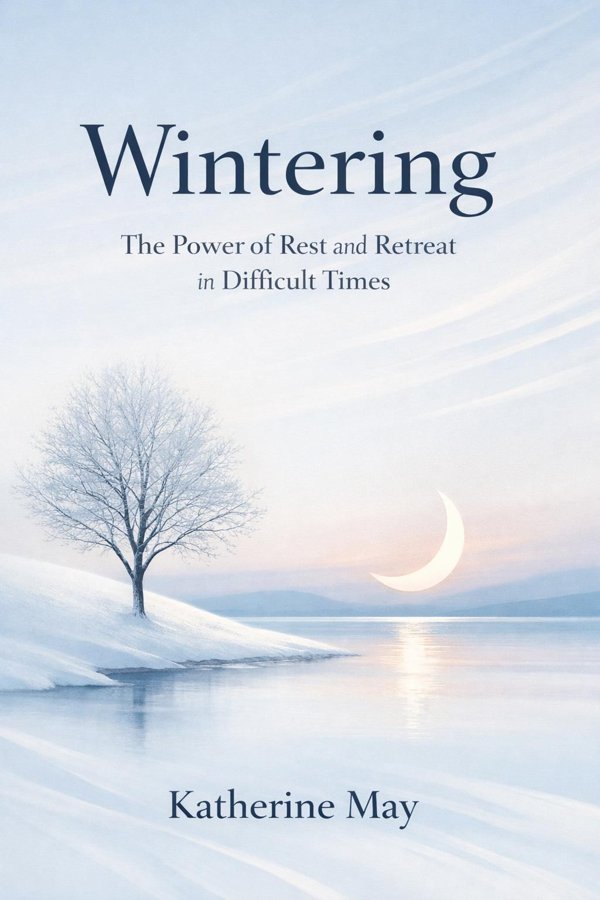
Wintering: The Power of Rest and Retreat in Difficult Times: Summary & Key Insights
 10 min9 chaptersAudio available
Key Takeaways from Wintering: The Power of Rest and Retreat in Difficult Times
Most people do not choose to winter; they are forced into it.
Winter in nature is not a failure of life; it is one of life’s strategies.
One of the book’s sharpest insights is that hardship is often intensified by the culture surrounding it.
When life becomes chaotic, stories can offer shape where experience feels formless.
Wintering is never only emotional; it is physical.
What Is Wintering: The Power of Rest and Retreat in Difficult Times About?
Wintering: The Power of Rest and Retreat in Difficult Times by Katherine May is a wellness book spanning 11 pages. Wintering: The Power of Rest and Retreat in Difficult Times is a deeply comforting meditation on what happens when life abruptly slows us down. Katherine May argues that periods of loss, illness, failure, burnout, loneliness, and uncertainty are not interruptions to a meaningful life; they are part of it. She calls these difficult stretches “wintering,” borrowing from the natural world to describe seasons when growth becomes invisible, energy recedes, and survival itself becomes the task. Rather than urging readers to push through pain or return quickly to productivity, May invites us to listen to what hardship asks of us: rest, patience, shelter, and a new relationship with time. Drawing on her own experiences of family illness, personal collapse, and emotional exhaustion, as well as literature, folklore, seasonal rituals, and observations of nature, she creates a rich and humane philosophy of endurance. The book matters because it offers an alternative to modern culture’s obsession with constant performance. May’s authority comes not from abstract theory alone, but from lived experience transformed into lucid, poetic, and practical wisdom.
This FizzRead summary covers all 9 key chapters of Wintering: The Power of Rest and Retreat in Difficult Times in approximately 10 minutes, distilling the most important ideas, arguments, and takeaways from Katherine May's work. Also available as an audio summary and Key Quotes Podcast.
Wintering: The Power of Rest and Retreat in Difficult Times
Wintering: The Power of Rest and Retreat in Difficult Times is a deeply comforting meditation on what happens when life abruptly slows us down. Katherine May argues that periods of loss, illness, failure, burnout, loneliness, and uncertainty are not interruptions to a meaningful life; they are part of it. She calls these difficult stretches “wintering,” borrowing from the natural world to describe seasons when growth becomes invisible, energy recedes, and survival itself becomes the task. Rather than urging readers to push through pain or return quickly to productivity, May invites us to listen to what hardship asks of us: rest, patience, shelter, and a new relationship with time. Drawing on her own experiences of family illness, personal collapse, and emotional exhaustion, as well as literature, folklore, seasonal rituals, and observations of nature, she creates a rich and humane philosophy of endurance. The book matters because it offers an alternative to modern culture’s obsession with constant performance. May’s authority comes not from abstract theory alone, but from lived experience transformed into lucid, poetic, and practical wisdom.
Who Should Read Wintering: The Power of Rest and Retreat in Difficult Times?
This book is perfect for anyone interested in wellness and looking to gain actionable insights in a short read. Whether you're a student, professional, or lifelong learner, the key ideas from Wintering: The Power of Rest and Retreat in Difficult Times by Katherine May will help you think differently.
- ✓Readers who enjoy wellness and want practical takeaways
- ✓Professionals looking to apply new ideas to their work and life
- ✓Anyone who wants the core insights of Wintering: The Power of Rest and Retreat in Difficult Times in just 10 minutes
Want the full summary?
Get instant access to this book summary and 100K+ more with Fizz Moment.
Get Free SummaryAvailable on App Store • Free to download
Key Chapters
Most people do not choose to winter; they are forced into it. Katherine May’s understanding of wintering begins with a period of collapse, when ordinary life became suddenly unmanageable. Her husband fell ill, family life grew unstable, and she found herself carrying exhaustion, anxiety, and practical responsibilities all at once. What makes this idea powerful is that May does not describe crisis as dramatic enlightenment. She shows how disorientation actually feels: missed routines, emotional numbness, shame, and the realization that the life you relied on can no longer carry you.
This matters because many readers assume that difficult seasons should be solved quickly. We expect ourselves to bounce back, return emails, care for everyone, stay cheerful, and make hardship look tidy. Wintering rejects that fantasy. It names the period after disruption as a real season of life, one with its own demands. In practical terms, that means acknowledging when your inner resources are depleted instead of pretending nothing has changed. A medical diagnosis, grief, divorce, job loss, depression, caregiving fatigue, or even chronic uncertainty can all trigger a personal winter.
May’s insight helps readers move from self-judgment to recognition. If you understand that you are wintering, you stop measuring yourself by summer standards. You may need fewer commitments, more structure, clearer boundaries, and permission to step back from social expectations. Instead of asking, “How do I get back to normal immediately?” you begin asking, “What kind of shelter do I need now?”
Actionable takeaway: The next time life destabilizes, pause long enough to name your season honestly. Write down what has changed, what is no longer sustainable, and three forms of support you need right now.
Winter in nature is not a failure of life; it is one of life’s strategies. May repeatedly returns to the natural world to show that dormancy, retreat, and stillness are not signs of weakness but conditions for renewal. Trees do not apologize for losing leaves. Seeds wait underground. Animals conserve energy. The world becomes quieter, but not empty. Beneath the apparent stillness, important work continues.
This perspective matters because human beings often misread low-energy periods as personal inadequacy. We assume that if visible progress has stopped, nothing meaningful is happening. May counters this with a seasonal model of growth. Just as the earth cycles through abundance and scarcity, expansion and withdrawal, people also move through rhythms that include rest and hidden transformation. Some lessons can only be learned slowly, in darkness, after plans have fallen apart.
Applied to daily life, this idea encourages a gentler pacing. A person recovering from burnout may not need a motivational plan but a reduction in sensory and emotional overload. Someone grieving may need repetitive, ordinary routines rather than major reinvention. Even creative work often benefits from an incubation period when reading, walking, and reflection replace immediate output. Nature reminds us that not every season is for blooming.
May’s seasonal lens also changes how we think about time. Instead of living in permanent urgency, we can ask what this particular season is for. Is it for effort, or for conservation? For visibility, or for quiet gestation? That question alone can reduce unnecessary suffering.
Actionable takeaway: Choose one area of life where you are forcing summer behavior during a winter season. Reduce the pressure there this week, and replace performance with protection.
One of the book’s sharpest insights is that hardship is often intensified by the culture surrounding it. Modern life rewards busyness, resilience theater, and uninterrupted output. Even rest is frequently marketed as a way to optimize future performance. May challenges this mindset by suggesting that not every pause should be justified as efficient. Sometimes rest is valuable because we are human, vulnerable, and finite.
This is especially important during emotional or physical difficulty. People who are wintering are often burdened not only by pain itself but by guilt over being less productive. They worry they are disappointing others, falling behind, wasting time, or becoming irrelevant. Social media, workplace norms, and self-help messaging can deepen this anxiety by framing every setback as a problem to conquer. May offers a quieter alternative: stop treating your hardest seasons as defects in your personal brand.
In practical terms, resisting productivity culture may mean saying no to nonessential obligations, reducing exposure to comparison-heavy environments, or redefining success for a season. A parent caring for a sick child may decide that completing basic daily tasks is enough. A person in grief may stop demanding emotional eloquence from themselves and simply focus on nourishment, sleep, and manageable companionship. A burned-out professional may need to do less, not because they are lazy, but because their system is already overdrawn.
May does not romanticize struggle. She simply insists that a relentless demand to remain useful can strip suffering of dignity. Healing requires spaciousness, and spaciousness often looks unproductive from the outside.
Actionable takeaway: Make a “winter standard” for yourself. List what truly counts as enough in this season, and let that replace your usual productivity metrics for the next two weeks.
When life becomes chaotic, stories can offer shape where experience feels formless. May weaves mythology, literature, folklore, and seasonal traditions into her reflections because humans have always used narrative to understand darkness. Ancient tales of descent, exile, waiting, and return remind us that suffering is not an aberration unique to us. It belongs to a larger human pattern.
This matters because one of wintering’s most painful features is isolation. When people are struggling, they often believe their experience is strange, embarrassing, or impossible to explain. Stories interrupt that loneliness. A myth about an underworld journey, a poem about bleak midwinter, or a folk tradition built around surviving dark months can all become companions. They do not erase pain, but they place it in a shared symbolic language. That can be profoundly stabilizing.
May’s use of cultural references also broadens the book beyond autobiography. She suggests that wisdom can be inherited through ritual, inherited language, and communal memory. Reading can become a sheltering act. So can revisiting songs, prayers, winter festivals, or family customs that acknowledge darkness instead of denying it. A person facing uncertainty may find comfort in literature that does not rush toward optimism. Someone in recovery may build a small reading practice around works that honor slowness and resilience.
Narrative also helps us reinterpret our own lives. Instead of seeing a difficult period as meaningless interruption, we can understand it as a threshold, a descent, a waiting room, or a season of hidden preparation. The metaphors matter because they influence how we suffer.
Actionable takeaway: Create a personal “winter reading and ritual list” of three books, poems, or traditions that make hardship feel more human, and return to them intentionally during difficult weeks.
Wintering is never only emotional; it is physical. May pays close attention to the body because difficult times do not stay neatly in the mind. They show up as fatigue, illness, sensory overload, anxiety, disrupted sleep, heaviness, numbness, and the strange feeling that your body has become unfamiliar terrain. By acknowledging the body’s role, she makes wintering more compassionate and more concrete.
This insight is crucial because many people try to think their way out of states that are deeply embodied. They seek better attitudes while ignoring depletion, grief chemistry, or nervous-system overload. May’s approach suggests that care must include physical gentleness: warmth, nourishment, reduced stimulation, predictable routines, and sleep. During wintering, the body often needs less conquest and more listening.
Practical applications can be simple but powerful. Someone experiencing burnout may dim lights earlier, walk instead of forcing intense exercise, and choose foods that feel grounding rather than aspirational. A person managing grief may establish a bedtime ritual, limit evening overstimulation, and take note of how certain spaces, sounds, or interactions affect their energy. Even breathing, bathing, stretching, or sitting in silence can become ways of communicating safety to a distressed system.
May also implies that embodiment helps us leave abstraction. Instead of endlessly analyzing what is wrong, we can ask more immediate questions: Am I cold? Hungry? Overtired? Overcommitted? Do I need quiet? This does not solve every problem, but it restores a sense of agency. When life feels impossible, tending to the body can be the smallest workable form of hope.
Actionable takeaway: Build a one-page “winter care protocol” for your body with five nonnegotiable basics, such as sleep, warmth, hydration, gentle movement, and reduced overstimulation.
A healthy wintering season requires a delicate balance: enough solitude to hear yourself, and enough connection to avoid disappearing into loneliness. May explores this tension with nuance. Retreat can be healing because it allows overstimulated people to recover, grieve privately, and step outside social performance. But total isolation can harden into despair. The challenge is learning the difference between restorative withdrawal and disconnection.
This is one of the book’s most practical contributions. Many people in hard seasons either overexpose themselves socially, exhausting what little energy they have, or vanish entirely because they do not want to be a burden. May suggests a middle path: selective, truthful connection. Community during wintering may not mean large gatherings or constant availability. It may mean one trusted friend, a quiet meal, a family ritual, a support group, or someone who can sit with you without demanding positivity.
Likewise, solitude should not always be feared. In a noisy culture, being alone can feel alarming, yet it is often in solitude that buried feelings become speakable. A walk in cold weather, time spent reading, a silent morning, or a few hours away from digital chatter can return a person to themselves. The goal is not to choose between people and privacy, but to build a rhythm that protects energy while preserving belonging.
A practical example is creating a “winter circle”: a small list of people you can contact honestly, along with clear guidance on what helps. Perhaps you need practical help, low-pressure companionship, or simply permission not to explain yourself fully. Thoughtful connection is more useful than constant contact.
Actionable takeaway: Identify two people for your winter circle and tell them specifically what support feels helpful, whether that is check-ins, practical assistance, or quiet company.
When life becomes uncertain, ritual can hold what mood cannot. May is drawn to seasonal practices, small ceremonies, repeated habits, and sensory anchors because they create continuity when emotions are unstable. Ritual does not need to be religious or elaborate. Its power comes from repetition, meaning, and the sense that some parts of life can still be tended with care.
This matters because wintering often distorts time. Days blur. Motivation disappears. People lose contact with the rhythms that once guided them. Ritual restores form. Lighting a candle at dusk, drinking tea before journaling, taking the same morning walk, cooking soup each Sunday, or observing a seasonal festival can become ways of saying: I am still here, and this day still has shape.
May’s attention to winter customs and slow practices shows that ritual also connects us to something larger than immediate distress. Seasonal observances remind us that darkness has been survived before. Repetition calms the nervous system because it reduces decision fatigue and makes care easier to access. This is especially useful for those who are overwhelmed. On difficult days, you may not be able to solve your life, but you may be able to follow a known sequence: wake, wash, step outside, eat, rest, read, sleep.
Ritual can also mark transitions. A private act of acknowledgment after loss, the first swim of a new season, a journal entry at the end of each month, or a spoken intention before bed can help difficult experiences feel witnessed rather than chaotic. We become steadier when we stop waiting for motivation and start relying on rhythm.
Actionable takeaway: Choose one daily and one weekly ritual that feel simple enough to keep during hard times, and practice them consistently for one month.
In wintering seasons, creativity is not always about producing art for others; often it is about making a livable inner world. May presents creativity as a refuge, a way of noticing, processing, and staying porous to beauty even when life is difficult. Writing, reading, drawing, music, cooking, knitting, photography, and other modest acts of making can become shelters where the self regathers.
This idea is especially helpful because many people abandon creativity when they feel depleted. They assume they must be energized, inspired, or ambitious before they can make anything. May suggests the opposite. In hard times, creativity can be tiny and private. A notebook entry, a loaf of bread, a collection of winter observations, or a few minutes of music may do more for the spirit than a forced quest for achievement.
Creativity matters during wintering because it transforms passive suffering into meaningful attention. It does not erase pain, but it allows experience to take form. A grieving person may keep a memory journal. Someone recovering from stress may sketch the same tree each week and notice the slow return of season and self. A lonely person may make soup from a family recipe and feel held by continuity. These acts are not distractions from reality; they are ways of living with it.
May also implies that creativity changes our scale of perception. During difficult periods, life can feel dominated by one problem. Making something small restores proportion. It reminds us that beauty, pattern, curiosity, and play still exist. That is not trivial. It is one of the ways people remain human under pressure.
Actionable takeaway: Start a low-pressure winter creativity practice that takes ten minutes or less, and commit to it three times a week without judging the outcome.
The final lesson of wintering is that renewal cannot be forced. May emphasizes acceptance and surrender not as passive defeat, but as mature alignment with reality. A winter season ends in its own time. The more fiercely we deny our limitations, resist our grief, or demand immediate transformation, the more we prolong the inner conflict. Acceptance allows energy wasted on resistance to become available for healing.
This is not a simplistic message about “letting go.” May does not suggest that readers enjoy suffering or stop caring about change. Instead, she invites them to stop fighting the fact of the season they are in. When we accept that a difficult period is real, we can respond more wisely. We choose supports that fit our capacity. We stop comparing ourselves to a previous self. We allow identity to loosen and reform.
Re-emergence, in May’s account, is often subtle. It may begin as renewed curiosity, a little more stamina, a desire to see people again, or the return of pleasure in ordinary things. Spring does not usually arrive as a revelation. It appears as a series of small permissions. The task is not to sprint out of winter but to carry its lessons forward. Integration means remembering that rest, limits, tenderness, and cyclical living are not emergency measures only; they are part of a sustainable life.
For readers, this offers a gentler model of growth. Difficult seasons do not merely test character; they reshape it. If we let them, they teach humility, patience, and a deeper trust in life’s rhythms.
Actionable takeaway: At the end of each week, note one sign of re-emergence and one lesson from winter you want to keep, so recovery becomes intentional rather than forgetful.
All Chapters in Wintering: The Power of Rest and Retreat in Difficult Times
About the Author
Katherine May is a British writer whose work explores vulnerability, resilience, seasonal living, and the inner life. She is best known for blending memoir with reflective nonfiction, drawing on personal experience while connecting it to broader cultural, literary, and natural themes. Her writing is admired for its lyrical clarity, emotional honesty, and ability to make ordinary experiences feel profound without becoming sentimental. In Wintering, May brought widespread attention to the idea that difficult periods are not failures to overcome quickly but meaningful seasons to inhabit with care. Her books often appeal to readers interested in wellness, nature, creativity, and more humane ways of understanding struggle. Through her essays and books, she has become an important voice for those seeking slowness, acceptance, and a deeper relationship with life’s changing rhythms.
Get This Summary in Your Preferred Format
Read or listen to the Wintering: The Power of Rest and Retreat in Difficult Times summary by Katherine May anytime, anywhere. FizzRead offers multiple formats so you can learn on your terms — all free.
Available formats: App · Audio · PDF · EPUB — All included free with FizzRead
Download Wintering: The Power of Rest and Retreat in Difficult Times PDF and EPUB Summary
Key Quotes from Wintering: The Power of Rest and Retreat in Difficult Times
“Most people do not choose to winter; they are forced into it.”
“Winter in nature is not a failure of life; it is one of life’s strategies.”
“One of the book’s sharpest insights is that hardship is often intensified by the culture surrounding it.”
“When life becomes chaotic, stories can offer shape where experience feels formless.”
“Wintering is never only emotional; it is physical.”
Frequently Asked Questions about Wintering: The Power of Rest and Retreat in Difficult Times
Wintering: The Power of Rest and Retreat in Difficult Times by Katherine May is a wellness book that explores key ideas across 9 chapters. Wintering: The Power of Rest and Retreat in Difficult Times is a deeply comforting meditation on what happens when life abruptly slows us down. Katherine May argues that periods of loss, illness, failure, burnout, loneliness, and uncertainty are not interruptions to a meaningful life; they are part of it. She calls these difficult stretches “wintering,” borrowing from the natural world to describe seasons when growth becomes invisible, energy recedes, and survival itself becomes the task. Rather than urging readers to push through pain or return quickly to productivity, May invites us to listen to what hardship asks of us: rest, patience, shelter, and a new relationship with time. Drawing on her own experiences of family illness, personal collapse, and emotional exhaustion, as well as literature, folklore, seasonal rituals, and observations of nature, she creates a rich and humane philosophy of endurance. The book matters because it offers an alternative to modern culture’s obsession with constant performance. May’s authority comes not from abstract theory alone, but from lived experience transformed into lucid, poetic, and practical wisdom.
You Might Also Like

How We Heal: Uncover Your Power and Set Yourself Free
Alexandra Elle
10 min
A Year of Self-Care: Daily Practices and Inspiration for Caring for Yourself
Zoe Shaw
10 min
Biohacker’s Handbook: Upgrade Your Life
Olli Sovijärvi, Teemu Arina, Jaakko Halmetoja
10 min
Bliss More: How to Succeed in Meditation Without Really Trying
Light Watkins
10 min
Body Kindness: Transform Your Health from the Inside Out—and Never Say Diet Again
Rebecca Scritchfield
10 min
Cook, Eat, Run: Cook Fast, Boost Performance with 75 Ultimate Recipes for Runners
Charlie Watson
10 minBrowse by Category
Ready to read Wintering: The Power of Rest and Retreat in Difficult Times?
Get the full summary and 100K+ more books with Fizz Moment.