
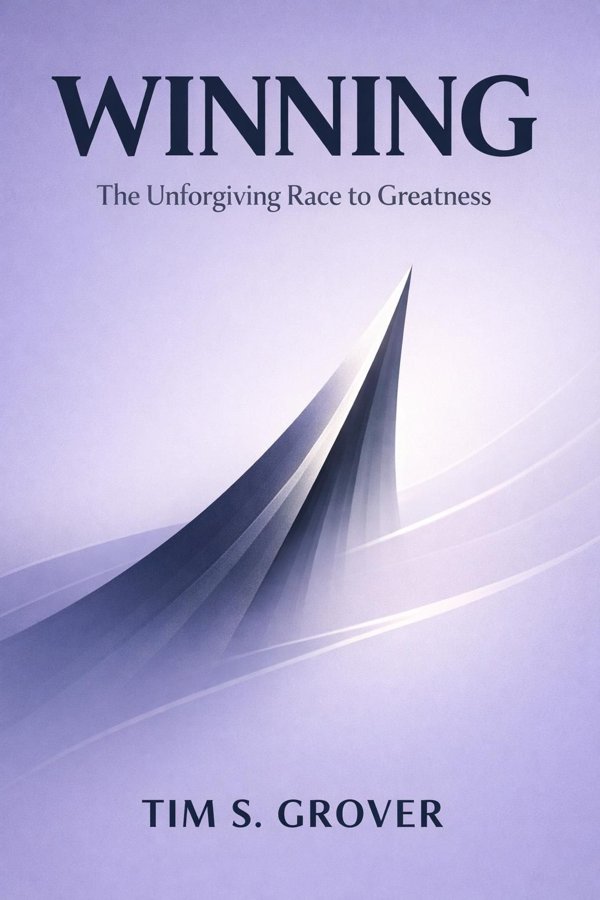
Winning: The Unforgiving Race to Greatness: Summary & Key Insights
 10 min9 chaptersAudio available
Key Takeaways from Winning: The Unforgiving Race to Greatness
Most people imagine winning as a finish line.
Pressure does not create a winner; it reveals one.
Greatness is rarely mysterious when you study it closely.
Excuses are appealing because they protect the ego.
Many books tell you to eliminate your darker impulses.
What Is Winning: The Unforgiving Race to Greatness About?
Winning: The Unforgiving Race to Greatness by Tim S. Grover is a leadership book spanning 3 pages. Winning: The Unforgiving Race to Greatness is Tim S. Grover’s blunt, high-intensity exploration of what it actually takes to perform at the highest level. This is not a motivational book about balance, positive thinking, or celebrating small improvements. It is a book about obsession, pressure, sacrifice, and the uncomfortable truth that real winning demands more than talent or hard work. Grover argues that greatness belongs to people who can operate with unusual focus, emotional control, and ruthless honesty when everything is on the line. Drawing on decades of experience training athletes such as Michael Jordan, Kobe Bryant, and Dwyane Wade, Grover writes with the authority of someone who has watched elite performers from the inside. He has seen what separates champions from contenders, and his answer is unsettling: winners think differently, tolerate more, and keep going long after others want relief, recognition, or rest. Through thirteen principles of winning, he shows that success is not a peak moment but a relentless standard. For leaders, athletes, entrepreneurs, and anyone pursuing excellence, this book offers a hard-edged framework for understanding how top performers are built.
This FizzRead summary covers all 9 key chapters of Winning: The Unforgiving Race to Greatness in approximately 10 minutes, distilling the most important ideas, arguments, and takeaways from Tim S. Grover's work. Also available as an audio summary and Key Quotes Podcast.
Winning: The Unforgiving Race to Greatness
Winning: The Unforgiving Race to Greatness is Tim S. Grover’s blunt, high-intensity exploration of what it actually takes to perform at the highest level. This is not a motivational book about balance, positive thinking, or celebrating small improvements. It is a book about obsession, pressure, sacrifice, and the uncomfortable truth that real winning demands more than talent or hard work. Grover argues that greatness belongs to people who can operate with unusual focus, emotional control, and ruthless honesty when everything is on the line.
Drawing on decades of experience training athletes such as Michael Jordan, Kobe Bryant, and Dwyane Wade, Grover writes with the authority of someone who has watched elite performers from the inside. He has seen what separates champions from contenders, and his answer is unsettling: winners think differently, tolerate more, and keep going long after others want relief, recognition, or rest. Through thirteen principles of winning, he shows that success is not a peak moment but a relentless standard. For leaders, athletes, entrepreneurs, and anyone pursuing excellence, this book offers a hard-edged framework for understanding how top performers are built.
Who Should Read Winning: The Unforgiving Race to Greatness?
This book is perfect for anyone interested in leadership and looking to gain actionable insights in a short read. Whether you're a student, professional, or lifelong learner, the key ideas from Winning: The Unforgiving Race to Greatness by Tim S. Grover will help you think differently.
- ✓Readers who enjoy leadership and want practical takeaways
- ✓Professionals looking to apply new ideas to their work and life
- ✓Anyone who wants the core insights of Winning: The Unforgiving Race to Greatness in just 10 minutes
Want the full summary?
Get instant access to this book summary and 100K+ more with Fizz Moment.
Get Free SummaryAvailable on App Store • Free to download
Key Chapters
Most people imagine winning as a finish line. Grover insists it is anything but. Winning is temporary, hungry, and constantly moving. The moment you achieve one goal, the standard rises, the pressure increases, and the world expects you to do it again. That is why the truly great never confuse a single victory with permanent arrival. They understand that success creates new demands, not lasting comfort.
Grover’s point is powerful because it cuts through the fantasy of achievement. We often think that once we land the promotion, launch the company, close the deal, or earn the title, we will feel complete. In reality, the next challenge begins almost immediately. Champions are prepared for this. They do not let applause relax them or criticism derail them. They treat every result as evidence of what must be done next.
This idea applies far beyond sports. A sales leader who breaks a company record still has to build next quarter’s pipeline. A founder who raises capital must now deliver growth. A manager who leads one successful turnaround must prove the success is repeatable. Sustained excellence comes from treating winning as a process of continual recalibration, not a trophy on a shelf.
The practical lesson is to build systems that survive success. Review performance after a win as seriously as after a loss. Ask what worked, what cannot be repeated by luck, and what the next standard should be. Celebrate briefly, then return to preparation. Actionable takeaway: stop treating success as closure and start treating it as a responsibility to perform again under higher expectations.
Pressure does not create a winner; it reveals one. Grover argues that the defining difference between elite performers and everyone else is not talent alone but the way they think when conditions become intense, uncertain, and unforgiving. Winners do not panic when stakes rise. They narrow their focus, trust their preparation, and make decisive moves while others hesitate.
This mindset is not casual confidence. It is built through repetition, self-knowledge, and a willingness to face reality without excuses. Average performers often need reassurance, external support, or ideal conditions before they act. Winners do not wait for all variables to line up. They expect chaos, criticism, fatigue, and doubt, and they perform anyway. That mental posture gives them a huge edge because they are not emotionally negotiating with the moment.
In leadership, this distinction matters enormously. During a crisis, some executives delay decisions because they fear blame. Others become reactive and spread their anxiety through the organization. A winning mindset means staying clear enough to separate signal from noise, prioritizing what matters most, and moving with conviction. It also means understanding your own tendencies: when you overthink, when you seek approval, and when fear disguises itself as caution.
To build this mindset, create pressure in practice before pressure finds you in reality. Rehearse difficult conversations, simulate high-stakes decisions, and review past moments when you reacted poorly. Learn what triggers you and prepare a response. Actionable takeaway: identify one environment where pressure weakens your performance, then design a routine that helps you think clearly and act decisively before the pressure arrives.
Greatness is rarely mysterious when you study it closely. In Winning, Grover organizes his philosophy into thirteen principles that describe how top performers operate. These principles are not soft habits or inspirational slogans. They are hard traits: winners know what they want, they are driven by a dark side, they own everything, they stay aggressive under stress, and they do not seek comfort in fairness, approval, or explanation.
The structure matters because Grover is not describing random characteristics. He is mapping a mentality. Winning requires obsession with the objective, emotional toughness when things go wrong, and the capacity to keep moving when others become distracted by ego, exhaustion, or public opinion. His principles also show that elite performance is not always socially comfortable. Winners can be intense, isolated, and misunderstood because they prioritize results over appearance.
For readers, the value of the thirteen principles lies in self-assessment. Which principles already define you, and which ones do you resist? Perhaps you want the rewards of winning but avoid accountability. Maybe you work hard but shrink from confrontation. Maybe you prepare carefully but lose your edge when outcomes become personal. Grover pushes readers to confront these contradictions honestly.
A practical way to use the principles is to treat them like a diagnostic framework. Pick three that feel strongest in your current life and three that are clearly underdeveloped. Then connect each weak area to a real behavior. If you avoid ownership, start by ending your habit of blaming circumstances. If you lose intensity, change your standards for follow-through. Actionable takeaway: use Grover’s principles not to admire winners from afar, but to measure where your own mindset still breaks under real pressure.
Excuses are appealing because they protect the ego. Grover rejects them completely. One of his core beliefs is that winners own everything: preparation, mistakes, results, reactions, and consequences. They do not waste energy blaming teammates, competitors, bosses, markets, or timing. Ownership gives them power because it keeps their attention on what can still be controlled.
This is not about pretending external factors do not exist. Of course they do. Bad luck, weak support, unfair systems, and difficult environments are real. But Grover’s argument is that dwelling on them weakens performance. The moment you define yourself as a victim of circumstance, you surrender the ability to respond aggressively and intelligently. Winners may acknowledge what is unfair, but they do not build an identity around it.
In the workplace, total ownership changes behavior quickly. A team leader who misses targets can either point to limited resources or analyze poor planning, weak communication, and delayed decisions. A founder whose product fails can blame the market or admit the offer was unclear. Ownership does not guarantee easy outcomes, but it accelerates learning and restores momentum.
This mindset is especially useful after failure. Instead of asking, “Who caused this?” ask, “What was my contribution to this result, and what can I change immediately?” That shift turns failure into feedback rather than humiliation. It also makes you more trustworthy, because people follow leaders who confront reality rather than hide from it.
Actionable takeaway: the next time something goes wrong, write down three factors you controlled but did not handle well. Fix those first before discussing anything outside your control.
Many books tell you to eliminate your darker impulses. Grover takes a more uncomfortable position: the traits society often labels dangerous, obsessive, or excessive can become sources of elite performance when they are disciplined and directed. Anger, doubt, resentment, insecurity, and the need to prove something can all become fuel. Winners do not always operate from calm positivity. Often, they channel deeper forces that others fear or suppress.
This idea can sound reckless unless it is understood carefully. Grover is not suggesting that people become destructive, abusive, or emotionally unstable. He is saying that high performers often possess intense internal energy, and pretending otherwise makes them weaker. The key is control. The same fire that can ruin judgment can also sharpen focus when aimed at preparation, execution, and persistence.
Consider an entrepreneur who is driven by past rejection, or an athlete who uses criticism to train harder. Those motivations may not sound elegant, but they can be effective if converted into disciplined action rather than impulsive reaction. The danger comes when emotion is left unmanaged and spills into ego battles, poor decisions, or self-sabotage.
A useful exercise is to identify the emotions that repeatedly energize you. What are you still trying to prove? What frustration keeps you moving? Rather than denying those forces, define rules for channeling them. Use them to drive preparation, not retaliation; standards, not chaos.
Actionable takeaway: name one uncomfortable emotion that reliably motivates you, then create a constructive outlet for it, such as harder practice, better planning, or tighter execution instead of emotional outbursts.
People often say they want to win when what they really want is security. Grover draws a hard line between the two. Winning requires discomfort: uncertainty, sacrifice, repetition, scrutiny, and the willingness to keep demanding more from yourself after others would be satisfied. Comfort, by contrast, seduces people into maintenance mode. They stop sharpening, stop risking, and start defending what they already have.
This is one of the book’s most relevant lessons for leaders and professionals. The moment a person becomes attached to convenience, routine, or reputation, performance usually plateaus. They avoid hard feedback, delay difficult decisions, and choose familiar tasks over necessary ones. What once looked like success gradually becomes stagnation.
Grover’s examples from elite sport make the principle clear. Champions do not train only when inspired. They accept monotony, pain, and discipline as the price of remaining dangerous. The same principle applies in business: the best operators keep learning after praise, challenge assumptions after wins, and do the work others find tedious. Their edge often comes not from brilliance but from their tolerance for sustained discomfort.
This does not mean burning yourself out blindly. It means recognizing that growth rarely feels relaxing. If your current routine feels completely manageable, you may not be stretching enough. Ask where you have become too protected by your own success.
Actionable takeaway: identify one area where you have grown comfortable because you are already competent. Raise the standard there this week by seeking harsher feedback, setting a bigger target, or committing to practice that feels inconvenient.
Elite performers are often misunderstood as emotionless. Grover makes a subtler point: winners are not empty of feeling, they are in command of it. They feel everything—anger, urgency, pride, fear, disappointment—but they do not allow emotion to hijack execution. They know when to use emotion as energy and when to shut it down because the moment requires precision.
This distinction is crucial in high-stakes settings. In a tense negotiation, a leader who reacts defensively may reveal weakness or lose leverage. In a crucial game, an athlete who becomes consumed by frustration breaks rhythm. In conflict, a manager who vents impulsively can damage trust and authority. Emotional control is not suppression for its own sake; it is strategic discipline.
Grover’s philosophy suggests that composure is trainable. The more clearly you understand your emotional patterns, the less likely they are to surprise you. If criticism makes you reckless, prepare for criticism. If uncertainty makes you freeze, rehearse decision-making with incomplete information. Emotional control comes from exposure, reflection, and recovery, not from pretending to be naturally calm.
One practical method is to separate feeling from action. You may feel insulted, threatened, or anxious, but what behavior will best serve the objective? That question creates a pause between stimulus and response. Over time, that pause becomes one of the most valuable tools in performance.
Actionable takeaway: the next time emotion spikes during an important moment, ask yourself one question before reacting: “What action helps me win here?” Let the answer, not the feeling, determine your next move.
Distraction is expensive, especially at the highest level. Grover argues that winners protect their attention with unusual aggression because they know every unnecessary input weakens execution. They do not chase every opportunity, answer every critic, or divide themselves across too many priorities. They know what matters now, and they organize their energy around it.
This kind of focus is increasingly rare. Modern work rewards responsiveness, visibility, and constant connectivity, but those habits often destroy deep performance. You can look productive while making little progress on the outcome that actually matters. Winners separate activity from advancement. They ask what directly improves results, then eliminate or reduce what does not.
In practical terms, ruthless focus may mean saying no to attractive side projects, protecting uninterrupted time for high-value work, or refusing to engage in gossip and politics. It may also mean simplifying goals. Many people fail not because they lack ambition, but because they pursue too many ambitions at once. Their effort becomes fragmented and their standards fall.
Grover’s message is especially useful for leaders responsible for teams. If your people are overwhelmed, clarity becomes a competitive advantage. Define the one or two outcomes that matter most, align decisions to them, and stop rewarding busywork. Focus is contagious when modeled consistently.
To sharpen your own attention, audit where your mental energy goes each day. What pulls you away from execution? Which tasks make you feel occupied but do not move the score? Actionable takeaway: choose one major objective for the next thirty days and eliminate at least two recurring distractions that compete with it.
Not everyone can go where you are trying to go. Grover emphasizes that winning often involves separation—emotionally, mentally, and sometimes socially. This does not mean arrogance or cruelty. It means recognizing that average expectations, constant approval-seeking, and the need to be understood can dilute exceptional performance. Winners are often willing to stand apart if that is what the objective demands.
This idea is uncomfortable because most people want both greatness and universal acceptance. Grover suggests that the two frequently conflict. If you are pushing beyond normal standards, your routines, priorities, and intensity may unsettle others. Some will admire it; others will resent it, misunderstand it, or try to soften it. If you depend too heavily on consensus, you may start negotiating down your edge.
Selective isolation can be practical. It might mean protecting morning hours for deep work instead of social chatter, limiting access to your time during critical projects, or choosing a smaller circle of people who understand your standards. It also means being careful about whose opinions you internalize. Feedback is useful, but indiscriminate exposure to noise weakens confidence and clarity.
For leaders, this principle requires balance. You still need trust, communication, and team alignment. But you also need the ability to make hard decisions that not everyone will like. Winning leadership is not popularity management.
Actionable takeaway: review your current environment and identify one relationship, habit, or source of noise that consistently lowers your standards. Reduce its influence so your focus and ambition have room to breathe.
All Chapters in Winning: The Unforgiving Race to Greatness
About the Author
Tim S. Grover is a leading performance coach, author, and speaker known for his work with some of the greatest athletes of all time. Over the course of his career, he trained NBA legends including Michael Jordan, Kobe Bryant, and Dwyane Wade, earning a reputation for his intense, no-excuses approach to excellence. Grover is the founder of Attack Athletics, a Chicago-based training facility that develops athletes and high performers through elite physical and mental conditioning. He first gained broad recognition with his bestselling book Relentless, which explored the traits of unstoppable competitors. In Winning, he builds on that philosophy, offering a sharper examination of what greatness really requires. His work focuses on mindset, discipline, pressure, accountability, and sustained high-level performance.
Get This Summary in Your Preferred Format
Read or listen to the Winning: The Unforgiving Race to Greatness summary by Tim S. Grover anytime, anywhere. FizzRead offers multiple formats so you can learn on your terms — all free.
Available formats: App · Audio · PDF · EPUB — All included free with FizzRead
Download Winning: The Unforgiving Race to Greatness PDF and EPUB Summary
Key Quotes from Winning: The Unforgiving Race to Greatness
“Most people imagine winning as a finish line.”
“Pressure does not create a winner; it reveals one.”
“Greatness is rarely mysterious when you study it closely.”
“Excuses are appealing because they protect the ego.”
“Many books tell you to eliminate your darker impulses.”
Frequently Asked Questions about Winning: The Unforgiving Race to Greatness
Winning: The Unforgiving Race to Greatness by Tim S. Grover is a leadership book that explores key ideas across 9 chapters. Winning: The Unforgiving Race to Greatness is Tim S. Grover’s blunt, high-intensity exploration of what it actually takes to perform at the highest level. This is not a motivational book about balance, positive thinking, or celebrating small improvements. It is a book about obsession, pressure, sacrifice, and the uncomfortable truth that real winning demands more than talent or hard work. Grover argues that greatness belongs to people who can operate with unusual focus, emotional control, and ruthless honesty when everything is on the line. Drawing on decades of experience training athletes such as Michael Jordan, Kobe Bryant, and Dwyane Wade, Grover writes with the authority of someone who has watched elite performers from the inside. He has seen what separates champions from contenders, and his answer is unsettling: winners think differently, tolerate more, and keep going long after others want relief, recognition, or rest. Through thirteen principles of winning, he shows that success is not a peak moment but a relentless standard. For leaders, athletes, entrepreneurs, and anyone pursuing excellence, this book offers a hard-edged framework for understanding how top performers are built.
More by Tim S. Grover
You Might Also Like

Extreme Ownership
Jocko Willink
10 min
Dare to Lead
Brene Brown
10 min
Leaders Eat Last
Simon Sinek
10 min
The 21 Irrefutable Laws of Leadership
John Maxwell
10 min
Start With Why
Simon Sinek
10 min
How to Lead When You're Not in Charge
Clay Scroggins
10 minBrowse by Category
Ready to read Winning: The Unforgiving Race to Greatness?
Get the full summary and 100K+ more books with Fizz Moment.