
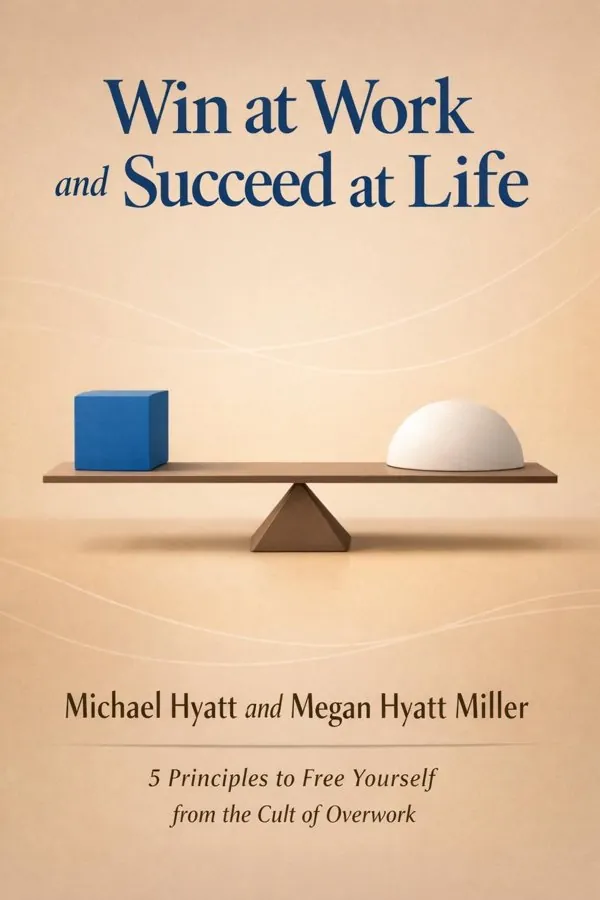
Win at Work and Succeed at Life: 5 Principles to Free Yourself from the Cult of Overwork: Summary & Key Insights
by Michael Hyatt, Megan Hyatt Miller
 10 min9 chaptersAudio available
Key Takeaways from Win at Work and Succeed at Life: 5 Principles to Free Yourself from the Cult of Overwork
One of the most accepted lies in modern professional life is that exhaustion proves commitment.
A meaningful life cannot be built on a single role, no matter how important that role may be.
Achievement without fulfillment is a hollow victory.
In a world obsessed with doing more, rest can feel lazy.
Every meaningful yes requires many strategic nos.
What Is Win at Work and Succeed at Life: 5 Principles to Free Yourself from the Cult of Overwork About?
Win at Work and Succeed at Life: 5 Principles to Free Yourself from the Cult of Overwork by Michael Hyatt and Megan Hyatt Miller is a leadership book spanning 8 pages. Win at Work and Succeed at Life is a timely challenge to one of modern culture’s most dangerous assumptions: that the more you work, the more valuable and successful you become. Michael Hyatt and Megan Hyatt Miller argue that this belief is not only false but deeply destructive. It leads ambitious people to trade health, relationships, joy, and long-term effectiveness for short-term output and social approval. In response, the authors offer a practical alternative: a framework for achieving what they call the “Double Win,” succeeding professionally while flourishing personally. Drawing from leadership coaching, business experience, behavioral research, and their own family and professional stories, Hyatt and Miller show that sustainable success depends on boundaries, rest, clarity, and intentional choices. Their five principles help readers reframe work as one important calling among many, redefine success to include fulfillment, build rhythms of recovery, learn the strategic power of saying no, and think in terms of decades rather than days. The result is a book for leaders, entrepreneurs, professionals, and overwhelmed high achievers who want to perform at a high level without sacrificing the life they are supposedly working so hard to build.
This FizzRead summary covers all 9 key chapters of Win at Work and Succeed at Life: 5 Principles to Free Yourself from the Cult of Overwork in approximately 10 minutes, distilling the most important ideas, arguments, and takeaways from Michael Hyatt and Megan Hyatt Miller's work. Also available as an audio summary and Key Quotes Podcast.
Win at Work and Succeed at Life: 5 Principles to Free Yourself from the Cult of Overwork
Win at Work and Succeed at Life is a timely challenge to one of modern culture’s most dangerous assumptions: that the more you work, the more valuable and successful you become. Michael Hyatt and Megan Hyatt Miller argue that this belief is not only false but deeply destructive. It leads ambitious people to trade health, relationships, joy, and long-term effectiveness for short-term output and social approval. In response, the authors offer a practical alternative: a framework for achieving what they call the “Double Win,” succeeding professionally while flourishing personally.
Drawing from leadership coaching, business experience, behavioral research, and their own family and professional stories, Hyatt and Miller show that sustainable success depends on boundaries, rest, clarity, and intentional choices. Their five principles help readers reframe work as one important calling among many, redefine success to include fulfillment, build rhythms of recovery, learn the strategic power of saying no, and think in terms of decades rather than days. The result is a book for leaders, entrepreneurs, professionals, and overwhelmed high achievers who want to perform at a high level without sacrificing the life they are supposedly working so hard to build.
Who Should Read Win at Work and Succeed at Life: 5 Principles to Free Yourself from the Cult of Overwork?
This book is perfect for anyone interested in leadership and looking to gain actionable insights in a short read. Whether you're a student, professional, or lifelong learner, the key ideas from Win at Work and Succeed at Life: 5 Principles to Free Yourself from the Cult of Overwork by Michael Hyatt and Megan Hyatt Miller will help you think differently.
- ✓Readers who enjoy leadership and want practical takeaways
- ✓Professionals looking to apply new ideas to their work and life
- ✓Anyone who wants the core insights of Win at Work and Succeed at Life: 5 Principles to Free Yourself from the Cult of Overwork in just 10 minutes
Want the full summary?
Get instant access to this book summary and 100K+ more with Fizz Moment.
Get Free SummaryAvailable on App Store • Free to download
Key Chapters
One of the most accepted lies in modern professional life is that exhaustion proves commitment. Hyatt and Miller begin by confronting the “cult of overwork,” a culture that praises long hours, constant availability, and self-sacrifice as markers of ambition and worth. The problem is that hustle often looks productive while quietly damaging the very things that make lasting success possible: focus, creativity, health, and strong relationships. People may gain short-term recognition from always being “on,” but over time they pay with burnout, resentment, poor decisions, and a shrinking sense of purpose.
The authors argue that overwork is not just a scheduling problem; it is a belief problem. Many people secretly assume that if they slow down, opportunities will disappear or others will outpace them. This fear-driven mindset traps them in reactive living. Instead of deciding what matters most, they let urgency and external expectations dictate their days. The result is a life that can look impressive from the outside while feeling hollow on the inside.
A practical example is the professional who answers messages late into the evening, skips exercise, and misses family dinners in the name of being indispensable. That person may seem highly dedicated, yet their performance usually declines as fatigue accumulates. A rested, focused, boundary-setting colleague often delivers better results with less drama.
Actionable takeaway: Identify one belief that fuels your overwork, such as “If I stop, I’ll fall behind,” and replace it with a healthier truth: sustainable success requires limits.
A meaningful life cannot be built on a single role, no matter how important that role may be. The first principle in the book is that work is only one of many callings. Most people are not just employees, founders, or executives. They are also parents, partners, friends, neighbors, community members, and individuals with physical, emotional, and spiritual needs. Trouble begins when work becomes the dominant lens through which identity, value, and purpose are measured.
Hyatt and Miller explain that elevating work above every other calling creates imbalance. Family gets whatever energy remains. Friendships weaken. Health becomes negotiable. Personal growth is postponed. Over time, the person may become outwardly successful and inwardly fragmented. By contrast, people who honor multiple callings make decisions differently. They consider not only what advances their career but also what protects their marriage, deepens their parenting, supports their well-being, and aligns with their values.
This principle does not diminish work; it puts work in its proper place. A high-performing executive can still pursue excellence, lead teams, and drive results while recognizing that career success is not the whole story. For example, a manager might decline a nonessential travel commitment that conflicts with a major family milestone, not because they lack ambition, but because they understand success is multidimensional.
Actionable takeaway: List your top five callings beyond work and review your calendar to see whether your time reflects the importance you say they have.
Achievement without fulfillment is a hollow victory. Hyatt and Miller argue that our culture tends to define success narrowly, usually in terms of money, status, titles, growth, or visible accomplishments. Yet many high achievers reach their goals only to discover they feel depleted, disconnected, or strangely disappointed. That is because achievement alone cannot sustain a meaningful life. The authors propose a fuller definition of success: accomplishment in your work combined with a deep sense of satisfaction in your life.
This is where the book introduces the idea behind the “Double Win.” Instead of assuming a tradeoff between career and personal well-being, readers are encouraged to pursue both together. That does not mean every day feels balanced or easy. It means the standard of success changes. A promotion that destroys your health is not a win. Revenue growth that costs you your marriage is not a win. Likewise, a peaceful personal life built on chronic professional avoidance is not the goal either. The target is integrated success.
In practical terms, this means measuring your life with more than professional KPIs. You might track progress in exercise, sleep, date nights, personal reading, spiritual practices, or time with children. A business owner, for instance, may celebrate hitting a quarterly target while also protecting weekends and maintaining healthy routines. Both matter.
Actionable takeaway: Write your own definition of success in one sentence, and make sure it includes both external achievement and internal fulfillment.
In a world obsessed with doing more, rest can feel lazy. Hyatt and Miller turn that assumption upside down by showing that rest is not the opposite of productivity but one of its essential ingredients. Human beings are not machines built for nonstop output. We perform in cycles, and our capacity depends on renewal. Without rest, work quality declines, judgment worsens, emotions fray, and motivation becomes harder to sustain.
The authors emphasize that rest includes more than sleep, though sleep is foundational. It also includes breaks during the day, evenings that truly end, days off, vacations, and mental space free from constant stimulation. Many professionals make the mistake of treating recovery as optional or something to earn after exhaustion. The book argues the opposite: recovery should be built into the system from the start.
Consider the difference between two leaders. One pushes through every weekend, checks email at midnight, and takes no real vacations. The other protects sleep, schedules time off, and ends work at a reasonable hour. The second leader often thinks more clearly, solves problems more creatively, and leads with greater patience. Rest does not reduce effectiveness; it preserves it.
This principle also requires emotional permission. Some people know they need rest but feel guilty taking it. The authors encourage readers to see rest as responsible stewardship of their energy and gifts.
Actionable takeaway: Choose one recovery habit to implement this week, such as a consistent bedtime, a device-free evening shutdown, or one full day each week without work.
Every meaningful yes requires many strategic nos. One reason overwork becomes chronic is that capable people are often rewarded for being helpful, available, and flexible. Over time, they accumulate obligations that exceed their capacity and dilute their best contribution. Hyatt and Miller argue that saying no is not selfish or uncooperative; it is one of the most important disciplines for effective leadership and healthy living.
The inability to say no usually comes from fear. People fear disappointing others, missing opportunities, damaging their reputation, or appearing less committed. But when leaders say yes to everything, they create hidden costs. Their priorities become blurred, their calendars become crowded, and the important gets buried under the merely urgent. Teams also suffer, because leaders who overcommit tend to bring stress, delays, and inconsistency into their organizations.
The authors encourage readers to filter requests through purpose and season. Is this opportunity aligned with your goals? Does it fit your current capacity? What will it displace if you accept it? For example, a director might decline joining another committee so they can focus on a major initiative and still preserve family evenings. A founder might postpone a promising project because the current quarter requires deeper attention elsewhere.
Saying no well can be gracious, clear, and respectful. It does not require elaborate justification. It requires courage and clarity.
Actionable takeaway: Before agreeing to any new commitment, ask, “What will I need to say no to if I say yes to this?”
Short-term urgency is one of the main drivers of unsustainable living. Hyatt and Miller introduce the importance of the long game: making decisions based not only on immediate demands but on the kind of life and leadership you want to sustain over time. Many professionals know how to sprint; far fewer know how to pace themselves for decades of contribution. Yet careers, families, and personal growth all unfold over the long arc of time, not in a single quarter.
A long-game mindset changes how you evaluate tradeoffs. You become less impressed by heroic bursts of effort that cannot be maintained and more interested in rhythms that produce consistent excellence. You ask better questions: Can I live this way for the next five years? Is this schedule strengthening the person I want to become? What am I teaching my family, team, and body through these patterns?
This perspective is especially helpful for ambitious people who are tempted to mortgage the future for present gains. Taking on too much may accelerate results briefly, but it can damage health, culture, or relationships in ways that are expensive to repair. By contrast, sustainable systems often appear slower at first but create compounding returns.
An example is a leader who structures regular planning, rest, and focused execution instead of operating in constant crisis mode. They may appear less frantic, but they are often more resilient and more effective over time.
Actionable takeaway: Evaluate one major habit or commitment by asking whether it is sustainable for the next ten years, not just the next ten weeks.
A better life rarely happens by accident. Hyatt and Miller make it clear that the Double Win is not a vague aspiration but a framework that must be designed into your calendar, commitments, and decision-making. Good intentions alone cannot protect what matters. If your schedule is built entirely around work demands, your personal priorities will be squeezed out no matter how strongly you value them.
Implementation begins with clarity. Readers are encouraged to identify their key life domains and define what winning looks like in each one. Then they must build those priorities into the week before the week gets filled by other people’s agendas. This may include setting firm work hours, creating start and stop rituals, planning personal appointments with the same seriousness as business meetings, and identifying nonnegotiables like family dinners, exercise, or weekly reflection.
The book also highlights the role of boundaries and systems. Boundaries answer where work ends and life begins. Systems make those boundaries repeatable. For example, a professional might create a daily shutdown routine, communicate availability clearly to colleagues, and schedule deep work blocks during business hours to avoid carrying unfinished tasks into the evening. A couple might review the week together every Sunday to ensure shared commitments are visible.
The point is not rigid perfection but thoughtful design. The more proactively you structure your life, the less likely you are to be ruled by chaos.
Actionable takeaway: Block time this week for one personal priority before adding any optional work commitments.
Many people do not realize how deeply overwork has shaped their lives until they stop long enough to examine the evidence. Hyatt and Miller include stories of transformation to show that change begins with honest self-assessment. The first breakthrough is often not a new tactic but a new level of awareness. Readers must confront the cost of their current patterns: fatigue, strained relationships, reduced joy, neglected health, spiritual dryness, and work that no longer feels meaningful.
These stories matter because they make the book’s ideas concrete. Change is possible, but it usually requires admitting that what once seemed normal is not actually working. A successful executive may discover that their children experience them as absent. An entrepreneur may realize their business growth has come at the expense of sleep and emotional stability. A manager may notice that constant busyness has become a substitute for strategic thinking.
Honest evaluation also prevents performative change. It is easy to make small cosmetic adjustments while preserving the same core habits and beliefs. Real transformation asks deeper questions: Why do I feel compelled to stay busy? What am I avoiding by not slowing down? What would have to change in my identity if I were no longer driven by overwork?
The authors show that when people face these questions and redesign their lives, they often gain more energy, better relationships, and stronger professional results.
Actionable takeaway: Conduct a personal audit of your last 30 days and identify one area where overwork has clearly harmed your well-being or effectiveness.
Leaders do not just manage their own lives; they model what is acceptable for everyone around them. Hyatt and Miller stress that personal overwork quickly becomes cultural overwork. When leaders send late-night emails, praise constant availability, and make busyness the badge of loyalty, teams absorb those signals. Even if no one explicitly demands overwork, employees often feel pressure to imitate what leadership normalizes.
This makes boundaries a leadership issue, not merely a personal preference. Healthy leaders create healthier organizations by setting realistic expectations, honoring time off, rewarding outcomes over performative busyness, and respecting the humanity of the people they lead. This kind of culture increases trust and often improves performance because employees have the energy and clarity to do better work.
For example, a team leader who communicates clear priorities, discourages unnecessary after-hours communication, and plans work with realistic timelines sends a powerful message: excellence matters, but so do people. On the other hand, a leader who glorifies overextension may achieve bursts of output while silently driving disengagement and turnover.
The book’s message is especially important for founders and managers who assume culture is shaped only by mission statements or policies. In reality, people watch behavior. What leaders practice becomes permission.
Actionable takeaway: Identify one signal you are sending to your team about work expectations and change it to better reflect sustainable excellence.
All Chapters in Win at Work and Succeed at Life: 5 Principles to Free Yourself from the Cult of Overwork
About the Authors
Michael Hyatt is a bestselling author, leadership mentor, and the founder of Full Focus, a company known for its work in productivity, goal-setting, and leadership development. Over the course of his career, he has helped thousands of professionals and executives build more intentional and effective lives. Megan Hyatt Miller is the CEO of Full Focus and a respected business leader who has played a central role in shaping the company’s coaching approach and organizational vision. Together, they combine strategic leadership experience with a strong commitment to sustainable success. Their work emphasizes that high performance does not require burnout, and that true achievement should support, not undermine, a meaningful and fulfilling life.
Get This Summary in Your Preferred Format
Read or listen to the Win at Work and Succeed at Life: 5 Principles to Free Yourself from the Cult of Overwork summary by Michael Hyatt and Megan Hyatt Miller anytime, anywhere. FizzRead offers multiple formats so you can learn on your terms — all free.
Available formats: App · Audio · PDF · EPUB — All included free with FizzRead
Download Win at Work and Succeed at Life: 5 Principles to Free Yourself from the Cult of Overwork PDF and EPUB Summary
Key Quotes from Win at Work and Succeed at Life: 5 Principles to Free Yourself from the Cult of Overwork
“One of the most accepted lies in modern professional life is that exhaustion proves commitment.”
“A meaningful life cannot be built on a single role, no matter how important that role may be.”
“Achievement without fulfillment is a hollow victory.”
“In a world obsessed with doing more, rest can feel lazy.”
“Every meaningful yes requires many strategic nos.”
Frequently Asked Questions about Win at Work and Succeed at Life: 5 Principles to Free Yourself from the Cult of Overwork
Win at Work and Succeed at Life: 5 Principles to Free Yourself from the Cult of Overwork by Michael Hyatt and Megan Hyatt Miller is a leadership book that explores key ideas across 9 chapters. Win at Work and Succeed at Life is a timely challenge to one of modern culture’s most dangerous assumptions: that the more you work, the more valuable and successful you become. Michael Hyatt and Megan Hyatt Miller argue that this belief is not only false but deeply destructive. It leads ambitious people to trade health, relationships, joy, and long-term effectiveness for short-term output and social approval. In response, the authors offer a practical alternative: a framework for achieving what they call the “Double Win,” succeeding professionally while flourishing personally. Drawing from leadership coaching, business experience, behavioral research, and their own family and professional stories, Hyatt and Miller show that sustainable success depends on boundaries, rest, clarity, and intentional choices. Their five principles help readers reframe work as one important calling among many, redefine success to include fulfillment, build rhythms of recovery, learn the strategic power of saying no, and think in terms of decades rather than days. The result is a book for leaders, entrepreneurs, professionals, and overwhelmed high achievers who want to perform at a high level without sacrificing the life they are supposedly working so hard to build.
You Might Also Like

Extreme Ownership
Jocko Willink
10 min
Dare to Lead
Brene Brown
10 min
Leaders Eat Last
Simon Sinek
10 min
The 21 Irrefutable Laws of Leadership
John Maxwell
10 min
Start With Why
Simon Sinek
10 min
How to Lead When You're Not in Charge
Clay Scroggins
10 minBrowse by Category
Ready to read Win at Work and Succeed at Life: 5 Principles to Free Yourself from the Cult of Overwork?
Get the full summary and 100K+ more books with Fizz Moment.