
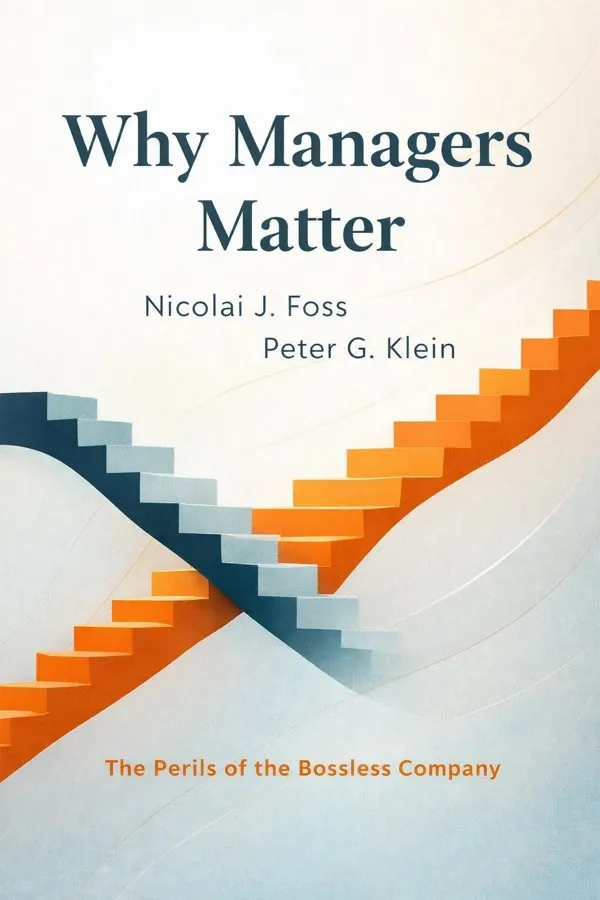
Why Managers Matter: The Perils of the Bossless Company: Summary & Key Insights
by Nicolai J. Foss, Peter G. Klein
 10 min9 chaptersAudio available
Key Takeaways from Why Managers Matter: The Perils of the Bossless Company
Every generation seems to rediscover the dream of a workplace without bosses, yet hierarchy keeps coming back.
The most powerful argument for management begins with a simple question: if markets are so efficient, why do firms exist at all?
Good intentions do not guarantee coordinated action.
When everyone is responsible, no one really is.
The real test of an organization is not how it functions when everyone agrees, but what happens when priorities collide.
What Is Why Managers Matter: The Perils of the Bossless Company About?
Why Managers Matter: The Perils of the Bossless Company by Nicolai J. Foss, Peter G. Klein is a leadership book spanning 11 pages. Why do so many modern companies dream of eliminating managers, even as coordination problems, slow decisions, and blurred accountability keep reappearing? In Why Managers Matter, Nicolai J. Foss and Peter G. Klein challenge the fashionable belief that hierarchy is outdated and that self-managing organizations naturally outperform traditional firms. Their central claim is both simple and provocative: managers are not bureaucratic leftovers from the industrial age, but essential mechanisms for aligning people, allocating resources, resolving conflict, and turning strategy into action. Drawing on economics, management theory, and evidence from real organizations, Foss and Klein show that firms exist precisely because markets and informal cooperation alone cannot solve every problem. When work becomes complex, interdependent, and uncertain, someone must make decisions, define priorities, and bear responsibility. That is the manager’s role. The book matters because it cuts through leadership fads and replaces ideology with analysis. Foss, a leading scholar of strategy and organizational economics, and Klein, a respected expert in entrepreneurship and corporate innovation, bring unusual intellectual rigor to a practical question every organization faces: how much structure is enough, and what happens when companies pretend they no longer need bosses?
This FizzRead summary covers all 9 key chapters of Why Managers Matter: The Perils of the Bossless Company in approximately 10 minutes, distilling the most important ideas, arguments, and takeaways from Nicolai J. Foss, Peter G. Klein's work. Also available as an audio summary and Key Quotes Podcast.
Why Managers Matter: The Perils of the Bossless Company
Why do so many modern companies dream of eliminating managers, even as coordination problems, slow decisions, and blurred accountability keep reappearing? In Why Managers Matter, Nicolai J. Foss and Peter G. Klein challenge the fashionable belief that hierarchy is outdated and that self-managing organizations naturally outperform traditional firms. Their central claim is both simple and provocative: managers are not bureaucratic leftovers from the industrial age, but essential mechanisms for aligning people, allocating resources, resolving conflict, and turning strategy into action.
Drawing on economics, management theory, and evidence from real organizations, Foss and Klein show that firms exist precisely because markets and informal cooperation alone cannot solve every problem. When work becomes complex, interdependent, and uncertain, someone must make decisions, define priorities, and bear responsibility. That is the manager’s role.
The book matters because it cuts through leadership fads and replaces ideology with analysis. Foss, a leading scholar of strategy and organizational economics, and Klein, a respected expert in entrepreneurship and corporate innovation, bring unusual intellectual rigor to a practical question every organization faces: how much structure is enough, and what happens when companies pretend they no longer need bosses?
Who Should Read Why Managers Matter: The Perils of the Bossless Company?
This book is perfect for anyone interested in leadership and looking to gain actionable insights in a short read. Whether you're a student, professional, or lifelong learner, the key ideas from Why Managers Matter: The Perils of the Bossless Company by Nicolai J. Foss, Peter G. Klein will help you think differently.
- ✓Readers who enjoy leadership and want practical takeaways
- ✓Professionals looking to apply new ideas to their work and life
- ✓Anyone who wants the core insights of Why Managers Matter: The Perils of the Bossless Company in just 10 minutes
Want the full summary?
Get instant access to this book summary and 100K+ more with Fizz Moment.
Get Free SummaryAvailable on App Store • Free to download
Key Chapters
Every generation seems to rediscover the dream of a workplace without bosses, yet hierarchy keeps coming back. That recurring pattern is the first clue that management is not merely a historical accident or a relic of factory-era thinking. Foss and Klein argue that hierarchies emerged because growing organizations faced real coordination problems that voluntary, informal cooperation could not reliably solve.
As firms expanded during industrialization, production involved more people, more specialized tasks, and tighter interdependence. Someone had to decide who did what, in what sequence, with which resources, and toward which goals. Managers arose not simply to supervise workers, but to reduce confusion, settle disputes, and connect daily activity to larger strategy. The rise of the modern corporation made managerial roles even more important because scale magnified the costs of delay, duplication, and misalignment.
Today, digital tools and collaborative platforms have changed how information flows, but they have not eliminated the basic need for authority. A software company may look very different from a steel mill, yet both still need mechanisms for setting priorities, making trade-offs, and ensuring accountability. Without that structure, complexity does not disappear; it gets pushed onto employees, who must spend more time negotiating boundaries and less time creating value.
A practical example is a fast-growing startup. In its earliest phase, informal communication may work because everyone sits in one room and understands the product intimately. But as hiring accelerates, teams specialize, customers diversify, and deadlines tighten. Suddenly, “everyone decides together” becomes an obstacle rather than a virtue. Managers become necessary not because trust has failed, but because complexity has increased.
Actionable takeaway: treat hierarchy as a tool for solving coordination problems, not as a moral failing. If your organization is growing, ask where ambiguity, duplication, or delay signal a need for clearer managerial roles.
The most powerful argument for management begins with a simple question: if markets are so efficient, why do firms exist at all? Foss and Klein build on Ronald Coase’s classic insight that using the market carries transaction costs. It takes time and effort to search for partners, negotiate contracts, monitor performance, and adapt agreements when conditions change. Firms arise because in many situations, coordinated authority is cheaper and more effective than constant market exchange.
Management sits at the center of this logic. Inside a firm, not every task needs a fresh negotiation. Employees do not bid on each assignment or draft a new contract each time priorities shift. Managers can redirect effort, reallocate resources, and respond to surprises more quickly than a purely market-based arrangement would allow. In other words, hierarchy economizes on the frictions of organizing work.
This matters especially in environments of uncertainty. If a product team discovers a design flaw two days before launch, a manager can make rapid trade-offs across engineering, marketing, and customer support. In a bossless system, the same issue may trigger prolonged discussion over who has the authority to decide, who bears the consequences, and how competing interests should be balanced.
The authors do not argue that hierarchy is always best or that markets and contracts are unimportant. Rather, they show that firms are hybrids: they use both market signals and managerial authority. The real question is where one approach ends and the other begins. Strong organizations understand that management is valuable precisely because not everything can be priced, negotiated, and coordinated in real time.
Actionable takeaway: when evaluating organizational design, do not ask whether hierarchy feels modern. Ask whether management lowers the costs of coordination, adaptation, and decision-making better than the available alternatives.
Autonomy is valuable, but it is not a universal organizing principle. Foss and Klein carefully distinguish between empowering employees and assuming that organizations can run entirely through self-management. The difference matters. People can have significant discretion in how they execute tasks while still operating within a hierarchy that sets goals, constraints, and accountability.
The limits of self-management become most visible when tasks are deeply interdependent, when investments are specific and difficult to reverse, or when strategic coherence matters across many units. In such settings, local decisions can create company-wide consequences. A team may optimize its own workflow while undermining another team’s priorities or the firm’s broader strategy. Managers help ensure that local autonomy does not become organizational fragmentation.
This has practical implications for industries such as aviation, pharmaceuticals, finance, and infrastructure, where errors are costly and compliance requirements are strict. In these environments, rules, oversight, and escalation procedures are not signs of distrust; they are safeguards against cascading failures. Even in creative industries, self-management can struggle when resource allocation, brand consistency, or sequencing across projects becomes complex.
At the same time, the authors do not advocate rigid command-and-control systems. They favor selective hierarchy: use managerial authority where interdependence and uncertainty demand it, and grant autonomy where knowledge is local and experimentation is beneficial. The challenge is diagnostic, not ideological.
A healthy organization therefore asks not, “Should we be hierarchical or self-managing?” but, “Which decisions require centralized authority, and which should remain decentralized?” That framing opens the door to smarter design.
Actionable takeaway: separate task autonomy from organizational anarchy. Give teams freedom over methods where possible, but preserve clear managerial authority over priorities, resource allocation, and cross-team trade-offs.
Hierarchy is often portrayed as the enemy of innovation, but Foss and Klein argue that this is a false choice. Poorly designed hierarchies can certainly become rigid and bureaucratic. Yet well-designed hierarchies can make innovation more likely by clarifying priorities, protecting resources, and preventing organizational chaos.
Innovation requires more than creativity. It also requires selecting among ideas, funding experiments, coordinating specialized contributors, and deciding when to scale or stop. These are managerial tasks. Without them, organizations can generate many possibilities but struggle to convert them into valuable outcomes. Managers create the structures within which experimentation can happen productively.
Consider a company developing new products. Engineers want technical elegance, marketing wants customer appeal, finance wants disciplined investment, and operations wants manufacturability. Innovation happens when these perspectives are integrated, not when each function acts independently. Managers make that integration possible by setting milestones, adjudicating trade-offs, and ensuring that experiments connect to strategic intent.
Flexibility also depends on authority. In volatile environments, organizations must reconfigure quickly. A clear hierarchy can speed adaptation by allowing leaders to redeploy talent, shift budgets, and redefine priorities without prolonged bargaining. Paradoxically, a company with no explicit structure may be less agile because every adjustment requires negotiation among peers.
The book’s message is not that managers should control all ideas. It is that innovation flourishes when authority is combined with openness: leaders create direction, employees contribute knowledge, and decision rights are explicit enough to keep momentum alive. The best hierarchies are enabling systems, not cages.
Actionable takeaway: design hierarchy to support experimentation. Clarify who can propose ideas, who can fund pilots, who decides to scale them, and how learning will be shared across the organization.
The strongest defense of management is not a defense of old-style authoritarianism. Foss and Klein make clear that the case for managers is a case for effective authority, not arbitrary control. In modern organizations, the manager’s role is increasingly to orchestrate rather than dominate: to align people, shape incentives, facilitate learning, and connect local action to broader strategy.
This means managers must do more than supervise tasks. They translate strategy into operational priorities, build teams, allocate scarce resources, and resolve conflicts that peers cannot settle on their own. They also create the conditions for productive autonomy by specifying goals, boundaries, and decision rights. In that sense, good management expands freedom because it reduces uncertainty about who decides what and why.
For leaders, the book offers a strategic lesson: organization design is itself a source of competitive advantage. Firms that get hierarchy right can move faster, scale better, and adapt more coherently than firms trapped either in rigid bureaucracy or in romantic but vague decentralization. The aim is not to maximize layers or eliminate them, but to align structure with task complexity, knowledge distribution, and strategic priorities.
A practical application is performance management. Instead of acting as enforcers alone, managers should function as integrators who combine coaching with judgment. They should know when to decentralize, when to intervene, and when to make a clear call. That balance is difficult, which is precisely why capable managers matter so much.
Actionable takeaway: redefine the managerial role in your organization around four core responsibilities—setting direction, allocating resources, clarifying accountability, and integrating specialized knowledge across teams.
All Chapters in Why Managers Matter: The Perils of the Bossless Company
About the Authors
Nicolai J. Foss is a leading scholar of strategy, organization, and the theory of the firm, with appointments at Copenhagen Business School and the Norwegian School of Economics. His research has focused on how organizations create value through structure, knowledge, and incentives. Peter G. Klein is a professor of entrepreneurship and corporate innovation at Baylor University and a prominent voice in organizational economics and business strategy. His work explores entrepreneurship, firm organization, and the economic logic behind managerial decision-making. Together, Foss and Klein combine deep academic expertise with practical insight, making them especially well suited to examine modern debates about hierarchy, self-management, and the role of managers in effective organizations.
Get This Summary in Your Preferred Format
Read or listen to the Why Managers Matter: The Perils of the Bossless Company summary by Nicolai J. Foss, Peter G. Klein anytime, anywhere. FizzRead offers multiple formats so you can learn on your terms — all free.
Available formats: App · Audio · PDF · EPUB — All included free with FizzRead
Download Why Managers Matter: The Perils of the Bossless Company PDF and EPUB Summary
Key Quotes from Why Managers Matter: The Perils of the Bossless Company
“Every generation seems to rediscover the dream of a workplace without bosses, yet hierarchy keeps coming back.”
“The most powerful argument for management begins with a simple question: if markets are so efficient, why do firms exist at all?”
“Good intentions do not guarantee coordinated action.”
“When everyone is responsible, no one really is.”
“The real test of an organization is not how it functions when everyone agrees, but what happens when priorities collide.”
Frequently Asked Questions about Why Managers Matter: The Perils of the Bossless Company
Why Managers Matter: The Perils of the Bossless Company by Nicolai J. Foss, Peter G. Klein is a leadership book that explores key ideas across 9 chapters. Why do so many modern companies dream of eliminating managers, even as coordination problems, slow decisions, and blurred accountability keep reappearing? In Why Managers Matter, Nicolai J. Foss and Peter G. Klein challenge the fashionable belief that hierarchy is outdated and that self-managing organizations naturally outperform traditional firms. Their central claim is both simple and provocative: managers are not bureaucratic leftovers from the industrial age, but essential mechanisms for aligning people, allocating resources, resolving conflict, and turning strategy into action. Drawing on economics, management theory, and evidence from real organizations, Foss and Klein show that firms exist precisely because markets and informal cooperation alone cannot solve every problem. When work becomes complex, interdependent, and uncertain, someone must make decisions, define priorities, and bear responsibility. That is the manager’s role. The book matters because it cuts through leadership fads and replaces ideology with analysis. Foss, a leading scholar of strategy and organizational economics, and Klein, a respected expert in entrepreneurship and corporate innovation, bring unusual intellectual rigor to a practical question every organization faces: how much structure is enough, and what happens when companies pretend they no longer need bosses?
You Might Also Like

Extreme Ownership
Jocko Willink
10 min
Dare to Lead
Brene Brown
10 min
Leaders Eat Last
Simon Sinek
10 min
The 21 Irrefutable Laws of Leadership
John Maxwell
10 min
Start With Why
Simon Sinek
10 min
How to Lead When You're Not in Charge
Clay Scroggins
10 minBrowse by Category
Ready to read Why Managers Matter: The Perils of the Bossless Company?
Get the full summary and 100K+ more books with Fizz Moment.