
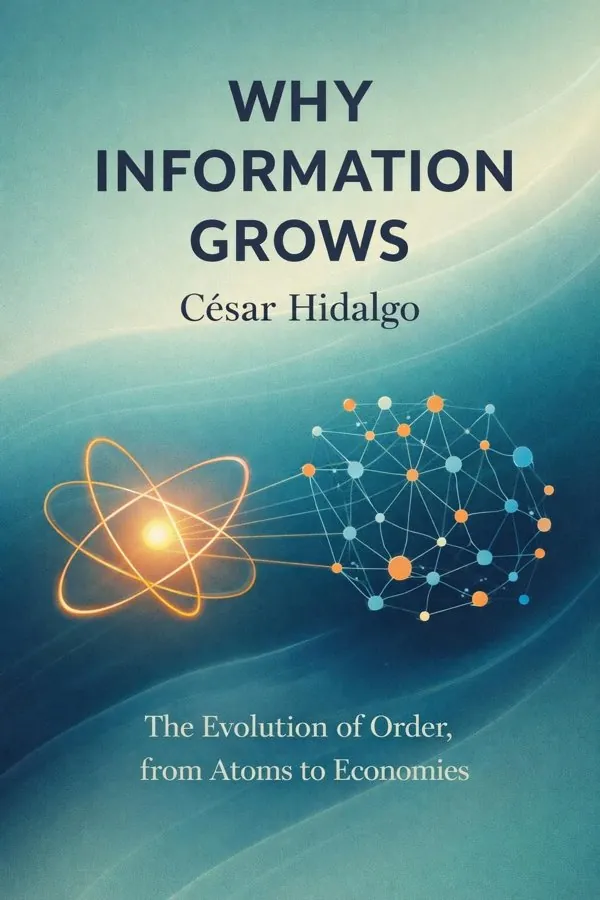
Why Information Grows: The Evolution of Order, from Atoms to Economies: Summary & Key Insights
 10 min10 chaptersAudio available
What Is Why Information Grows: The Evolution of Order, from Atoms to Economies About?
Why Information Grows: The Evolution of Order, from Atoms to Economies by César Hidalgo is a economics book spanning 10 pages. In this groundbreaking work, César Hidalgo explores how information shapes the physical and economic world. He argues that the growth of information—embodied in products, technologies, and societies—drives the evolution of complexity and wealth. By connecting physics, biology, and economics, Hidalgo reveals how knowledge and networks enable the creation of order from chaos, explaining why some nations prosper while others stagnate.
This FizzRead summary covers all 10 key chapters of Why Information Grows: The Evolution of Order, from Atoms to Economies in approximately 10 minutes, distilling the most important ideas, arguments, and takeaways from César Hidalgo's work. Also available as an audio summary and Key Quotes Podcast.
Why Information Grows: The Evolution of Order, from Atoms to Economies
In this groundbreaking work, César Hidalgo explores how information shapes the physical and economic world. He argues that the growth of information—embodied in products, technologies, and societies—drives the evolution of complexity and wealth. By connecting physics, biology, and economics, Hidalgo reveals how knowledge and networks enable the creation of order from chaos, explaining why some nations prosper while others stagnate.
Who Should Read Why Information Grows: The Evolution of Order, from Atoms to Economies?
This book is perfect for anyone interested in economics and looking to gain actionable insights in a short read. Whether you're a student, professional, or lifelong learner, the key ideas from Why Information Grows: The Evolution of Order, from Atoms to Economies by César Hidalgo will help you think differently.
- ✓Readers who enjoy economics and want practical takeaways
- ✓Professionals looking to apply new ideas to their work and life
- ✓Anyone who wants the core insights of Why Information Grows: The Evolution of Order, from Atoms to Economies in just 10 minutes
Want the full summary?
Get instant access to this book summary and 100K+ more with Fizz Moment.
Get Free SummaryAvailable on App Store • Free to download
Key Chapters
Every story of information begins with the physical universe. To understand why information grows, we must first explore how matter itself organizes into patterns. In physics, entropy represents the natural tendency toward disorder, yet in specific conditions, pockets of order arise—crystals form, stars ignite, and structures emerge. These are local triumphs over chaos, enabled by the constant flow of energy.
Order, therefore, is not free; it is maintained by the dissipation of energy. When a plant grows, it takes in sunlight and uses that energy to arrange atoms into complex molecules. Similarly, when humans create technology, we borrow energy and manipulate matter to give it form and function. The result is physical information—the arrangement of components that carry meaning.
In this view, the economy itself is an extension of the physics of order. Each product is a frozen record of the knowledge and energy invested in its creation. The more intricate the product, the more informational content it embodies. A wooden chair and a microchip differ not only in material but in informational density—the organization required to make them is vastly different.
By acknowledging the physicality of information, we discover a continuity between the laws of thermodynamics and the laws of human progress. What we call innovation is, at its essence, the expansion of order—the transformation of energy into structured complexity.
Life is the great leap in the story of information. Unlike inanimate matter, living systems actively process information. They take energy from their environment and use it to maintain structure, to copy themselves, and to evolve. DNA, the molecule of life, is a code—a memory device that stores information about how to build and sustain an organism. Each living being is therefore a dynamic repository of physical and biological order.
When we look at life as an information-processing system, we begin to understand evolution as a process of increasing informational complexity. Natural selection does not just favor survival; it favors the preservation and amplification of useful information. Over time, life accumulates the knowledge of how to survive, adapt, and innovate.
This biological understanding provides a foundation for human knowledge. Our brains evolved as information-processing machines that could represent the world, predict outcomes, and communicate intentions. From this biological instinct for organization and understanding springs culture, technology, and eventually economics.
In life, information produces adaptation; in societies, information produces coordination. The ability to process and act upon information defines the boundary between survival and prosperity. Every organism, like every economy, depends on its capacity to store and use knowledge effectively.
+ 8 more chapters — available in the FizzRead app
All Chapters in Why Information Grows: The Evolution of Order, from Atoms to Economies
About the Author
César A. Hidalgo is a Chilean-born physicist and data scientist known for his research on complexity, economic development, and information theory. He has served as a professor at MIT Media Lab and later at the University of Toulouse, contributing influential work on the relationship between knowledge, networks, and economic growth.
Get This Summary in Your Preferred Format
Read or listen to the Why Information Grows: The Evolution of Order, from Atoms to Economies summary by César Hidalgo anytime, anywhere. FizzRead offers multiple formats so you can learn on your terms — all free.
Available formats: App · Audio · PDF · EPUB — All included free with FizzRead
Download Why Information Grows: The Evolution of Order, from Atoms to Economies PDF and EPUB Summary
Key Quotes from Why Information Grows: The Evolution of Order, from Atoms to Economies
“Every story of information begins with the physical universe.”
“Life is the great leap in the story of information.”
Frequently Asked Questions about Why Information Grows: The Evolution of Order, from Atoms to Economies
Why Information Grows: The Evolution of Order, from Atoms to Economies by César Hidalgo is a economics book that explores key ideas across 10 chapters. In this groundbreaking work, César Hidalgo explores how information shapes the physical and economic world. He argues that the growth of information—embodied in products, technologies, and societies—drives the evolution of complexity and wealth. By connecting physics, biology, and economics, Hidalgo reveals how knowledge and networks enable the creation of order from chaos, explaining why some nations prosper while others stagnate.
You Might Also Like

Business Adventures
John Brooks
10 min
Nudge
Richard H. Thaler, Cass R. Sunstein
10 min
The Hitchhiker"s Guide to the Galaxy
Douglas Adams
10 minThe Muqaddimah
Ibn Khaldun
10 minThe Outsiders
William N. Thorndike
10 min
A Little History of Economics
Niall Kishtainy
10 minBrowse by Category
Ready to read Why Information Grows: The Evolution of Order, from Atoms to Economies?
Get the full summary and 100K+ more books with Fizz Moment.