
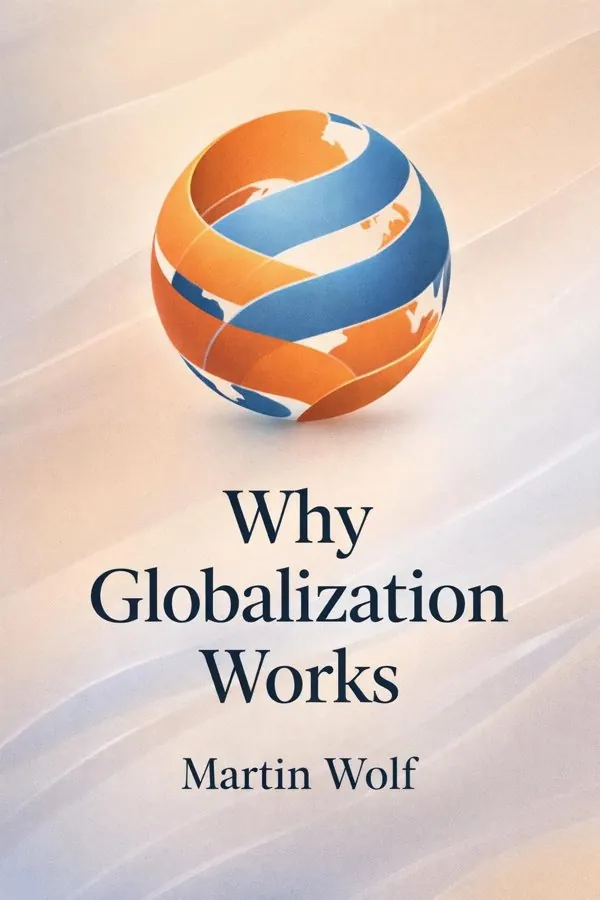
Why Globalization Works: Summary & Key Insights
by Martin Wolf
 10 min11 chaptersAudio available
What Is Why Globalization Works About?
Why Globalization Works by Martin Wolf is a economics book spanning 11 pages. In this influential work, Martin Wolf, chief economics commentator at the Financial Times, presents a rigorous defense of globalization. He argues that open markets and international trade have been the most effective forces for reducing poverty and promoting prosperity worldwide. Drawing on economic history, empirical data, and policy analysis, Wolf dismantles common criticisms of globalization and explains why managed openness, rather than protectionism, is essential for global stability and growth.
This FizzRead summary covers all 11 key chapters of Why Globalization Works in approximately 10 minutes, distilling the most important ideas, arguments, and takeaways from Martin Wolf's work. Also available as an audio summary and Key Quotes Podcast.
Why Globalization Works
In this influential work, Martin Wolf, chief economics commentator at the Financial Times, presents a rigorous defense of globalization. He argues that open markets and international trade have been the most effective forces for reducing poverty and promoting prosperity worldwide. Drawing on economic history, empirical data, and policy analysis, Wolf dismantles common criticisms of globalization and explains why managed openness, rather than protectionism, is essential for global stability and growth.
Who Should Read Why Globalization Works?
This book is perfect for anyone interested in economics and looking to gain actionable insights in a short read. Whether you're a student, professional, or lifelong learner, the key ideas from Why Globalization Works by Martin Wolf will help you think differently.
- ✓Readers who enjoy economics and want practical takeaways
- ✓Professionals looking to apply new ideas to their work and life
- ✓Anyone who wants the core insights of Why Globalization Works in just 10 minutes
Want the full summary?
Get instant access to this book summary and 100K+ more with Fizz Moment.
Get Free SummaryAvailable on App Store • Free to download
Key Chapters
To understand why globalization works, one must begin by seeing it not as a modern invention but as part of a much longer human story. The roots of global exchange stretch back to Silk Road caravans, maritime empires, and early transcontinental trade networks. Yet the decisive acceleration came with the Industrial Revolution. Beginning in the late eighteenth century, technological innovation — steam power, mechanization, and later electricity and mass production — unleashed productivity growth that made sustained trade across borders not only possible but essential.
The nineteenth century’s great liberalization underpinned the first wave of globalization. Britain led the way, abandoning mercantilism in favor of free trade, and by the mid-1800s global trade volumes were expanding faster than ever before. The gold standard provided monetary stability, while colonial networks often, albeit imperfectly, integrated regions into a single global economy. The outbreak of World War I shattered this system. What followed — nationalist protectionism, depression, and war — illustrated, in devastating form, what happens when the world closes itself.
Post–World War II leaders learned this lesson well. The creation of the Bretton Woods institutions, the General Agreement on Tariffs and Trade (GATT), and later the World Trade Organization (WTO), reflected a determination to prevent the economic nationalism of the 1930s from returning. The second half of the twentieth century thus became an era of renewed integration, culminating in the dramatic industrial rise of East Asia and the entry of China and India into the world economy. The historical record is unambiguous: open economies grow faster, innovate more, and reduce poverty more decisively than closed ones.
History, in other words, is the first proof of my argument: globalization is not a reckless experiment but the defining mechanism of modern progress.
The economic case for globalization rests on a theoretical foundation as old as modern economics itself. Adam Smith’s concept of the division of labor and David Ricardo’s theory of comparative advantage form the cornerstone: when nations specialize according to their productive strengths and exchange freely, total wealth increases. Trade, in this view, is not a zero-sum contest but a cooperative process in which all participants can gain, provided markets are open and flexible.
Yet modern globalization also draws on newer developments in economic thought — models of endogenous growth, innovation diffusion, and network effects. As ideas and technologies move across borders, productivity rises not only through the reallocation of resources but through shared knowledge. The spillovers from trade and foreign investment, in research and education, create self-reinforcing growth cycles that closed economies cannot replicate.
Critics often argue that such theoretical elegance fails to capture real-world complexity. But the data consistently show that the theory works remarkably well in practice. Countries that have embraced openness — South Korea, Taiwan, Malaysia, and China — have lifted hundreds of millions out of poverty. Those that remain isolated — North Korea, Myanmar (before opening), and historically many African states — stagnate. The logic of trade and openness, properly mediated by institutions, is thus not merely abstract but profoundly empirical. It is the economic equivalent of gravity: sometimes inconvenient, always real.
+ 9 more chapters — available in the FizzRead app
All Chapters in Why Globalization Works
About the Author
Martin Wolf is a British economist, journalist, and author, best known as the chief economics commentator at the Financial Times. He has been recognized as one of the world’s most influential economic thinkers and has written extensively on global finance, trade, and economic policy.
Get This Summary in Your Preferred Format
Read or listen to the Why Globalization Works summary by Martin Wolf anytime, anywhere. FizzRead offers multiple formats so you can learn on your terms — all free.
Available formats: App · Audio · PDF · EPUB — All included free with FizzRead
Download Why Globalization Works PDF and EPUB Summary
Key Quotes from Why Globalization Works
“To understand why globalization works, one must begin by seeing it not as a modern invention but as part of a much longer human story.”
“The economic case for globalization rests on a theoretical foundation as old as modern economics itself.”
Frequently Asked Questions about Why Globalization Works
Why Globalization Works by Martin Wolf is a economics book that explores key ideas across 11 chapters. In this influential work, Martin Wolf, chief economics commentator at the Financial Times, presents a rigorous defense of globalization. He argues that open markets and international trade have been the most effective forces for reducing poverty and promoting prosperity worldwide. Drawing on economic history, empirical data, and policy analysis, Wolf dismantles common criticisms of globalization and explains why managed openness, rather than protectionism, is essential for global stability and growth.
More by Martin Wolf

You Might Also Like

Business Adventures
John Brooks
10 min
Nudge
Richard H. Thaler, Cass R. Sunstein
10 min
The Hitchhiker"s Guide to the Galaxy
Douglas Adams
10 minThe Muqaddimah
Ibn Khaldun
10 minThe Outsiders
William N. Thorndike
10 min
A Little History of Economics
Niall Kishtainy
10 minBrowse by Category
Ready to read Why Globalization Works?
Get the full summary and 100K+ more books with Fizz Moment.