

Who Not How: Summary & Key Insights
by Dan Sullivan
 10 min10 chaptersAudio available
Key Takeaways from Who Not How
One innocent question can quietly shrink your future.
Growth becomes faster when you stop treating success as a solo project.
Many people do not fail because they lack resources; they fail because they assume resources are scarce.
Not all productive hours are equal.
Big goals rarely collapse because the vision is too ambitious; they collapse because the structure around the vision is too weak.
What Is Who Not How About?
Who Not How by Dan Sullivan is a business book published in 2020 spanning 11 pages. What if the biggest obstacle to your success is not a lack of talent, discipline, or ambition, but the question you keep asking? In Who Not How, Dan Sullivan, with co-author Benjamin Hardy, argues that many capable people stay stuck because they instinctively ask, “How can I do this?” That question seems responsible, but it often traps them inside their current skills, limited time, and personal bandwidth. The better question, the authors insist, is “Who can help me achieve this?” This simple shift changes productivity, leadership, and growth. Instead of trying to master every task yourself, you learn to build relationships, delegate strategically, and multiply your results through other people’s strengths. The book is especially powerful for entrepreneurs, managers, creators, and professionals who feel overwhelmed by too many responsibilities and too little time. Dan Sullivan brings unusual authority to this idea. As the founder of Strategic Coach, he has spent decades advising high-performing entrepreneurs on how to grow without burning out. Who Not How distills that experience into a practical framework for achieving bigger goals with less friction, more freedom, and far greater impact.
This FizzRead summary covers all 10 key chapters of Who Not How in approximately 10 minutes, distilling the most important ideas, arguments, and takeaways from Dan Sullivan's work. Also available as an audio summary and Key Quotes Podcast.
Who Not How
What if the biggest obstacle to your success is not a lack of talent, discipline, or ambition, but the question you keep asking? In Who Not How, Dan Sullivan, with co-author Benjamin Hardy, argues that many capable people stay stuck because they instinctively ask, “How can I do this?” That question seems responsible, but it often traps them inside their current skills, limited time, and personal bandwidth. The better question, the authors insist, is “Who can help me achieve this?”
This simple shift changes productivity, leadership, and growth. Instead of trying to master every task yourself, you learn to build relationships, delegate strategically, and multiply your results through other people’s strengths. The book is especially powerful for entrepreneurs, managers, creators, and professionals who feel overwhelmed by too many responsibilities and too little time.
Dan Sullivan brings unusual authority to this idea. As the founder of Strategic Coach, he has spent decades advising high-performing entrepreneurs on how to grow without burning out. Who Not How distills that experience into a practical framework for achieving bigger goals with less friction, more freedom, and far greater impact.
Who Should Read Who Not How?
This book is perfect for anyone interested in business and looking to gain actionable insights in a short read. Whether you're a student, professional, or lifelong learner, the key ideas from Who Not How by Dan Sullivan will help you think differently.
- ✓Readers who enjoy business and want practical takeaways
- ✓Professionals looking to apply new ideas to their work and life
- ✓Anyone who wants the core insights of Who Not How in just 10 minutes
Want the full summary?
Get instant access to this book summary and 100K+ more with Fizz Moment.
Get Free SummaryAvailable on App Store • Free to download
Key Chapters
One innocent question can quietly shrink your future. When you ask, “How can I do this?” you usually assume that the solution must come from your own effort, knowledge, and time. That sounds productive, but it can become a hidden form of self-limitation. Instead of moving toward the biggest result, you start calculating what is possible within your current capacity. Your goals become constrained by your calendar, your technical abilities, and your mental energy.
Sullivan argues that this is why many ambitious people stay overworked. They are not lacking opportunity; they are trapped in self-reliance. Every new challenge becomes another problem to solve personally. That creates bottlenecks, delays progress, and increases stress. It also pulls you away from the work you are uniquely suited to do. A founder starts designing websites, fixing software, and managing payroll instead of leading strategy. A consultant spends hours on scheduling and formatting instead of serving clients.
The deeper issue is psychological. Asking “How?” often reflects a belief that competence means doing everything yourself. But true effectiveness is not about personal mastery of every task. It is about creating results through the best available resources, including other people.
Imagine someone launching a podcast. Instead of learning audio editing, cover design, distribution, and marketing from scratch, they could work with an editor, a designer, and a growth specialist. The show launches faster and with better quality.
Actionable takeaway: The next time you face a major goal, pause before asking “How?” Write down the outcome you want and list three types of people who could help make it happen faster and better.
Growth becomes faster when you stop treating success as a solo project. The core idea of Who Not How is that achievement expands dramatically when you shift from personal effort to collaborative leverage. A “who” is any person, partner, expert, assistant, teammate, mentor, or service provider who can help you accomplish an outcome more effectively than you could alone.
This principle is powerful because it changes the structure of progress. Instead of spending months learning every step of a process, you connect with someone who already has the skill, experience, or network you need. That does not make you dependent; it makes you strategic. High achievers often advance not because they know more than everyone else, but because they know how to assemble the right people around a vision.
The “who” approach also improves quality. Specialists usually produce better work than generalists trying to juggle too many roles. A business owner may be decent at bookkeeping, customer service, and copywriting, but a bookkeeper, support manager, and copywriter will each outperform them in those specific domains. The result is not just less work, but better outcomes.
Sullivan emphasizes that your role is to define the destination clearly, not to personally execute every step. If you know the result you want, you can invite others to help shape the path. This applies to business, health, family logistics, investing, and creative work.
Actionable takeaway: Choose one goal that has been stalled for more than a month. Instead of making another to-do list, identify the single most important “who” who could unlock momentum, and reach out within 24 hours.
Many people do not fail because they lack resources; they fail because they assume resources are scarce. A scarcity mindset says, “No one will care as much as I do,” “I cannot afford help,” or “I should be able to handle this myself.” Those beliefs create isolation and overwork. Sullivan invites readers to adopt an abundance mindset, which assumes that the world is full of capable people, complementary talents, and opportunities for mutually beneficial collaboration.
Abundance thinking begins with the belief that other people’s strengths are not a threat to your value. They are an extension of what you can create. Once you accept that, you stop seeing delegation as a cost and start seeing it as an investment. You also become more willing to ask, propose, and partner.
This mindset is especially important for entrepreneurs and professionals who feel guilty about outsourcing or asking for support. They may think hiring help is indulgent or premature. But if an assistant frees up five hours a week for high-value work, that help can generate far more return than it costs. The same applies to coaching, expert advice, or strategic partnerships.
Abundance also transforms relationships. Instead of treating interactions as transactions, you begin to ask: what can we build together that neither of us could build alone? A consultant may partner with a designer to offer a stronger client package. A startup founder may collaborate with an operator who loves systems while the founder focuses on growth.
Actionable takeaway: Write down three scarcity beliefs you hold about delegation or collaboration. Then rewrite each one into an abundance statement that opens the door to support, partnership, or investment.
Not all productive hours are equal. One of Sullivan’s most influential ideas is “Unique Ability,” the set of activities you are exceptionally good at, deeply energized by, and able to perform at a very high level. The problem is that most people spend too much of their day outside that zone. They are buried in tasks they can do, but should not be doing.
Who Not How argues that real progress comes when you identify your highest-value contribution and design your life around it. This requires honesty. You may be competent at many things, but competence is not the same as genius. If your best work comes from selling, teaching, inventing, writing, or leading, then spending hours on administrative details weakens your impact. It drains energy that should be reserved for your most meaningful contribution.
Delegation becomes easier when framed this way. You are not handing off tasks because they are beneath you; you are handing them off because someone else may be better suited for them. In healthy collaboration, one person’s burden is another person’s zone of excellence. An executive assistant may love order, scheduling, and follow-through. A creative founder may love idea generation and client visioning. Both win when each stays closer to their strengths.
A practical way to apply this is to track your work for a week. Mark tasks that energize you and produce outsized results, and mark tasks that drain you. Patterns quickly emerge. Those draining tasks are often the first candidates for a “who.”
Actionable takeaway: Make two lists today: “What energizes me?” and “What drains me?” Keep the first list as your Unique Ability map and begin assigning, automating, or eliminating items from the second.
Big goals rarely collapse because the vision is too ambitious; they collapse because the structure around the vision is too weak. Sullivan shows that effective partnerships are not accidental. They are built intentionally around trust, clarity, complementary strengths, and shared wins. A great partnership does not mean two people doing the same work. It means each person bringing something distinct that makes the other more effective.
The best partnerships often form when one person is visionary and another is operational, or when one excels at relationships and another at execution. Problems arise when people collaborate without clear expectations. One person assumes ownership while the other waits for direction. One expects quick decisions while the other values process. That is why defining roles matters as much as finding talent.
In business, this may mean pairing a founder with an integrator, a salesperson with a fulfillment expert, or a creator with a producer. In personal life, it may mean creating better systems with a spouse, nanny, accountant, or coach. The key is to move from vague help to structured collaboration.
Sullivan’s philosophy suggests that the right “who” is not merely someone available. It is someone whose strengths align with the specific result you want. Once that match is found, the relationship improves further through communication, recognition, and shared purpose.
Actionable takeaway: Pick one recurring area of friction in your work or life. Define the exact outcome you need, then specify the qualities, skills, and responsibilities of the ideal partner who could own that area with you.
Sometimes the biggest barrier to support is not logistics but identity. Many people cling to the belief that doing everything themselves proves intelligence, commitment, or leadership. Sullivan challenges that assumption directly. The desire to stay in control often comes from ego, fear, or distrust rather than wisdom. If you insist on touching everything, you may feel important, but you also become the ceiling on growth.
Control is seductive because it feels safe. No one will do it exactly like you, so you keep the task. But that standard becomes expensive. It creates delays, exhaustion, and lost opportunity. Worse, it prevents others from developing ownership. Real leadership is not about being involved in every detail; it is about setting direction and empowering capable people to execute.
This lesson applies far beyond entrepreneurship. A manager who rewrites every team member’s work trains the team to wait passively. A parent who micromanages every household task creates dependency instead of shared responsibility. A founder who never delegates finances or operations turns the company into a one-person machine that cannot scale.
Letting go does not mean becoming careless. It means defining standards, outcomes, and accountability while allowing others room to contribute in their own way. Often, the result is not merely acceptable but superior, because the person doing the work brings expertise you do not have.
Actionable takeaway: Identify one task you are still controlling mainly because “no one can do it like I do.” Write down the true desired outcome, communicate that clearly, and let another capable person handle the process.
Most people talk about time as if it were fixed, but Sullivan treats time as expandable through leverage. You cannot create more hours in a day, but you can dramatically increase what gets accomplished inside those hours by involving the right people. In that sense, the “who” principle is really a principle of time multiplication.
When you try to do everything yourself, each new ambition competes with the same limited pool of hours. Your business growth competes with family time. New projects compete with sleep, health, or rest. But when tasks are distributed to others who are better equipped for them, your calendar opens for higher-level work, deeper thinking, and greater presence.
This is one reason successful leaders seem to operate at a different pace. They are not necessarily working harder. They are making fewer decisions about lower-value tasks and spending more energy where they matter most. A founder who delegates email filtering, scheduling, financial reporting, and project management gains time for hiring, strategy, and key clients. A physician who uses strong administrative support protects mental bandwidth for patient care. A parent who coordinates household help may gain more quality time with children instead of more chore time.
Expanded time is not just practical; it is emotional. The right support reduces overwhelm and makes goals feel possible again. Progress becomes less frantic and more intentional.
Actionable takeaway: Review your weekly schedule and circle every recurring task that does not require your highest skill. Estimate how many hours those tasks consume, then create a plan to delegate at least one hour of them this week.
A clear vision is powerful, but vision alone does not build anything. Sullivan argues that leadership is not defined by having all the answers. It is defined by seeing the opportunity, articulating the destination, and attracting the people who can help make it real. In other words, strong leaders do not obsess over every “how.” They become architects of collaboration.
This distinction matters because many ambitious people confuse leadership with personal problem-solving. They think they must master every detail before moving forward. Yet great leaders are often people who ask better questions, create strong environments, and assemble aligned teams. They focus on clarity of purpose and confidence in others.
Consider the difference between saying, “I need to figure out how to launch this product,” and saying, “I need a product strategist, a designer, and an operations lead who can help us launch this well.” The second approach invites movement. It turns uncertainty into a leadership task rather than a personal burden.
Vision also helps you attract the right people. Skilled collaborators want more than tasks; they want to contribute to something meaningful. If you can clearly explain what you are building and why it matters, you become more compelling to talented “whos.” That is true in startups, nonprofits, creative work, and even family planning.
Actionable takeaway: For one major goal, write a one-paragraph vision statement describing the outcome, why it matters, and what success looks like. Then use that statement to start conversations with potential collaborators.
Delegation without accountability is not leverage; it is wishful thinking. One reason people resist finding “whos” is that they have had poor experiences with unclear expectations, missed deadlines, or weak follow-through. Sullivan’s framework works best when collaboration is paired with ownership. The right person should not just help vaguely; they should know what result they own, by when, and according to what standard.
This means the “who” question must be followed by other useful questions: Who owns the outcome? What does success look like? How will we communicate? What decisions can they make independently? Accountability creates trust because everyone knows the rules of engagement.
In practice, this could mean giving a marketing contractor a clear target, budget, reporting cadence, and decision rights. It could mean asking an assistant to own travel planning end to end rather than sending you partial options for every small choice. It could mean a co-founder taking full responsibility for operations metrics while another owns sales. Clarity reduces the need for micromanagement.
The authors also imply that accountability runs both ways. If you bring in a “who,” you must equip them properly. Poor delegation often comes from vague instructions, unrealistic expectations, or failure to provide context. Strong ownership is built through mutual clarity, not blind handoff.
Actionable takeaway: The next time you delegate, define the outcome in one sentence, the deadline in one line, and the success criteria in three bullet points. Make sure the other person confirms understanding before work begins.
A powerful idea changes your life only when it becomes a repeated practice. Sullivan does not present Who Not How as a one-time technique for hiring help on large projects. He presents it as an operating system for daily life. The habit is simple: whenever you face a new challenge, delay the reflex to solve it alone and first consider the people, tools, or partnerships that could move it forward more effectively.
This habit gradually rewires your identity. You stop seeing yourself as the person who must carry everything and start seeing yourself as the person who creates outcomes through networks, systems, and relationships. Over time, this changes what goals feel realistic. Objectives that once seemed impossible become approachable because you no longer assume you must personally execute every piece.
Daily integration can be small. If you need to improve your health, your “who” may be a trainer, nutrition coach, or workout partner. If you want to publish regularly, your “who” may be an editor, researcher, or accountability group. If you want more family peace, your “who” may be a counselor, organizer, or trusted relative. The principle is universal.
To sustain the habit, many people benefit from regular reflection. Ask weekly: What drained me? Where did I become a bottleneck? What outcome still needs the right “who”? These questions keep collaboration top of mind and prevent backsliding into overcontrol.
Actionable takeaway: Create a recurring weekly review called “Who, not how.” List one area where you got stuck, one task to delegate, and one new person or partner to contact before the next week begins.
All Chapters in Who Not How
About the Author
Dan Sullivan is a Canadian-born entrepreneur, speaker, and business coach best known as the founder of Strategic Coach, a coaching organization created to help entrepreneurs grow their businesses while gaining more freedom and focus. Over decades of advising high-performing founders and executives, he developed influential concepts such as Unique Ability, strategic delegation, and entrepreneurial time management. Sullivan’s work centers on helping people stop being overwhelmed by complexity and instead build lives around their highest-value strengths. He is the author or co-author of numerous books on entrepreneurship, mindset, and personal growth. In Who Not How, he distills years of coaching insight into a simple but powerful principle: success accelerates when you stop trying to do everything yourself and start finding the right people to help.
Get This Summary in Your Preferred Format
Read or listen to the Who Not How summary by Dan Sullivan anytime, anywhere. FizzRead offers multiple formats so you can learn on your terms — all free.
Available formats: App · Audio · PDF · EPUB — All included free with FizzRead
Download Who Not How PDF and EPUB Summary
Key Quotes from Who Not How
“One innocent question can quietly shrink your future.”
“Growth becomes faster when you stop treating success as a solo project.”
“Many people do not fail because they lack resources; they fail because they assume resources are scarce.”
“One of Sullivan’s most influential ideas is “Unique Ability,” the set of activities you are exceptionally good at, deeply energized by, and able to perform at a very high level.”
“Big goals rarely collapse because the vision is too ambitious; they collapse because the structure around the vision is too weak.”
Frequently Asked Questions about Who Not How
Who Not How by Dan Sullivan is a business book that explores key ideas across 10 chapters. What if the biggest obstacle to your success is not a lack of talent, discipline, or ambition, but the question you keep asking? In Who Not How, Dan Sullivan, with co-author Benjamin Hardy, argues that many capable people stay stuck because they instinctively ask, “How can I do this?” That question seems responsible, but it often traps them inside their current skills, limited time, and personal bandwidth. The better question, the authors insist, is “Who can help me achieve this?” This simple shift changes productivity, leadership, and growth. Instead of trying to master every task yourself, you learn to build relationships, delegate strategically, and multiply your results through other people’s strengths. The book is especially powerful for entrepreneurs, managers, creators, and professionals who feel overwhelmed by too many responsibilities and too little time. Dan Sullivan brings unusual authority to this idea. As the founder of Strategic Coach, he has spent decades advising high-performing entrepreneurs on how to grow without burning out. Who Not How distills that experience into a practical framework for achieving bigger goals with less friction, more freedom, and far greater impact.
More by Dan Sullivan
The Gap and the Gain: The High Achievers' Guide to Happiness, Confidence, and Success
Dan Sullivan, Benjamin Hardy
10 min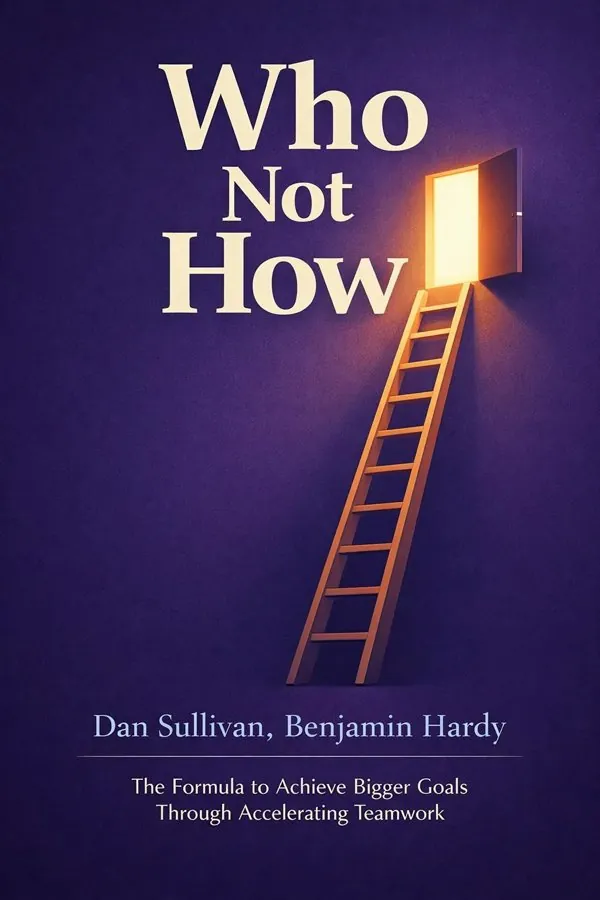
Who Not How: The Formula to Achieve Bigger Goals Through Accelerating Teamwork
Dan Sullivan, Benjamin Hardy
10 min
10x Is Easier Than 2x: How World-Class Entrepreneurs Achieve More by Doing Less
Dan Sullivan, Benjamin Hardy
10 minYou Might Also Like





Browse by Category
Ready to read Who Not How?
Get the full summary and 100K+ more books with Fizz Moment.