
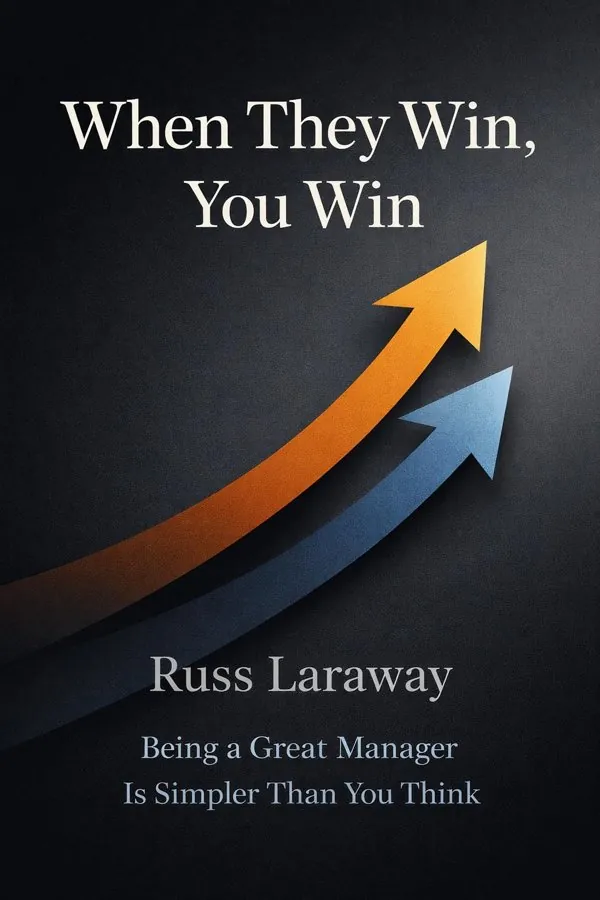
When They Win, You Win: Being a Great Manager Is Simpler Than You Think: Summary & Key Insights
by Russ Laraway
 10 min10 chaptersAudio available
Key Takeaways from When They Win, You Win: Being a Great Manager Is Simpler Than You Think
Many managers fail not because they do too little, but because they try to do too much.
Leadership becomes manageable when you stop treating it as an abstract identity and start treating it as a set of responsibilities.
People cannot perform consistently when they are forced to guess what success looks like.
Feedback is only useful when it helps someone improve, and that is why coaching matters more than criticism.
People want more from work than a paycheck; they want progress.
What Is When They Win, You Win: Being a Great Manager Is Simpler Than You Think About?
When They Win, You Win: Being a Great Manager Is Simpler Than You Think by Russ Laraway is a leadership book spanning 11 pages. Management is often treated like a mysterious art form, full of personality-driven tricks, motivational slogans, and endless complexity. Russ Laraway argues the opposite. In When They Win, You Win, he shows that great management is not vague or magical; it is practical, learnable, and far simpler than most organizations make it. The core idea is powerful: a manager’s job is not to control people, but to help them succeed. When employees grow, perform, and move toward meaningful goals, the team and company benefit too. Drawing on leadership experience at Google, Twitter, and Qualtrics, Laraway offers a clear framework built around three responsibilities: direction, coaching, and career development. Rather than drowning readers in theory, he focuses on behaviors managers can apply immediately in one-on-ones, goal setting, feedback, and long-term development conversations. The book matters because so many managers are promoted without being taught how to lead, and the cost of poor management is enormous. For new managers, experienced leaders, and anyone building teams, Laraway provides a refreshingly concrete guide to creating trust, accountability, and high performance by putting people’s success first.
This FizzRead summary covers all 10 key chapters of When They Win, You Win: Being a Great Manager Is Simpler Than You Think in approximately 10 minutes, distilling the most important ideas, arguments, and takeaways from Russ Laraway's work. Also available as an audio summary and Key Quotes Podcast.
When They Win, You Win: Being a Great Manager Is Simpler Than You Think
Management is often treated like a mysterious art form, full of personality-driven tricks, motivational slogans, and endless complexity. Russ Laraway argues the opposite. In When They Win, You Win, he shows that great management is not vague or magical; it is practical, learnable, and far simpler than most organizations make it. The core idea is powerful: a manager’s job is not to control people, but to help them succeed. When employees grow, perform, and move toward meaningful goals, the team and company benefit too.
Drawing on leadership experience at Google, Twitter, and Qualtrics, Laraway offers a clear framework built around three responsibilities: direction, coaching, and career development. Rather than drowning readers in theory, he focuses on behaviors managers can apply immediately in one-on-ones, goal setting, feedback, and long-term development conversations. The book matters because so many managers are promoted without being taught how to lead, and the cost of poor management is enormous. For new managers, experienced leaders, and anyone building teams, Laraway provides a refreshingly concrete guide to creating trust, accountability, and high performance by putting people’s success first.
Who Should Read When They Win, You Win: Being a Great Manager Is Simpler Than You Think?
This book is perfect for anyone interested in leadership and looking to gain actionable insights in a short read. Whether you're a student, professional, or lifelong learner, the key ideas from When They Win, You Win: Being a Great Manager Is Simpler Than You Think by Russ Laraway will help you think differently.
- ✓Readers who enjoy leadership and want practical takeaways
- ✓Professionals looking to apply new ideas to their work and life
- ✓Anyone who wants the core insights of When They Win, You Win: Being a Great Manager Is Simpler Than You Think in just 10 minutes
Want the full summary?
Get instant access to this book summary and 100K+ more with Fizz Moment.
Get Free SummaryAvailable on App Store • Free to download
Key Chapters
Many managers fail not because they do too little, but because they try to do too much. A common trap in leadership is believing the manager must always have the answers, oversee every detail, and personally drive every result. That mindset feels responsible, but it often creates confusion, dependency, and low engagement. Team members stop thinking for themselves, managers become bottlenecks, and performance suffers under the weight of unnecessary control.
Russ Laraway argues that this is the wrong mental model. Management is not about being the smartest person in the room or controlling every variable. It is about creating the conditions in which other people can do excellent work. Instead of asking, “How do I make sure everything goes exactly my way?” better managers ask, “How do I help my people succeed?” That shift changes everything. It moves a manager from micromanaging tasks to enabling clarity, growth, and accountability.
Consider a manager who rewrites every presentation before a client meeting. The short-term result may look polished, but the employee learns little and becomes more reliant on the boss. A better approach would be to explain what success looks like, review the draft together, offer coaching, and let the employee improve. Over time, the employee becomes stronger and the manager becomes freer to lead.
The practical lesson is simple: whenever you feel the urge to take over, pause and ask whether you are solving the problem or preventing someone else from learning how to solve it. Great management begins when control gives way to contribution.
Leadership becomes manageable when you stop treating it as an abstract identity and start treating it as a set of responsibilities. Laraway reduces great management to three jobs: setting direction, coaching, and career development. This matters because many managers are evaluated on business outcomes without being taught what they actually need to do every day to produce those outcomes through other people.
Setting direction means making sure employees understand what matters, why it matters, and how success will be measured. Coaching means helping them improve performance through observation, feedback, and support. Career development means understanding what employees want for their future and helping them build toward it. Together, these responsibilities create alignment, performance, and engagement.
This framework is powerful because it is concrete. Instead of vaguely trying to be “inspiring” or “strategic,” a manager can ask three practical questions: Does my team know where we are going? Am I actively helping them get better? Do I understand their long-term aspirations? If the answer to any of these is no, the management system is incomplete.
Imagine a high-performing employee who suddenly seems disengaged. Without this framework, a manager might assume attitude problems. With it, the manager checks the basics: Is the person unclear about goals? Are they not receiving useful coaching? Have they outgrown the role and need development support? Often the issue becomes solvable once management is broken into its core functions.
The actionable takeaway is to use these three responsibilities as your weekly leadership checklist. If your calendar, conversations, and priorities do not reflect direction, coaching, and career development, you are probably managing reactively rather than effectively.
People cannot perform consistently when they are forced to guess what success looks like. One of the manager’s most important responsibilities is to provide clear direction, yet many leaders assume that broad company goals or occasional status updates are enough. Laraway makes the case that direction must be explicit, repeated, and translated into language employees can use to make decisions on their own.
Clear direction includes priorities, expectations, standards, and context. Employees need to know not only what they are doing, but why it matters and how their work connects to broader objectives. Without that clarity, teams waste energy on low-value tasks, duplicate effort, and develop competing interpretations of success. Ambiguity does not create autonomy; it creates misalignment.
A practical example is a manager assigning a project by saying, “Improve customer onboarding.” That sounds reasonable, but it is too vague. Better direction would define the goal, such as reducing first-week customer drop-off by 15 percent, explain why it matters, identify key constraints, and clarify decision rights. With that structure, the employee has room to think creatively without losing strategic alignment.
Direction also involves making tradeoffs visible. Teams need help understanding what takes priority when resources are limited or deadlines conflict. Good managers prevent churn by clarifying what matters most before confusion turns into frustration.
The actionable takeaway is to test your clarity regularly. Ask team members to describe the top priorities, success metrics, and major constraints in their own words. If their answers vary widely, your direction is not yet clear enough. Repetition, specificity, and context are not overcommunication; they are leadership.
Feedback is only useful when it helps someone improve, and that is why coaching matters more than criticism. Laraway treats coaching as a central management discipline, not an occasional correction after something goes wrong. Great managers observe performance, identify gaps, reinforce strengths, and help employees practice better ways of working. Coaching is less about judgment and more about development.
Too many managers avoid coaching because they fear awkwardness or assume adults should figure things out alone. Others only speak up when there is a problem, which causes feedback to feel punitive. Laraway recommends a healthier pattern: make coaching frequent, specific, and tied to observable behavior. When employees know that feedback is a normal part of growth, they are far more likely to receive it constructively.
Suppose a team member gives rambling updates in meetings. A weak manager says nothing until performance reviews, then labels the person as “not executive-ready.” A stronger manager gives timely coaching: “In today’s meeting, your update ran long and buried the key point. Next time, lead with the decision, then give two supporting facts.” That guidance is concrete, fair, and actionable.
Effective coaching also includes positive reinforcement. If a manager only points out mistakes, employees become defensive. Recognizing what someone did well helps them repeat successful behaviors and builds confidence alongside accountability.
The actionable takeaway is to make coaching a rhythm, not an event. During one-on-ones, discuss one specific behavior to continue and one to improve. Keep feedback tied to actions, outcomes, and next steps. Done consistently, coaching helps people grow faster and makes performance conversations less stressful for everyone.
People want more from work than a paycheck; they want progress. One of Laraway’s most valuable ideas is that career development is not a bonus feature of management but a core responsibility. Employees are more engaged when they believe their manager understands their ambitions and is actively helping them move toward a meaningful future. Without that support, even strong performers may become stagnant, frustrated, or ready to leave.
Career development starts with curiosity. Managers need to know what kind of work energizes each person, what skills they want to build, and what roles or experiences they aspire to over time. The point is not to promise promotions on demand. It is to align current work with future growth wherever possible. That might mean assigning a stretch project, connecting someone with a mentor, or helping them build visibility in a new area.
For example, if an employee hopes to become a people manager, their current role can include opportunities to lead a project, mentor a new hire, or present team recommendations. If another employee wants deeper technical expertise instead of management, development might involve specialized training or ownership of a complex system. The same team can support different paths if the manager takes the time to understand them.
Career development also requires honesty. Managers should not invent unrealistic expectations, but they should help employees see what capabilities are required for the next step and how to build them.
The actionable takeaway is to hold dedicated career conversations, not just performance check-ins. Ask each employee where they hope to be in two or three years, what experiences they need, and what concrete opportunities you can help create now. Development is one of the strongest signals that a manager genuinely cares.
High standards do not thrive in fear; they thrive in trust. Laraway emphasizes that direction, coaching, and development only work when employees believe their manager is fair, honest, and invested in their success. Psychological safety does not mean lowering expectations or avoiding difficult conversations. It means creating an environment where people can speak up, ask for help, share ideas, and admit mistakes without fearing humiliation or retaliation.
Trust is built through consistency. Managers create it when they do what they say, explain decisions, listen seriously, and treat people with respect even under pressure. They destroy it when they play favorites, avoid accountability, or make feedback feel personal. Employees watch behavior closely. If a manager says they welcome input but punishes dissent, the team will quickly become silent.
A practical example is a postmortem after a failed launch. In a low-trust environment, people hide mistakes and blame each other. In a high-trust environment, the team examines what happened, identifies process gaps, and improves the system. The difference is not softness; it is whether people feel safe enough to tell the truth.
Psychological safety also strengthens coaching. Employees are more willing to hear feedback when they believe the manager is trying to help, not score points. Similarly, career conversations become more honest when people trust they will not be judged for sharing aspirations that differ from the expected path.
The actionable takeaway is to audit your own behavior for trust signals. Do you respond calmly to bad news? Do you invite disagreement and reward candor? Do your employees believe you care about their growth? Safety is not created by slogans; it is earned through repeated managerial behavior.
Good intentions are not a management system. One reason teams struggle is that managers handle leadership work inconsistently, reacting only when problems become visible. Laraway argues that great management should be operationalized through regular habits and predictable mechanisms. In other words, if direction, coaching, and development matter, they need to show up in calendars, meeting structures, and team routines.
This is where one-on-ones become essential. A strong one-on-one is not a status meeting disguised as support. It is protected time for discussing priorities, obstacles, feedback, and growth. Team meetings can reinforce direction. Project reviews can create coaching opportunities. Quarterly development conversations can keep long-term goals in focus. Structure does not make management robotic; it makes it reliable.
Take a manager with ten direct reports who claims to care deeply about development but never schedules dedicated conversations. In practice, employees will conclude that urgent work always wins over their growth. By contrast, a manager who holds regular one-on-ones, documents goals, and revisits development plans sends a much stronger message: your success matters enough to deserve time and process.
Systems also help managers scale. When leadership depends entirely on memory and instinct, quality varies wildly. When there are clear routines for expectation-setting, feedback, and development, employees receive more consistent support.
The actionable takeaway is to convert your management philosophy into recurring habits. Schedule one-on-ones, define meeting purposes, track development commitments, and review team goals regularly. If a behavior is important, it should not rely on spare time or mood. Management improves when it becomes intentional, visible, and repeatable.
Managers are often judged by team output alone, but Laraway pushes a more useful question: are your people succeeding because of your management? That shift matters because short-term results can hide unhealthy leadership. A team may hit targets while burning out, losing trust, or failing to develop future capability. Great management should be measured not just by what the team delivers, but by whether employees are clear, improving, and growing.
Useful signals include engagement, retention of strong performers, internal mobility, quality of execution, and the employee’s understanding of goals and expectations. Managers can also look at whether people receive regular coaching, whether they can articulate development plans, and whether the team can function without constant intervention. These indicators reveal whether the manager is building a sustainable high-performance environment.
For instance, a manager might celebrate a successful quarter while quietly dealing with rising attrition and constant firefighting. That is not evidence of strong leadership; it may signal dependence on heroic effort. Another manager may deliver slightly slower short-term gains while building a team that learns quickly, collaborates effectively, and produces future leaders. Laraway’s framework values the second model because it compounds over time.
Measurement should include direct input from employees. Ask whether they know what is expected, whether feedback helps them improve, and whether they see a future for themselves on the team. These are not soft questions. They are central indicators of managerial effectiveness.
The actionable takeaway is to expand your scorecard. Track not only performance metrics, but also clarity, coaching frequency, development progress, and team health. If your people are thriving, your management is likely working. If they are confused, stagnant, or leaving, the numbers may be telling an incomplete story.
Bad management rarely comes from bad intentions. More often, it grows from avoidable habits: unclear expectations, delayed feedback, inconsistent standards, and neglect of employee growth. Laraway highlights the importance of recognizing these common pitfalls before they become cultural norms. Managers who know what to watch for can correct course early and prevent unnecessary damage.
One major mistake is confusing busyness with leadership. A manager may spend every day in meetings and still fail to provide direction or coaching. Another is waiting too long to address performance issues, hoping problems will resolve themselves. In reality, delayed feedback makes correction harder and often feels unfair to employees who were never told there was an issue. Favoritism is another danger, even when subtle. If some employees get more access, support, or forgiveness than others, trust erodes quickly.
Managers also fail when they make development transactional. Asking employees about their goals once a year during review season is not enough. Growth requires ongoing attention. Similarly, some leaders over-index on relationships and avoid hard conversations, while others emphasize accountability so aggressively that people stop speaking honestly. Great management requires both care and candor.
Imagine a manager who gives star performers all the best projects while weaker team members receive little coaching. The top talent may advance, but the rest of the team stalls and morale drops. A better manager uses top performers strategically while also investing in broader capability across the group.
The actionable takeaway is to conduct a personal management audit each month. Ask: Where have I been unclear? Who needs feedback? Am I developing everyone fairly? Which conversations am I avoiding? Most managerial problems become easier to solve when they are addressed early, directly, and consistently.
A few strong managers can improve a team, but organizations win when great management becomes cultural rather than individual. Laraway shows that his framework is not just for one-on-one leadership; it can shape how companies hire, train, evaluate, and promote managers at scale. When direction, coaching, and career development are treated as universal expectations, employees experience more consistency and trust across the organization.
Scaling great management starts with defining it clearly. Many companies say they value leadership but never specify the behaviors that matter. As a result, managers are promoted for technical excellence or short-term output rather than their ability to help people succeed. A stronger system identifies managerial expectations upfront, teaches them explicitly, and reinforces them through feedback and performance evaluation.
For example, an organization can require regular one-on-ones, train managers in coaching techniques, and include employee development outcomes in leadership reviews. Senior leaders also play a crucial role by modeling the same behaviors themselves. If executives fail to coach, communicate poorly, or treat development as optional, lower levels will do the same. Culture spreads through observed practice, not policy documents alone.
This idea is especially important for fast-growing companies. As teams expand, informal leadership breaks down. Without a shared management standard, employees experience radically different levels of support depending on who they report to. That inconsistency weakens performance and retention.
The actionable takeaway is to treat management quality as a strategic capability. Define what good management looks like, train for it, measure it, and reward it. The more consistently leaders help employees win, the more resilient and high-performing the organization becomes over time.
All Chapters in When They Win, You Win: Being a Great Manager Is Simpler Than You Think
About the Author
Russ Laraway is a leadership expert, executive coach, and former senior people leader whose career has centered on helping managers become more effective. He held leadership roles at major technology companies including Google, Twitter, and Qualtrics, where he worked closely with teams on performance, organizational development, and managerial excellence. Laraway is also known for his connection to Radical Candor, having co-founded the company with Kim Scott, further establishing his reputation in the field of feedback and people leadership. His work combines practical operating experience with a strong belief that great management can be taught through clear, evidence-based behaviors. In When They Win, You Win, he distills decades of experience into a simple framework that helps managers build trust, develop talent, and create high-performing teams.
Get This Summary in Your Preferred Format
Read or listen to the When They Win, You Win: Being a Great Manager Is Simpler Than You Think summary by Russ Laraway anytime, anywhere. FizzRead offers multiple formats so you can learn on your terms — all free.
Available formats: App · Audio · PDF · EPUB — All included free with FizzRead
Download When They Win, You Win: Being a Great Manager Is Simpler Than You Think PDF and EPUB Summary
Key Quotes from When They Win, You Win: Being a Great Manager Is Simpler Than You Think
“Many managers fail not because they do too little, but because they try to do too much.”
“Leadership becomes manageable when you stop treating it as an abstract identity and start treating it as a set of responsibilities.”
“People cannot perform consistently when they are forced to guess what success looks like.”
“Feedback is only useful when it helps someone improve, and that is why coaching matters more than criticism.”
“People want more from work than a paycheck; they want progress.”
Frequently Asked Questions about When They Win, You Win: Being a Great Manager Is Simpler Than You Think
When They Win, You Win: Being a Great Manager Is Simpler Than You Think by Russ Laraway is a leadership book that explores key ideas across 10 chapters. Management is often treated like a mysterious art form, full of personality-driven tricks, motivational slogans, and endless complexity. Russ Laraway argues the opposite. In When They Win, You Win, he shows that great management is not vague or magical; it is practical, learnable, and far simpler than most organizations make it. The core idea is powerful: a manager’s job is not to control people, but to help them succeed. When employees grow, perform, and move toward meaningful goals, the team and company benefit too. Drawing on leadership experience at Google, Twitter, and Qualtrics, Laraway offers a clear framework built around three responsibilities: direction, coaching, and career development. Rather than drowning readers in theory, he focuses on behaviors managers can apply immediately in one-on-ones, goal setting, feedback, and long-term development conversations. The book matters because so many managers are promoted without being taught how to lead, and the cost of poor management is enormous. For new managers, experienced leaders, and anyone building teams, Laraway provides a refreshingly concrete guide to creating trust, accountability, and high performance by putting people’s success first.
You Might Also Like

Extreme Ownership
Jocko Willink
10 min
Dare to Lead
Brene Brown
10 min
Leaders Eat Last
Simon Sinek
10 min
The 21 Irrefutable Laws of Leadership
John Maxwell
10 min
Start With Why
Simon Sinek
10 min
How to Lead When You're Not in Charge
Clay Scroggins
10 minBrowse by Category
Ready to read When They Win, You Win: Being a Great Manager Is Simpler Than You Think?
Get the full summary and 100K+ more books with Fizz Moment.