
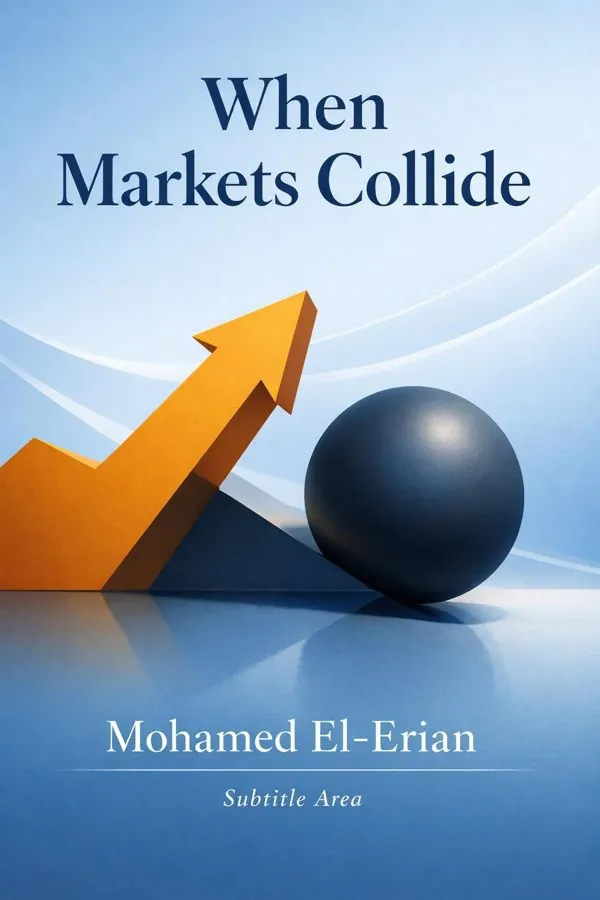
When Markets Collide: Investment Strategies for the Age of Global Economic Change: Summary & Key Insights
 10 min8 chaptersAudio available
What Is When Markets Collide: Investment Strategies for the Age of Global Economic Change About?
When Markets Collide: Investment Strategies for the Age of Global Economic Change by Mohamed El-Erian is a finance book spanning 8 pages. This influential work by Mohamed El-Erian explores the structural transformations reshaping global financial markets. It analyzes how investors, policymakers, and institutions can adapt to a world where traditional correlations and assumptions no longer hold. El-Erian provides strategic insights into risk management, asset allocation, and the interplay between developed and emerging economies, offering a framework for navigating uncertainty in global finance.
This FizzRead summary covers all 8 key chapters of When Markets Collide: Investment Strategies for the Age of Global Economic Change in approximately 10 minutes, distilling the most important ideas, arguments, and takeaways from Mohamed El-Erian's work. Also available as an audio summary and Key Quotes Podcast.
When Markets Collide: Investment Strategies for the Age of Global Economic Change
This influential work by Mohamed El-Erian explores the structural transformations reshaping global financial markets. It analyzes how investors, policymakers, and institutions can adapt to a world where traditional correlations and assumptions no longer hold. El-Erian provides strategic insights into risk management, asset allocation, and the interplay between developed and emerging economies, offering a framework for navigating uncertainty in global finance.
Who Should Read When Markets Collide: Investment Strategies for the Age of Global Economic Change?
This book is perfect for anyone interested in finance and looking to gain actionable insights in a short read. Whether you're a student, professional, or lifelong learner, the key ideas from When Markets Collide: Investment Strategies for the Age of Global Economic Change by Mohamed El-Erian will help you think differently.
- ✓Readers who enjoy finance and want practical takeaways
- ✓Professionals looking to apply new ideas to their work and life
- ✓Anyone who wants the core insights of When Markets Collide: Investment Strategies for the Age of Global Economic Change in just 10 minutes
Want the full summary?
Get instant access to this book summary and 100K+ more with Fizz Moment.
Get Free SummaryAvailable on App Store • Free to download
Key Chapters
We are witnessing nothing short of a tectonic realignment of the global economy. For decades, the world was economically bipolar—anchored by the industrialized West and Japan on one end, and emerging economies seeking stability and growth on the other. But by the early twenty-first century, this dynamic began to shift profoundly. Countries such as China, India, Brazil, and Russia moved from being marginal players in global trade and investment to being core engines of growth. Their emergence altered everything—the flow of capital, the geography of production, and even the psychology of investors.
From my vantage point, this transformation was not a temporary boom but a rebalancing of global economic power, accelerated by technological advances and demographic forces. The savings glut in emerging economies met the consumption patterns of developed societies, creating imbalances that financial markets struggled to absorb. The world became more integrated financially but less synchronized economically. Investors who once assumed Western markets were the primary source of opportunity found that emerging economies offered not only growth but also stability born of prudent fiscal management and rising domestic demand.
This new landscape challenges simplistic notions of decoupling or contagion. It demands a more nuanced appreciation of interdependence. Capital now flows more freely and instantaneously, yet with far greater complexity. The price of oil, the direction of sovereign funds, and the policies of central banks in emerging nations can ripple across continents in seconds. Understanding this dynamic is no longer optional; it is essential for any investor hoping to understand global risk and return.
The conventional financial theories many of us learned—the efficient market hypothesis, mean-variance optimization, and traditional diversification models—were built for a world that no longer exists. They assume stable relationships between risk and return, clear distinctions between asset classes, and predictable policy responses. But when markets collide under structural change, these assumptions break down. In recent crises and policy shifts, correlations that were once negative have turned positive; assets meant to hedge risk have become sources of risk themselves.
The old order’s failure stems from its static view of globalization. For decades, diversification across regions or asset types provided real protection. But as global linkages deepen, shocks transmit faster. Asset classes that once behaved independently now move in tandem. This convergence means investors must look beyond old categories and seek structural rather than surface-level diversification—thinking in terms of exposure to distinct economic drivers, policy regimes, and liquidity factors.
I recall my years observing global flows at PIMCO: traditional models often misread risk because they ignored behavioral factors and systemic interconnections. The assumption that crisis would remain contained within one geography, or one asset class, proved catastrophically wrong. Recognizing the end of the old order is painful but liberating. It opens the door to new frameworks—ones that accept complexity as the norm and volatility as a permanent companion rather than an anomaly.
+ 6 more chapters — available in the FizzRead app
All Chapters in When Markets Collide: Investment Strategies for the Age of Global Economic Change
About the Author
Mohamed A. El-Erian is a renowned economist and investor, known for his leadership at PIMCO and his expertise in global macroeconomic analysis. He has served as CEO and co-CIO of PIMCO, chaired President Obama’s Global Development Council, and is a frequent commentator on international finance and economic policy.
Get This Summary in Your Preferred Format
Read or listen to the When Markets Collide: Investment Strategies for the Age of Global Economic Change summary by Mohamed El-Erian anytime, anywhere. FizzRead offers multiple formats so you can learn on your terms — all free.
Available formats: App · Audio · PDF · EPUB — All included free with FizzRead
Download When Markets Collide: Investment Strategies for the Age of Global Economic Change PDF and EPUB Summary
Key Quotes from When Markets Collide: Investment Strategies for the Age of Global Economic Change
“We are witnessing nothing short of a tectonic realignment of the global economy.”
“The conventional financial theories many of us learned—the efficient market hypothesis, mean-variance optimization, and traditional diversification models—were built for a world that no longer exists.”
Frequently Asked Questions about When Markets Collide: Investment Strategies for the Age of Global Economic Change
When Markets Collide: Investment Strategies for the Age of Global Economic Change by Mohamed El-Erian is a finance book that explores key ideas across 8 chapters. This influential work by Mohamed El-Erian explores the structural transformations reshaping global financial markets. It analyzes how investors, policymakers, and institutions can adapt to a world where traditional correlations and assumptions no longer hold. El-Erian provides strategic insights into risk management, asset allocation, and the interplay between developed and emerging economies, offering a framework for navigating uncertainty in global finance.
You Might Also Like




Browse by Category
Ready to read When Markets Collide: Investment Strategies for the Age of Global Economic Change?
Get the full summary and 100K+ more books with Fizz Moment.