
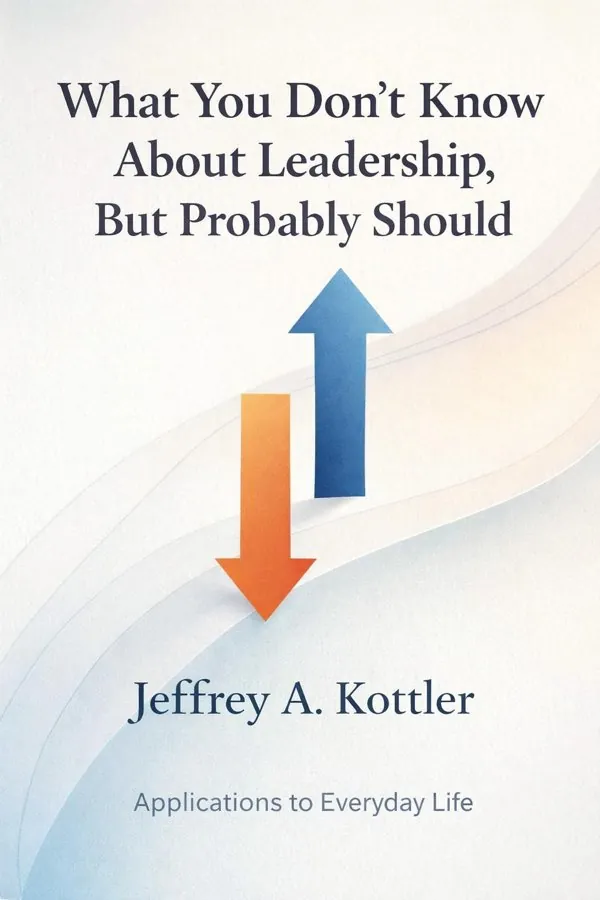
What You Don't Know About Leadership, But Probably Should: Applications to Everyday Life: Summary & Key Insights
 10 min9 chaptersAudio available
Key Takeaways from What You Don't Know About Leadership, But Probably Should: Applications to Everyday Life
One of the biggest misconceptions about leadership is that it starts with authority, when in reality it starts with relationship.
A leader who does not understand themselves will eventually confuse personal baggage with professional judgment.
Leadership requires confidence, but confidence without humility quickly becomes arrogance.
People rarely remember every instruction a leader gives, but they vividly remember how that leader made them feel.
The leaders who thrive are not the ones who always have the perfect plan; they are the ones who can adjust when reality changes.
What Is What You Don't Know About Leadership, But Probably Should: Applications to Everyday Life About?
What You Don't Know About Leadership, But Probably Should: Applications to Everyday Life by Jeffrey A. Kottler is a leadership book spanning 13 pages. Leadership is often treated as a set of techniques reserved for executives, politicians, or people with formal authority. Jeffrey A. Kottler argues that this view is far too narrow. In What You Don't Know About Leadership, But Probably Should, he shows that leadership is woven into everyday life: in families, workplaces, classrooms, friendships, and communities. The book focuses on the less obvious qualities that shape real influence, including self-awareness, emotional intelligence, flexibility, humility, courage, and ethical judgment. Rather than glorifying charisma or command, Kottler explores the inner work that allows people to guide others with clarity and integrity. What makes the book especially valuable is Kottler’s background as a psychologist, educator, and prolific author on human behavior. He brings psychological insight to the practical realities leaders face, from managing conflict and motivating others to handling stress and learning from failure. The result is a grounded, accessible guide for anyone who wants to understand leadership beyond slogans. This is not just a book about how to direct others; it is a book about how to know yourself well enough to make a meaningful difference.
This FizzRead summary covers all 9 key chapters of What You Don't Know About Leadership, But Probably Should: Applications to Everyday Life in approximately 10 minutes, distilling the most important ideas, arguments, and takeaways from Jeffrey A. Kottler's work. Also available as an audio summary and Key Quotes Podcast.
What You Don't Know About Leadership, But Probably Should: Applications to Everyday Life
Leadership is often treated as a set of techniques reserved for executives, politicians, or people with formal authority. Jeffrey A. Kottler argues that this view is far too narrow. In What You Don't Know About Leadership, But Probably Should, he shows that leadership is woven into everyday life: in families, workplaces, classrooms, friendships, and communities. The book focuses on the less obvious qualities that shape real influence, including self-awareness, emotional intelligence, flexibility, humility, courage, and ethical judgment. Rather than glorifying charisma or command, Kottler explores the inner work that allows people to guide others with clarity and integrity.
What makes the book especially valuable is Kottler’s background as a psychologist, educator, and prolific author on human behavior. He brings psychological insight to the practical realities leaders face, from managing conflict and motivating others to handling stress and learning from failure. The result is a grounded, accessible guide for anyone who wants to understand leadership beyond slogans. This is not just a book about how to direct others; it is a book about how to know yourself well enough to make a meaningful difference.
Who Should Read What You Don't Know About Leadership, But Probably Should: Applications to Everyday Life?
This book is perfect for anyone interested in leadership and looking to gain actionable insights in a short read. Whether you're a student, professional, or lifelong learner, the key ideas from What You Don't Know About Leadership, But Probably Should: Applications to Everyday Life by Jeffrey A. Kottler will help you think differently.
- ✓Readers who enjoy leadership and want practical takeaways
- ✓Professionals looking to apply new ideas to their work and life
- ✓Anyone who wants the core insights of What You Don't Know About Leadership, But Probably Should: Applications to Everyday Life in just 10 minutes
Want the full summary?
Get instant access to this book summary and 100K+ more with Fizz Moment.
Get Free SummaryAvailable on App Store • Free to download
Key Chapters
One of the biggest misconceptions about leadership is that it starts with authority, when in reality it starts with relationship. Kottler challenges the popular image of the leader as the person at the top giving directions. In his view, leadership is less about control and more about the ability to connect with people in ways that inspire trust, movement, and shared purpose. Titles may grant power, but they do not automatically create followership.
This matters because people respond most strongly to leaders who make them feel seen, respected, and included. A manager who knows how to listen, acknowledge concerns, and explain the why behind a decision often has more influence than one who simply enforces policy. A parent who models consistency and empathy leads more effectively than one who only demands obedience. Even in peer groups, leadership emerges when someone helps others organize, stay calm, and move toward a common goal.
Kottler’s broader point is that leadership is not confined to extraordinary moments. It happens in routine exchanges: how you respond when someone is frustrated, whether you take responsibility, how you build confidence in others, and whether your actions align with your words. The best leaders understand that influence grows through credibility and emotional presence, not intimidation.
In everyday life, this means shifting your focus from “How do I get people to do what I want?” to “How do I create the conditions for people to willingly engage?” That small change reframes leadership as a collaborative act rather than a personal performance.
Actionable takeaway: In your next important interaction, focus first on understanding the other person’s needs, fears, and goals before trying to persuade them.
A leader who does not understand themselves will eventually confuse personal baggage with professional judgment. Kottler emphasizes that self-awareness is the foundation of effective leadership because hidden fears, ego needs, insecurities, and blind spots shape behavior whether we admit it or not. Without self-knowledge, people often overreact, seek approval, avoid hard conversations, or interpret disagreement as disrespect.
Authentic leadership is not about displaying every feeling or being casually transparent. It is about knowing your values, motives, limitations, and emotional triggers well enough to act consistently. When leaders are clear about who they are, they communicate with steadiness. They do not need to pretend to know everything, nor do they constantly reshape themselves to please others. This creates trust because others sense they are dealing with a real person rather than a role.
Kottler’s psychological perspective is especially useful here. He suggests that unresolved issues often leak into leadership behavior. For example, a leader with a strong need for validation may micromanage to feel indispensable. Someone uncomfortable with conflict may avoid setting boundaries until resentment builds. By contrast, self-aware leaders notice these patterns and correct them before they damage relationships.
Practical self-awareness can be developed through reflection, feedback, journaling, coaching, or simply asking after tense moments, “What was I really reacting to?” Consider how your mood affects your tone, how your assumptions shape decisions, and where you may be compensating for insecurity. The more honest you are with yourself, the less likely you are to distort the environment around you.
Actionable takeaway: Identify one recurring leadership pattern, such as defensiveness or overcontrol, and spend a week noticing when it appears, what triggers it, and how you can respond more intentionally.
Leadership requires confidence, but confidence without humility quickly becomes arrogance. Kottler presents these qualities not as opposites but as partners. Effective leaders project enough belief in themselves to make decisions, guide others, and endure uncertainty, yet remain humble enough to question their assumptions, invite feedback, and admit mistakes.
This balance is difficult because many people misunderstand confidence. Real confidence is not loudness, certainty, or dominance. It is a grounded trust in your ability to learn, adapt, and respond. Humility, likewise, is not weakness or passivity. It is the willingness to recognize that your perspective is incomplete and that other people have knowledge, experience, and strengths you need.
In practice, leaders who combine confidence and humility are easier to trust. A team leader can say, “Here is the direction I believe we should take,” while also adding, “Tell me what I’m missing.” A school principal can confidently set standards while acknowledging that teachers on the ground may have better insight into student needs. In family life, a parent can make firm decisions while admitting when they handled something poorly.
Kottler suggests that humility protects leaders from isolation and overconfidence. When leaders begin to believe they are indispensable or always right, they stop learning. Their organizations become less honest because people hesitate to bring them bad news. Humility keeps leaders teachable. Confidence keeps them decisive. Together, these qualities create resilient authority.
Actionable takeaway: The next time you make an important decision, state your view clearly and then actively ask two people for dissenting perspectives before finalizing your course of action.
People rarely remember every instruction a leader gives, but they vividly remember how that leader made them feel. Kottler stresses that emotional intelligence is central to leadership because influence depends not only on logic but on emotional awareness, regulation, and empathy. Leaders are constantly affecting the emotional climate around them, whether they realize it or not.
Emotional intelligence includes several abilities: recognizing your own emotions, managing them constructively, reading what others may be experiencing, and responding in ways that support trust and effectiveness. A leader who senses rising tension in a meeting and slows the conversation before conflict escalates is practicing emotional intelligence. So is a supervisor who notices burnout in an employee and responds with curiosity rather than criticism.
Empathy is especially important. It does not mean agreement, and it does not require abandoning standards. It means trying to understand another person’s perspective, pressures, and feelings before reacting. This can transform difficult interactions. For example, an employee who seems disengaged may be dealing with confusion, discouragement, or personal stress. A leader who asks thoughtful questions will learn more than one who jumps straight to blame.
Kottler also points out that emotionally intelligent leaders manage their own internal states. They do not dump anxiety, anger, or frustration onto others. They pause, reflect, and choose responses that fit the situation. This steadiness is contagious. Teams often mirror the emotional tone of the person leading them.
Actionable takeaway: In your next tense conversation, spend the first few minutes naming what you observe and asking clarifying questions before offering solutions or judgments.
The leaders who thrive are not the ones who always have the perfect plan; they are the ones who can adjust when reality changes. Kottler highlights flexibility and adaptability as essential but underrated leadership strengths. Many people equate strong leadership with unwavering certainty, yet rigid leaders often break under pressure because they mistake consistency for inflexibility.
Adaptable leadership begins with accepting uncertainty. Conditions shift, people change, information emerges, and strategies that worked before may no longer fit. A leader who clings to a familiar method simply because it feels safe can hold everyone back. By contrast, adaptable leaders revise approaches without losing sight of core values. They know the mission should remain clear even when the route changes.
This quality shows up in all kinds of situations. In business, a team manager may need to alter a project timeline after learning the original assumptions were wrong. In education, a teacher may need to change communication style for students with different needs. In personal life, a caregiver or parent may need to rethink routines when family circumstances shift. Adaptability allows leaders to respond to the actual situation instead of forcing reality to match their expectations.
Kottler does not present flexibility as indecision. The point is not to become endlessly reactive. Rather, adaptable leaders gather information, remain open, and adjust thoughtfully. They treat mistakes as feedback rather than proof of failure. This mindset encourages experimentation and learning, which in turn makes teams more resilient.
Actionable takeaway: Choose one area where you have been relying on habit, then ask yourself what has changed in the situation and what a more flexible response would look like.
Many leaders assume communication is primarily about delivering clear messages, but Kottler argues that listening is the more neglected and often more powerful skill. Leaders who speak well but listen poorly create confusion, resentment, and false agreement. People may nod in meetings while disengaging internally because they do not feel heard.
Deep listening is more than remaining silent while waiting for your turn. It involves paying close attention to both words and underlying concerns, asking questions that clarify meaning, and checking that you understood correctly. It also requires noticing what is not being said. Hesitation, withdrawal, or repeated misunderstandings often signal that people do not feel safe enough to be fully honest.
Good communication, then, is relational rather than purely informational. A leader may explain a new policy perfectly, but if employees believe their worries are dismissed, resistance will remain. By contrast, when a leader says, “Here is the change, here is why it matters, and I want to hear what challenges you see,” communication becomes collaborative. Listening does not weaken authority; it strengthens buy-in.
Kottler’s perspective is especially practical in conflict situations. Leaders often rush to defend themselves or solve the problem before fully understanding it. Yet conflict often softens when people feel acknowledged. In everyday life, this might mean a spouse pausing to reflect back what they heard, a manager asking for examples before responding to criticism, or a coach inviting athletes to speak openly about morale.
Actionable takeaway: In your next important conversation, spend at least as much time asking and reflecting as you do explaining, and end by summarizing the other person’s point of view.
Leadership is never exercised in a vacuum. Kottler reminds readers that wise decisions require more than personal conviction; they require ethical reflection and sensitivity to context. What works in one environment, culture, or relationship may fail in another, and a leader who ignores these differences can do harm even with good intentions.
Ethical leadership begins with the recognition that influence carries responsibility. Leaders affect opportunities, morale, trust, and sometimes people’s livelihoods. That is why motives matter, but outcomes matter too. A leader must ask not only, “Can I do this?” but “Should I?” and “Who will be affected?” Ethical judgment often involves tension between competing goods: loyalty versus fairness, speed versus transparency, compassion versus accountability.
Cultural and contextual awareness deepens this ethical practice. People interpret authority, directness, feedback, and conflict through the norms of their background and setting. A blunt communication style that seems efficient in one context may feel disrespectful in another. A reward system that motivates one team may alienate another. Leaders need curiosity about the social world they are operating in, not just confidence in their own habits.
Kottler’s contribution here is to show that mature leadership depends on perspective-taking. It requires stepping outside your default assumptions and considering how your choices land on others. This applies globally in diverse workplaces, but also locally in families, schools, neighborhoods, and volunteer groups. Context is not an inconvenience; it is part of reality.
Actionable takeaway: Before making a consequential decision, ask three questions: Who benefits, who bears the cost, and how might different people experience this decision differently based on their role or background?
A leader’s success should not be measured only by personal achievement but by the growth they create in others. Kottler argues that one of the most important, and often overlooked, dimensions of leadership is development: helping people build confidence, capability, judgment, and independence. Leadership fails when followers remain permanently dependent on the leader for clarity, courage, or approval.
This developmental approach changes how leaders think about motivation. Instead of manipulating people with rewards, pressure, or charisma alone, strong leaders tap into meaning and ownership. They help others see how their work matters, where their strengths lie, and what challenges can help them grow. They do not merely extract performance; they cultivate potential.
In practical terms, developing others can mean delegating real responsibility instead of hoarding control, giving feedback that is honest but respectful, and creating opportunities for learning rather than punishing every mistake. A team leader might invite a quieter employee to lead part of a meeting. A mentor might ask questions that encourage reflection instead of always supplying answers. A parent might gradually transfer responsibility so a child learns competence and self-trust.
Kottler also links this idea to legacy. Leaders eventually move on, burn out, or lose relevance if everything depends on them. The healthiest systems outlast any single individual because leadership has been shared and multiplied. That is why teaching, mentoring, and empowering are not side activities. They are central responsibilities.
Actionable takeaway: Identify one person you influence and give them a stretch opportunity this week, paired with support, feedback, and the message that you believe they are capable of more.
Leadership is tested less by success than by what happens after disappointment, criticism, or failure. Kottler emphasizes that stress, setbacks, and emotional strain are unavoidable parts of leadership. Anyone who takes responsibility, makes difficult decisions, or works closely with people will eventually feel overwhelmed, discouraged, or exposed. The issue is not whether stress appears, but how leaders respond to it.
Resilient leaders do not deny pressure or pretend to be invulnerable. Instead, they build practices that help them recover, think clearly, and continue learning. This may include setting boundaries, seeking support, reflecting after difficult events, and maintaining a life outside the leadership role. Without these habits, leaders become brittle. They grow reactive, cynical, exhausted, or emotionally unavailable.
Kottler also frames resilience as a meaning-making process. Setbacks can deepen leadership if they are examined honestly. A failed initiative may reveal poor communication. A conflict may uncover hidden assumptions. A public mistake may teach humility and strengthen trust if handled with accountability. Leaders who treat every struggle as humiliation miss the developmental value of adversity.
This idea connects to sustaining growth and legacy. Leadership is not a single performance but a long process of becoming. The most enduring leaders remain learners. They keep refining character, judgment, and relationships over time. Their legacy comes not from appearing flawless but from demonstrating integrity, courage, and renewal in the face of difficulty.
Actionable takeaway: After your next setback, resist self-criticism for a moment and instead write down three lessons: what happened, what it revealed about your leadership, and one change you will make going forward.
All Chapters in What You Don't Know About Leadership, But Probably Should: Applications to Everyday Life
About the Author
Jeffrey A. Kottler is a psychologist, professor, counselor educator, and prolific author whose work spans counseling, psychotherapy, personal development, and leadership. Known for blending psychological depth with accessible language, he has written extensively on how people grow, relate, and perform under pressure. His background in mental health and education gives his leadership writing a distinctive focus on self-awareness, emotional intelligence, ethics, resilience, and human connection. Rather than treating leadership as a purely managerial skill, Kottler examines the inner life and interpersonal dynamics that shape influence in real settings. His books are widely appreciated for translating complex ideas into practical guidance that professionals and general readers can apply in everyday life.
Get This Summary in Your Preferred Format
Read or listen to the What You Don't Know About Leadership, But Probably Should: Applications to Everyday Life summary by Jeffrey A. Kottler anytime, anywhere. FizzRead offers multiple formats so you can learn on your terms — all free.
Available formats: App · Audio · PDF · EPUB — All included free with FizzRead
Download What You Don't Know About Leadership, But Probably Should: Applications to Everyday Life PDF and EPUB Summary
Key Quotes from What You Don't Know About Leadership, But Probably Should: Applications to Everyday Life
“One of the biggest misconceptions about leadership is that it starts with authority, when in reality it starts with relationship.”
“A leader who does not understand themselves will eventually confuse personal baggage with professional judgment.”
“Leadership requires confidence, but confidence without humility quickly becomes arrogance.”
“People rarely remember every instruction a leader gives, but they vividly remember how that leader made them feel.”
“The leaders who thrive are not the ones who always have the perfect plan; they are the ones who can adjust when reality changes.”
Frequently Asked Questions about What You Don't Know About Leadership, But Probably Should: Applications to Everyday Life
What You Don't Know About Leadership, But Probably Should: Applications to Everyday Life by Jeffrey A. Kottler is a leadership book that explores key ideas across 9 chapters. Leadership is often treated as a set of techniques reserved for executives, politicians, or people with formal authority. Jeffrey A. Kottler argues that this view is far too narrow. In What You Don't Know About Leadership, But Probably Should, he shows that leadership is woven into everyday life: in families, workplaces, classrooms, friendships, and communities. The book focuses on the less obvious qualities that shape real influence, including self-awareness, emotional intelligence, flexibility, humility, courage, and ethical judgment. Rather than glorifying charisma or command, Kottler explores the inner work that allows people to guide others with clarity and integrity. What makes the book especially valuable is Kottler’s background as a psychologist, educator, and prolific author on human behavior. He brings psychological insight to the practical realities leaders face, from managing conflict and motivating others to handling stress and learning from failure. The result is a grounded, accessible guide for anyone who wants to understand leadership beyond slogans. This is not just a book about how to direct others; it is a book about how to know yourself well enough to make a meaningful difference.
You Might Also Like

Extreme Ownership
Jocko Willink
10 min
Dare to Lead
Brene Brown
10 min
Leaders Eat Last
Simon Sinek
10 min
The 21 Irrefutable Laws of Leadership
John Maxwell
10 min
Start With Why
Simon Sinek
10 min
How to Lead When You're Not in Charge
Clay Scroggins
10 minBrowse by Category
Ready to read What You Don't Know About Leadership, But Probably Should: Applications to Everyday Life?
Get the full summary and 100K+ more books with Fizz Moment.