
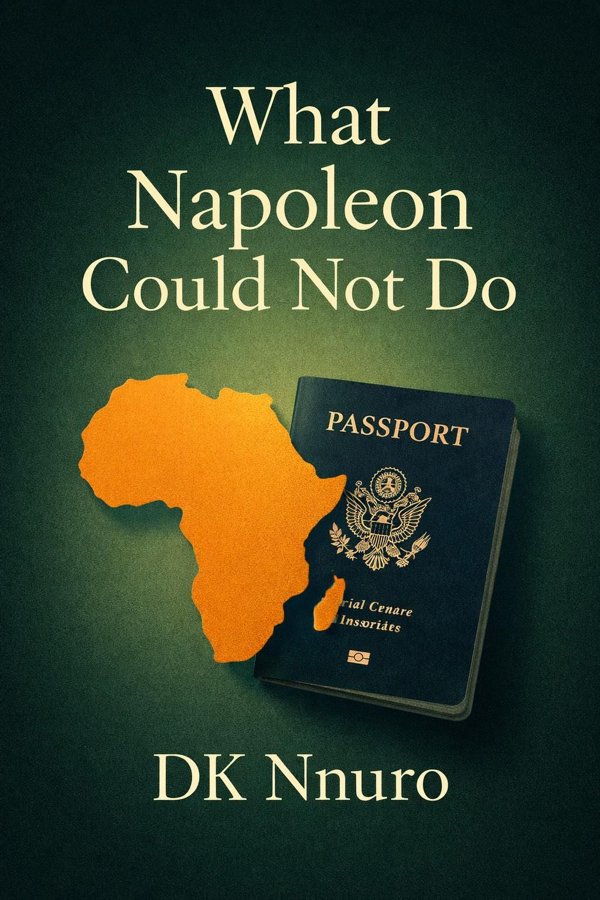
What Napoleon Could Not Do: Summary & Key Insights
by DK Nnuro
 10 min5 chaptersAudio available
What Is What Napoleon Could Not Do About?
What Napoleon Could Not Do by DK Nnuro is a bestsellers book spanning 5 pages. A debut novel exploring the immigrant experience and the complex pursuit of the American dream through the lives of a Ghanaian family divided between Ghana and the United States. The story examines identity, belonging, and the emotional cost of ambition and displacement.
This FizzRead summary covers all 5 key chapters of What Napoleon Could Not Do in approximately 10 minutes, distilling the most important ideas, arguments, and takeaways from DK Nnuro's work. Also available as an audio summary and Key Quotes Podcast.
What Napoleon Could Not Do
A debut novel exploring the immigrant experience and the complex pursuit of the American dream through the lives of a Ghanaian family divided between Ghana and the United States. The story examines identity, belonging, and the emotional cost of ambition and displacement.
Who Should Read What Napoleon Could Not Do?
This book is perfect for anyone interested in bestsellers and looking to gain actionable insights in a short read. Whether you're a student, professional, or lifelong learner, the key ideas from What Napoleon Could Not Do by DK Nnuro will help you think differently.
- ✓Readers who enjoy bestsellers and want practical takeaways
- ✓Professionals looking to apply new ideas to their work and life
- ✓Anyone who wants the core insights of What Napoleon Could Not Do in just 10 minutes
Want the full summary?
Get instant access to this book summary and 100K+ more with Fizz Moment.
Get Free SummaryAvailable on App Store • Free to download
Key Chapters
Jacob’s story begins long before his plane touches American soil; it begins in Ghana, where ambition is a currency and America is a myth. He grows up hearing how the United States transforms lives, how it turns ordinary men into success stories. When he finally arrives, he carries with him the grandeur of that dream — and the quiet fear of failing it. His early days in America are marked by disillusionment. He finds employment that bruises his pride and relationships that force him to negotiate identity in ways he never needed to back home. The country that promised reinvention instead demands erasure.
I wrote Jacob not as a symbol but as a man trying to translate himself across cultures. He wants to embody his family’s hopes, but those hopes feel foreign in the context of his struggles. The American dream, for Jacob, becomes less about prosperity and more about survival — an unending attempt to prove his worth in a system designed to question it. Through his interactions with American colleagues and his relationship with Patricia, we see how assimilation often asks the immigrant to abandon the language of origin — not just linguistically, but emotionally.
Jacob’s journey is a chronicle of contradictions: comfort in instability, pride in invisibility, ambition within isolation. He finds himself navigating an America that celebrates him for his perseverance yet refuses to recognize his pain. When he looks toward Ghana, longing for those who still believe in his success, he’s caught in the cruel irony that returning would confirm defeat, while remaining means living as an outsider. His entire existence becomes an emotional negotiation between belonging and performance.
In writing him, I wanted to reveal that the American dream’s fragility lies not in its unreachability but in its conditionality. Success here is often defined by conformity, and Jacob’s failure is that he remains too aware of who he was before he arrived. His story forces us to ask: what if the dream isn’t broken, but simply incomplete? What if its cost is the very truth of one’s self?
Belinda exists in Ghana but imagines America as her redemption. She watches Jacob’s life from afar, interpreting every photograph and message as proof of triumph. Her understanding of America is filtered through envy and hope — it is the promised space where privilege replaces struggle, and transformation comes without loss. Her marriage to a Ghanaian man grounds her physically but not emotionally; her heart is elsewhere, in the fantasy of an American life that mirrors none of the hardships Jacob endures.
She represents the idealizer — the dreamer who sees migration as a moral victory. For Belinda, the act of leaving Ghana is equated with rising above its limitations. The home she knows is constraining; America is, in her mind, the place of endless self-expression. Yet I intended her narrative to expose how idealization can become a form of exile even before one leaves home. Belinda’s sense of inadequacy feeds her obsession with departure, pressing her to measure her worth against an imagined world.
When Belinda finally visits America, she confronts its dissonant reality. What she finds is not the glittering utopia she envisioned but a landscape of fragmentation. Her brother’s life unsettles her — the cramped apartment, the exhaustion of endless work, the subtle alienations. The dream collapses, but with that collapse comes painful clarity. In witnessing Jacob’s struggle, she realizes that success abroad isn’t about escape but endurance.
Belinda’s vision becomes a mirror of our own fantasies about reinvention. I wanted to remind readers that longing for elsewhere doesn’t always lead to fulfillment. Often, it deepens the fracture between who we are and who we want to be. Belinda and Jacob embody two sides of the same longing: one chasing the dream, the other confronting its consequences. Together they reveal that belonging cannot be outsourced; it must be built from the contradictions of our own stories.
+ 3 more chapters — available in the FizzRead app
All Chapters in What Napoleon Could Not Do
About the Author
Get This Summary in Your Preferred Format
Read or listen to the What Napoleon Could Not Do summary by DK Nnuro anytime, anywhere. FizzRead offers multiple formats so you can learn on your terms — all free.
Available formats: App · Audio · PDF · EPUB — All included free with FizzRead
Download What Napoleon Could Not Do PDF and EPUB Summary
Key Quotes from What Napoleon Could Not Do
“Jacob’s story begins long before his plane touches American soil; it begins in Ghana, where ambition is a currency and America is a myth.”
“Belinda exists in Ghana but imagines America as her redemption.”
Frequently Asked Questions about What Napoleon Could Not Do
What Napoleon Could Not Do by DK Nnuro is a bestsellers book that explores key ideas across 5 chapters. A debut novel exploring the immigrant experience and the complex pursuit of the American dream through the lives of a Ghanaian family divided between Ghana and the United States. The story examines identity, belonging, and the emotional cost of ambition and displacement.
You Might Also Like

The Godfather
Mario Puzo
10 min
The Handmaid's Tale
Margaret Atwood
10 min
The Hunger Games
Suzanne Collins
10 min
The Nightingale
Kristin Hannah
10 min
The Seven Husbands of Evelyn Hugo
Taylor Jenkins Reid
10 min
Backwater Justice
Fern Michaels
10 minBrowse by Category
Ready to read What Napoleon Could Not Do?
Get the full summary and 100K+ more books with Fizz Moment.