
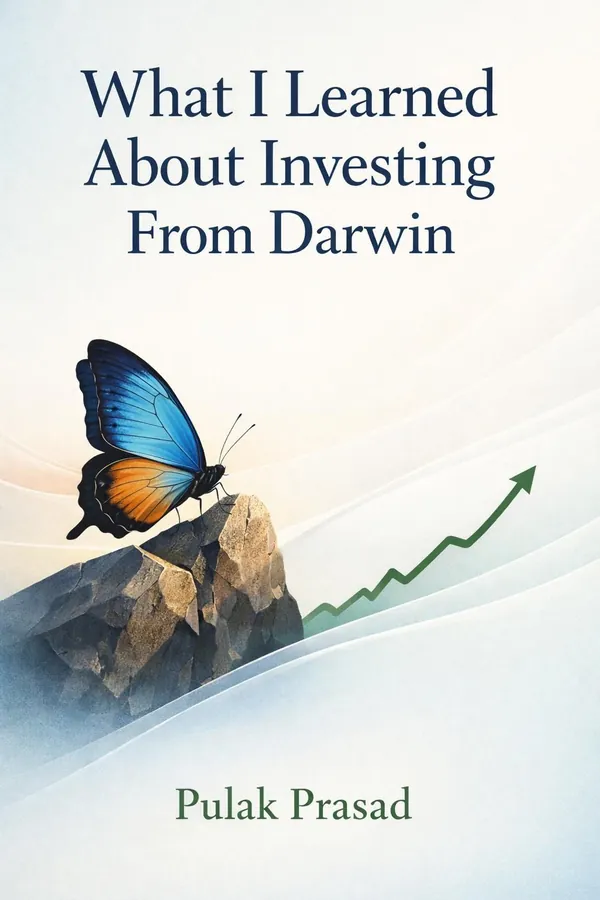
What I Learned About Investing From Darwin: Summary & Key Insights
by Pulak Prasad
 10 min11 chaptersAudio available
What Is What I Learned About Investing From Darwin About?
What I Learned About Investing From Darwin by Pulak Prasad is a finance book spanning 11 pages. This book presents a philosophy of patient, long-term investing inspired by evolutionary biology. Drawing lessons from Darwinian concepts, the author mixes vivid examples from nature with stories of investment decisions, including his own. The book outlines counterintuitive principles for long-term gain, emphasizing risk avoidance, buying high-quality businesses at fair prices, and maintaining a disciplined, 'very lazy' approach. It advocates for permanently owning high-quality businesses and provides practical insights into why evolutionary biology can help investors improve their craft.
This FizzRead summary covers all 11 key chapters of What I Learned About Investing From Darwin in approximately 10 minutes, distilling the most important ideas, arguments, and takeaways from Pulak Prasad's work. Also available as an audio summary and Key Quotes Podcast.
What I Learned About Investing From Darwin
This book presents a philosophy of patient, long-term investing inspired by evolutionary biology. Drawing lessons from Darwinian concepts, the author mixes vivid examples from nature with stories of investment decisions, including his own. The book outlines counterintuitive principles for long-term gain, emphasizing risk avoidance, buying high-quality businesses at fair prices, and maintaining a disciplined, 'very lazy' approach. It advocates for permanently owning high-quality businesses and provides practical insights into why evolutionary biology can help investors improve their craft.
Who Should Read What I Learned About Investing From Darwin?
This book is perfect for anyone interested in finance and looking to gain actionable insights in a short read. Whether you're a student, professional, or lifelong learner, the key ideas from What I Learned About Investing From Darwin by Pulak Prasad will help you think differently.
- ✓Readers who enjoy finance and want practical takeaways
- ✓Professionals looking to apply new ideas to their work and life
- ✓Anyone who wants the core insights of What I Learned About Investing From Darwin in just 10 minutes
Want the full summary?
Get instant access to this book summary and 100K+ more with Fizz Moment.
Get Free SummaryAvailable on App Store • Free to download
Key Chapters
The foundation of my investment philosophy is the principle of risk aversion, a lesson drawn directly from the natural world. In evolution, survival is paramount. Every organism, from the cautious deer at the waterhole to the vigilant bumblebee avoiding predators, is shaped by the relentless pressure to avoid fatal mistakes. In statistical terms, these are Type I errors—actions that lead to self-harm or extinction. Evolution has favored those who are more sensitive to the risk of catastrophic loss, even at the cost of missing out on some opportunities (Type II errors).
In investing, this translates to a relentless focus on avoiding major risks and capital loss. The wisdom of Warren Buffett—"Rule number one: never lose money. Rule number two: never forget rule number one"—is not just a catchy slogan, but a distillation of evolutionary logic. Most investment literature is obsessed with how to make money, but few focus on how not to lose it. Yet, as in nature, the ability to avoid ruin is the prerequisite for long-term success.
My own experience, including painful early mistakes, taught me that the greatest returns come not from chasing every opportunity, but from rigorously filtering out situations where the risk of permanent loss is high. This means avoiding companies run by dishonest managers, shunning highly leveraged businesses, steering clear of industries in constant flux, and refusing to invest in situations where the interests of owners and shareholders are misaligned. The cost of this approach is missing out on some spectacular winners, but the benefit is survival—and, over time, outperformance.
Just as the bumblebee avoids flowers that might harbor predators, even at the cost of missing some nectar, I have learned to accept the inevitability of missed opportunities. The key is to avoid the mistakes that can wipe you out. In the long run, as in evolution, it is the survivors who win.
After risk is controlled, the next evolutionary lesson is the importance of selection. In nature, selection operates on traits that confer survival and reproductive advantages. In investing, the equivalent is the selection of high-quality businesses—those with a proven ability to generate superior returns on capital over long periods.
The challenge is to identify a single, measurable trait that correlates with a host of desirable business characteristics, much as the selection for tameness in the Siberian silver fox experiment led to a cascade of beneficial changes. For me, that trait is historical return on capital employed (ROCE). High ROCE is not just a number; it is a signal that a business has a strong management team, effective capital allocation, durable competitive advantages, and the ability to generate cash while taking prudent risks.
By filtering for companies with a long history of high ROCE, I can efficiently narrow the universe of potential investments to those most likely to possess the qualities I seek. This approach is not foolproof—past performance does not guarantee future results, and some great companies may be missed—but it dramatically increases the odds of success. The key is to start with a trait that, like tameness in foxes, brings with it a host of other positive attributes.
The process is simple but powerful: screen for high ROCE, then conduct deeper analysis to confirm the sustainability of the business's advantages. This method allows me to focus my time and energy on the most promising candidates, while avoiding the distractions of flashy growth stories or charismatic management teams that lack substance.
+ 9 more chapters — available in the FizzRead app
All Chapters in What I Learned About Investing From Darwin
About the Author
Pulak Prasad is an equity fund manager and founder of Nalanda Capital, an investment firm managing over $5 billion in Indian listed securities. He previously co-headed India for Warburg Pincus, a global private equity firm, and worked at McKinsey as a management consultant. His career spans consulting and investing across multiple industries and continents.
Get This Summary in Your Preferred Format
Read or listen to the What I Learned About Investing From Darwin summary by Pulak Prasad anytime, anywhere. FizzRead offers multiple formats so you can learn on your terms — all free.
Available formats: App · Audio · PDF · EPUB — All included free with FizzRead
Download What I Learned About Investing From Darwin PDF and EPUB Summary
Key Quotes from What I Learned About Investing From Darwin
“The foundation of my investment philosophy is the principle of risk aversion, a lesson drawn directly from the natural world.”
“After risk is controlled, the next evolutionary lesson is the importance of selection.”
Frequently Asked Questions about What I Learned About Investing From Darwin
What I Learned About Investing From Darwin by Pulak Prasad is a finance book that explores key ideas across 11 chapters. This book presents a philosophy of patient, long-term investing inspired by evolutionary biology. Drawing lessons from Darwinian concepts, the author mixes vivid examples from nature with stories of investment decisions, including his own. The book outlines counterintuitive principles for long-term gain, emphasizing risk avoidance, buying high-quality businesses at fair prices, and maintaining a disciplined, 'very lazy' approach. It advocates for permanently owning high-quality businesses and provides practical insights into why evolutionary biology can help investors improve their craft.
You Might Also Like


Browse by Category
Ready to read What I Learned About Investing From Darwin?
Get the full summary and 100K+ more books with Fizz Moment.