
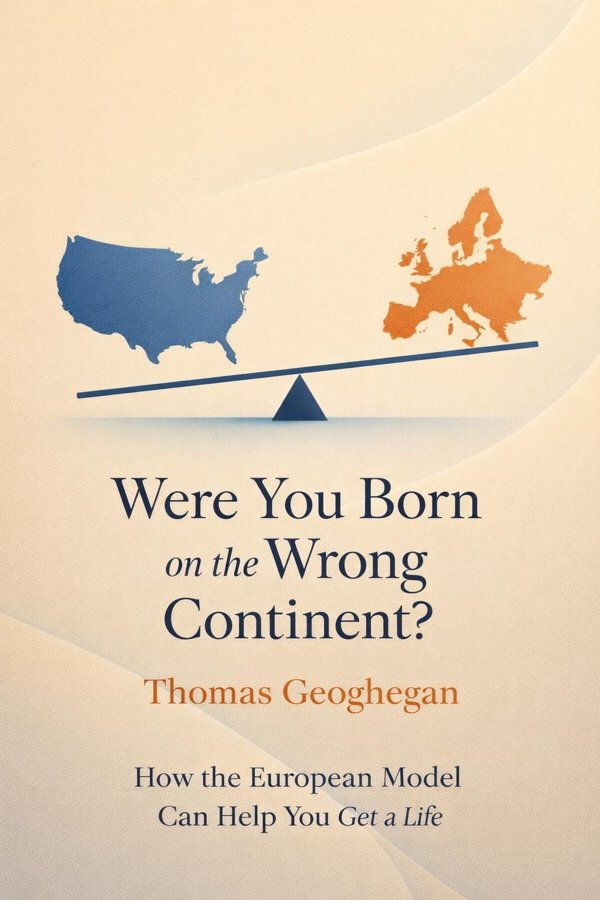
Were You Born on the Wrong Continent?: How the European Model Can Help You Get a Life: Summary & Key Insights
 10 min9 chaptersAudio available
What Is Were You Born on the Wrong Continent?: How the European Model Can Help You Get a Life About?
Were You Born on the Wrong Continent?: How the European Model Can Help You Get a Life by Thomas Geoghegan is a economics book spanning 9 pages. In this thought-provoking book, labor lawyer and author Thomas Geoghegan explores the social and economic systems of Western Europe, particularly Germany, to argue that Americans might live happier, more balanced lives under a European-style social democracy. He examines work-life balance, labor rights, healthcare, and education, contrasting them with the U.S. model to highlight how different policy choices shape quality of life.
This FizzRead summary covers all 9 key chapters of Were You Born on the Wrong Continent?: How the European Model Can Help You Get a Life in approximately 10 minutes, distilling the most important ideas, arguments, and takeaways from Thomas Geoghegan's work. Also available as an audio summary and Key Quotes Podcast.
Were You Born on the Wrong Continent?: How the European Model Can Help You Get a Life
In this thought-provoking book, labor lawyer and author Thomas Geoghegan explores the social and economic systems of Western Europe, particularly Germany, to argue that Americans might live happier, more balanced lives under a European-style social democracy. He examines work-life balance, labor rights, healthcare, and education, contrasting them with the U.S. model to highlight how different policy choices shape quality of life.
Who Should Read Were You Born on the Wrong Continent?: How the European Model Can Help You Get a Life?
This book is perfect for anyone interested in economics and looking to gain actionable insights in a short read. Whether you're a student, professional, or lifelong learner, the key ideas from Were You Born on the Wrong Continent?: How the European Model Can Help You Get a Life by Thomas Geoghegan will help you think differently.
- ✓Readers who enjoy economics and want practical takeaways
- ✓Professionals looking to apply new ideas to their work and life
- ✓Anyone who wants the core insights of Were You Born on the Wrong Continent?: How the European Model Can Help You Get a Life in just 10 minutes
Want the full summary?
Get instant access to this book summary and 100K+ more with Fizz Moment.
Get Free SummaryAvailable on App Store • Free to download
Key Chapters
When I speak of the 'European model,' I mean something quite specific. It’s the social democratic framework that took shape after World War II, especially in Germany, Scandinavia, and northern Europe. At its heart lies a moral conviction that capitalism should serve the public good, not the other way around. This model doesn’t abolish markets or private enterprise; it civilizes them. It builds guardrails that protect workers, families, and communities from the volatile swings of global capital.
In Germany, for example, labor laws require that workers sit on corporate boards, a principle known as co-determination. Collective bargaining covers entire industries, not just individual companies. Universal health insurance is treated as a right, not a commodity. The state helps coordinate vocational training so that young people move seamlessly into stable, skilled work. These aren’t perks—they’re the scaffolding of a social contract that expects the economy to sustain human life rather than exhaust it.
American readers often assume such systems must stifle creativity or competitiveness. Yet the truth is almost the opposite. Because worker participation in decision-making fosters trust, and because employment security reduces fear, productivity per hour actually tends to be higher in Germany and other European nations than in the United States. The European model doesn’t serve efficiency by extracting more labor; it serves efficiency by investing in human capability.
Let’s face it: Americans work too much. We work ourselves into stress disorders, into heart attacks, into families that barely see each other. Every courtroom and union hall I’ve ever been in tells me the same story—people are tired. They’re running out of time. In Europe, by contrast, people take time seriously. The standard German workweek is shorter, the vacation longer, and overtime is compensated not just with money but sometimes with mandatory rest. Unions are strong, and they bargain not only for wages but for dignity and rhythm in daily life.
The real difference, I found, isn’t just in the length of the workday. It’s in the idea of leisure itself. Europeans see leisure not as wasted time but as an essential component of citizenship. To participate in a democracy, you need time to think, to read, to care for others, to belong to something larger than your job. In the U.S., we glorify the 'workaholic' as though burnout were proof of moral worth. In Europe, they worry about a society that doesn’t know how to stop.
When people have predictable schedules and paid time off, they stop clutching so desperately at their jobs. Paradoxically, that security makes them more willing to adapt, to innovate, and to learn new skills. The work-life balance Europeans defend is not laziness—it’s wisdom. It’s an understanding that work should serve life, not consume it.
+ 7 more chapters — available in the FizzRead app
All Chapters in Were You Born on the Wrong Continent?: How the European Model Can Help You Get a Life
About the Author
Thomas Geoghegan is an American labor lawyer, author, and political activist known for his writings on labor policy, social democracy, and the American middle class. He has written several books examining the intersection of law, economics, and social justice.
Get This Summary in Your Preferred Format
Read or listen to the Were You Born on the Wrong Continent?: How the European Model Can Help You Get a Life summary by Thomas Geoghegan anytime, anywhere. FizzRead offers multiple formats so you can learn on your terms — all free.
Available formats: App · Audio · PDF · EPUB — All included free with FizzRead
Download Were You Born on the Wrong Continent?: How the European Model Can Help You Get a Life PDF and EPUB Summary
Key Quotes from Were You Born on the Wrong Continent?: How the European Model Can Help You Get a Life
“When I speak of the 'European model,' I mean something quite specific.”
“We work ourselves into stress disorders, into heart attacks, into families that barely see each other.”
Frequently Asked Questions about Were You Born on the Wrong Continent?: How the European Model Can Help You Get a Life
Were You Born on the Wrong Continent?: How the European Model Can Help You Get a Life by Thomas Geoghegan is a economics book that explores key ideas across 9 chapters. In this thought-provoking book, labor lawyer and author Thomas Geoghegan explores the social and economic systems of Western Europe, particularly Germany, to argue that Americans might live happier, more balanced lives under a European-style social democracy. He examines work-life balance, labor rights, healthcare, and education, contrasting them with the U.S. model to highlight how different policy choices shape quality of life.
You Might Also Like

Business Adventures
John Brooks
10 min
Nudge
Richard H. Thaler, Cass R. Sunstein
10 min
The Hitchhiker"s Guide to the Galaxy
Douglas Adams
10 minThe Muqaddimah
Ibn Khaldun
10 minThe Outsiders
William N. Thorndike
10 min
A Little History of Economics
Niall Kishtainy
10 minBrowse by Category
Ready to read Were You Born on the Wrong Continent?: How the European Model Can Help You Get a Life?
Get the full summary and 100K+ more books with Fizz Moment.