
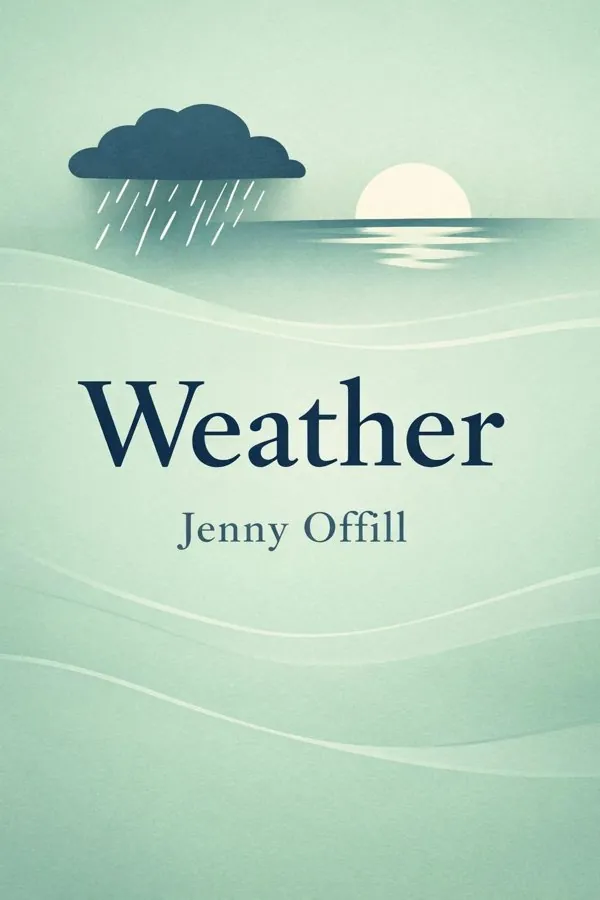
Weather: Summary & Key Insights
by Jenny Offill
 10 min9 chaptersAudio available
Key Takeaways from Weather
One of the novel’s deepest insights is that global anxiety is always experienced locally, inside a single life.
A family can be both shelter and weather system, and Henry’s story reveals how deeply one person’s instability reshapes everyone around him.
Fear becomes more contagious when it is dressed as expertise, and Sylvia’s presence in Weather dramatizes that unsettling truth.
Love in Weather is not sentimental; it is logistical, repetitive, and morally demanding.
Modern consciousness rarely moves in smooth narrative lines, and Offill’s fragmentary style is not a gimmick but a diagnosis.
What Is Weather About?
Weather by Jenny Offill is a bestsellers book spanning 6 pages. Jenny Offill’s Weather is a compact, piercing novel about what it feels like to live an ordinary life under extraordinary pressure. Through the voice of Lizzie Benson—a librarian, wife, mother, sister, and part-time assistant to a famous podcast host—Offill explores the low hum of modern dread: climate catastrophe, political instability, addiction, economic fragility, and the private fear that no one really knows how to prepare for what is coming. Rather than offering a conventional plot-driven story, the book unfolds in sharp fragments, observations, jokes, warnings, and moments of tenderness that mirror the way contemporary consciousness actually works. That formal choice is part of what makes the novel so powerful: it captures the mental weather of our time. Offill is especially suited to this subject. Known for her innovative, compressed prose and emotionally precise writing, she has built a reputation for turning scattered thought into profound insight. Weather matters because it speaks directly to a generation trying to raise children, care for family, hold relationships together, and remain morally awake while the world feels increasingly unstable.
This FizzRead summary covers all 9 key chapters of Weather in approximately 10 minutes, distilling the most important ideas, arguments, and takeaways from Jenny Offill's work. Also available as an audio summary and Key Quotes Podcast.
Weather
Jenny Offill’s Weather is a compact, piercing novel about what it feels like to live an ordinary life under extraordinary pressure. Through the voice of Lizzie Benson—a librarian, wife, mother, sister, and part-time assistant to a famous podcast host—Offill explores the low hum of modern dread: climate catastrophe, political instability, addiction, economic fragility, and the private fear that no one really knows how to prepare for what is coming. Rather than offering a conventional plot-driven story, the book unfolds in sharp fragments, observations, jokes, warnings, and moments of tenderness that mirror the way contemporary consciousness actually works. That formal choice is part of what makes the novel so powerful: it captures the mental weather of our time. Offill is especially suited to this subject. Known for her innovative, compressed prose and emotionally precise writing, she has built a reputation for turning scattered thought into profound insight. Weather matters because it speaks directly to a generation trying to raise children, care for family, hold relationships together, and remain morally awake while the world feels increasingly unstable.
Who Should Read Weather?
This book is perfect for anyone interested in bestsellers and looking to gain actionable insights in a short read. Whether you're a student, professional, or lifelong learner, the key ideas from Weather by Jenny Offill will help you think differently.
- ✓Readers who enjoy bestsellers and want practical takeaways
- ✓Professionals looking to apply new ideas to their work and life
- ✓Anyone who wants the core insights of Weather in just 10 minutes
Want the full summary?
Get instant access to this book summary and 100K+ more with Fizz Moment.
Get Free SummaryAvailable on App Store • Free to download
Key Chapters
One of the novel’s deepest insights is that global anxiety is always experienced locally, inside a single life. At the heart of Weather is Lizzie, a librarian whose days are shaped by routines that seem modest and ordinary: answering patrons’ questions, parenting her son Eli, navigating marriage with Ben, and trying to support her troubled brother Henry. Yet Offill shows that these everyday acts do not protect Lizzie from the larger storms of the age. Climate fears, political dread, and cultural noise seep into the kitchen, the workplace, and the mind.
What makes Lizzie compelling is that she is neither heroic nor detached. She is intelligent, observant, funny, and often overwhelmed. She wants to be responsible, but she also wants to keep functioning. That tension gives the novel its emotional force. Lizzie represents the modern person who is aware enough to feel the danger but still expected to shop for groceries, answer emails, and make school lunches.
This is one of Offill’s key achievements: she refuses the false divide between “important global issues” and “small domestic concerns.” Caring for a child, listening to a spouse, or getting through the day without panic are not trivial in a destabilized world. They are part of how people survive history.
In practice, this idea invites readers to treat their own daily life as morally meaningful. You do not need a grand public role to be implicated in the future. Notice where world-scale concerns are already shaping your habits, moods, and relationships. The actionable takeaway: instead of dismissing your ordinary life as separate from the crises around you, ask how your daily routines can become a steadier, more conscious way of living through uncertainty.
A family can be both shelter and weather system, and Henry’s story reveals how deeply one person’s instability reshapes everyone around him. Lizzie’s younger brother lives in the shadow of addiction and relapse, and his presence gives the novel one of its most intimate forms of suspense. Unlike the abstract fears surrounding climate or politics, Henry’s vulnerability is immediate. A missed call, a strange silence, or a new scheme can signal disaster.
Offill portrays addiction with unusual restraint. She does not turn Henry into a symbol or a lesson. Instead, she shows how recovery is fragile, nonlinear, and exhausting for both the person struggling and the family trying to help. Lizzie is drawn into cycles of vigilance, hope, disappointment, and renewed care. The emotional labor of loving someone in danger becomes one more burden she carries while already stretched thin.
This storyline broadens the novel’s understanding of crisis. Not all emergencies are public or visible. Some arrive through blood ties, old histories, and repeated phone calls. Henry also reveals a difficult truth: love does not guarantee rescue. Family members can offer support, boundaries, money, transport, listening, and forgiveness, but they cannot control outcomes.
Readers can apply this insight by rethinking what support really means. In families affected by addiction, mental illness, or chronic instability, care must include limits as well as compassion. Help is not the same as self-erasure. The actionable takeaway: identify one relationship where you are carrying too much responsibility, and define a healthier balance between being available and trying to manage what is not yours to fix.
Fear becomes more contagious when it is dressed as expertise, and Sylvia’s presence in Weather dramatizes that unsettling truth. Lizzie begins assisting Sylvia, a former academic turned public intellectual and podcast host, who fields anxious questions from listeners preparing for ecological collapse, social breakdown, and moral emergency. Through Sylvia’s inbox and public persona, Lizzie enters a world where people ask not just how to live well, but how to survive what may be coming.
Sylvia is fascinating because she is both serious and performative. She represents a modern class of thinkers who translate catastrophe into discourse, advice, and influence. Around her gathers a community hungry for interpretation: people want forecasts, guidance, and emotional permission to panic. Lizzie, who is more grounded in domestic reality, becomes a witness to how intellectual culture processes dread. The book never mocks climate concern; instead, it examines what happens when existential fear becomes a daily media environment.
Offill is especially sharp on the psychological effect of constant anticipation. Many people are not only worried about disaster itself; they are worried about whether they are worried enough, informed enough, or prepared enough. That secondary anxiety can be paralyzing.
In real life, this dynamic appears in doomscrolling, survivalist fantasies, and endless consumption of alarming content that creates the illusion of control. Awareness matters, but awareness without proportion can hollow out the present.
The actionable takeaway: choose one concrete way to stay informed about large-scale risks—such as a trusted weekly source or one local civic action—and refuse the endless, anxiety-amplifying loop of speculative consumption that leaves you frightened but inactive.
Love in Weather is not sentimental; it is logistical, repetitive, and morally demanding. Lizzie’s marriage to Ben and her relationship with her son Eli show how care operates under pressure. Offill pays close attention to the minor negotiations of family life: scheduling, emotional availability, sexuality, worry, discipline, and shared fatigue. These are not side concerns. They are the arena in which character is tested.
Ben’s past and present choices complicate the marriage, and Lizzie’s role as mother intensifies her sense of responsibility toward the future. Eli is not just a child she loves; he is a living reason to confront what kind of world is being inherited. This gives the domestic storyline unusual moral weight. Parenting becomes inseparable from larger questions: How do you raise a child in unstable times? How much fear should you conceal? How do you teach attention, kindness, and steadiness when adults themselves feel disoriented?
Offill suggests that care is one of the few meaningful responses to uncertainty. But she also refuses to idealize it. Caring for others can become draining, especially when women are expected to absorb everyone else’s needs. Lizzie often appears as the emotional hinge for family, work, and crisis management. That pressure is familiar to many readers.
The practical lesson is that households need intentional, not assumed, structures of care. Emotional labor should be named and shared. Children need honesty scaled to their age, not total protection from reality or unchecked adult panic.
The actionable takeaway: have one explicit conversation in your home about invisible labor—who remembers, plans, soothes, and organizes—and make one concrete redistribution so care becomes more sustainable rather than silently unequal.
When the future feels unmanageable, the temptation is to believe that only drastic gestures matter. Weather pushes back against that fantasy by showing the quiet significance of small acts of care, attention, and restraint. Lizzie cannot solve climate change, cure addiction, stabilize politics, or guarantee her child’s future. What she can do is show up, listen, notice, comfort, refuse cruelty, and keep participating in the lives around her.
This does not amount to naive optimism. Offill is too clear-eyed for that. The novel never suggests that private kindness replaces structural change. Instead, it argues that small acts are the human scale at which moral life is actually lived. They are not sufficient to repair the world, but they are essential to remaining a person within it.
There is a subtle but important distinction here. Small acts are not valuable because they let us avoid larger responsibility. They matter because despair often begins by convincing people that if they cannot do everything, nothing counts. Offill resists that all-or-nothing logic. A meal cooked for someone in crisis, a truthful conversation, a moment of patience with a child, or a decision to stay present rather than dissociate—these are forms of shelter.
In everyday life, readers can apply this insight by shrinking the distance between concern and practice. Instead of asking, “How do I fix everything?” ask, “What kind of person can I still be today?” Such a question restores agency without denying reality.
The actionable takeaway: choose one repeatable act of grounded care—checking on a relative, reducing one wasteful habit, reading with your child, volunteering locally—and treat consistency, not scale, as the measure of meaningful response.
One of Offill’s most original observations is that catastrophe in modern life often arrives not as a single event, but as background noise. People go to work, answer text messages, monitor school schedules, and half-listen to predictions of collapse. The apocalyptic has become ambient. It hums beneath ordinary life so continuously that it can start to feel both unbearable and strangely normalized.
This is psychologically dangerous because the mind adapts to repeated alarms in unstable ways. Some people become hypervigilant, unable to relax because every calm moment feels irresponsible. Others become numb, treating grim forecasts as just another content stream. Weather captures both reactions. Lizzie fluctuates between alertness and exhaustion, between wanting to know more and wanting to shut everything out.
By making apocalypse ambient rather than cinematic, Offill reveals why so many people feel spiritually depleted. The problem is not only fear of disaster; it is the endless low-level management of dread. This affects decision-making, relationships, and attention. It becomes harder to distinguish urgent from important, probable from possible, and action from performance.
A useful application of this idea is to notice your own relationship to constant alert. Do headlines set your baseline mood? Do speculative fears consume more energy than immediate obligations? Are you mistaking exposure for engagement?
The actionable takeaway: create a threshold for what deserves immediate attention. Limit reactive information intake, designate specific times for news, and protect spaces in your day where your nervous system is not required to rehearse catastrophe. Clearer attention is not denial; it is a precondition for durable action.
Sometimes the only honest response to overwhelming reality is a joke, and Offill understands that humor can be a survival tool rather than an escape route. Weather is often very funny, but its humor is dry, nervous, and exact. It comes through odd observations, deadpan exchanges, and the absurdity of trying to maintain dignity while the culture spirals. This wit matters because it keeps the novel from sinking into heaviness without reducing the seriousness of its concerns.
Humor in the book serves several functions. First, it creates emotional oxygen. Readers can tolerate difficult truths more readily when the prose acknowledges the absurd theater of contemporary life. Second, it reveals intelligence. Lizzie’s ability to notice incongruity is part of how she stays psychologically alive. Third, humor exposes defensive habits. People joke about collapse, therapy language, wellness trends, and public intellectual posturing because comedy can uncover what piety conceals.
But Offill’s irony is not cynical. It does not flatten moral distinction or imply that everything is equally ridiculous. Instead, it helps preserve tenderness. The laughs in Weather sharpen, rather than cancel, its seriousness. They make room for grief, affection, and uncertainty to coexist.
Readers can use this idea in their own lives by treating humor as a form of resilience that works best when joined to honesty. Not every joke is avoidance; some are ways of naming unbearable things without surrendering to them. The actionable takeaway: when anxiety rises, try sharing one precise, humane observation that makes the situation feel more bearable. Use humor to connect and clarify, not to dismiss what genuinely matters.
The novel’s most lasting lesson may be that adulthood often means acting responsibly without the comfort of certainty. Weather offers no grand solution to climate crisis, addiction, marriage strain, or the future of civilization. Instead, it asks what kind of ethical posture is possible when knowledge is partial, systems are unstable, and personal control is limited.
Lizzie embodies this dilemma. She is informed but not all-knowing, caring but imperfect, alert but fatigued. She cannot secure the future, yet she still has to make choices in the present. Offill refuses the fantasy that moral life requires total clarity before action. In fact, one of the traps of anxious intelligence is waiting for perfect understanding, perfect planning, or perfect innocence before doing anything.
The book points toward a humbler ethic: remain attentive, keep your obligations in view, resist cruelty, accept limits, and continue making local acts of repair even when outcomes are uncertain. This is not resignation. It is disciplined modesty. It recognizes that human beings rarely act from complete information, but that incompleteness does not excuse indifference.
In practical terms, this means learning to live with unresolved questions. You may not know the best long-term answer to every global problem, but you can still reduce harm, build trustworthy relationships, support vulnerable people, and cultivate steadier habits of attention.
The actionable takeaway: stop postponing ethical action until you feel fully prepared. Choose one imperfect but meaningful response—personal, familial, civic, or environmental—and commit to it now, accepting that responsible living is usually iterative rather than definitive.
All Chapters in Weather
About the Author
Jenny Offill is an American novelist, editor, and writing teacher celebrated for her distinctive literary style: compressed, fragmentary, and emotionally exact. She first gained attention with Last Things, and later received wide acclaim for Dept. of Speculation, a novel admired for its originality and psychological sharpness. With Weather, she further established herself as a major contemporary voice able to capture the anxieties of modern life—marriage, motherhood, climate fear, and social instability—with wit and unusual precision. Offill’s work often combines philosophical reflection with domestic realism, creating books that feel both intimate and intellectually alert. In addition to writing fiction, she has edited books and taught creative writing, influencing readers and students through her commitment to concise, inventive prose.
Get This Summary in Your Preferred Format
Read or listen to the Weather summary by Jenny Offill anytime, anywhere. FizzRead offers multiple formats so you can learn on your terms — all free.
Available formats: App · Audio · PDF · EPUB — All included free with FizzRead
Download Weather PDF and EPUB Summary
Key Quotes from Weather
“One of the novel’s deepest insights is that global anxiety is always experienced locally, inside a single life.”
“A family can be both shelter and weather system, and Henry’s story reveals how deeply one person’s instability reshapes everyone around him.”
“Fear becomes more contagious when it is dressed as expertise, and Sylvia’s presence in Weather dramatizes that unsettling truth.”
“Love in Weather is not sentimental; it is logistical, repetitive, and morally demanding.”
“Modern consciousness rarely moves in smooth narrative lines, and Offill’s fragmentary style is not a gimmick but a diagnosis.”
Frequently Asked Questions about Weather
Weather by Jenny Offill is a bestsellers book that explores key ideas across 9 chapters. Jenny Offill’s Weather is a compact, piercing novel about what it feels like to live an ordinary life under extraordinary pressure. Through the voice of Lizzie Benson—a librarian, wife, mother, sister, and part-time assistant to a famous podcast host—Offill explores the low hum of modern dread: climate catastrophe, political instability, addiction, economic fragility, and the private fear that no one really knows how to prepare for what is coming. Rather than offering a conventional plot-driven story, the book unfolds in sharp fragments, observations, jokes, warnings, and moments of tenderness that mirror the way contemporary consciousness actually works. That formal choice is part of what makes the novel so powerful: it captures the mental weather of our time. Offill is especially suited to this subject. Known for her innovative, compressed prose and emotionally precise writing, she has built a reputation for turning scattered thought into profound insight. Weather matters because it speaks directly to a generation trying to raise children, care for family, hold relationships together, and remain morally awake while the world feels increasingly unstable.
More by Jenny Offill
You Might Also Like

The Godfather
Mario Puzo
10 min
The Handmaid's Tale
Margaret Atwood
10 min
The Hunger Games
Suzanne Collins
10 min
The Nightingale
Kristin Hannah
10 min
The Seven Husbands of Evelyn Hugo
Taylor Jenkins Reid
10 min
Backwater Justice
Fern Michaels
10 minBrowse by Category
Ready to read Weather?
Get the full summary and 100K+ more books with Fizz Moment.