
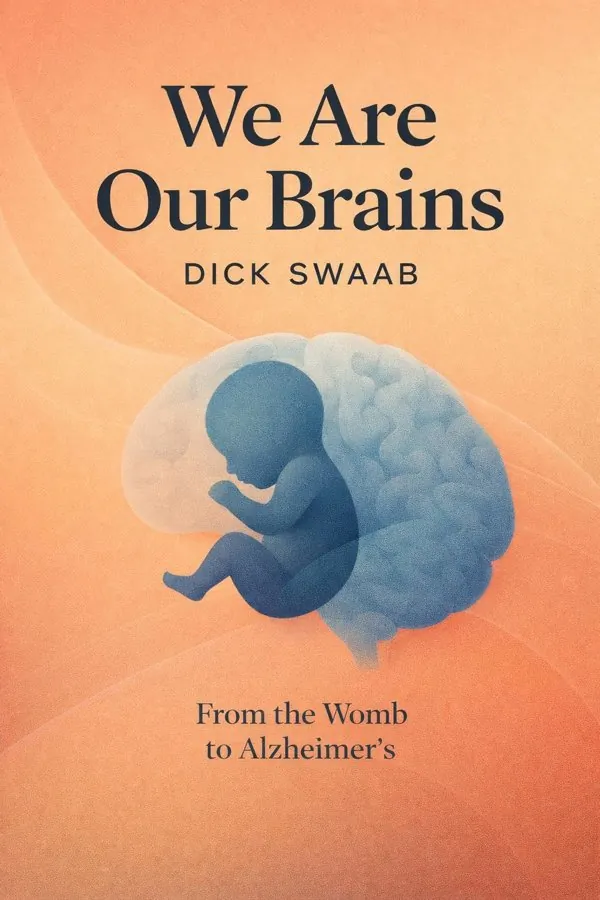
We Are Our Brains: From the Womb to Alzheimer’s: Summary & Key Insights
by Dick Swaab
 10 min12 chaptersAudio available
What Is We Are Our Brains: From the Womb to Alzheimer’s About?
We Are Our Brains: From the Womb to Alzheimer’s by Dick Swaab is a neuroscience book spanning 12 pages. In this influential popular science book, Dutch neuroscientist Dick Swaab explores how the brain shapes every aspect of our lives—from conception to death. He discusses topics such as gender differences, sexual orientation, brain disorders, and aging, showing that our identity, emotions, and behavior all stem from brain function. The book offers an accessible yet profound look into neuroscience and the biological foundations of who we are.
This FizzRead summary covers all 12 key chapters of We Are Our Brains: From the Womb to Alzheimer’s in approximately 10 minutes, distilling the most important ideas, arguments, and takeaways from Dick Swaab's work. Also available as an audio summary and Key Quotes Podcast.
We Are Our Brains: From the Womb to Alzheimer’s
In this influential popular science book, Dutch neuroscientist Dick Swaab explores how the brain shapes every aspect of our lives—from conception to death. He discusses topics such as gender differences, sexual orientation, brain disorders, and aging, showing that our identity, emotions, and behavior all stem from brain function. The book offers an accessible yet profound look into neuroscience and the biological foundations of who we are.
Who Should Read We Are Our Brains: From the Womb to Alzheimer’s?
This book is perfect for anyone interested in neuroscience and looking to gain actionable insights in a short read. Whether you're a student, professional, or lifelong learner, the key ideas from We Are Our Brains: From the Womb to Alzheimer’s by Dick Swaab will help you think differently.
- ✓Readers who enjoy neuroscience and want practical takeaways
- ✓Professionals looking to apply new ideas to their work and life
- ✓Anyone who wants the core insights of We Are Our Brains: From the Womb to Alzheimer’s in just 10 minutes
Want the full summary?
Get instant access to this book summary and 100K+ more with Fizz Moment.
Get Free SummaryAvailable on App Store • Free to download
Key Chapters
Life begins long before birth, in the intricate molecular choreography inside the womb. From the earliest stages of conception, our genetic code orchestrates the formation of neurons, directing them to migrate and connect in precise patterns. Hormones act as powerful sculptors, shaping regions responsible for future behaviors, preferences, and sensitivities. During development, testosterone, estrogen, and other signaling molecules trigger subtle differences between male and female brains—differences that will influence cognition, emotion, and even vulnerability to disease.
From my studies, it became evident that personality does not arrive as a blank slate. The fetus’s exposure to maternal stress hormones can alter neurotransmitter systems, predisposing an individual to anxiety or resilience later in life. Nutritional factors, toxins, and even the mother’s emotional state can leave biochemical fingerprints on neural development. What we observe in newborns—their temperament, sleeping patterns, and motor control—is already inscribed in these prenatal experiences. It is astonishing to realize that our first encounter with the world is through the biochemical environment of our mother’s body; her placenta is the first library our brain consults.
Thus, many traits we consider innate—shyness, sociability, musical aptitude—begin as neurobiological tendencies long before we take our first breath. Understanding this early period dissolves the illusion of pure choice at birth. We are the continuation of developmental processes that stretch back into the womb, carrying with them the legacy of evolution and hormonal orchestration.
When a newborn enters the world, the brain makes its most intense leap of growth. In this stage, billions of synapses form each day, mapping sensory input to patterns of recognition. The newborn’s cries, movements, and rapid learning all emerge from an organ evolving through experience. It is crucial to know that after birth, the genetic program of the brain interacts with the environment. Stimulation, affection, language—all these become the nourishment of neural development.
In my clinical observations, infants deprived of emotional warmth show measurable deficits in regions associated with attachment and empathy. Conversely, playful interaction and comforting contact help shape the pathways of trust and social cognition. Childhood therefore represents a dance between biology and education. While the architecture of the brain is predetermined, the connectivity—the way neurons link to create meaning—is molded by family, culture, and learning.
The child’s early experiences encode lasting patterns: a stress-filled household might prime an oversensitive cortisol system, while stability fosters flexible emotional control. This period demonstrates the brain’s plasticity; it is capable of adapting, strengthening, and pruning based on lived reality. By the time we reach school age, the foundations for language, memory, and personality are laid, and yet they remain open to modification. The brain in early childhood reminds us that nurture is not an external force acting upon an immutable nature—it is a biological collaboration that defines who we become.
+ 10 more chapters — available in the FizzRead app
All Chapters in We Are Our Brains: From the Womb to Alzheimer’s
About the Author
Dick Swaab (born December 17, 1944) is a Dutch neurobiologist and professor at the University of Amsterdam. He founded the Netherlands Institute for Neuroscience and is known for his research on sex differences and brain development. His work has had a major international impact on understanding the relationship between the brain and behavior.
Get This Summary in Your Preferred Format
Read or listen to the We Are Our Brains: From the Womb to Alzheimer’s summary by Dick Swaab anytime, anywhere. FizzRead offers multiple formats so you can learn on your terms — all free.
Available formats: App · Audio · PDF · EPUB — All included free with FizzRead
Download We Are Our Brains: From the Womb to Alzheimer’s PDF and EPUB Summary
Key Quotes from We Are Our Brains: From the Womb to Alzheimer’s
“Life begins long before birth, in the intricate molecular choreography inside the womb.”
“When a newborn enters the world, the brain makes its most intense leap of growth.”
Frequently Asked Questions about We Are Our Brains: From the Womb to Alzheimer’s
We Are Our Brains: From the Womb to Alzheimer’s by Dick Swaab is a neuroscience book that explores key ideas across 12 chapters. In this influential popular science book, Dutch neuroscientist Dick Swaab explores how the brain shapes every aspect of our lives—from conception to death. He discusses topics such as gender differences, sexual orientation, brain disorders, and aging, showing that our identity, emotions, and behavior all stem from brain function. The book offers an accessible yet profound look into neuroscience and the biological foundations of who we are.
You Might Also Like
Anxious
Joseph LeDoux
10 min
Hallucinations
Oliver Sacks
10 min
The Biological Mind: How Brain, Body, and Environment Collaborate to Make Us Who We Are
Alan Jasanoff
10 min
The Feeling of Life Itself: Why Consciousness Is Widespread but Can't Be Computed
Christof Koch
10 min
The No-Nonsense Meditation Book
Steven Laureys
10 min
A General Theory of Love
Thomas Lewis, Fari Amini, Richard Lannon
10 minBrowse by Category
Ready to read We Are Our Brains: From the Womb to Alzheimer’s?
Get the full summary and 100K+ more books with Fizz Moment.