
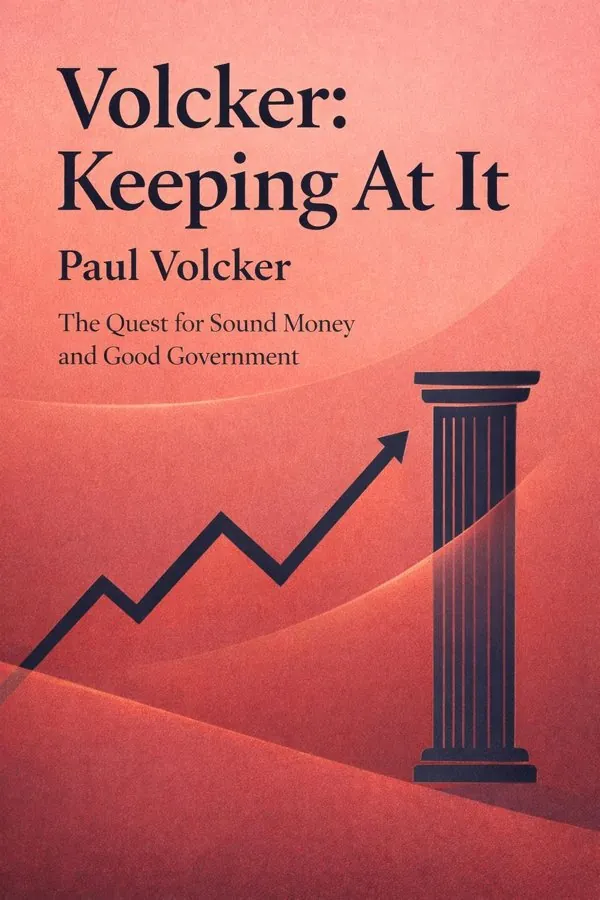
Volcker: Keeping At It: The Quest for Sound Money and Good Government: Summary & Key Insights
by Paul Volcker
 10 min9 chaptersAudio available
Key Takeaways from Volcker: Keeping At It: The Quest for Sound Money and Good Government
Character is often formed long before authority is granted.
Expertise becomes dangerous when it forgets who it is supposed to help.
Stable systems often look eternal just before they break.
Inflation is not only an economic statistic; it is a social and political corrosive.
The hardest decisions in public life are often the ones most likely to make a leader hated in the short term.
What Is Volcker: Keeping At It: The Quest for Sound Money and Good Government About?
Volcker: Keeping At It: The Quest for Sound Money and Good Government by Paul Volcker is a economics book spanning 8 pages. Paul Volcker’s Keeping At It is more than a memoir from a famous central banker. It is a forceful reflection on what public service looks like when it is guided by duty rather than popularity, and by long-term stability rather than short-term applause. Best known for leading the Federal Reserve through the brutal inflation crisis of the late 1970s and early 1980s, Volcker recounts the decisions, pressures, and principles that shaped his life in government. He explains how monetary policy works, why inflation can corrode trust as surely as it erodes purchasing power, and why institutions only endure when leaders are willing to do difficult things for the right reasons. What makes this book especially valuable is Volcker’s rare authority. He was not merely an observer of modern economic history; he helped make it. From the collapse of Bretton Woods to the anti-inflation campaign at the Fed and later efforts to reform finance after the global crisis, Volcker stood at the center of defining policy battles. This book matters because it connects economics, ethics, and governance, showing that sound money and good government ultimately depend on character.
This FizzRead summary covers all 9 key chapters of Volcker: Keeping At It: The Quest for Sound Money and Good Government in approximately 10 minutes, distilling the most important ideas, arguments, and takeaways from Paul Volcker's work. Also available as an audio summary and Key Quotes Podcast.
Volcker: Keeping At It: The Quest for Sound Money and Good Government
Paul Volcker’s Keeping At It is more than a memoir from a famous central banker. It is a forceful reflection on what public service looks like when it is guided by duty rather than popularity, and by long-term stability rather than short-term applause. Best known for leading the Federal Reserve through the brutal inflation crisis of the late 1970s and early 1980s, Volcker recounts the decisions, pressures, and principles that shaped his life in government. He explains how monetary policy works, why inflation can corrode trust as surely as it erodes purchasing power, and why institutions only endure when leaders are willing to do difficult things for the right reasons.
What makes this book especially valuable is Volcker’s rare authority. He was not merely an observer of modern economic history; he helped make it. From the collapse of Bretton Woods to the anti-inflation campaign at the Fed and later efforts to reform finance after the global crisis, Volcker stood at the center of defining policy battles. This book matters because it connects economics, ethics, and governance, showing that sound money and good government ultimately depend on character.
Who Should Read Volcker: Keeping At It: The Quest for Sound Money and Good Government?
This book is perfect for anyone interested in economics and looking to gain actionable insights in a short read. Whether you're a student, professional, or lifelong learner, the key ideas from Volcker: Keeping At It: The Quest for Sound Money and Good Government by Paul Volcker will help you think differently.
- ✓Readers who enjoy economics and want practical takeaways
- ✓Professionals looking to apply new ideas to their work and life
- ✓Anyone who wants the core insights of Volcker: Keeping At It: The Quest for Sound Money and Good Government in just 10 minutes
Want the full summary?
Get instant access to this book summary and 100K+ more with Fizz Moment.
Get Free SummaryAvailable on App Store • Free to download
Key Chapters
Character is often formed long before authority is granted. Volcker begins by showing that his commitment to integrity, restraint, and public duty did not emerge from elite theory alone. It grew out of his upbringing in Teaneck, New Jersey, where his father served as the town’s first city manager. From that example, Volcker absorbed a practical lesson that runs through the entire book: government is not meant to be a theater for ego, but a tool for solving common problems responsibly.
His early life illustrates how values shape judgment later under pressure. He was raised in a middle-class environment that respected competence, modesty, and service. Education sharpened his analytical abilities, but the moral foundation had already been laid. This matters because technical skill without civic purpose can easily drift into self-protection or ideology. Volcker’s later willingness to make unpopular decisions at the Federal Reserve becomes easier to understand when viewed as the extension of a deeper belief: public institutions exist to serve the long-term public interest, even when that interest is politically inconvenient.
For modern readers, this idea applies far beyond economics. In business, management, or public administration, people often face incentives to chase appearances, quarterly gains, or personal advancement. Volcker’s story suggests that the steadier compass comes from values cultivated early and reinforced consistently. A leader who sees responsibility as service rather than status is more likely to preserve trust when circumstances turn difficult.
Actionable takeaway: identify the core values that should govern your decisions before you enter high-pressure situations, and write them down as standards you will not compromise when convenience tempts you.
Expertise becomes dangerous when it forgets who it is supposed to help. Volcker’s entry into public service at the Federal Reserve Bank of New York reflects his belief that the mechanics of money, banking, and exchange rates mattered because they affected the real economy and the lives of ordinary citizens. He was drawn not to glamour but to the challenge of understanding how financial systems actually function beneath headlines and political slogans.
In his early assignments, Volcker learned the discipline of institutional analysis. Monetary policy was not a matter of instinct or rhetoric. It required careful attention to data, market structure, international flows, and the behavior of banks and governments. Yet one of the book’s key insights is that technical competence is not enough on its own. Experts must remember that their role is not to defend complexity for its own sake, but to use it in service of stability, fairness, and public confidence.
This principle remains deeply relevant today. Many professionals operate in domains that are opaque to outsiders: finance, law, health systems, software, regulation. In each case, specialists can either become insulated from public consequences or remain grounded in them. Volcker demonstrates the second path. He respected complexity without worshipping it. He understood that clear thinking and institutional seriousness were essential, but they were meaningful only when tied to accountable public outcomes.
For readers in leadership roles, this is a warning against hiding behind jargon or process. Real authority requires translating difficult systems into sound decisions. Technical excellence earns trust only when paired with responsibility.
Actionable takeaway: if you work in a specialized field, regularly ask how your decisions affect nonexperts, and practice explaining your reasoning in plain language that connects expertise to real-world consequences.
Stable systems often look eternal just before they break. Volcker’s account of the Nixon years and the end of Bretton Woods reveals how international monetary arrangements can unravel when political realities diverge from economic commitments. The postwar system had tied major currencies to the U.S. dollar and the dollar to gold, creating a framework of exchange-rate stability. But as fiscal strains, balance-of-payments pressures, and shifting global conditions intensified, the system became harder to sustain.
Volcker was deeply involved in the policy debates surrounding the 1971 suspension of dollar convertibility into gold. His perspective is especially valuable because he neither romanticizes the old order nor treats its collapse as a mere technical adjustment. He shows that monetary systems depend on credibility, coordination, and discipline. Once those weaken, rules that appear solid can quickly become untenable. The end of Bretton Woods was not just a currency story. It was a lesson in how economic institutions fail when governments try to preserve political flexibility without acknowledging the costs.
The broader lesson is that policy frameworks need constant realism. In organizations, markets, and governments, people often cling to legacy structures because they once worked well. But conditions change. A framework that no longer matches underlying incentives will eventually crack, often in disruptive ways. Volcker’s realism is useful here: reform is sometimes unavoidable, but it must be approached with seriousness and a clear understanding of tradeoffs.
This idea applies to corporate strategy as much as to central banking. Companies that ignore changing cost structures, regulators who ignore systemic risk, and leaders who rely on outdated assumptions may preserve appearances temporarily while increasing eventual instability.
Actionable takeaway: regularly review whether the rules, incentives, and assumptions governing your work still match reality, and address structural weaknesses before a crisis forces a disorderly adjustment.
Inflation is not only an economic statistic; it is a social and political corrosive. Volcker’s return to the Federal Reserve came at a time when rising prices had become embedded in American life. Inflation was no longer a temporary disturbance but a persistent condition that distorted expectations, contracts, wages, savings, and confidence in government itself. One of the book’s strongest contributions is its insistence that inflation erodes more than purchasing power. It undermines trust in institutions and weakens the moral promise that money should hold stable value over time.
Volcker explains how inflation feeds on delay. Policymakers hesitate to impose pain, especially when unemployment and political backlash loom. Businesses adapt by raising prices preemptively. Workers demand compensation for expected increases. Borrowers and lenders adjust behavior around instability. Soon inflation becomes self-reinforcing. At that point, modest corrections are no longer enough. The price of avoiding difficult action early is often much harsher action later.
This lesson remains relevant in every environment where problems are tolerated because confronting them is uncomfortable. Inflation serves as a model for broader institutional decay. Small breaches in discipline, when normalized, become larger ones. In personal finance, constantly spending ahead of income creates hidden fragility. In organizations, repeatedly excusing poor standards can make dysfunction permanent. Volcker’s message is that delayed discipline usually multiplies eventual costs.
His framing also helps readers understand why public credibility matters so much. If people believe leaders lack the will to protect stability, behavior changes in ways that make instability worse. Confidence is not rhetoric; it is built through decisions that align words with action.
Actionable takeaway: when a problem is becoming embedded in habits and expectations, address it early and decisively rather than hoping gradual neglect will somehow reduce the eventual cost.
The hardest decisions in public life are often the ones most likely to make a leader hated in the short term. Volcker’s chairmanship of the Federal Reserve is inseparable from the historic fight against inflation beginning in 1979. Faced with a worsening inflationary spiral, he and the Fed moved toward tighter monetary policy, allowing interest rates to rise sharply. The consequences were severe: recession, public anger, political criticism, and immense pressure from nearly every direction.
Volcker does not present this period as triumphalist. He acknowledges the pain, uncertainty, and human cost of disinflation. Farmers protested. Builders mailed pieces of lumber to the Fed. Unemployment rose. Yet his argument is that leadership cannot be reduced to popularity management. If inflation had been allowed to continue, the long-term damage to the economy and public trust would have been deeper. The temporary pain, while real and serious, was part of restoring a foundation for sustainable growth.
This is one of the book’s central insights about responsibility. Good leadership is not recklessness disguised as toughness. It is the disciplined willingness to absorb criticism when the alternatives are worse. Volcker’s example shows that courage in office often looks less like charisma than endurance. He stayed focused on the long-term objective of restoring price stability even when immediate opinion was overwhelmingly hostile.
The application extends to executives, school leaders, nonprofit directors, and anyone responsible for institutional health. Sometimes preserving standards means refusing expedient compromise. A manager may need to restructure failing operations, enforce neglected controls, or end practices that once seemed convenient. The choice can be painful, but postponement often deepens the eventual damage.
Actionable takeaway: evaluate major decisions by their long-term institutional effects, not by whether they minimize immediate criticism, and prepare yourself emotionally for resistance when doing what is necessary.
Repairing a damaged economy is rarely a clean or immediate process. Volcker emphasizes that once inflation became entrenched, restoring stability required more than a single policy shift. It took persistence, consistency, and a public demonstration that the Federal Reserve would not retreat at the first sign of pain. The long road to recovery matters in his story because it shows that credibility is built cumulatively. People must come to believe that institutions mean what they say.
One of the practical lessons here is that outcomes often lag behind decisions. During the anti-inflation campaign, many Americans experienced the costs before they could see the benefits. This is one reason difficult reforms are politically fragile. Citizens and stakeholders feel the disruption immediately, while gains arrive slowly and unevenly. Volcker’s account shows why leaders need both strategic clarity and communication discipline. They must understand the horizon of reform and explain why temporary hardship is linked to durable improvement.
This idea has broad application. A business in turnaround mode may have to cut costs, reset expectations, or rebuild product quality before revenue recovers. A family trying to reduce debt may feel the constraints long before financial freedom becomes visible. In each case, inconsistency can undo progress. If pressure causes constant reversal, trust in the process disappears and the underlying problem often returns.
Volcker’s experience also underscores that credibility belongs to institutions, not only individuals. The Federal Reserve’s reputation mattered because it shaped future expectations. Likewise, organizations build capital when they repeatedly show that standards are real and commitments are not temporary.
Actionable takeaway: when pursuing difficult reform, define success over a realistic timeline, communicate that timeline clearly, and remain consistent long enough for credibility to convert effort into results.
Not everything that can be engineered should be celebrated. In his life after the Fed, Volcker became a persistent critic of a financial culture that increasingly rewarded complexity, leverage, and short-term gain without sufficient regard for systemic consequences. His name became attached to the Volcker Rule, which aimed to restrict proprietary trading by banks benefiting from public support. Behind that policy stood a broader conviction: finance should serve the real economy, not turn into a self-referential system that privatizes gains and socializes losses.
Volcker’s critique is not anti-market. It is anti-confusion about the purpose of markets. He respected useful innovation, efficient capital allocation, and the role of private enterprise. What concerned him was the erosion of boundaries between socially valuable intermediation and speculative activity that exposed the broader public to avoidable risk. When institutions become too large, too opaque, or too politically protected to bear the consequences of their own behavior, both market discipline and democratic legitimacy weaken.
This is one of the book’s most enduring insights for the post-2008 world. Regulation is often portrayed as a contest between freedom and control. Volcker frames it differently: the real issue is whether rules preserve the integrity of institutions whose failures can damage everyone else. Similar logic applies in technology, healthcare, and corporate governance. Innovation without ethical limits can produce impressive short-term gains while hollowing out long-term resilience.
For individual readers, this chapter encourages skepticism toward systems that reward complexity but make accountability harder. If a product, business model, or policy becomes impossible to evaluate except by insiders, the risk of distorted incentives rises.
Actionable takeaway: judge financial and organizational innovations not only by profitability or novelty, but by whether they create clear accountability and genuine value for the wider system they affect.
A nation’s strength depends not only on policies but on whether its institutions deserve trust. Throughout the book, Volcker returns to the idea that good government is inseparable from competence, honesty, and restraint. He worries about bureaucratic drift, political theater, and the weakening of public confidence in institutions that are supposed to act in the common interest. For him, the issue is not nostalgia for a cleaner past, but concern that democratic systems cannot function well when cynicism becomes the default public attitude.
Volcker’s standard for government is demanding but practical. He does not imagine a flawless state. He asks for something both humbler and harder: serious people doing serious work with a clear sense of responsibility. That means agencies led by professionals who value evidence, officials willing to tell inconvenient truths, and structures that reduce conflicts of interest. It also means resisting the temptation to use public office primarily as a platform for ideology, celebrity, or personal gain.
Readers can apply this framework in smaller settings. Institutional integrity matters in universities, hospitals, charities, companies, and local governments. Once people believe rules are selectively enforced or mission is secondary to politics, morale and performance decline. Trust is expensive to rebuild after repeated compromise. Volcker’s memoir therefore becomes not just a story of central banking, but a guide to institutional stewardship.
The chapter also implies a civic responsibility for citizens. Good government cannot survive if the public rewards style over substance or punishes honesty when it is uncomfortable. Institutions reflect culture as much as design.
Actionable takeaway: strengthen the institutions around you by rewarding competence, demanding transparency, and defending standards even when shortcuts or political convenience make compromise seem easier.
The final lesson of Keeping At It is that the most important form of leadership may be persistence in principle over decades. Volcker’s career moved through changing administrations, monetary regimes, crises, and reform efforts, yet the thread connecting it all was consistency. He believed in sound money, institutional credibility, ethical restraint, and the dignity of public service. His reflections on leadership suggest that legacy is not built by isolated dramatic moments alone, but by repeated alignment between belief and action.
This insight matters because modern culture often confuses leadership with visibility. Volcker was not a performer by temperament. He was blunt, measured, and often unfashionable. But his influence endured because he treated office as a trust rather than a stage. That stance allowed him to remain relevant long after his Fed tenure, whether arguing for financial reform or speaking against the corrosion of civic standards.
The practical implication is that leaders should think in terms of institutional memory, not just immediate wins. What habits are you reinforcing? What norms are you teaching others to expect? A person who consistently chooses honesty, rigor, and accountability may lose tactical advantages in the short term, but often builds deeper authority over time. In contrast, repeated compromise for convenience may produce quick victories while eroding the very foundation of influence.
Volcker’s title, Keeping At It, captures this ethic perfectly. Sound judgment is not a one-time achievement. It is a discipline sustained despite fatigue, opposition, and changing circumstances. In that sense, the book is a manual for anyone who wants to do difficult work without surrendering standards.
Actionable takeaway: define the principles you want your career or leadership to embody, and measure success not only by outcomes achieved, but by whether you upheld those principles consistently over time.
All Chapters in Volcker: Keeping At It: The Quest for Sound Money and Good Government
About the Author
Paul Volcker (1927–2019) was an American economist, central banker, and one of the most influential public servants in modern financial history. He served in several major policy roles, including at the U.S. Treasury and the Federal Reserve Bank of New York, before becoming Chairman of the Federal Reserve in 1979. Volcker is best known for leading the campaign that brought down the runaway inflation of the late 1970s and early 1980s, restoring confidence in U.S. monetary policy. After leaving the Fed, he continued to shape public debate through work on financial reform, government accountability, and economic governance. Admired for his independence, discipline, and moral seriousness, Volcker became a lasting symbol of principled leadership in public life.
Get This Summary in Your Preferred Format
Read or listen to the Volcker: Keeping At It: The Quest for Sound Money and Good Government summary by Paul Volcker anytime, anywhere. FizzRead offers multiple formats so you can learn on your terms — all free.
Available formats: App · Audio · PDF · EPUB — All included free with FizzRead
Download Volcker: Keeping At It: The Quest for Sound Money and Good Government PDF and EPUB Summary
Key Quotes from Volcker: Keeping At It: The Quest for Sound Money and Good Government
“Character is often formed long before authority is granted.”
“Expertise becomes dangerous when it forgets who it is supposed to help.”
“Stable systems often look eternal just before they break.”
“Inflation is not only an economic statistic; it is a social and political corrosive.”
“The hardest decisions in public life are often the ones most likely to make a leader hated in the short term.”
Frequently Asked Questions about Volcker: Keeping At It: The Quest for Sound Money and Good Government
Volcker: Keeping At It: The Quest for Sound Money and Good Government by Paul Volcker is a economics book that explores key ideas across 9 chapters. Paul Volcker’s Keeping At It is more than a memoir from a famous central banker. It is a forceful reflection on what public service looks like when it is guided by duty rather than popularity, and by long-term stability rather than short-term applause. Best known for leading the Federal Reserve through the brutal inflation crisis of the late 1970s and early 1980s, Volcker recounts the decisions, pressures, and principles that shaped his life in government. He explains how monetary policy works, why inflation can corrode trust as surely as it erodes purchasing power, and why institutions only endure when leaders are willing to do difficult things for the right reasons. What makes this book especially valuable is Volcker’s rare authority. He was not merely an observer of modern economic history; he helped make it. From the collapse of Bretton Woods to the anti-inflation campaign at the Fed and later efforts to reform finance after the global crisis, Volcker stood at the center of defining policy battles. This book matters because it connects economics, ethics, and governance, showing that sound money and good government ultimately depend on character.
You Might Also Like

Business Adventures
John Brooks
10 min
Nudge
Richard H. Thaler, Cass R. Sunstein
10 min
The Hitchhiker"s Guide to the Galaxy
Douglas Adams
10 minThe Muqaddimah
Ibn Khaldun
10 minThe Outsiders
William N. Thorndike
10 min
A Little History of Economics
Niall Kishtainy
10 minBrowse by Category
Ready to read Volcker: Keeping At It: The Quest for Sound Money and Good Government?
Get the full summary and 100K+ more books with Fizz Moment.