
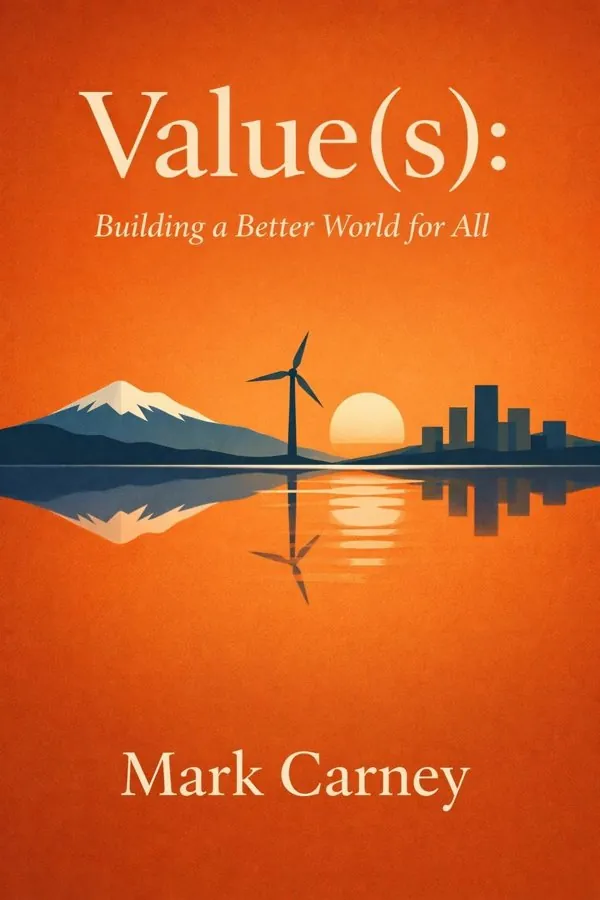
Value(s): Building a Better World for All: Summary & Key Insights
by Mark Carney
 10 min5 chaptersAudio available
What Is Value(s): Building a Better World for All About?
Value(s): Building a Better World for All by Mark Carney is a economics book spanning 5 pages. In 'Value(s): Building a Better World for All', Mark Carney, former Governor of the Bank of England and Bank of Canada, explores how society can redefine value to create a more sustainable and equitable economy. Drawing on his experience in global finance and public policy, Carney examines the moral and economic foundations of markets, the climate crisis, and the role of values in shaping capitalism for the 21st century.
This FizzRead summary covers all 5 key chapters of Value(s): Building a Better World for All in approximately 10 minutes, distilling the most important ideas, arguments, and takeaways from Mark Carney's work. Also available as an audio summary and Key Quotes Podcast.
Value(s): Building a Better World for All
In 'Value(s): Building a Better World for All', Mark Carney, former Governor of the Bank of England and Bank of Canada, explores how society can redefine value to create a more sustainable and equitable economy. Drawing on his experience in global finance and public policy, Carney examines the moral and economic foundations of markets, the climate crisis, and the role of values in shaping capitalism for the 21st century.
Who Should Read Value(s): Building a Better World for All?
This book is perfect for anyone interested in economics and looking to gain actionable insights in a short read. Whether you're a student, professional, or lifelong learner, the key ideas from Value(s): Building a Better World for All by Mark Carney will help you think differently.
- ✓Readers who enjoy economics and want practical takeaways
- ✓Professionals looking to apply new ideas to their work and life
- ✓Anyone who wants the core insights of Value(s): Building a Better World for All in just 10 minutes
Want the full summary?
Get instant access to this book summary and 100K+ more with Fizz Moment.
Get Free SummaryAvailable on App Store • Free to download
Key Chapters
In 2008, the world witnessed a defining rupture—a moment when confidence, trust, and collective restraint evaporated. The global financial crisis was not merely a failure of risk management, regulation, or liquidity; it was fundamentally a failure of values. Market participants, institutions, and even regulators came to believe that if a number had a price, it must have worth. Mortgages were securitized, sold, and rated as though the machinery of finance could transform moral hazard into opportunity. Yet behind those instruments were families, homes, and communities. When markets crashed, we saw that price had lost contact with value.
I remember, as a policymaker, the sense of moral urgency that followed. It was not enough to inject capital or cut interest rates. We needed to restore a belief in shared responsibility, a compact between finance and society. The lessons of that crisis resonated beyond economics: when we value only what can be measured in monetary terms, we neglect the intangible assets that truly sustain us—trust, integrity, compassion. The misalignment between market and moral values produces externalities that threaten not only stability but legitimacy. If finance forgets its purpose, people lose faith in markets themselves.
This chapter calls for a re-examination of how we measure success. Market efficiency without moral direction leads to fragility. We must remember that the economy serves society, not the reverse. The crisis revealed that moral sentiments are not luxuries; they are systemic necessities.
To understand the balance between moral and market values, I draw heavily on Adam Smith—not the caricatured advocate of selfishness, but the moral philosopher who wrote 'The Theory of Moral Sentiments'. Smith envisioned a market tempered by empathy, governed by an invisible hand guided by societal norms of fairness and justice. Over time, however, modern economics has stripped away that moral dimension, focusing instead on efficiency and optimization.
The separation of these two halves of Smith’s legacy created a distorted capitalism: one that prizes self-interest yet forgets collective welfare. Markets thrive only when they are embedded in a social context that values trust. Without that foundation, transactions become exploitative rather than cooperative, and liberty becomes license.
Our contemporary challenge is to re-embed this moral core into economic behavior. Whether in corporate governance or consumer choice, each decision carries moral weight. I argue for a renewed synthesis—where the moral sentiments Smith described coexist with the economic discipline of markets. This harmony is not nostalgic; it’s pragmatic. Empathy and fairness are not fictive ideals—they are the invisible infrastructures sustaining prosperity.
+ 3 more chapters — available in the FizzRead app
All Chapters in Value(s): Building a Better World for All
About the Author
Mark Carney is a Canadian economist and banker who served as Governor of the Bank of Canada and later the Bank of England. He has been a leading voice on sustainable finance and climate change, serving as UN Special Envoy on Climate Action and Finance.
Get This Summary in Your Preferred Format
Read or listen to the Value(s): Building a Better World for All summary by Mark Carney anytime, anywhere. FizzRead offers multiple formats so you can learn on your terms — all free.
Available formats: App · Audio · PDF · EPUB — All included free with FizzRead
Download Value(s): Building a Better World for All PDF and EPUB Summary
Key Quotes from Value(s): Building a Better World for All
“In 2008, the world witnessed a defining rupture—a moment when confidence, trust, and collective restraint evaporated.”
“Smith envisioned a market tempered by empathy, governed by an invisible hand guided by societal norms of fairness and justice.”
Frequently Asked Questions about Value(s): Building a Better World for All
Value(s): Building a Better World for All by Mark Carney is a economics book that explores key ideas across 5 chapters. In 'Value(s): Building a Better World for All', Mark Carney, former Governor of the Bank of England and Bank of Canada, explores how society can redefine value to create a more sustainable and equitable economy. Drawing on his experience in global finance and public policy, Carney examines the moral and economic foundations of markets, the climate crisis, and the role of values in shaping capitalism for the 21st century.
You Might Also Like

Business Adventures
John Brooks
10 min
Nudge
Richard H. Thaler, Cass R. Sunstein
10 min
The Hitchhiker"s Guide to the Galaxy
Douglas Adams
10 minThe Muqaddimah
Ibn Khaldun
10 minThe Outsiders
William N. Thorndike
10 min
A Little History of Economics
Niall Kishtainy
10 minBrowse by Category
Ready to read Value(s): Building a Better World for All?
Get the full summary and 100K+ more books with Fizz Moment.